X Launches Its First Parental Controls Feature: A New Step in Teen Account Management
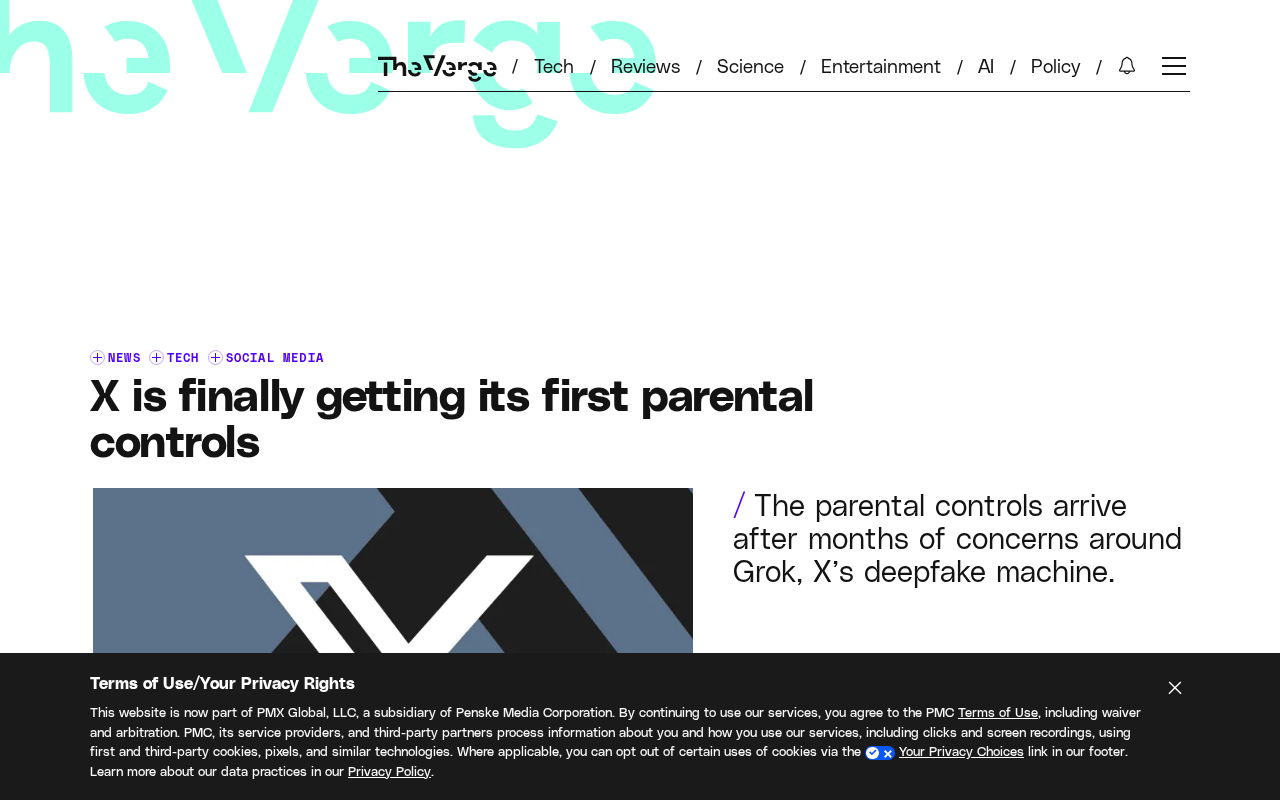
X launches first parental controls, responding to regulatory pressure and catching up to rivals.
X (formerly Twitter) announced its first parental controls, letting parents and guardians view teen usage time, set daily limits, approve new follow requests, and restrict some content access. Teens keep account ownership while parents get oversight tools rather than full takeover. The move responds to global regulatory pressure on minor protection and helps X close the gap with Instagram and TikTok. Challenges remain, including teens bypassing limits with false ages and balancing oversight with privacy.
Introduction
Social media platform X (formerly Twitter) recently announced that it will introduce parental controls for the first time, allowing parents and guardians to manage teen accounts. This move marks an important step by X in protecting minors and responds to long-standing concerns about teen safety on the platform.
Feature Details: What Can Parents Do?
According to official information, parents and guardians can now:
- View usage time: See how much time their child spends on X each day.
- Set daily limits: Set a maximum daily usage duration for their child.
- Manage follow requests: Require parental approval for new followers.
- Restrict content access: Limit access to certain content (specific details have not been fully disclosed).
You may not have noticed that teens still retain ownership of their accounts, meaning they can maintain a certain degree of autonomy, but parents will gain oversight tools.
The Separated Design of "Account Ownership" and "Oversight Authority"
The model X adopts is that teens retain account ownership while parents only receive oversight tools, contrasting with the "full parental custody of accounts" offered by some platforms. The advantage of the former is that it respects teens' space for autonomous expression and reduces confrontation caused by forced takeover; the cost is that parents' control permissions depend on the teen account's cooperative setup, and if the oversight relationship can be unilaterally dissolved, the actual binding force will be weakened. This design reflects the industry's trade-off between "protecting minors" and "respecting their digital autonomy."
Background and Motivation: Why Launch Now?
X's rollout of parental controls is no accident. In recent years, regulators worldwide have become increasingly concerned about the impact of social media on teen mental health. Multiple countries have enacted or are drafting relevant regulations requiring platforms to provide parental control tools. X's move can be seen as a response to regulatory pressure and as part of its efforts to rebuild its brand image and enhance user trust.
In addition, competitors such as Instagram and TikTok have long offered similar features, and X has lagged relatively behind in teen safety. The launch of parental controls helps X fill this gap and maintain compliance in competition.
The Global Context of Teen Social Media Regulation
In recent years, legislation targeting minors' use of social media has accelerated markedly in many countries. Several U.S. states have passed laws requiring platforms to obtain parental consent before opening accounts for minors; the UK's Online Safety Act requires platforms to implement age verification and content classification for minors; and the EU's Digital Services Act also lists minor protection as a key compliance matter. What these regulations share is that they shift part of the responsibility for teen safety from families alone to platforms, requiring platforms to provide verifiable parental tools and default high-privacy settings. For this reason, parental controls have gone from a "bonus feature" to a "compliance baseline" in many markets—an important external driver behind X's launch of this feature at this time.
User Reactions and Potential Challenges
Although parental controls are welcomed by some parents, their effectiveness still faces challenges. On the one hand, teens may bypass restrictions through false age information; on the other hand, the privacy balance between parents and teens has also sparked discussion. How to ensure the feature is both effective and does not infringe on teens' legitimate privacy will be an area X needs to continuously optimize.
Age Verification and the Technical Difficulty of "Bypassing Restrictions"
Teens bypassing restrictions by misreporting their birthdays is a common weakness of parental controls on virtually all social platforms. Platforms typically can only rely on self-reported ages or infer from device-side signals and behavioral characteristics, with limited accuracy and prone to privacy controversies. A stricter approach is to introduce third-party age verification (such as ID verification or facial age estimation), but this brings additional data collection costs and compliance risks. Therefore, the effectiveness of parental control tools depends heavily on the authenticity of account age information; if the age threshold at registration can be easily bypassed, subsequent time limits and follow approvals will also fail accordingly.
Conclusion
X's parental controls represent an important attempt by the platform to protect minors, but its actual effectiveness remains to be seen. As regulation tightens and user expectations rise, social media platforms need to find a balance between commercial interests and social responsibility. Whether X's move can win recognition from parents and teens remains to be seen.
One-line Summary
X launches parental controls for the first time, responding to regulatory pressure and catching up with competitors.
Paragraph Summary
X (formerly Twitter) announced its first parental controls feature, allowing parents and guardians to view teen usage time, set daily time limits, approve new follow requests, and restrict access to certain content. Teens retain account ownership, while parents receive oversight tools rather than full takeover. The article notes that this move is both a response to global regulators' demands for stronger minor protection on platforms and an effort by X to close the gap with competitors such as Instagram and TikTok. The feature's effectiveness still faces challenges: teens may bypass restrictions through false age information, and the balance between parental oversight and teen privacy also needs continuous optimization.
Related articles

Stop Pasting AI Prompts Repeatedly: Optimize Your Claude Code Workflow with Skill Files
Repeatedly pasting AI prompts is inefficient and wastes tokens. Learn how to package workflows into Skill files that load on demand in Claude Code, Cursor, and Codex.
Snap's MCP Gateway: Verifying Both Human and Agent Identity
Snap's MCP Gateway verifies both user and agent identity in the agent call chain, solving the failure of traditional authentication models in LLM agent scenarios. This article analyzes the necessity of dual verification, the engineering advantages of centralizing at the gateway layer, and deployment challenges such as expressing delegation relationships and handling policy conflicts.

Google Forces AI Agents to Use Its Own MCP Servers, Yet the Gmail Version Can't Send Emails
Google pushes AI agents to use its MCP servers, but Gmail MCP can't send emails, sparking Hacker News debate on ecosystem control, security, and AI agent impact.