Google Gemini 4 Carbon Tops the Benchmarks, API Pricing Targets Kimi
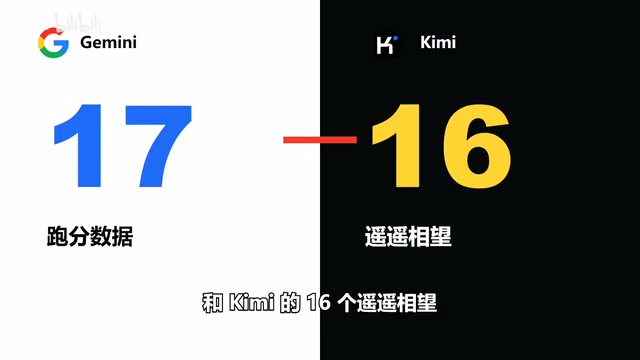
Google launches Gemini 4 Carbon, topping many of 17 benchmarks and undercutting Kimi on price.
Just one month after its flagship launch, Google released Gemini 4 Carbon, first opened to select cybersecurity defense personnel, continuing the roughly two-week cadence from security staff to Pro users. The model released 17 benchmarks, taking first place globally in general capability and values safety, and topping coding, computer use, office, multimodal, long context, scientific reasoning, and cybersecurity — with all three cybersecurity benchmarks first, justifying priority access for defenders. Pricing is $2 per million input tokens, $10 per million output tokens, and $0.1 per million cached input tokens, with output and cache cheaper than Kimi K3.1 Pro, clearly targeting cost-effectiveness competition. However, the benchmarks didn't include a direct comparison with K3.1 Pro, and domestic models' competitive volume remains to be seen.
Google has released a new model, Gemini 4 Carbon, just one month after its flagship model launch. This time it's not a full public beta — it's first being opened to select cybersecurity defense personnel, but based on past cadence, the gap from security staff to Pro users is roughly two weeks. This rapid iteration rhythm seems designed to break free from the Flash series' old curse of "fast but not strong enough," and it also brings to mind the recent pressure from domestic models like Kimi — whether the former "big three" are about to make a comeback is the most intriguing question surrounding this launch.
Benchmarks Across the Board: Leading in General, Coding, and Multimodal
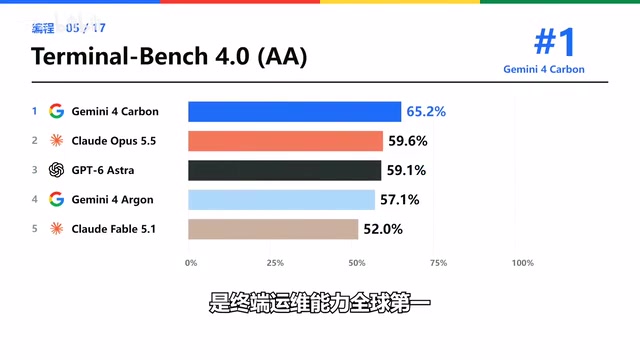
Google released 17 benchmarks in one go this time, going head-to-head with Kimi's 16. From the results, it took first place globally in both general capability (AA's assessment of foundational ability and intelligence level) and values safety evaluation (VI), directly beating Anthropic's flagship model. On the coding dimension, SWE code repair capability ranks first globally, SWE2 software engineering capability is second only to OpenAI and Anthropic's flagships, and TB terminal operations capability ranks first globally.
On computer use, ALE complex agent capability ranks first globally, and OSWORD operating system capability is second only to one of OpenAI's 5.5 models. In office scenarios, AB automated operations and VB2 financial capability both top the charts — finance once again proves to be a rich battleground for model capability comparisons. On multimodal, chart analysis (BB diagram understanding) ranks first globally, with understanding of architectural drawings, engineering blueprints, and other visual information standing out as a highlight.
Long Context and Scientific Reasoning: Aiming at Millennium Problems
Ultra-long context capability GEW takes first place globally, which carries real weight in scenarios like long document processing and codebase-level understanding. A more specific detail on scientific capability: the RB high-speed reasoning test set includes higher-order mathematical reasoning related to the Riemann Hypothesis, and Gemini 4 Carbon outperformed both OpenAI and Anthropic's flagships, ranking first globally. Though it's still far from actually solving the Millennium Prize problems, at least on the relevant reasoning benchmarks, Google is showing ambition to tackle fundamental scientific questions. Scientific computing TBS also ranks first globally.
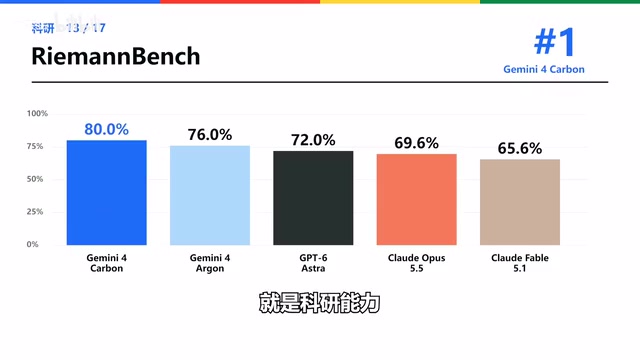
The Riemann Hypothesis is one of the seven Millennium Prize Problems with a million-dollar bounty from the Clay Mathematics Institute. Its core assertion is that all non-trivial zeros of the Riemann zeta function lie on the critical line with real part 1/2 in the complex plane. It is closely tied to the distribution of prime numbers, and if proven or disproven, it would profoundly affect number theory and even cryptography. Solving it requires entirely new mathematical ideas, not just computational power; but higher-order mathematical reasoning benchmarks can reflect a model's level in long-chain derivation, symbolic computation, and strategy search. Therefore, Gemini 4 Carbon's lead on this test set only shows it performs better on controlled reasoning tasks — there's still an essential gap between that and actually solving a Millennium Prize problem.
Cybersecurity: Using the Sharpest Spear to Test the Hardest Shield
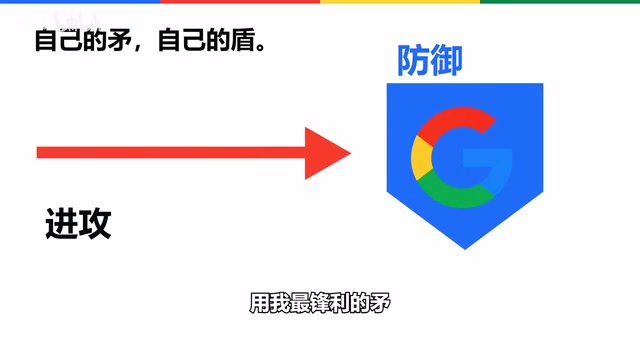
Cybersecurity capability is at the heart of this release strategy. CWE vulnerability discovery ranks first globally, EG hacking capability (using and generating vulnerabilities and exploit code) ranks first globally, and SEC security defense also ranks first globally. All three cybersecurity benchmarks topped the charts, explaining why it's being opened first to security defense personnel — Google is testing its own shield with its own spear. This "self-contradictory" release approach reflects both confidence in the model's offensive and defensive capabilities and caution about abuse risks.
CWE (Common Weakness Enumeration) is a software defect classification system maintained by MITRE, covering common vulnerability types such as buffer overflows, injection, and out-of-bounds read/write, and is often used as the labeling basis for vulnerability discovery evaluations. Benchmarks framed around CWE typically require models to locate weaknesses in given code and provide remediation suggestions. Giving a model both vulnerability generation and defense capabilities means it could be used for automated attacks as well as code auditing and security hardening. Google's choice to open it first to defenders is precisely to observe abuse boundaries through controlled distribution, continuing the recent practice of frontier model vendors adopting tiered releases for high-risk capabilities.
Pricing Precision Strike: Slightly Pricier Input, Cheaper Output
Pricing is another bombshell. Gemini 4 Carbon costs $2 per million input tokens (about 13+ RMB), $10 per million output tokens (about 66+ RMB), and $0.1 per million cached input tokens (about 0.6+ RMB). Compared with Kimi K3.1 Pro, apart from input being about 0.3 RMB more expensive, output and cache prices are both lower. This pricing clearly targets Kimi's cost-effectiveness advantage, trying to win back ground among developers.
However, the benchmark leaderboard didn't include a direct comparison with K3.1 Pro, and domestic models still seem to lack volume in this round of competition — future moves from Qwen and JLM are worth watching. If the benchmarks hold up, Google has genuinely shown good faith on both capability and price this time; what remains is to see real-world performance after the official release.
LLM API pricing is typically billed separately per million tokens across three tiers: input, output, and cached input, with significant price differences. Output tokens require the model to generate word by word, incurring the highest computational cost, so the unit price is often several times that of input; cached input reuses repeated context, making it the cheapest. For developers, scenarios like long-document Q&A and codebase analysis are input-heavy, and cache hit rates directly determine cost; while scenarios like agents and code generation have a high output share, making output pricing more decisive. By lowering output and cache prices, Gemini 4 Carbon is essentially competing for developers on two types of workloads — high-frequency interaction and long-context reuse — rather than simply competing on input quotes.
Background Notes
The abbreviations AA, SWE, ALE, TB, GEW, CWE, and others appearing repeatedly in this article each point to different evaluation systems. AA usually refers to the Artificial Analysis series of comprehensive evaluations, measuring a model's foundational capability and intelligence level; the SWE series (including SWE and SWE2) uses software engineering tasks as scenarios, testing a model's ability to read codebases and submit patches to fix defects — one of the most recognized benchmarks for coding capability today; ALE focuses on planning and tool use in complex agent tasks; TB refers to terminal operations tasks; GEW evaluates retrieval and understanding under ultra-long contexts; and CWE is based on the Common Weakness Enumeration system, testing a model's ability to find real vulnerabilities. Most of these benchmarks are public or semi-public, but differences in details such as prompts and sampling counts across vendors affect comparability, so benchmark leads should be interpreted in light of specific evaluation settings.
Related articles

Can Nuclear War Really End Civilization? A Scientific Look at Common Misconceptions
Can nuclear war end civilization? This article examines the physics of nuclear weapons—blast, fallout, and urban fires—distinguishing airbursts from groundbursts, dose from contamination, and explaining why nuclear war is a massive disaster but not an extinction event, while exploring key factors for post-strike social reconstruction.

The Truth Behind Titanic's Sinking: Key Decisions and Communication Failures in the National Geographic Documentary
National Geographic's The Unsinkable Ship uses survivor testimony to reconstruct Titanic's fatal decisions—from the missing MSG telegram prefix and the broken boiler-room-to-bridge link to how 'unsinkable' thinking delayed damage control and evacuation.

74M-Parameter Open-Source Model Partially Outperforms Jev AI in Testing
Fastino AI's Glider 2.5 models, with just 74M–300M parameters, reportedly outperform Jev AI in some guardrail benchmarks per YouTube testing, run on consumer hardware, and even play Doom. We analyze small models' competitiveness and deployment value on specific tasks.