Google Gemini 4 Hydrogen Released: A Double Win on Speed and Cost, the New King of Everyday AI Tasks
Google releases the lightweight Gemini 4 Hydrogen, challenging mid-tier workhorse models at one-third the cost.
Google launches the new-generation lightweight model Gemini 4 Hydrogen, positioned for speed and price first, benchmarked against mid-tier everyday workhorse models such as Anthropic Sonic 5.5 and OpenAI GPT 6.1 Tera. Multiple benchmarks show it leading on code, agent, and visual document tasks; Artificial Analysis scores it 51 at default and 54 at X-High, close to Sonic's top-setting 55. Cost is the core selling point: about $3.16 per task at its highest setting, just one-third of Sonic's $10.2. In demos, it can generate a walkable 3D island game from a single sentence, and on 3D scene tasks both time and cost are about half those of the flagship Carbon. Google also introduced Orchestrator, letting Carbon plan and Hydrogen execute; on TerminalBench 4.1, task volume is close to Carbon running alone, with 24% less quota used and 19% faster on average.
Title
Google Gemini 4 Hydrogen Released: A Double Win on Speed and Cost, the New King of Everyday AI Tasks
Meta Description
Google releases the lightweight Gemini 4 Hydrogen model, matching Anthropic Sonic 5.5 and OpenAI GPT 6.1 Tera on coding and agent tasks—faster and at about one-third the cost—plus Orchestrator lets Carbon and Hydrogen divide the work.
Article Content
Google has just released its new-generation lightweight model Gemini 4 Hydrogen, aimed squarely at the coding and agent tasks most people use every day. According to its official positioning and third-party evaluations, it beats the everyday workhorse models from Anthropic and OpenAI on a range of practical tasks—at roughly one-third the cost per task of Cloud Sonnet.
Hydrogen is now available through the Gemini app, Google Search, AI Studio, and the Gemini API, and free users can access it via automatic model selection within the app.
Positioning: Lightweight but Not Lightweight-Class
Google named this generation after the periodic table: the flagship is Carbon, and Hydrogen is the lightest element—fittingly matching its positioning built for speed and price. Google compares it with Anthropic's Sonic 5.5 and OpenAI's GPT 6.1 Tera—the two are each company's mid-tier models, one notch below the top models but handling a large share of people's everyday tasks.
Hydrogen's default setting is "high thinking," and it also offers low, medium, and high thinking intensities, plus a new X-High tier that lets developers make smooth trade-offs among quality, speed, and cost.
Benchmarks: The Leader Among Mid-Tier Models
Across multiple benchmarks, Hydrogen shows a clear advantage over models in its class:
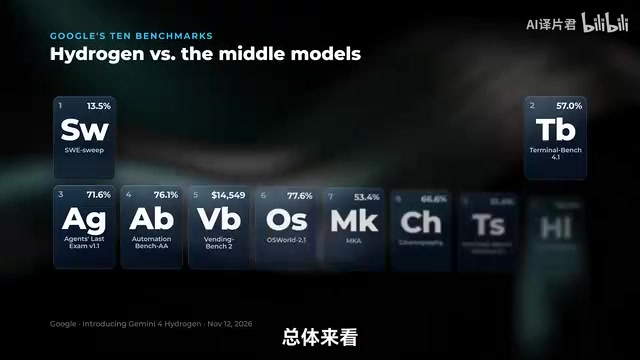
- Suesway code test: Hydrogen scores 13.5, while Tera scores only 8 and Sonic only 3—more than double Tera and more than four times Sonic.
- Agent's Last Exam: Hydrogen scores nearly 72%, Tera slightly below 70%, and Sonic around 60%.
- Automation Bench: Hydrogen about 76%, Sonic 72%, Tera 60%.
- MKA visual document test: Hydrogen about 53%, Sonic 52%, Tera about 44%.
Google says it is suited to messy office work: throw PDFs, spreadsheets, charts, audio, and video at it, and it returns a report. However, Google's own charts also show it lagging in a few areas: on the OS World 2.1 test, Hydrogen is slightly behind Sonic; on the Terminal Bench Science scientific tasks, both trail.
Independent evaluation by third-party organization Artificial Analysis offers another perspective. Its Intelligence Index aggregate score shows Hydrogen scoring 51 under default settings, surpassing Gemini 4.2's 50; set to X-High, it reaches 54, while Sonic 5.5 scores 55 at its highest setting and Tera scores 51 at its highest setting. According to Chinese tech media AI Front, it also broke into the global top five on an agent leaderboard.
Artificial Analysis Intelligence Index is a composite capability score maintained by the independent evaluation organization Artificial Analysis. It normalizes and weights dozens of common benchmarks (math, code, reasoning, instruction following, etc.) into a single number for easy cross-vendor comparison. The index is usually measured separately at different "thinking intensity" settings, so the same model can have multiple scores (e.g., default vs. highest setting). Because it does not rely on vendor-reported data, it is often used by media and developers as a relatively neutral reference—but note that the aggregation weights and the chosen benchmark suite can significantly affect rankings, and a single total score cannot fully represent performance on any specific task.
Cost and Speed: The Real Killer Feature
Based on Artificial Analysis's per-task cost calculation, Tera is actually cheaper than Hydrogen, but its top score is lower. Sonic's highest tier costs $10.2 per task, while Hydrogen's highest tier costs $3.16—one point less, at roughly one-third the cost.
On speed, at the default high-thinking setting, Hydrogen completes tasks 2.5% faster than Google's previous fast model Gemini 3.8 Flash; this gap becomes noticeable when repeatedly checking code. AI Front's view is that if daily work mainly relies on Sonic or Tera, Hydrogen can already replace them—near top-tier quality, 2.5 times their speed, and one-third the cost, which is more worthwhile than being number one on a leaderboard.
Per-task cost is an estimation metric proposed by Artificial Analysis: how many dollars on average it takes to complete one task in its evaluation set, factoring in input/output token unit prices, the actual number of tokens the model generates (including thinking process), and retries. It is closer to real-world experience than a simple "price per million tokens," because reasoning models at high thinking settings generate large amounts of invisible thinking tokens, making bills far higher than the nominal unit price. Costs vary greatly across tasks, so this metric is suitable for relative comparison within the same evaluation set rather than direct conversion into absolute production costs.
One-Sentence 3D Game Generation: Hard Power in the Demo
Google's demo headliner is a Minecraft-style 3D graphics tool called Gemini Island. You type a single prompt, and Hydrogen immediately writes the entire game in 3D—an island with roads, buildings, and large animals, where you can walk around in first person.
The developer community has also contributed impressive examples. A former user named Kim Onesimus built a canyon flying game with 3JS, with code-generated terrain, flowing water, and 25 scoring gates to fly through; another demo, Pure Physics, is a real-time 3D scene where light bends, bounces, splits into different colors, and is absorbed as it passes through water and glass—all in real time. This requires both graphics code and a genuine understanding of how light propagates.
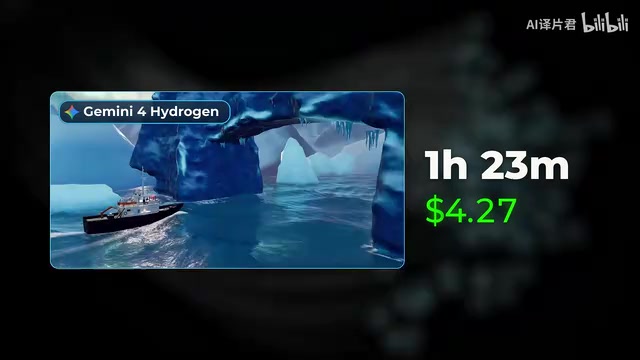
Developer Tony gave the same task to Hydrogen and Carbon separately: a 3D scene of a ship passing through glaciers. Hydrogen took 1 hour 23 minutes and cost $4.27, while Carbon took 2 hours 39 minutes and cost $8.83. Time halved, cost roughly halved, and Hydrogen's version still looks very close to Google's own top model.
There is also a classic AI test: having the model draw a pelican riding a bicycle in SVG. A user named Marcel raised the difficulty, having the pelican ride continuously through 5 transforming seasons, then gave it to Hydrogen and Fable 5.2—Fable took about 25 minutes, Hydrogen took 5 minutes, and the result looks quite solid.
Orchestrator: Letting the Flagship and Lightweight Models Divide the Work
Google's bigger plan is to run Hydrogen and Carbon together, powered by a new option called Orchestrator in the AI coding app Anti-Gravity.
The idea is clear: Carbon comes in first in read-only mode, only looking without modifying, figuring out how the code connects, writing a concrete plan and setting checkpoints for re-evaluation; then Hydrogen does the work—writing, modifying, updating project dependencies, and running tests; if Hydrogen gets stuck, Carbon comes back to inspect the problem and revise the plan. In short, Carbon is the senior engineer, and Hydrogen is the fast junior engineer doing the typing.
On the TerminalBench 4.1 test, Orchestrator completes almost as many tasks as Carbon running alone, while using 24% less quota and being 19% faster on average. Hydrogen alone scores 57% on this test, more than triple Gemini 3.8 Flash's 18.2%. Developers can also connect the two models themselves using the Anti-Gravity SDK.
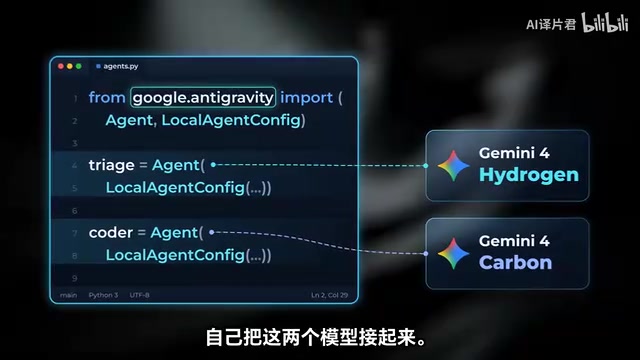
In Google's demo, when an open-source project is flooded with reports, the Hydrogen agent keeps up—searching the code, asking clarifying questions, and quickly adjusting the design based on review feedback—while the Carbon agent handles larger rewrites and new features.
Orchestrator comes in a Carbon version and an Argon version; Ultra subscribers get both, while Pro subscribers only get the Argon version. Enterprises can get Hydrogen and Orchestrator through Gemini for Business.
TerminalBench is a class of agent benchmark oriented toward the command line and real development environments. It requires models to autonomously execute commands, read and write files, install dependencies, and complete multi-step engineering tasks in a terminal, scored on whether tasks are successfully completed. It is closer to "can an agent work independently" than traditional code-completion or unit-test benchmarks, so it is often used to measure a model's stability and error-recovery ability in long chains of tool calls. The TerminalBench 4.1 mentioned in the article is a newer version with longer tasks and more realistic environments; scores often depend on the model's ability to plan, try and error, and recover from errors—not just the quality of a single code generation.
Same-Day Developments: Microsoft Teases Ignite, ChatGPT Adds a Wallet
Around the Hydrogen release, other moves in the AI field are also worth noting.
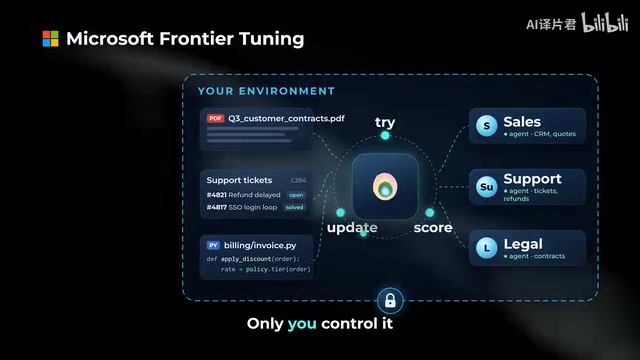
Microsoft AI business head Mustafa Suleiman reposted an announcement: the Microsoft Ignite conference will be held from November 17 to 20, and Microsoft's model team Maya will bring "something new"—new model demos and developer talks. However, the announcement gives no model names, demo titles, or speakers, essentially announcing "that something will be announced." The last time real specs were revealed was at the Microsoft Build conference on June 2, when Suleiman released 7 new Maya models, among them Melee Thinking 1, a mixture-of-experts model that activates only about 35 billion parameters per response and can hold 256,000 tokens at once.
OpenAI, meanwhile, launched ChatGPT Wallet on November 13, letting a shopping agent called Dots help you pick products and check out. Currently the service is only available to a small number of US ChatGPT Pro subscribers, requiring users to be at least 18 and hold a US-issued Visa, MasterCard, or American Express card. After linking a bank card once, you will see the total price and the card used before checkout, then confirm with Face ID or a fingerprint; the wallet charges the card using a payment token, and the real card number is invisible to both Dots and the merchant.
AI agent shopping currently has mixed results: DoorDash and Uber report very few orders placed by AI agents, while Meta's Muse has over 10 million users, and AI-assisted shopping has become one of the most common things people do there. OpenAI wants to break in, but retailers are divided, and the biggest obstacle is Amazon—which bans these agents and steers people toward its own Alexa.
What It Means for Everyday Developers
The core signal from Hydrogen is not "another number one on a leaderboard" but "good-enough quality + faster speed + one-third the cost." For developers who run agent tasks, fix bugs, and build prototypes daily on Sonic or Tera, this means the same budget can run more rounds—or the saved quota can be reserved for heavy work that truly needs a flagship model.
The emergence of Orchestrator points to a more practical trend: having strong models plan and fast models execute may be more cost-effective than using top models throughout. Google's data shows task completion is almost unchanged, while using 24% less quota and being 19% faster on average. Whether this path can hold up in real projects will depend on developer feedback over the next few months.
One-line Summary
Google releases the lightweight model Gemini 4 Hydrogen, challenging mid-tier workhorse models at one-third the cost.
Paragraph Summary
Google launches the new-generation lightweight model Gemini 4 Hydrogen, positioned for speed and price first, benchmarked against mid-tier everyday workhorse models such as Anthropic Sonic 5.5 and OpenAI GPT 6.1 Tera. Multiple benchmarks show it leading on code, agent, and visual document tasks; Artificial Analysis scores it 51 at default and 54 at X-High, close to Sonic's top-setting 55. Cost is the core selling point: about $3.16 per task at its highest setting, just one-third of Sonic's $10.2. In demos, it can generate a walkable 3D island game from a single sentence, and on 3D scene tasks both time and cost are about half those of the flagship Carbon. Google also introduced Orchestrator, letting Carbon plan and Hydrogen execute; on TerminalBench 4.1, task volume is close to Carbon running alone, with 24% less quota used and 19% faster on average.
Related articles

OpenAI to Shut Down Agent Builder and Two Other Services on November 30, Developers Must Migrate Urgently
OpenAI will shut down Agent Builder, the evals dashboard, and reusable prompts on November 30; evals is already read-only. Here's the scope, OpenAI's migration paths (Agent SDK, PromptFu, your own code), and what developers should export and rebuild this week.

RankSpot: A Pay-Per-Use SEO & AI Search Execution Layer That Lets Agents Write, Publish, and Build Backlinks for You
RankSpot is an SEO & AI search execution layer for AI Agents. Connect via MCP to Claude or ChatGPT to write, publish & build backlinks. Pay-per-use, $3/article.

Appxiom: Giving AI Coding Assistants Production Context
Appxiom gives AI coding agents production context—crashes, jank, memory leaks, failed network calls—across Android, iOS, Flutter, KMP, and Web, ranking bugs by Goal Friction Impact.