Google Gemini 4 Hydrogen Released: Better at Understanding Complex Questions
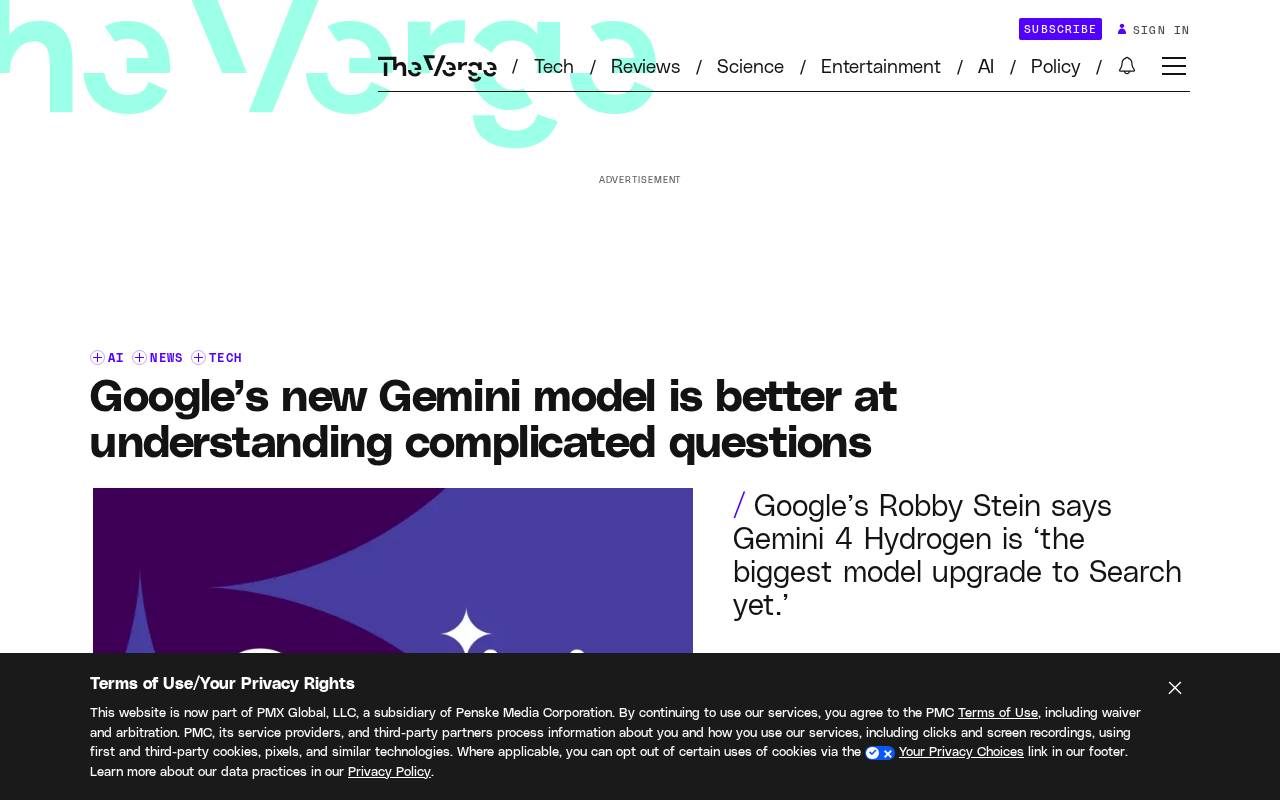
Google releases Gemini 4 Hydrogen, improving complex question decomposition and typo-tolerant understanding across all product lines.
Google launches Gemini 4 Hydrogen, whose core improvement is decomposing and responding to complex queries: it automatically breaks long sentences with multiple sub-questions or conditions into components and addresses each one, reducing the need for repeated clarification. It also better tolerates typos and ambiguous input by inferring user intent. The update rolled out simultaneously across Google Search, the Gemini app, and all service tiers. Google did not disclose technical details or benchmark data, so real-world performance still awaits verification.
Google recently launched its next-generation Gemini model, Gemini 4 Hydrogen, claiming significant improvements in understanding complex questions. According to Google's official announcement, the model can provide more helpful answers to "questions with multiple parts, hard-to-understand typos, or highly specific requests." The update is rolling out starting today across Search, the Gemini app, and all tiers of Google's services.
A Breakthrough in Handling Complex Questions
The core improvement in Gemini 4 Hydrogen lies in its ability to break down and respond to complex queries. Google says the new model can automatically decompose a user's question into multiple components and address each part individually in its answer. This means when users pose long sentences containing multiple sub-questions or conditions, the model no longer requires repeated clarification—it can deliver a structured, complete answer in one go.
The new model also shows stronger tolerance for typos and ambiguous input. Traditional search or conversational models often return irrelevant results when faced with misspellings, whereas Gemini 4 Hydrogen can infer user intent and still provide relevant answers even when the input is garbled.
"Semantic parsing" refers to the process of converting natural language input into structured, computable semantic representations—an underlying step in how models understand complex questions. When faced with long sentences containing multiple clauses, parallel conditions, or nested questions, the model needs to identify each semantic unit and its logical relationships (causal, parallel, conditional, etc.) in order to correctly split and address them one by one. Working alongside this, "context management" focuses on the model's ability to retain and recall relevant information across multi-turn conversations, including topic-thread tracking and forgetting control. Together, the two determine the quality of multi-part question decomposition: semantic parsing is responsible for "reading and understanding," while context management handles "remembering and using it in the right place."
Simultaneous Launch Across Multiple Products
This update spans several Google product lines. As of launch, Gemini 4 Hydrogen is available in Google Search, the standalone Gemini app, and all tiers of Google's services. This synchronized deployment strategy signals Google's intent to push the latest model capabilities to all users quickly, rather than limiting them to paid subscribers or specific regions.
For everyday users, the most immediate change is that entering complex questions into the search box yields clearer, more comprehensive answers. In the Gemini app, multi-turn conversation coherence is also expected to improve, with the model better remembering and responding to multiple topic threads within a dialogue.
Impact on the AI Assistant Competitive Landscape
The release of Gemini 4 Hydrogen further intensifies competition in the AI assistant space. Major AI models today all emphasize complex reasoning and multi-step task handling, and Google's focus on "understanding complex questions" directly addresses a real pain point users encounter in daily use—the more specific and complex the question, the more likely models are to miss the point.
From a technical standpoint, decomposing multi-part questions and answering each part requires stronger semantic parsing and context management capabilities. Google did not disclose specific technical details or benchmark data, but explicitly listing "highly specific requests" as an improvement area suggests the new model has been specifically optimized for instruction following and detail capture.
"Instruction following" is a key metric for measuring large model capability, referring to how well a model completes tasks according to the specific requirements given by users (format, constraints, tone, steps, etc.). In complex requests, users often attach multiple constraints—for example, "list in three points," "cite only data from the past five years," or "avoid technical jargon." If the model misses any one of these conditions, it is considered an instruction-following failure. Current mainstream evaluation frameworks (such as IFEval) specifically construct instruction sets with automatically verifiable constraints to quantify this capability. By listing "highly specific requests" as an improvement area, Google is essentially emphasizing the model's ability to capture and execute fine-grained constraints—a key threshold for AI assistants moving from "can answer" to "reliably usable."
Real-World Experience and What Remains to Be Seen
The model is now fully rolled out, and users can experience it directly in Google Search and the Gemini app. However, Google's announcement is relatively brief and does not provide detailed performance comparisons or user testing data. How the new model performs in real-world scenarios—especially its accuracy when facing highly specialized or ambiguous questions—still awaits user feedback and third-party evaluation.
For users who rely on Google Search for information, this update is worth watching. If the improvement in complex question handling reaches the level Google claims, it could significantly reduce the time cost of repeatedly revising search queries. But the ultimate effectiveness will need to be verified through actual use.
One-line Summary
Google releases Gemini 4 Hydrogen, focusing on improved complex question decomposition and typo-tolerant understanding, launched simultaneously across all product lines.
Paragraph Summary
Google has launched its next-generation model Gemini 4 Hydrogen, with core improvements in decomposing and responding to complex queries: the model can automatically break long sentences containing multiple sub-questions or conditions into components and address each one in its answer, reducing the need for repeated clarification. The new model also shows stronger tolerance for typos and ambiguous input, inferring user intent rather than returning irrelevant results. The update rolled out simultaneously across Google Search, the Gemini app, and all tiers of Google's services from launch day, signaling Google's intent to quickly deliver its latest capabilities to all users. The article notes that this release intensifies competition among AI assistants in complex reasoning and multi-step task handling, but Google has not disclosed technical details or benchmark data, and real-world performance still awaits user feedback and third-party evaluation.
Related articles

OpenAI to Shut Down Agent Builder and Two Other Services on November 30, Developers Must Migrate Urgently
OpenAI will shut down Agent Builder, the evals dashboard, and reusable prompts on November 30; evals is already read-only. Here's the scope, OpenAI's migration paths (Agent SDK, PromptFu, your own code), and what developers should export and rebuild this week.

RankSpot: A Pay-Per-Use SEO & AI Search Execution Layer That Lets Agents Write, Publish, and Build Backlinks for You
RankSpot is an SEO & AI search execution layer for AI Agents. Connect via MCP to Claude or ChatGPT to write, publish & build backlinks. Pay-per-use, $3/article.

Appxiom: Giving AI Coding Assistants Production Context
Appxiom gives AI coding agents production context—crashes, jank, memory leaks, failed network calls—across Android, iOS, Flutter, KMP, and Web, ranking bugs by Goal Friction Impact.