Google Gemini 4 Neon Released: Faster and Cheaper, Hands-On Comparison with Claude and GPT

Gemini 4 Neon leverages its mid-tier positioning and low pricing, using toolchain and thinking-depth adjustment to deliver strong cost-performance.
Google shipped four Gemini 4 models in 49 days; Neon sits between flagship Carbon and lightweight Hydrogen, supporting four thinking depths and 1,048,576-token context, with sticker prices below Claude Opus 5.5. It ranks third on the composite intelligence leaderboard but stands out in coding agent, long-context, and office automation tests. Hands-on testing shows actual cost depends heavily on output volume and thinking depth: dropping one level saves over 40%. With Anti-Gravity tools, Neon rapidly generates complete app skeletons via parallel sub-agents at about half the cost of top flagships; without the toolchain in the web chat box, stability drops and self-correction allowance is needed. Overall, it's suited for low-cost rapid prototyping rather than one-shot maximum image quality.
Google released Gemini 4 Neon, a new member of the Gemini 4 family, on November 18. Just six days after the previous lightweight model Hydrogen—and counting Argon on September 30 and Carbon on October 28—Google has shipped four Gemini 4 models in 49 days, announcing three in the last three weeks alone. This release density is quite rare in AI model history, almost as if they were naming them off the periodic table one by one.
Product Positioning: The Middle Ground Between Flagship and Lightweight
According to the DeepMind model card, Neon is adapted from its bigger sibling Carbon. The heaviest, longest hard problems go to Gemini 4 Carbon, everyday chunks go to the lightweight Hydrogen, and Neon sits right in the middle. It supports four thinking depths—low, medium, high, and extra-high—and through the API can read text, images, video, audio, and PDFs simultaneously, outputting plain text. Input and output share a single total context capacity of 1,048,576 tokens, equivalent to an entire large codebase or hundreds of pages of documents fed in at once. In default synchronous mode it outputs up to 65,536 tokens per request, and with long output enabled it can expand to match the total capacity.
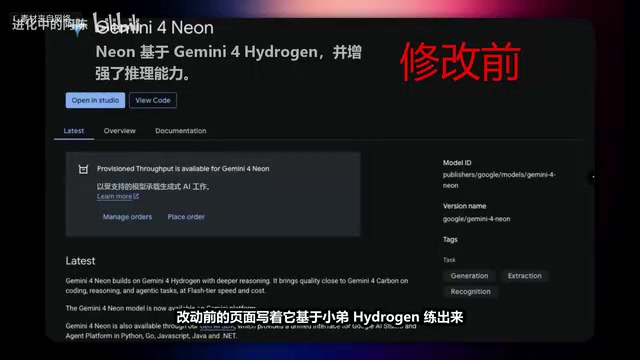
In terms of availability, Google AI Pro and Ultra paid members get it first, usable in the Gemini web app, mobile app, and the Anti-Gravity developer tool. Developers can access it through the paid API in AI Studio, and enterprise users can select it via API or model menu in Gemini for Business.
Context Window and KV Cache: The phrase "input and output share a single total context capacity" refers to the unified upper limit on context length that Transformer-based models have during inference. When processing each token, the model must perform attention computations with all previous tokens, and the computational cost grows quadratically with context length. To control costs, vendors typically have input and output share the same token quota pool. Cached input (such as the $0.15 per million tokens in the pricing mentioned) relies on the KV Cache mechanism: the key-value pairs corresponding to previously processed prompts are cached and reused in subsequent requests, avoiding redundant computation, which is why the price is far lower than standard input. In long-context scenarios (like whole-codebase analysis), KV Cache can significantly reduce latency and cost.
Reasoning Effort: Neon supports four thinking depths, corresponding to the upper limit of "internal reasoning tokens" the model is allowed to consume before generating the final answer. Higher settings make the model spend more tokens on chain-of-thought, self-verification, and tool planning, usually improving scores on complex tasks, but output token counts directly drive up the bill. In the article's hands-on testing, dropping from extra-high to high lost only 1 point but saved 36.6% of output tokens, indicating that most tasks have a clear inflection point of diminishing marginal returns on reasoning.
Pricing Strategy: Low Sticker Price, but Actual Cost Depends on Usage
At standard API pricing, it's $3 per million input tokens, $0.15 for cached input, and $15 for output, with no free API tier. Looking at the sticker price per million tokens alone, it's exactly a quarter cheaper than Claude Opus 5.5's $4 and $20. On the OpenAI side, it sits right between GPT 6.2 Sol's $2 and $10 and the higher-tier GPT 6.2 Astra's $8 and $40. Its own bigger sibling Carbon still has a limited-time $2 and $10 discount through November 30, and will revert to standard $4 and $20 pricing starting December 1.
However, that's only comparing sticker prices; how much a task actually costs in practice depends on how many tokens each run outputs. According to third-party hands-on testing, Neon's evaluation time is about 40% less than Carbon's, with similar tasks dropping from 36 minutes to 21 minutes—it's not just about unit price.
Performance Testing: Third Overall, but Clear Scenario Differences
Composite Intelligence Leaderboard and Coding Agents
On a third-party composite intelligence leaderboard, with maximum thinking depth enabled, Gemini 4 Neon scored 61 points for third place, with only GPT 6.2 Astra at 62 and Claude Fable 5.2 at 65 ahead of it. Behind it are Claude Opus 5.5 at 59 and GPT 6.2 Sol at 57. On the same third-party organization's coding agent index, Google's announcement states Neon scored 58.6, ranking first at launch.
Another set—the Valse Index version 2.2, which specifically tests real work capability—saw Neon score 70.9% for second place; on the same official table, Claude Opus 5.5 scored 70.1% and GPT 6.2 Sol scored 66.1%. On Valse's independent evaluation page, Neon ranked first in both legal research and tax agency categories.
Code Subtests Show Clear Strengths and Weaknesses
Breaking down the individual code subtests in the official table makes the strengths and weaknesses clear. On the editor-assisted coding test Cursor Bench 4.1, Neon scored 65.4%, clearly above Opus 5.5's 58.1%. On the terminal command-line coding test 4.1, Neon scored 65.2%, nearly tied with Opus 5.5's 65.8%, while GPT 6.2 Sol managed only 61.5% on the same test. On the more hardcore repository code test Frontier Code 2.0, Neon scored 46.2%, slightly behind Opus 5.5's 47.3%, but still ahead of GPT 6.2 Sol's 43.8%.
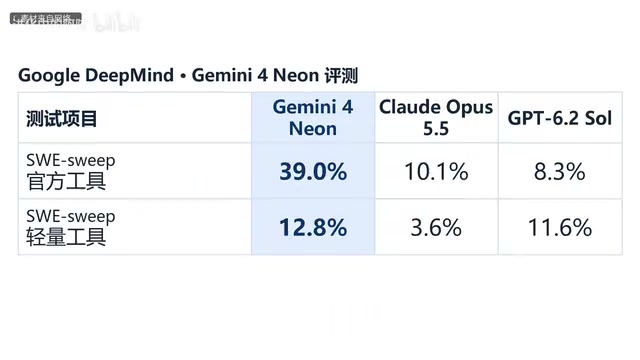
The code repair test SWE Sweep better illustrates the impact of the tool environment: the same Neon with only lightweight tools scored just 12.8%, but when run in Google's own Anti-Gravity environment, the score jumped directly to 39.0%—the model itself is one thing, but whether the tools it's paired with can keep up can make a difference of more than three times in score.
Clear Advantages in Office Automation and Long-Horizon Tasks
Moving to office automation and long-horizon tasks, the advantages are more obvious. On the automation workflow test Automation Bench, Neon reached 56.3%, far above Opus 5.5's 42.5%, with GPT 6.2 Sol at only 41.3%. On the Agentic Comprehensive Exam version 1.1, Neon scored 75.8%, also beating Opus 5.5's 71.6% and GPT 6.2 Sol's 73.0%.
Strong Contrast in Multimodal and Long-Context Tests
On the video understanding test LV Bench, Neon scored 89.0%, above Opus 5.5's 83.7% and ahead of GPT 6.2 Sol's 87.6%. On the long-context test GraphWalks, Neon scored 95.2%, blowing past Opus 5.5's 66.8%, while GPT 6.2 Sol scored 80.1% on this test. Of course, these percentages each measure different tasks and need to be looked at separately.
Coding Agent Index and Valse Index: The Coding Agent Index measures a model's ability to autonomously complete multi-step tasks in real development environments, including reading repositories, locating bugs, modifying code, running tests, and iterating. Unlike single-turn code completion, it emphasizes tool calling and long-horizon planning, so the same model can score several times differently in different tool environments (such as a plain sandbox vs. Anti-Gravity). The Valse Index version 2.2 focuses on "real work capability," covering knowledge-intensive workflows like legal research and tax agency, evaluating task completion rates and accuracy in professional workflows. Both are third-party comprehensive evaluations, but with different emphases: the former looks at code implementation, the latter at business processes. Neon's 58.6 ranking first on the Coding Agent Index while only third on the composite intelligence leaderboard precisely illustrates that model rankings can diverge significantly across different evaluation dimensions.
The Cost Truth: Thinking Depth Determines the Bill
The most practical comparison involves thinking depth. In hands-on testing, dropping Neon's thinking depth down one notch from extra-high to high reduced the composite score only from 61 to 60—almost no difference—but output tokens dropped by 36.6%, and average cost per composite evaluation task fell from $6.44 to $3.74, saving over 40%. The building-block animation mentioned earlier actually cost more; if output balloons, the bill still jumps.
Billing Relationship Between Output Tokens and Reasoning Tokens: LLM APIs price input tokens and output tokens separately, with output typically costing several times more than input (in the article, Neon is $3 vs. $15, a 5x difference). The key point is that tokens consumed by the model's internal reasoning are also billed as output—even if those tokens aren't directly shown to the user. Therefore, when a model spends a lot of output on "talking to itself" reasoning rather than producing usable code or text, actual costs can far exceed estimates based on sticker price. In the medieval battlefield example, 42.7% of Fable 5.2's output went to reasoning, ultimately producing only 1034 lines of code, while Neon used only 16.3% for internal reasoning and produced 5138 lines. This explains why a lower-priced model can actually be more expensive on a single task. When choosing a model, focus on the "effective output ratio" rather than just the per-million-token sticker price.
Anti-Gravity Boost: Parallel Sub-Agents and Rapid Prototyping
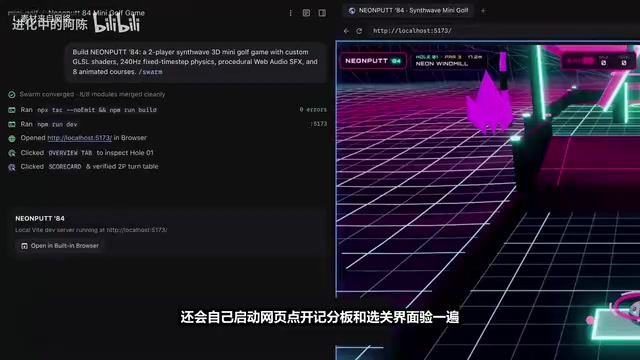
Since brute force alone is expensive, what Google is really using to boost Neon's efficiency this time is its own development tool Anti-Gravity. Turning on the parallel task delegation feature in this tool, when given a 3D mini-golf requirement with 240Hz physics collision sound effects and 8 animated levels, Neon didn't write it from start to finish itself—it split into 8 parallel branches (jargon: sub-agents) working simultaneously: one writing physics rules, one doing lighting and rendering, one assembling levels and button interfaces, each handling its own part, merging with zero errors in 5 minutes, and even launching the web page itself to click through the scoreboard and level selection interface to verify.
The same approach plugged into the 3D modeling software Blender—Google also released several samples to demonstrate capability: Neon built an entire chemical element lab bench following the family's naming, hooked up a high-voltage transformer to light up the neon glass tube representing itself; it also grabbed an old photo of King's College, Cambridge from 1936 as reference and built computer pioneer Alan Turing's study and that era's Turing machine; it also used real terrain data from Mont Blanc and Chamonix in the Alps to create a first-person 3D skiing simulation playable in the browser without installing a client, with ski boards, snow cliffs, and ground lighting following in real time as you ski down the slope.
Sub-agent Parallel Architecture: "Parallel task delegation" in Anti-Gravity is a multi-agent orchestration pattern: the main agent breaks a complex requirement into several independent subtasks, distributes them to multiple sub-agents for simultaneous execution, and finally aggregates and merges. Each sub-agent has independent context and tool permissions, and can write physics rules, rendering, UI, and other modules in parallel, thereby compressing wall-clock time. This pattern requires from the model not just single-generation quality, but also task decomposition rationality, adherence to interface contracts, and ability to handle merge conflicts. Neon splitting into 8 parallel branches and merging with zero errors in 5 minutes reflects the model's planning ability in structured collaboration, not just raw code generation speed. This also explains why the same model scores far higher with tools attached than running bare—the toolchain essentially extends the model's "hands" and "working memory."
The Real Arena: Head-to-Head with Claude Fable 5.2
3D Building-Block Animation: Cheaper Unit Price but More Money Spent
The first comparison brought in the currently highest-rated Claude Fable 5.2 for the same task: a 3D building-block ninja animation with fire, electric, ice, and shadow effect characters taking turns, ending with six ninjas combining poses. Action and lighting looked fine on both sides, but the bill was surprising: completing the whole set, Neon cost a cumulative $12.93, while Fable 5.2 on the other side used only $11.19. With a clearly cheaper unit price, how did it spend a dollar seventy more in the first head-to-head?
Medieval Battlefield: 30-Minute Time-Limited Showdown
This time it again took on Claude Fable 5.2, but with a fair rule: both sides work solo at maximum thinking depth, building the same medieval battlefield with the web 3D tool 3JS, each limited to 30 minutes. Comparing the visuals side by side, this round's image quality evaluation favored Fable 5.2's archer formation, firelight, and distant castle silhouette, which were indeed more detailed; Neon did produce red-clad soldiers drawing bows and firing arrows, sky-full rocket trails, and shield-raising counterattacks, but zoomed in the material texture was still a bit rougher.
But once you open the backend runtime ledger, the situation completely reverses. At the 30-minute mark, Neon had written 5138 lines of code, 181.3KB in size, with only 16.3% of its total output used for internal reasoning—most of its effort going into writing usable code; Fable 5.2 on the other side had 42.7% of its output consumed by lengthy reasoning, meaning nearly half its output was reasoning, ultimately landing only 1034 lines, 78.8KB. The billing contrast is even more stark: Fable 5.2's tool reported $10.35 in spending at the end; Neon's tool doesn't automatically calculate totals, but estimated against usage at official unit prices it comes to about $5.07—almost half saved.
This approach of laying down code aggressively and rapidly prototyping through high output works especially well for web pages and interactive games. It generated 7 different style web pages in a row—from a mechanical clock-style page with scroll-triggered animations, a geometric color chart tool with resizable ratios, a black-background minimalist system page, light-colored e-commerce product cards, to contrasting-color dynamic grid layouts, a black-background headphone detail page supporting 360-degree drag to view hotspots, and a data narrative page with scrolling number cards—layout and interaction all clicked reliably, no longer ending up half-finished like before.
Moved into Anti-Gravity, it even made a Call of Duty-style 3D shooter in one go, with a minimap showing direction in the top-left corner, kill notifications, slide and crouch, primary/secondary weapon switching, red dot sight, reload prompts, and health loss from heavy damage all implemented—though looking closely, the wall textures are still rather plain. Based on the reviewer's experience, wanting top-notch polish from the first attempt might still be more reliable with pricier models like Opus, but using Neon to build a complete, runnable, playable skeleton at low cost and then refining it is already a quite practical approach.
Vector Graphics and 3D Scenes
Not just writing apps and games—it also draws with code—line art called vector graphics that don't blur no matter how much you zoom in—and this skill is also solid. From a pink-purple butterfly specimen with flapping wings that can switch species, to a New York harbor skyline with a day-night timeline, to a framed Lantern Bay night scene, the lines and lighting layers are all done in fine detail.

Given the same task of drawing a black game controller, first compared side by side with GPT-6.2 SOAR, then with its own Hydrogen placed below as reference, the hands-on evaluation most favored Neon's three-dimensional form and gradient lighting on the buttons. Then head-to-head with Opus 5.5 on a two-level ecological water city, with water reflections, turning windmills, and airship and boat details more fully laid out, the reviewer likewise considered this version superior to Opus 5.5. Even the famous "pelican riding a bicycle" prompt widely recognized in AI circles as specifically testing graphical structure understanding—where many models can't even draw a static simple sketch correctly—Neon delivered an entire animated short with rhythmic timing and a group of characters charging out in formation.
This visual command extends into large 3D scenes and shows even more skill. In Anti-Gravity with thinking depth at maximum, a single instruction without follow-up questions ran for 39 minutes, and Neon delivered a Tokyo rainy night—first-person walking through neon-lit rainy alleys, with puddles on the road clearly reflecting the colorful reflections of Japanese signage on both sides, glowing vending machines and passersby with red umbrellas along the street. Then the autumn animation short truly amazed the hands-on author: inspired by the British poet's 1819 poem of the same name, relying entirely on the most basic native web scripting code without any ready-made 3D tool libraries, from an opening on a dirt road through wildflowers in wheat fields, through an orchard farmhouse hung with apples and grapevines, into an old barn and along a path through half-harvested wheat fields, wading across a stream, ending in pink-purple sunset clouds and sky-full of swallows, complete with wind sounds, insect chirps, and full English recitation.
Going Solo: How Much Capability Remains Without Tools?
But most of these grand scenes rely on the Anti-Gravity development tool for support. Back in the Gemini web chat box that ordinary people use most, without tools and fighting solo, how much capability remains? Testing the classic Minecraft-style block sandbox with lighting directly in the chat window, the result was realistic: it didn't succeed in one shot—the first generated code had two extra formatting symbols at the beginning and end, and the web page threw a syntax error on running, requiring one round of self-correction before it opened smoothly. Fortunately, after fixing, entering the world's day-night lighting transitions, breaking blocks to build structures, and even diving underwater to see ripple light transmission were all implemented—except that no matter how much menu searching, the survival mode for fighting monsters couldn't be found.
Should You Make It Your Main Model?
Looking at all these hands-on tests together, Gemini 4 Neon's true capabilities are actually clear: judged purely on one-shot maximum image quality and detail polish, it hasn't comprehensively surpassed Claude Fable 5.2 and Opus 5.5, and making 3D building-block animations might even cost more than its competitors; back in the ordinary web chat box running large projects, it still needs one round of self-correction allowance. But as long as you equip it with development tools, or set thinking depth to high for heavy work, in this real-world battlefield, it uses nearly half the cost to first build a runnable complete skeleton or even grand scenes—the cost-performance is genuinely there.
If you usually pick a main assistant to help write small tools and build web prototypes, would you choose it for being faster and cheaper, using this middle-ground model as your everyday mainstay? Or would you rather wait a bit longer and keep grinding with the most expensive top-tier flagship?
Related articles

Jingle Jam 2026 Registration Opens: Lewis Uses Old Footage to Rally Volunteers for Fundraising
Jingle Jam 2026 fundraising registration is open. Lewis uses old footage edited into a new video, calling on viewers to create fundraising pages at jingle jam.tiltify.com to support eight charities. The event takes place in the first two weeks of December.

Gemini 4 Neon Hands-On Test: Can It Replace Claude Opus 5.5?
A Bilibili creator tests Gemini 4 Neon, Claude Opus 5.5, and GPT 6.2 across three coding Agent challenges—pelican animation, 3D racing, and code-generated video—to see if Gemini can replace Opus.
FBI-Warned Artex: How an AI Attack Framework With No In-House Model Pries Open Enterprise Doors
The FBI-warned open-source AI attack framework Artex has no model of its own—it plugs into Claude, GPT, and other external LLMs to drive an agent loop, turning ordinary tools like Nmap into an automated attack pipeline. This article examines three real cases—South Korean finance, ConnectWise, and Barracuda—analyzes the three drivers of speed, cost, and noise, and outlines defenses such as exposure inventory and short-lived credentials.