Google Genie 4 Released: Real-Time World Editing, AI Generation Enters a New Interactive Era

Google opens Genie 4, bringing real-time editing, native audio, and a creation agent.
Google DeepMind and Google Labs announced a major Project Genie update, with Genie 4 now available to eligible Google AI Ultra subscribers. Genie 4 is billed as the most realistic and interactive world model to date, with core breakthroughs in real-time natural language editing within a session and the first pairing of visuals with real-time native audio. Genie 3 is also upgraded: exploration sessions extend from 60 seconds to 3 minutes, with 360-degree panoramic grounding and world linking. A new Project Genie agent lets users build complex worlds through conversation and call on Gemini for suggestions or to trigger events. The community gallery supports publishing, exploring, and remixing works, and all generated content includes SynthID watermarks and undergoes safety screening.
Google DeepMind and Google Labs jointly announced a major update to Project Genie: the Genie 4 model is now officially available to eligible Google AI Ultra subscribers. This update not only brings more realistic world generation capabilities but also introduces real-time natural language editing, native audio, a creation agent (Agent), and a community gallery—taking AI-generated worlds from "view-only" to "playable, editable, and shareable."
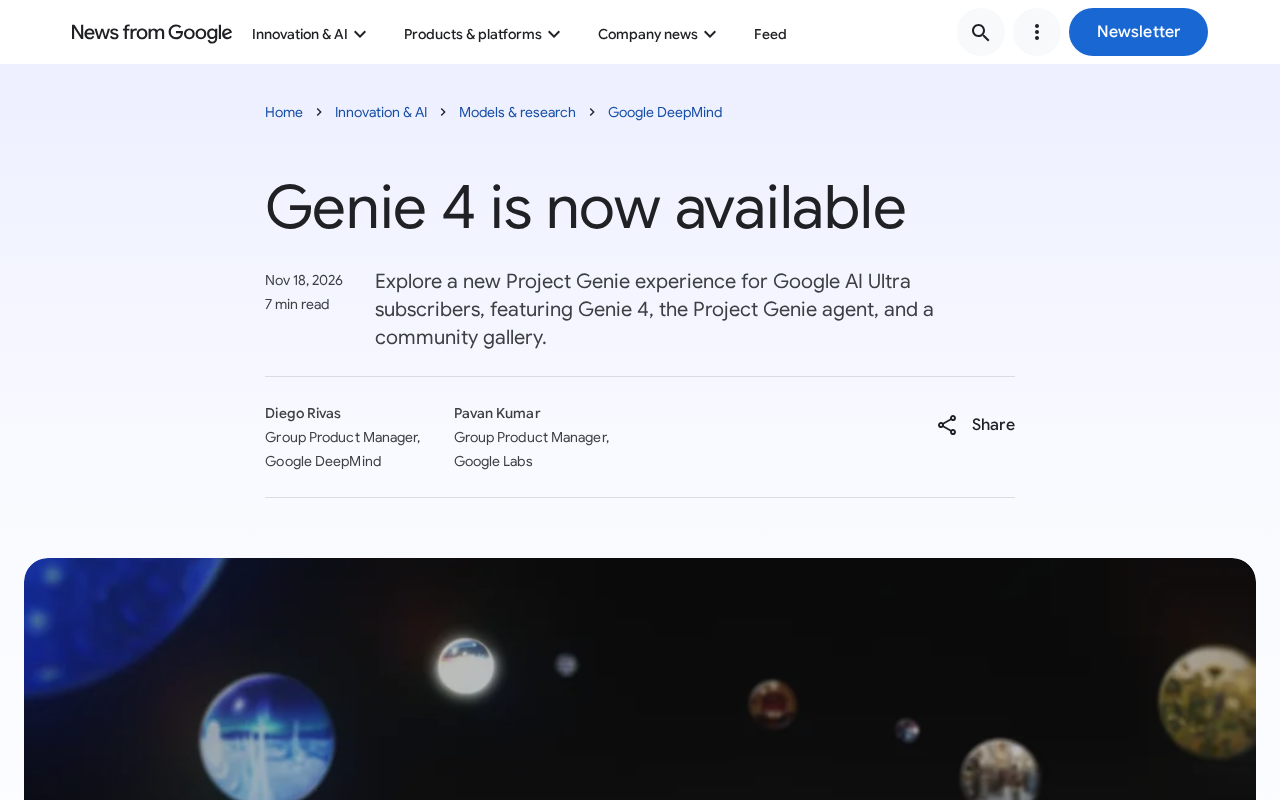
Genie 4: Change the World in Real Time with a Single Sentence
Genie 4 is officially described as "the most realistic and interactive world model to date." Compared with previous versions, the biggest breakthrough is real-time editing within a session: you no longer need to exit the current world and regenerate—just enter a new prompt while exploring, and you can instantly change the environment. For example, adjust the weather, add a new character, or directly change the direction of the story.
Even more strikingly, Genie 4 pairs visuals with real-time native audio for the first time. Audio dynamically adapts to the scene—from ambient sound effects to character dialogue, everything evolves naturally as the world changes. This means generated worlds are no longer just visually immersive but offer a complete experience with synchronized audio and visuals.
According to Google's official blog, early testers said they wanted "deeper control over what happens inside the world, and easier ways to build and share." Genie 4's real-time editing and audio capabilities are a direct response to that need.
World Model is a key concept for understanding the positioning of the Genie series. It refers to a class of generative models that can predict and simulate future environment states, where the input can be text, images, or actions, and the output is an interactive scene that evolves over time. Unlike ordinary video generation models, world models emphasize interactivity and state consistency: every user action (moving the camera, changing the prompt) should produce coherent results consistent with physics and narrative logic, rather than independent fragments. The Genie series iterates along this path, moving from generating a single explorable video to gradually supporting long-duration exploration, real-time editing, and auditory feedback in dynamic worlds. The goal of this direction is to make AI a simulator that can be "entered" and "controlled," not merely a passive producer of content.
Genie 3 Upgraded in Parallel: Longer Duration, Panoramic Grounding, and World Linking
Although Genie 4 goes further in fidelity and interactivity, Genie 3 has not been retired. In Project Genie's model selector, Genie 3 is still available, suitable for scenarios requiring longer runtime or generating spaces based on panoramic images. This time, Genie 3 received three important updates:
- Extended sessions and world linking: the duration of a single generated exploration session has increased from 60 seconds to up to 3 minutes, and multiple worlds can be linked together to form longer journeys.
- 360-degree panoramic grounding: supports seeding new worlds from 360-degree panoramic images while maintaining scene consistency. The official example shows the stable performance of facade details in Petra Canyon when looking around.
- Real-time in-world events: dynamically change the environment through natural language prompts during exploration, such as summoning a dragon mid-flight and riding it.
These upgrades give Genie 3 a differentiated positioning from Genie 4 in "long-duration exploration" and "scene consistency."
Panoramic grounding refers to a technique that uses 360-degree panoramic images as conditional input to "anchor" world generation. Ordinary image input provides information from only a fixed viewpoint, while a panorama covers the full spherical field of view, allowing the model to infer the surrounding environment layout. When the user rotates the camera to look around, the generated frames need to remain consistent with the content in the corresponding direction in the panorama, thereby avoiding scene "drift" or elements appearing out of nowhere. The value of this approach lies in scene consistency and reproducibility: the same panorama can repeatedly generate spatially stable structures, making it suitable for building worlds that require long exploration or multiple entries.
Project Genie Agent: Build Complex Worlds Through Conversation
The newly added Project Genie agent further lowers the barrier to creation. You no longer need to carefully design a single text or image prompt; instead, you describe your idea as if chatting, and the agent orchestrates Google's suite of multimodal models to generate the initial visuals, paired with custom background music that matches the atmosphere.
During exploration, you can also bring Gemini models into the session at any time. Gemini observes everything happening on screen, provides context-relevant suggestion chips telling you where you can go next, or automatically triggers in-world events based on the journey's progress. In the official demo, a natural language prompt first became an interactive spacewalk, and then an alien spacecraft appeared on request.
Community Gallery: Discover, Explore, and Remix
The newly added community gallery in Project Genie brings together curated worlds and community creations. You can jump straight into exploration, or remix existing works by adjusting the underlying world structure, soundtrack, or rules to create your own version.
The gallery showcases some striking collaborative examples:
- Living Memory: transforms personal photos into explorable spaces.
- Dino Field Guide: a roam through prehistoric habitats based on 360-degree panoramic images.
- Rock Paper Scissors: tabletop object battles with Gemini acting as real-time referee.
- Villa Giallo: a collaboration with creative technologist Will aka BLVCKL!GHT, using Genie 4 to turn a Gothic mansion into a room-by-room interactive puzzle.
- The Life of Ants: a collaboration with filmmaker Anand Gandhi, leveraging Genie 4's photorealism to let users navigate a complex ant colony from an ant's perspective.
Users can publish their creations to the community gallery for others to explore and remix. This cycle of "create—share—recreate" is turning world generation into a social creative activity.
Building Responsibly: Watermarking and Safety Screening
Google emphasizes responsible development of interactive world models. All videos and audio generated in Project Genie contain SynthID watermarks, and all model inputs and outputs undergo safety screening.
Google also acknowledges that Genie 3 and Genie 4 are still at the frontier research stage and are actively addressing key challenges such as camera latency, complex physical interactions, real-time audio accuracy, and long-term scene persistence. More details on model limitations and research progress can be found in the Genie 4 model research overview.
SynthID is an AI-generated content watermarking technology developed by Google DeepMind. Its distinguishing feature is that it embeds invisible digital signals directly into the generated content itself rather than attaching them to file metadata. For images and video, the watermark is encoded into pixels; for audio, it is embedded as spectral perturbations that are difficult for the human ear to detect. This way, even if the content is cropped, compressed, or format-converted, detectors still have a chance to identify its AI-generated origin. The significance of SynthID lies in providing a means of provenance for large-scale generated content, helping platforms and users distinguish real recordings from AI synthesis, and providing a technical foundation for copyright attribution and misinformation governance.
How to Try It
Eligible Google AI Ultra subscribers can try the new version of Project Genie starting today. Google AI Pro members can join the waitlist on the same page.
From the release of Genie 4, it is clear that AI world generation is rapidly evolving from "generating a static scene" to "generating a dynamic world that can be interacted with in real time and shared socially." The combination of real-time editing, native audio, and a creation agent makes world-building in the browser more intuitive than ever. Although there is still room for improvement in physical realism and scene persistence, the direction is clear: future AI-generated content will increasingly be interactive and editable.
One-line Summary
Google opens Genie 4, bringing real-time editing, native audio, and a creation agent.
Paragraph Summary
Google DeepMind and Google Labs announced a major update to Project Genie, with Genie 4 now available to eligible Google AI Ultra subscribers. Genie 4 is described as the most realistic and interactive world model to date, with its core breakthrough being real-time natural language editing of environments within a session and, for the first time, pairing visuals with real-time native audio. Genie 3 has also been upgraded in parallel: single exploration sessions have been extended from 60 seconds to 3 minutes, with support for 360-degree panoramic grounding and world linking. The newly added Project Genie agent lets users build complex worlds through conversation and call on Gemini at any time for suggestions or to trigger events. The community gallery supports publishing, exploring, and remixing works, and all generated content contains SynthID watermarks and undergoes safety screening.
Related articles

RePlan-VLA: Progress-Aware Replanning Breakthrough for Long-Horizon Robotic Manipulation
The RePlan-VLA framework converts VLA models' short-horizon capabilities into reliable long-horizon execution through progress-aware adaptive replanning, improving success rates by 21.9% and 10.4% on RoboCasa365 and CALVIN, and validating real-world deployment on a Franka Research 3 robot.

Geometric Bridge Flow Matching: A New Breakthrough in Blind Rigid Motion Correction
Geometric bridge flow matching enables blind rigid motion correction in head CBCT, achieving 37.1 dB PSNR and 0.27 mm RPE on simulated data in ~9.1 minutes, outperforming existing methods.

Google Releases Gemini 4 Hydrogen: 2.5x Faster Without Sacrificing Intelligence
Google releases the lightweight Gemini 4 Hydrogen: 2.5x faster task completion, AA Intelligence Index of 54 beating its flagship sibling, 7.3s single-step on Agent Arena faster than Claude and GPT rivals, four thinking levels with pay-as-you-need pricing, now available across AI Studio and more.