google-jules-mcp: A MCP Bridge Connecting Claude to Google Jules
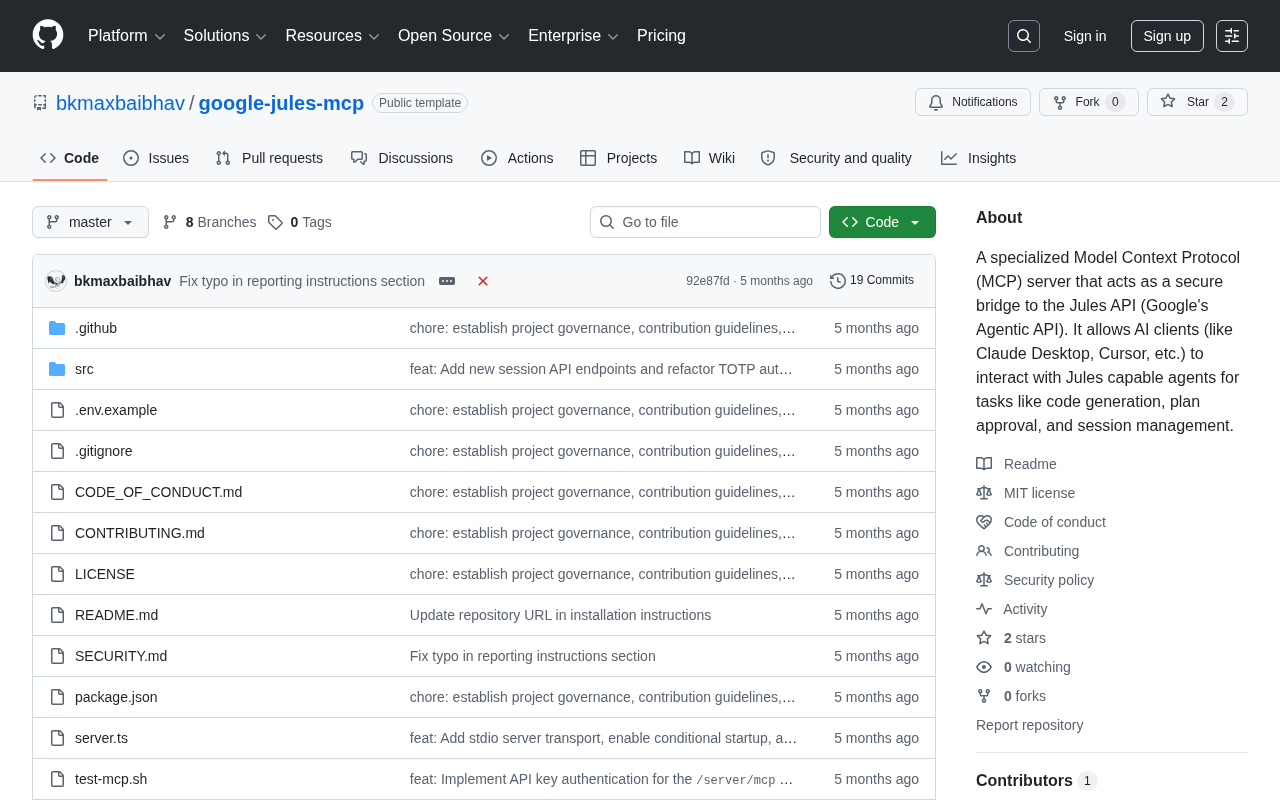
google-jules-mcp wraps Google Jules Agentic API as a standardized MCP server interface.
google-jules-mcp is an early-stage open-source project that wraps Google Jules' Agentic API as a standardized MCP server, enabling AI clients like Claude Desktop and Cursor to invoke Jules' code generation, plan approval, and session management capabilities without handling authentication or request formatting directly. Written in TypeScript and emphasizing secure bridging, the project currently has only 2 Stars and 0 Forks, making it better suited as a learning reference for MCP adapter implementation than a production-ready solution.
What is google-jules-mcp
As Model Context Protocol (MCP) increasingly becomes the universal standard for connecting AI clients with external tools, the open-source ecosystem around it is expanding rapidly. google-jules-mcp is one such specialized MCP server project, positioned as a secure bridge between AI clients and Google Jules API — Google's Agentic API.
In short, this project enables MCP-compatible AI clients like Claude Desktop and Cursor to directly invoke Jules' agent capabilities for tasks such as code generation, plan approval, and session management. Written in TypeScript, the project is currently in its early stages (2 Stars, TypeScript, 0 Forks), making it an exploratory community tool.
Model Context Protocol (MCP) is a communication protocol specification proposed and open-sourced by Anthropic in late 2024, designed to standardize interactions between large model applications and external tools or data sources. Its core idea is analogous to a USB interface: as long as both parties follow the same protocol, any MCP client (such as Claude Desktop or Cursor) can communicate with any MCP server without needing to develop custom adapter code for each pairing. The protocol defines three basic primitives: Tools (functions callable by the model), Resources (data readable by the model), and Prompts (preset prompt templates). Google Jules is an AI coding agent from Google aimed at developers, capable of autonomously completing code modifications, bug fixes, and similar tasks. It is powered by Gemini model capabilities and offers a dedicated Agentic API for programmatic access.
Why MCP Needs Specialized Servers Like This
MCP was designed to provide large models with a standardized interface for context and tool invocation, preventing every application from reinventing the wheel. But MCP itself is just a protocol — actually making a specific service (like Google Jules) usable still requires an intermediary layer, the MCP server, to wrap the capabilities of an external API into tools and resources that MCP clients can understand.
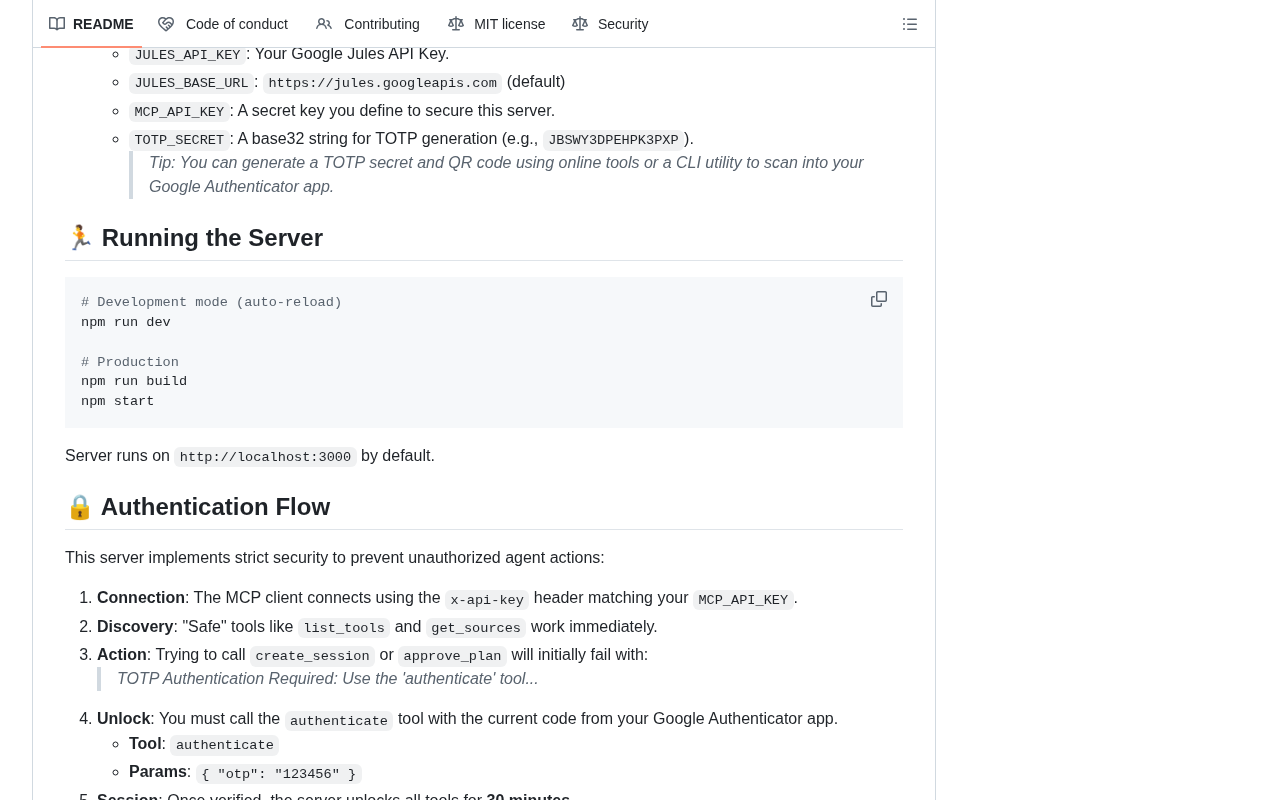
google-jules-mcp plays exactly this role. It encapsulates Jules API's invocation logic and authentication flow, exposing a standardized set of interfaces to upstream AI clients. This way, instructions issued within Claude or Cursor can be translated into actual operations on the Jules agent, without users needing to manually handle API keys, request formats, or other low-level details.
The project description specifically highlights the concept of a "secure bridge." In practice, Agentic APIs often involve sensitive operations such as code execution and task planning. Safely passing credentials between the client and the API, and isolating permissions, are critical design considerations for this type of middleware service.
Core Capabilities: Code Generation, Plan Approval, and Session Management
According to the project documentation, google-jules-mcp primarily supports three categories of Jules agent capabilities:
Code Generation
Leveraging Jules' agent capabilities, users can trigger code generation tasks directly within their preferred AI client, while Jules handles the underlying inference and output. For developers already using AI coding tools like Cursor, this represents an additional pathway to access Google's agent capabilities.
Plan Approval
"Plan approval" is a typical step in agentic workflows: the agent first presents an execution plan, which is reviewed and confirmed by a human or client before execution proceeds. By exposing this step through MCP, users can review the agent's proposed action plan within their client, preserving human-in-the-loop control.
Human-in-the-loop is an important safety mechanism in AI automation, referring to the mandatory introduction of a human confirmation step before an agent executes high-risk or irreversible operations. This design is especially critical in scenarios involving code modifications, file writes, and API calls — the agent presents the planned sequence of operations to the user in a readable format, and only executes after the user reviews and approves. This contrasts with a fully automated "fire-and-forget" model, effectively reducing the risk of destructive outcomes caused by the agent misinterpreting instructions or hallucinating. Exposing the plan approval step to the client via MCP means this control point can be surfaced directly within Claude Desktop or Cursor's interface, without requiring users to switch to Jules' native interface.
Session Management
Agent tasks are often multi-turn and stateful. Session management capabilities allow clients to create, track, and maintain interaction sessions with Jules, ensuring contextual continuity across complex tasks.
Positioning and Current Status
From a technical architecture perspective, google-jules-mcp follows the typical "protocol adapter layer" pattern in the current MCP ecosystem: one end connects to standard MCP clients, while the other wraps a specific vendor's API. The value of this pattern lies in reducing integration costs — as long as a client supports MCP, it can reuse the same integration logic.
That said, it's important to be realistic: the project is still at a very early stage. The data — 2 Stars and 0 Forks — indicates it has not yet received widespread attention or community validation. Its functional completeness, stability, and security have yet to be proven in practice. Teams looking to use Jules capabilities in production environments should treat it as a reference implementation or starting point rather than a mature solution.
For developers, the project's greater significance lies in demonstrating how to write an MCP adapter layer for an Agentic API. If you're researching how to implement MCP servers or want to integrate a third-party API with clients like Claude or Cursor, small and focused open-source projects like this often serve as excellent learning examples.
Summary
google-jules-mcp is a snapshot of the rapidly evolving MCP ecosystem: more and more developers are writing standardized integration bridges for various APIs, enabling large model clients to invoke external agent capabilities in a unified way. Its wrapper around Google Jules covers core scenarios including code generation, plan approval, and session management — implemented in TypeScript with an emphasis on secure bridging. While the project is still young, the technical trend it reflects — connecting AI clients with vendor Agentic APIs via MCP — is well worth watching.
Related articles
Insufficient Source Material: A Tweet With No Substantive Content
A single tweet reading 'Available until the goblins notice.' with two unexpanded links provides no substantive content to write an article from.
Google Jules AI Coding Assistant: A Quick Look at an Open-Source Practice Repo
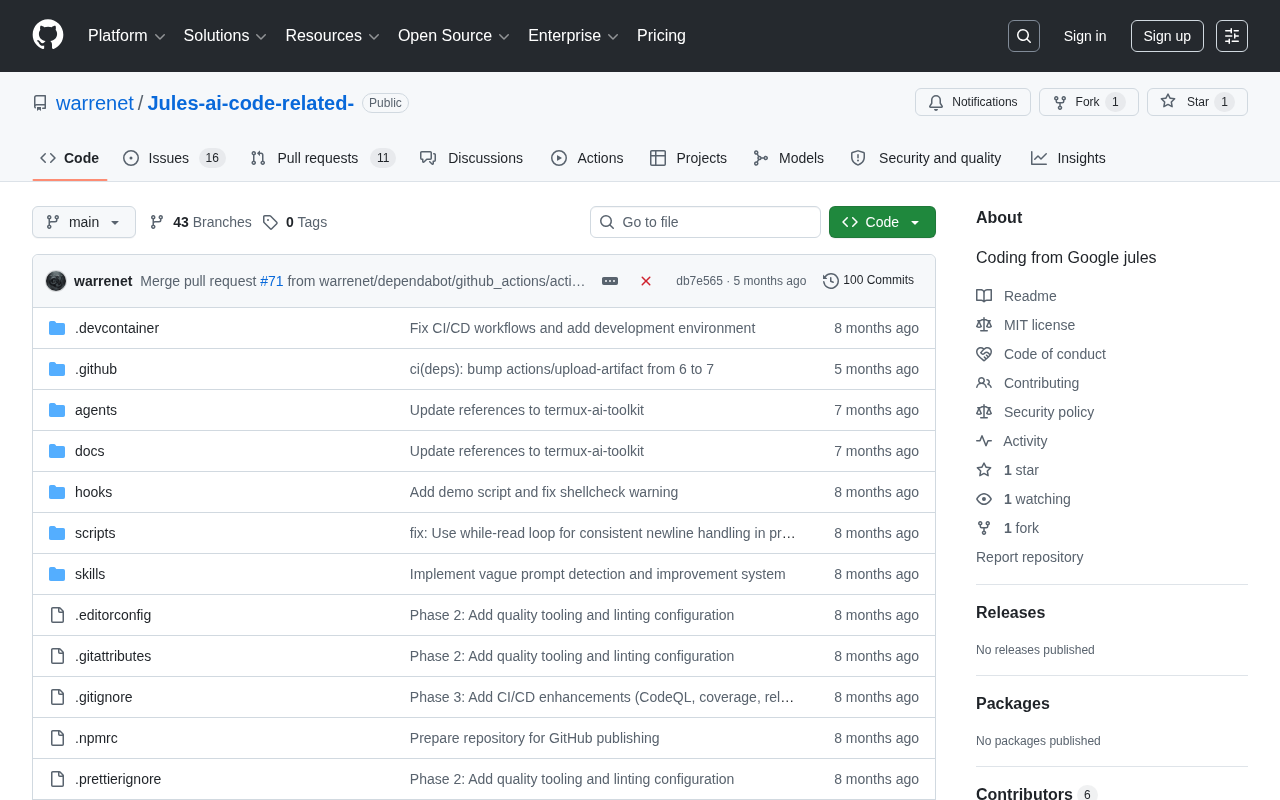
A look at a small GitHub repo centered on Google Jules, an autonomous AI coding agent. Explores what Jules does, the repo's practical value, and how to evaluate early-stage AI tool projects.
GitHub Project Overview: prateek0221/jules — Critically Lacking Information
The GitHub repo prateek0221/jules has only 1 star, no code, and no README. We review available info and provide background on Google's Jules AI coding agent.