Google Officially Supports Pi Coding Agent: The AI Programming Tool Ecosystem Expands Further
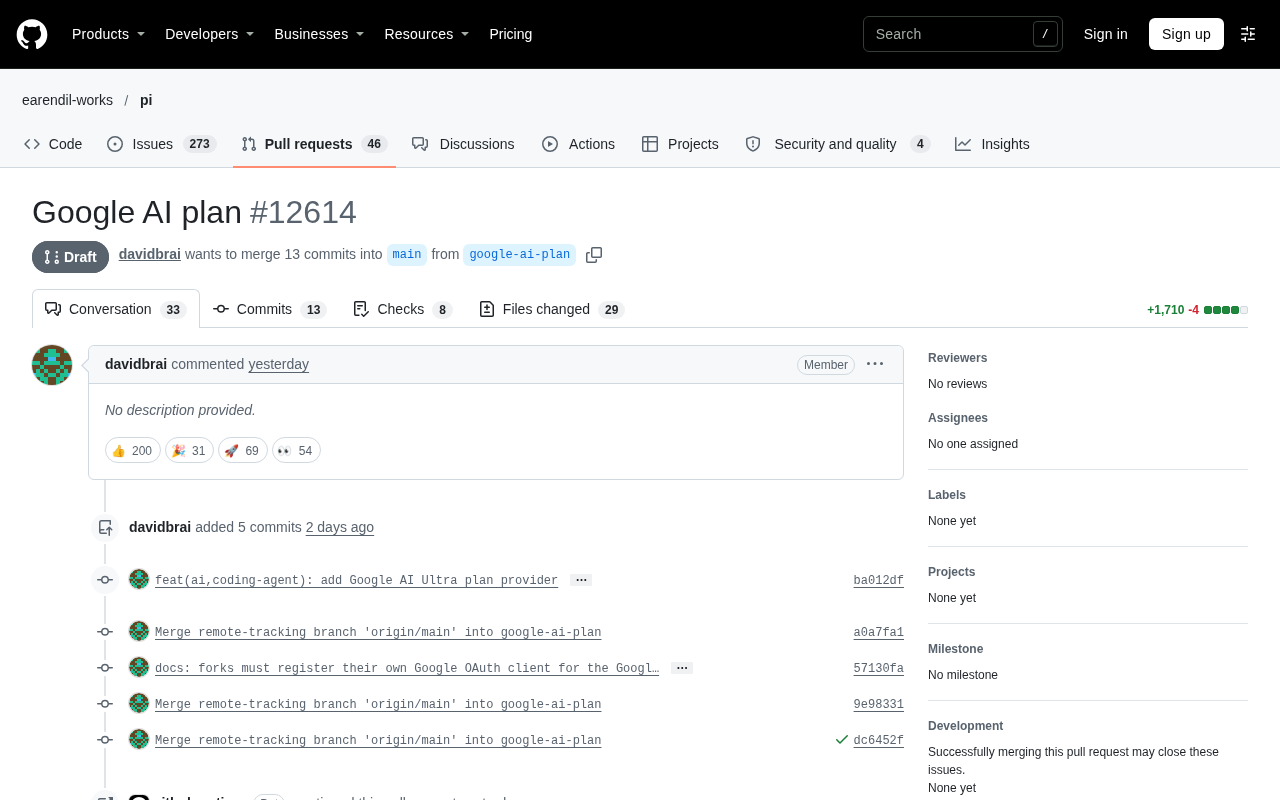
Google provides official AI plan support for the open-source coding agent Pi, marking that large model vendors have begun actively connecting with third-party agent tools.
The article centers on Google's addition of official Google AI plan support for the open-source coding agent Pi. The author notes that coding agents, with closed-loop execution capabilities such as reading files, executing commands, and iterating based on errors, are more likely than chat-based AI to create user stickiness and have therefore become a developer entry point contested by large model vendors. Official support means stable authentication, clear quota billing, and interface adaptation for agent scenarios, reducing configuration costs and improving runtime stability. The article also raises two directions for observation: first, the path dependence and neutrality issues that may arise after agent tools become bound to model vendors; second, implementation details such as quota calculation, free versus paid distinctions, and billing for looped calls, which will directly affect developers' willingness to adopt. The overall judgment is that competition in AI programming tools has extended from model capability to workflow integration.
From Community Tool to Official Support: Pi Coding Agent Reaches a Key Milestone
A low-key but noteworthy development appeared on Hacker News: Google is adding official Google AI plan support to the Pi coding agent. Although the information is brief—only 6 points and 2 comments—it points to a structural change taking place in the AI programming tool ecosystem: general-purpose large model vendors are beginning to actively connect with third-party coding agents.
Pi is an open-source coding agent project that allows developers to drive code generation, modification, and execution through natural language. Previously, users who wanted to use Google's AI capabilities in Pi mostly had to rely on unofficial channels or configure the API themselves. Now, with the addition of official support, Google has formally brought this type of agent tool into the application scenario map of its AI services.
Why Coding Agents Have Become a Battleground for Vendors
The core difference between coding agents and ordinary chat-based AI lies in "closed-loop execution." Chatbots output text, while coding agents need to read files, run commands, and repeatedly iterate based on error messages. This model places higher demands on the model's reasoning stability, tool-calling capabilities, and context management, and it is also more likely to create sustained user stickiness.
For Google, making agents like Pi natively support its AI plans is equivalent to planting an entry point in developers' workflows. Once developers become accustomed to a model's performance within an agent, subsequent API calls and subscription conversions have a foundation. This is consistent with the trend over the past year of vendors racing to launch coding-specific models and deeply integrating IDE plugins.
Google AI plans (here referring to Google's developer-facing AI service subscription and API system, such as Gemini API, Google AI Studio, and their paid tiers) are Google's entry point for providing model invocation capabilities to developers. Such plans usually include API key management, token-based billing, rate limits, and quota tiers. When a third-party tool gains "official support," it generally means the vendor has provided a formal OAuth or API Key authentication process, stable endpoints and SDK adaptation, and listed it in the documentation as a supported scenario. This contrasts with access methods that rely on community reverse engineering or unofficial compatibility layers. The former has clear boundaries of responsibility for interface changes, quota adjustments, and troubleshooting, while the latter may fail at any time due to upstream changes.
What Official Support Means
From an engineering perspective, official support usually covers several levels: a stable authentication method, clear quota and billing rules, and interface adaptation for agent scenarios. For developers, the most direct benefit is lower configuration costs and improved runtime stability—no longer needing to rely on community-maintained compatibility layers, and no need to worry about unofficial interfaces failing at any time.
From an ecosystem perspective, this sends a signal: coding agents, as a part of AI infrastructure, are being recognized by mainstream vendors. Although Pi is a relatively niche open-source project, gaining official-level integration shows that when evaluating partners, vendors value scenario fit more than pure user scale.
Closed-loop execution means that the agent does not merely generate text once, but converts model output into actual operations on the environment, and then feeds the results of those operations (such as compilation errors, test failures, and command output) back to the model for the next round of reasoning. This loop imposes additional requirements on model capabilities: it needs to accurately determine when to call which tool, how to parse structured returns, and how to keep the task objective from drifting across multiple turns of context. Closed-loop execution also significantly amplifies token consumption, because each iteration must carry the historical context again, making the billing method (per call or per token, and whether there are discounts for agent loops) a key variable affecting usage costs.
Two Directions Worth Watching
First, how the binding relationship between agent tools and model vendors will evolve. Official support brings convenience, but it may also create path dependence in tool model selection. As an open-source project, whether Pi can maintain official integration with multiple vendors while remaining multi-model compatible will affect its long-term neutrality.
Second, the implementation details of such support. Currently, public information is limited. How quotas are calculated, whether free and paid plans are distinguished, and whether the billing method for looped agent calls is friendly—these practical issues will directly determine developers' willingness to adopt. In the Hacker News discussion, although the number of comments is small, attention to pricing and quota transparency is usually the core of such topics.
Path dependence in the AI tool ecosystem refers to the following: when a tool is deeply integrated with a specific model vendor, the configurations, prompts, and workflows developers accumulate around that combination create migration costs, thereby reducing their willingness to try other models. For open-source agent projects, maintaining official integrations with multiple vendors simultaneously requires continuous investment in adaptation and testing resources, and different vendors differ markedly in interface style, authentication methods, and billing models. Therefore, there is often tension between "multi-model compatibility" and "official support from each vendor": the broader the compatibility, the shallower the depth of integration with any single vendor may be; and deep integration may weaken neutrality. This trade-off is an important perspective for evaluating the long-term positioning of open-source agents.
Practical Significance for Developers
If you are already using or considering using a coding agent, the practical value of this development is that Google AI capabilities in Pi will upgrade from "it can run" to "it is guaranteed." For teams that rely on agents for daily refactoring, test generation, and script writing, improved stability is more meaningful than new features.
More broadly, competition in AI programming tools has extended from model capability comparisons to workflow integration. Whoever can more smoothly embed into developers' daily operations is more likely to become the default choice. Google's official support for Pi is another step along this path.
Coding Agent is a type of software system that uses large language models as its reasoning core and can autonomously complete code-related tasks. Unlike code completion plugins or chat-based programming assistants, coding agents usually have tool-calling capabilities and can read and write files, execute terminal commands, run tests, and iteratively correct based on results. Their typical work loop is "observe—reason—act—verify," which places high demands on the model's instruction following, long-context management, and error recovery capabilities. Representative industry projects include the open-source Pi, Aider, and OpenHands, as well as commercial products such as Claude Code and Cursor Agent. The value of coding agents lies in encapsulating model capabilities into reusable automated processes, shifting developers from line-by-line instruction to goal description.
Related articles

Loom: One Machine for Weaving, Knitting and Braiding
Loom is a device that aims to seamlessly combine weaving, knitting and braiding in a single machine, drawing attention on Hacker News. This article examines its engineering challenges, significance for flexible manufacturing, and lessons for makers and hardware developers.
Running Local AI Agents on Mac: A Full Breakdown of the MLX Four-Layer Stack
A breakdown of Apple engineer Joanna's local Mac AI agent solution: the MLX four-layer stack, a three-step setup, and how the neural network accelerator, continuous batching, and distributed inference solve local agent performance bottlenecks.
52KB Engine Runs 2B LLM in a Browser Tab
52KB Engine Runs 2B LLM in a Browser Tab
A 52KB WebAssembly engine on Hacker News claims to run Qwen3.5-2B in a browser tab. We analyze the engine-model separation, browser inference pros and cons, and the on-device AI runtime race.