Google Open-Sources EmbeddingGemma 2: A New On-Device Multimodal Embedding Option

Google open-sources EmbeddingGemma 2 for on-device AI as OpenAI's math claims spark academic debate.
Google releases EmbeddingGemma 2, a 740M-parameter multimodal embedding model that runs on-device with as little as 191MB RAM, enabling local RAG and semantic search. OpenAI's release of 722 AI-generated math manuscripts draws skepticism from Fields Medal winners over academic standards. Anthropic consolidates its cybersecurity verification program, uncovering 129,000+ vulnerabilities. Meanwhile, agent deployment faces a key bottleneck: anti-bot defenses blocking execution, with a new standard emerging to address machine access rules.
Google Launches EmbeddingGemma 2: Multimodal Embeddings Go On-Device
Google has officially released EmbeddingGemma 2, a multimodal embedding model that maps text, code, images, video, and audio into a unified embedding space. As reported by IT Home citing Google's blog post, the model has approximately 740 million parameters, is built on the Gemma architecture, and is released under the commercially friendly Apache 2.0 license — developers can already download it on Hugging Face and Kaggle.
For developers, the most compelling aspect is the low cost of on-device inference. The quantized text-only version requires approximately 191MB of RAM on a Pixel-class phone, while the full multimodal version needs around 567MB. The model also supports truncating output vectors to lower dimensions, reducing local storage requirements by up to six times. This means local search, code retrieval, offline RAG, and similar use cases can run directly on mobile devices or lightweight hardware.
Google claims it leads benchmarks among small-scale multimodal embedding models — though these are vendor-reported results and developers should verify performance for their own use cases. That said, compressing multimodal capabilities into a sub-billion parameter model and releasing the weights represents a meaningful new building block for on-device AI applications.
An embedding model is a type of model that converts different forms of data (text, images, audio, etc.) into high-dimensional numerical vectors. The distances between these vectors in space reflect semantic similarity — content with similar meaning gets mapped to nearby positions. The key to multimodal embedding is mapping data from different modalities into the same vector space, so that "a photo of a cat" and "text describing a cat" can be directly compared by distance, without separate processing. This technology underpins semantic search, cross-modal retrieval, and RAG (Retrieval-Augmented Generation). RAG refers to the practice of retrieving relevant content from a knowledge base using embedding vectors before sending a query to a large language model, helping compensate for the model's knowledge cutoff and reduce hallucinations. EmbeddingGemma 2's on-device value lies precisely here: where RAG traditionally relied on cloud APIs for retrieval, local deployment can significantly reduce latency and privacy risks.
OpenAI Publishes Large Volume of Math Results — Mixed Reactions from the Math Community
According to IT Home, OpenAI has released a substantial collection of mathematical research outputs, comprising 722 manuscripts and 372 results. The company says these were produced by an unreleased frontier model, covering answers to hundreds of long-standing open problems, with reasoning process summaries and compute estimates attached. OpenAI noted that a typical result consumed roughly the equivalent of ChatGPT Pro thinking continuously for about 3 hours.
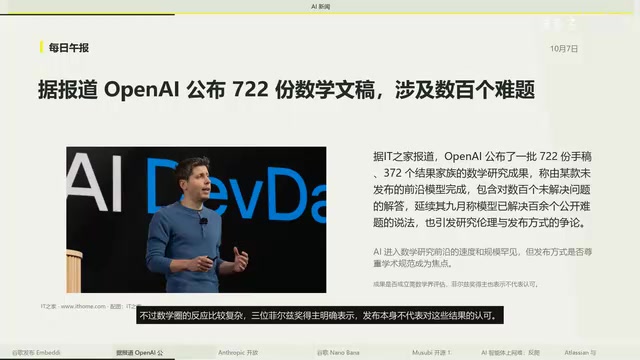
The mathematics community's response has been cautious. Three Fields Medal recipients explicitly stated that the release itself does not constitute endorsement of the results. The independent advisory group handling communications had previously urged that mathematical achievements not be used as a model marketing tool. These results will still require mathematicians to spend time reviewing and digesting them, and their full impact won't be clear for some time.
The more pressing questions are: What academic channels should AI-generated mathematical results go through? How should existing work by human mathematicians be credited? These normative questions may demand more urgent answers from the industry than the results themselves.
Anthropic Consolidates Cybersecurity Verification Program
According to Reuters, Anthropic has merged two programs that ran over the past six months into a new cybersecurity verification initiative, divided into three tiers: defensive, red team, and specialized. Cybersecurity professionals who pass a vetting process can access models with relaxed security restrictions — including stronger versions like Claude Opus and Sonnet — and each participant undergoes joint review with the U.S. government.
The numbers are significant: partners identified at least 129,000 verified vulnerabilities over several months, with more than 33,000 rated critical or high severity, and Anthropic's own scans found an additional approximately 5,500. The company acknowledges these figures likely undercount the reality, and the actual impact could be several times larger.
This tiered vetting mechanism serves a dual purpose: it creates a clearer pathway for security professionals to use the most capable models for vulnerability research, while also directly addressing concerns about AI being misused for offensive attacks — balancing capability access with risk through a controllable, audited framework.
Red teaming in cybersecurity refers to specialized testing activities that simulate real attacker behavior to proactively identify system vulnerabilities, as opposed to the "blue team" (defenders). Applied to AI safety, red teamers specifically attempt to elicit harmful outputs from models or bypass content filters, exposing potential risks before public deployment. Anthropic's three-tier verification structure — defensive, red team, and specialized — essentially brings both offense and defense under a controlled framework: the defensive tier helps security practitioners use AI to find and fix real vulnerabilities, while the red team tier allows researchers to legally test the upper limits of a model's offensive potential. The core logic of this tiered mechanism is "auditable capability access" — rather than fully blocking high-risk functionality, it limits users to a trusted range through credential vetting and joint government review, balancing research value with misuse risk control.
Image Models and Open-Source Ecosystem: Nano Banana 2.1 and a Lightweight Moderation Model
Google's image model Nano Banana 2.1 has also arrived. According to IT Home, this update focuses on three areas: improved composition completeness in visual design; more precise mask-based editing that can modify specific areas of an image without regenerating the whole thing; and better subject consistency that keeps the appearance of characters and objects stable across repeated edits or batch generation. That last point is especially useful for users doing sequential storyboards or batch image generation — your protagonist won't look like a different person in every frame. The model is being gradually rolled out across Gemini, AI Studio, Flow, and other entry points, supporting text, image, audio, and video input with output resolutions ranging from 1K to 4K.

There's also notable news from the open-source ecosystem. According to TechCrunch, a company called Mausibi has released Policy-LM, a lightweight decision-making model purpose-built for content moderation, released with open weights and positioned for real-time moderation decision workflows. Content moderation has long been an expensive and labor-intensive part of platform operations. If a 1.7B-scale small model can make fast preliminary judgments locally, the cost structure for small and mid-sized teams could shift considerably. Details remain limited, however, and the model's accuracy and edge cases in real-world moderation scenarios have yet to be independently verified.
The Real Bottleneck for Agent Deployment and Enterprise Partnerships
AI agents are one of the hottest topics right now, but they've run into a very practical wall. According to TechCrunch, personal AI agents can theoretically shop, book flights, and make restaurant reservations on your behalf — but when it comes to execution, deliberate website blocking and anti-bot defenses shut them out, leaving consumers caught in the middle.

The report mentions that a new standard is being developed to allow websites to grant agent access in a controlled manner. The significance here is that the capability bottleneck for agents may not lie in the models themselves, but in whether the broader internet is willing to establish rules for machine access. If the standard is widely adopted, the pace at which agents move from demos to everyday use could accelerate considerably.
On the enterprise side, Atlassian and OpenAI announced an expanded partnership focused on connecting frontier models with enterprise knowledge bases to help teams better plan, build, and deliver work. The potential is clear: knowledge scattered across documents, tasks, and code could be synthesized by models directly into actionable recommendations, rather than requiring people to dig through materials manually. No specific product form or launch timeline has been disclosed, but this represents a broader trend — large models are moving out of chat windows and into everyday enterprise workflows.
The "new standard" mentioned here refers to the agent authorization protocol direction currently being explored by the industry. Among the approaches attracting attention are mechanisms similar to agents.txt or OAuth-based extensions — analogous to how robots.txt files historically told crawlers which pages could be indexed, the new standard aims to let websites declare "which agents can perform which actions with what level of permission." The main obstacles agents currently face when accessing websites include CAPTCHA challenges, behavioral fingerprinting, IP rate limiting, and websites' legal and liability concerns around automated actions. Once a universal standard is established and adopted by major platforms, agents could interact with websites using identifiable, authorized identities — and websites would have a basis for accountability or billing — breaking through the current real-world bottleneck where model capabilities are sufficient but execution is blocked at the access layer.
Related articles

Automate Job Search with AI Agents and Residential Proxies for Precise Matching
Build an AI Agent with MCP and residential proxies to bypass recruitment site anti-scraping and geo-restrictions, scrape thousands of DevOps jobs, then have Claude score and rank each against your resume. Includes proxy comparison experiments, project structure, and cost analysis—filtering only, no auto-submission.

The AI Task Assistant That Knows When to Back Off: A Cure for Activation Struggles
One Small Step is an AI assistant for task initiation struggles, using agentic decisions for guilt-free reminders, timely retreat, and cross-platform task management. The developer shares real test results on 13 tasks and architectural trade-offs.

FastAPI: A High-Performance Python Framework and a Production-Ready API Development Powerhouse
FastAPI is a high-performance web framework based on Python type hints, supporting async and automatic OpenAPI docs. With over 100k GitHub stars, this article analyzes its core strengths, production readiness, and selection advice.