Google Pushes AI Features, Three Major US School Districts Consider Dropping Search
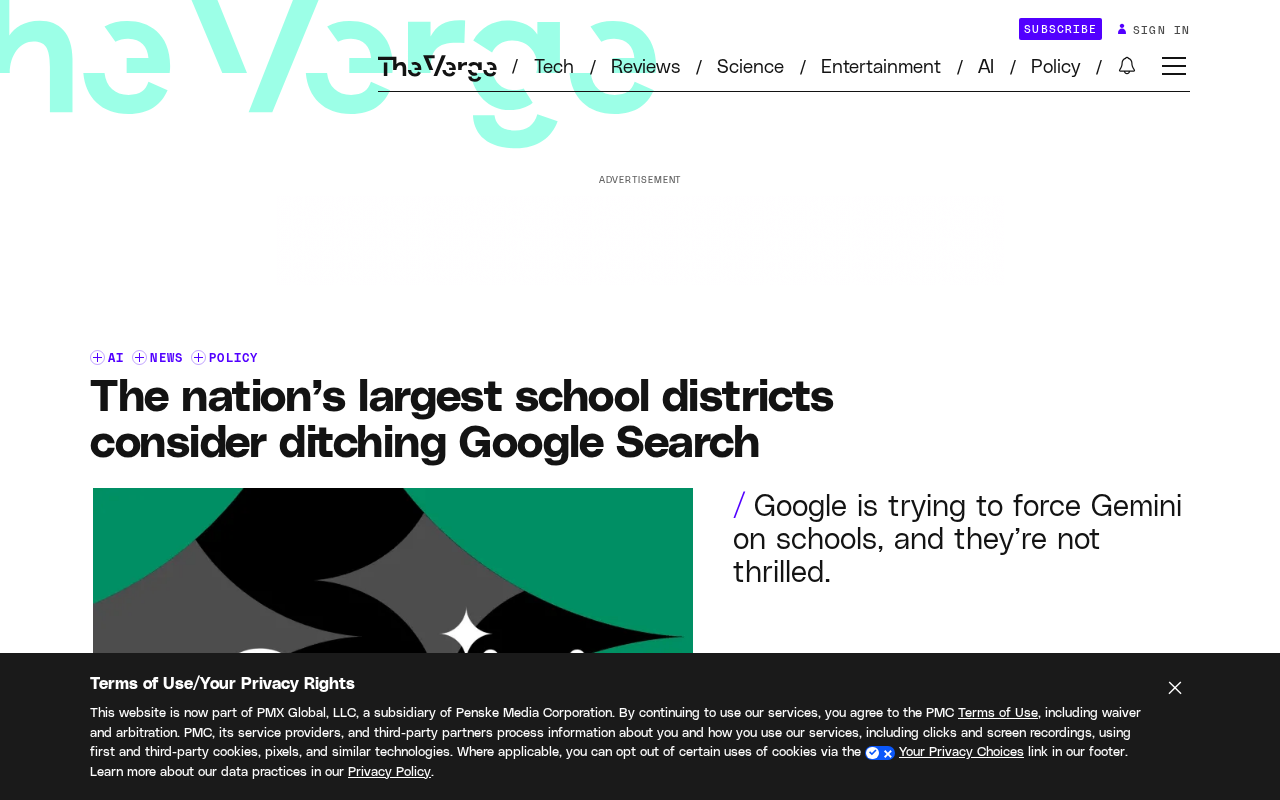
Google forces schools to bundle Gemini AI with search; NYC, LA, and Chicago districts consider dropping Google Search.
Google announced that starting next year, schools cannot disable its Gemini-driven AI features while keeping search—both must be on or off. This bundling strategy has triggered backlash, with New York, Los Angeles, and Chicago public school systems considering abandoning Google Search. Districts' concerns focus on data privacy, content safety, and teaching autonomy; mandatory AI means losing fine-grained control. The change creates education market opportunities for competitors like Microsoft Bing and DuckDuckGo. It reflects that tech companies pushing AI commercialization must balance adoption with different user groups' needs for feature boundaries and control—forced bundling may accelerate customer churn.
According to The New York Times, the public school systems of New York, Los Angeles, and Chicago are considering abandoning Google Search. The trigger for this decision is Google's announcement that, starting next year, if schools choose to disable its Gemini-driven AI features, they will not be able to keep search services separately—both must be turned on or off together.
Google's Bundling Strategy Sparks Backlash from the Education Sector
Chris Phillips, Google's Vice President of Education, said in response that the company believes AI features are inseparable from the search experience. But this explanation clearly failed to calm the concerns of school district administrators. For educational institutions, mandatorily enabling generative AI means losing fine-grained control over the classroom technology environment.
The largest school districts in the US—New York, Los Angeles, and Chicago—serve more than one million students combined. Technology decisions in these districts often have a demonstration effect; once they begin to migrate, more regions may be prompted to re-evaluate their partnerships with Google.
Why School Districts Are So Wary of AI Features
Concerns about AI in educational settings focus on three main areas: data privacy, content safety, and teaching autonomy. School districts typically need to ensure that the tools they use comply with student data protection regulations, and the unpredictable outputs of generative AI increase management difficulty.
Google's bundling strategy essentially deprives schools of choice. Previously, schools could disable Gemini features separately while retaining search—a flexible configuration that is crucial for educational institutions that need to introduce new technologies in phases. The current policy change means that districts cautious about AI will be forced to choose between fully embracing AI and completely abandoning search.
Generative AI and Data Protection Regulations
When procuring technology tools, US school districts typically must comply with the Family Educational Rights and Privacy Act (FERPA) and state-level student data privacy laws (such as California's Student Online Personal Information Protection Act). These regulations require vendors to clearly specify the scope of data collection, storage location, and purpose of use, and to restrict the use of student data for commercial purposes. Generative AI models may receive student-input text, assignment content, or even conversation records during inference, and their data processing chain is more complex than traditional search, making it difficult for districts to fully audit data flows. In addition, the uncertainty of AI-generated content increases the burden of content moderation—schools need to ensure that classroom tools do not output inappropriate content, whereas traditional search results are relatively predictable and can be managed through filtering mechanisms. These additional costs in compliance and content governance are the deeper reasons why school districts are cautious about mandatorily enabling AI features.
Market Opportunities for Alternatives
This policy change creates opportunities for Google's competitors. Search engines such as Microsoft Bing and DuckDuckGo, as well as technology vendors focused on the education market, may see new customer demand. When evaluating alternatives, school districts will not only consider search quality but also focus on vendors' configurability of AI features and data governance capabilities.
Interestingly, this incident reflects a common challenge large tech companies face in the commercialization of AI: how to promote technology adoption while respecting the differentiated needs of different user groups regarding feature boundaries. Schools, as a special setting, are subject to multiple layers of scrutiny from parents, teachers' unions, and regulatory agencies in their technology procurement decisions, which exposes Google's hardline strategy to higher risk of backlash.
Configurability in EdTech Procurement
In software procurement for enterprises and public institutions, "configurability" refers to the ability of administrators to enable or disable specific feature modules according to organizational policy. The demand for configurability is particularly prominent in educational settings because different grade levels and courses vary greatly in their openness to technology tools, and schools often need phased pilots and gradual rollouts. Google's previous allowance for schools to disable Gemini separately while retaining search was precisely an embodiment of this configurability. When vendors bundle AI features with core services, school districts lose not only the choice of features but also the administrative authority to adjust the technology environment according to teaching pace. This makes "feature toggle granularity" and "admin control panels" considerations as important as search quality in procurement evaluations.
Implications for the Tech Industry
Google's decision in the education market may become a cautionary case for bundling AI features with core services. Enterprise clients and public institution users are far more sensitive to technology autonomy than ordinary consumers. When vendors attempt to force AI adoption through product design, they may instead accelerate customer churn.
It remains unclear whether these school districts will ultimately implement their abandonment plans, but the negotiations themselves have sent a clear signal: in edtech procurement, control and flexibility are non-negotiable elements. Google needs to find a more balanced path between AI promotion and user trust, or it may lose share in this sizable market.
One-line Summary
Google forces schools to bundle Gemini AI with search; New York, Los Angeles, and Chicago school districts consider dropping Google Search.
Paragraph Summary
Google announced that starting next year, if schools disable its Gemini-driven AI features, they cannot retain search services separately—both must be turned on or off together. This bundling strategy has sparked strong backlash from the education sector, with the three major public school systems of New York, Los Angeles, and Chicago considering abandoning Google Search. School districts' concerns about generative AI center on data privacy, content safety, and teaching autonomy; mandatory enabling means losing fine-grained control over the classroom technology environment. This policy change creates opportunities in the education market for competitors such as Microsoft Bing and DuckDuckGo. The incident reflects that tech companies promoting AI commercialization need to balance technology adoption with the differentiated needs of various user groups regarding feature boundaries and control rights; forced bundling may instead accelerate customer churn.
Related articles

The Gemini 4 Trio and 3.8 Flash: A Full Comparison of Positioning, Pricing, and Benchmarks
A comparison of Gemini 4 Neon, Carbon, Argon, and Gemini 3.8 Flash: positioning, context, API pricing, Artificial Analysis and Arena benchmark scores, and available entry points.

AI Coding Model Leaderboard: Opus 5.5 Crowned, Gemini Neon Stages a Comeback
Tech blogger Matthew Berman releases an AI coding model tier list: Claude Opus 5.5 holds S-tier, Gemini Neon surprises with A-tier, OpenAI Astra lands B-tier. How do open-source models like DeepSeek fare? We break down the scoring logic and practical takeaways.

New Jersey Joe Sandwich: Meat and Coleslaw on Triple-Decker Rye
New Jersey Sloppy Joe isn't a ground beef burger—it's triple-decker rye bread with meat, Swiss cheese, and coleslaw, plus Russian dressing. Learn the authentic Essex County method and family recipe.