Google Releases Gemini 3.6 Flash and Two Other New Models: Comprehensive Expansion of the Flash Family

Google releases three new Gemini Flash models, expanding its lightweight AI lineup with tiered and vertical options.
Google has announced Gemini 3.6 Flash, 3.5 Flash-Lite, and 3.5 Flash Cyber, continuing its strategy of building a multi-tiered model matrix. Flash targets speed-performance balance, Flash-Lite addresses cost-sensitive scenarios and edge deployment, while Flash Cyber signals vertical domain optimization likely for cybersecurity. The releases reflect industry-wide trends toward model tiering, efficient AI, and scenario-specific solutions.
Google Expands the Gemini Flash Family Once Again
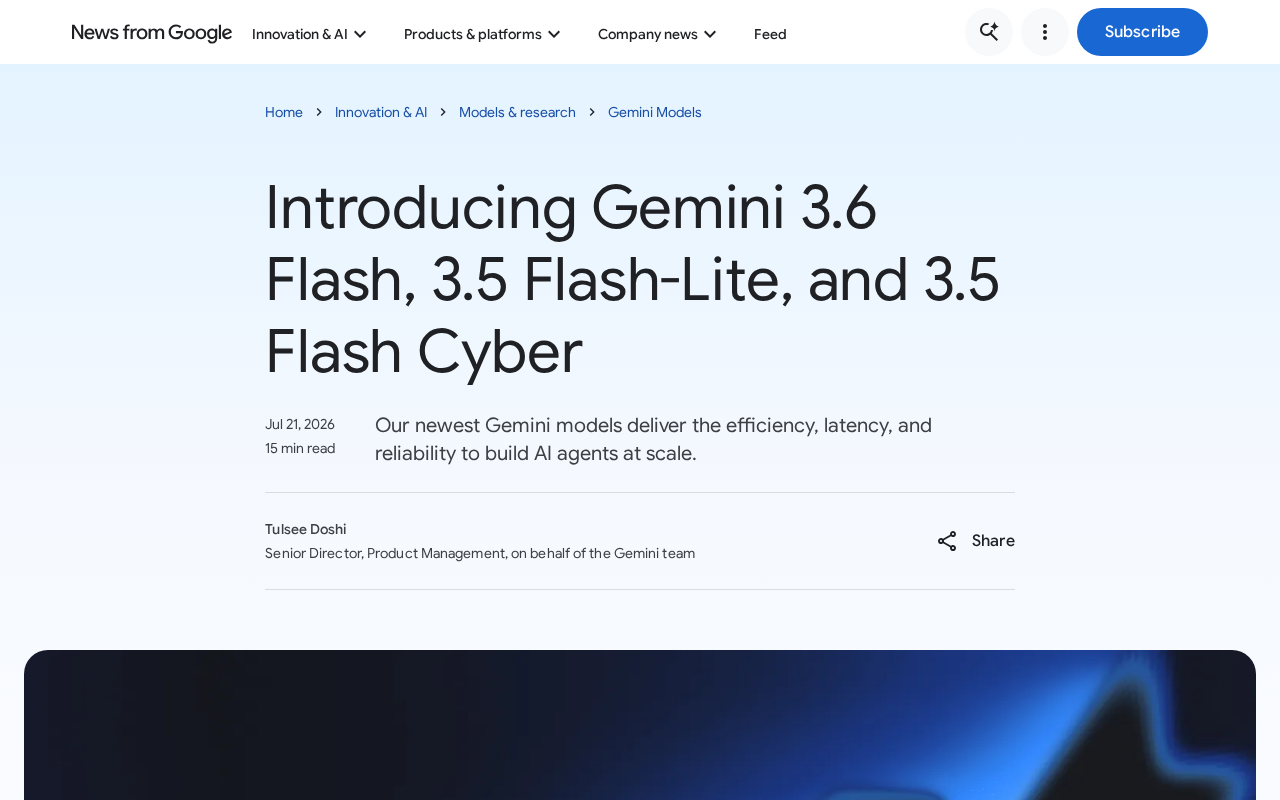
Google recently announced a new batch of Gemini models, including Gemini 3.6 Flash, Gemini 3.5 Flash-Lite, and Gemini 3.5 Flash Cyber. This series of updates continues Google's sustained investment in lightweight, high-performance AI models, signaling that the Flash product line is evolving toward greater segmentation and scenario-specific optimization.
The Gemini model family is deeply optimized based on Google's Transformer architecture. The Flash series' core technical advantage comes from Model Distillation — extracting knowledge from larger Pro/Ultra models and compressing it into smaller model structures, thereby significantly reducing parameter count and computational overhead while retaining most capabilities. Additionally, Google's long-term investments in TPU (Tensor Processing Unit) hardware and inference optimization frameworks enable Flash models to achieve extremely low Time to First Token (TTFT) and high throughput on its own infrastructure.
The naming convention reveals that Google is building a clearly layered model matrix: Flash targets the balance between general-purpose speed and performance, Flash-Lite addresses scenarios extremely sensitive to cost and latency, while the "Cyber" designation likely indicates optimization for specific professional domains (such as cybersecurity or code-related tasks). This tiered strategy aligns with industry best practices — using models of different specifications to cover the full spectrum of needs from edge devices to enterprise applications.
Model Tiering has become the standard product strategy for large model providers. OpenAI has its GPT-4o and GPT-4o-mini tier division, Anthropic has its three-tier Claude Opus/Sonnet/Haiku architecture, and Meta's Llama series also offers variants at different parameter scales. The underlying logic of this strategy is clear: not all AI tasks require the most powerful model — using a flagship model for a simple text classification task wastes compute and adds latency. By offering models with different capability-to-cost ratios, providers can cover the complete development lifecycle from prototype validation to production deployment.
Positioning and Core Advantages of the Gemini Flash Series
A Speed-First Product Philosophy
Since its introduction, the Gemini Flash series has always positioned "speed" as its core selling point. Compared to the flagship Pro models, Flash dramatically reduces inference latency and API costs while maintaining strong capabilities. This makes it particularly suitable for high-concurrency, real-time application scenarios such as chatbots, content moderation, real-time translation, and large-scale data processing pipelines.
In AI model engineering practice, Capability, Cost, and Latency form a classic impossible triangle. Improving model capability typically means increasing parameter count and computation, which directly leads to higher inference costs and longer response times. The industry employs various technical approaches to break this constraint: Speculative Decoding accelerates inference by using a small model to predict the output of a larger model; Quantization compresses model weights from 32-bit floating point to 8-bit or even 4-bit integers to reduce computation and memory requirements; MoE (Mixture of Experts) architecture balances total parameter count with actual computation by activating only a subset of parameters. Each iteration of the Flash series is essentially searching for a better Pareto frontier within this triangle.
The newly released Gemini 3.6 Flash, with its higher version number, likely brings incremental improvements in reasoning capability, context understanding, and multimodal processing. Meanwhile, 3.5 Flash-Lite further compresses the model size, offering a new option for developers pursuing the ultimate cost-performance ratio.
The value of ultra-lightweight models like Flash-Lite extends beyond reducing cloud API call costs — it also opens up possibilities for On-device Deployment. As smartphones, IoT devices, and edge servers grow more powerful, an increasing number of AI inference tasks are migrating from the cloud to the device. On-device inference eliminates network latency, protects user privacy data, and functions normally in offline environments. Google has already deployed small Gemini models on Pixel phones, and continued optimization of Flash-Lite likely paves the way for broader on-device AI experiences.
Flash Cyber: The Vertical Strategy Behind the Differentiated Naming
You may not have noticed the emergence of the Gemini Flash Cyber variant. Models with dedicated suffixes often indicate that Google is conducting targeted fine-tuning for vertical domains. If "Cyber" indeed points to cybersecurity or technical tasks, this signals Google's effort to further productize and specialize general-purpose large models — no longer a "one model fits all" approach, but rather providing more tailored solutions based on the actual needs of different industries.
The vertical domain customization represented by Flash Cyber typically follows these technical paths: on top of a general-purpose foundation model, supervised fine-tuning (SFT) is performed using high-quality domain-specific data, followed potentially by RLHF (Reinforcement Learning from Human Feedback) or DPO (Direct Preference Optimization) to further align with domain expert preferences. In the cybersecurity field, this might include training on specialized corpora such as vulnerability analysis reports, malicious code samples, and threat intelligence documents. Compared to training a domain model from scratch, this approach achieves significant domain performance improvements at minimal cost. Notably, Google's security brands like Mandiant and VirusTotal provide rich cybersecurity data assets, giving the Cyber variant a natural data advantage for training.
Practical Impact on Developers and the Industry
A Richer Model Selection Space
For developers, the increase in model options presents both opportunities and challenges. On one hand, a more segmented product line means finding a more precise balance between cost, speed, and quality; on the other hand, choosing the right model for a specific business scenario requires more evaluation and testing. In practice, many teams are adopting "Model Routing" strategies — dynamically selecting models of different tiers based on request complexity, handling simple queries with Flash-Lite and routing complex reasoning to Flash or even Pro models, thereby achieving optimal cost efficiency at the system level.
The continuous iteration of lightweight models (like Flash-Lite) reflects the entire industry's pursuit of "efficient AI." With large model compute costs remaining high, smaller models that can accomplish tasks with lower resource consumption are becoming the critical path for enterprises scaling AI deployment. According to industry estimates, for enterprise applications with millions of daily API calls, choosing lightweight models over flagship models can reduce inference costs by 80%-95% while shortening response latency from seconds to the hundred-millisecond range — a transformative improvement in user experience.
Shifts in the AI Model Competitive Landscape
Google's intensive Flash series updates also serve as a direct response to competitors like OpenAI and Anthropic. In the fast-model segment, every provider is competing to deliver the best "capability/cost/speed" triangle balance. OpenAI's GPT-4o-mini, Anthropic's Claude 3.5 Haiku, and Meta's open-source Llama 3 series small models are all vying for this market. Frequent version iterations indicate that competition in the AI model market has shifted from pure capability comparisons to an all-encompassing contest of engineering efficiency and product experience.
This competitive dynamic is also driving continuous improvement of the industry's benchmarking ecosystem. Beyond traditional academic evaluations like MMLU and HumanEval, engineering metrics from real-world applications — latency distribution (P50/P95/P99), cost per million tokens, and concurrent processing capacity — are becoming equally important. For enterprise customers, model selection is no longer just about leaderboard scores but requires comprehensive consideration of TCO (Total Cost of Ownership), SLA (Service Level Agreement) guarantees, and ecosystem maturity.
Summary and Outlook
While official technical details for the releases of Gemini 3.6 Flash, 3.5 Flash-Lite, and 3.5 Flash Cyber remain limited, the product layout reveals Google's clear strategy: covering the widest possible range of application needs through a multi-tiered, multi-scenario model matrix.
As more technical specifications and benchmark data are released, we'll be able to more accurately assess the actual performance of these new models. For developers and enterprises focused on AI application deployment, keeping up with these updates and adjusting technology choices in a timely manner will help maintain competitiveness in the rapidly evolving AI ecosystem. From a broader perspective, the rapid iteration of the Flash series also signals that AI infrastructure is becoming a utility — when model capabilities are strong enough and API costs are low enough, AI will truly become a ubiquitous foundational capability layer rather than an expensive luxury technology.
(Note: This article is based on preliminary information from Google's official announcement. For more detailed performance specifications and pricing strategies, please refer to the official final release.)
Related articles

Beyond Vibe Coding: A Practical Guide to Enterprise-Level AI Programming
Go beyond Vibe Coding with enterprise AI programming: Claude Code, Codex tool selection, SuperPower plugin, and SDD workflows for production-ready projects.

Why Do ResNet Skip Connections Work? Reproducing the Deep Network Degradation Problem
Reproducing the deep network degradation problem on CIFAR-10: a 56-layer plain network achieves only 84% training accuracy vs. 95% for 20 layers. How ResNet skip connections solve this.

Entropic Scree: Reconstructing PCA Dimensionality Reduction by Replacing Variance with Information Entropy
Entropic Scree is a new information-theory-based dimensionality reduction method that replaces linear variance with entropy to estimate intrinsic data dimensions, with applications in neural network bottleneck design.