Google Releases Gemini 3 Hydrogen: 2.5x Faster for Everyday Tasks

Google releases Gemini 3 Hydrogen fast-execution model, focused on everyday small tasks, 2.5x faster.
Google launches Gemini 3 Hydrogen, not pursuing bigger parameters but positioning it as a fast-execution model focused on high-frequency small tasks like everyday search, coding, and tool calls, leaving complex reasoning to Carbon and Argon. Google's tests show 2.5x the speed of Gemini 3.8 Flash at the default high thinking tier, with Terminal Bench 4.1 score rising from 18.2 to 57%, but the data is official and not independently reproduced. Developers can try it via Gemini API and AI Studio, while free-tier users get automatic selection. The article sees this as a signal that model competition is shifting from parameter scale to scenario-based efficiency.
Google recently released a new model called Gemini 3 Hydrogen, but it doesn't follow the "bigger parameters" route. According to a share from Bilibili creator "可夫小子", this model targets the small tasks AI performs repeatedly every day—searching, writing code, and calling tools faster. Google positions it as a "fast execution" model, leaving complex problems that require long reasoning to Carbon and Argon.
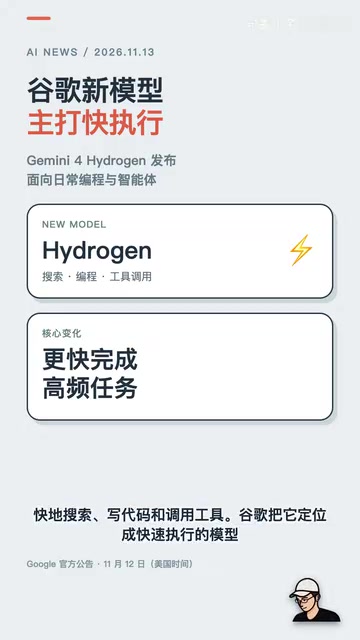
Not every job needs the heaviest model
In the current large model race, parameter scale is often treated as a core selling point. But Gemini 3 Hydrogen takes a different approach: everyday tasks also need speed. Google's product logic is that users' needs for models are layered across different scenarios—simple, high-frequency operations require low-latency responses, while deep reasoning tasks call for heavier models. This layered strategy helps balance experience and cost.
From a developer's perspective, this means when calling the API, you can choose different models based on task type instead of always using the largest and most powerful version. For scenarios like programming assistance and tool calling that require rapid iteration, Hydrogen's positioning is clearly more targeted.
Model parameter scale typically refers to the number of trainable weights in a neural network, an indicator of model capacity. More parameters theoretically allow the model to memorize and model more complex patterns, but also bring higher computational overhead and longer response times. In recent years, the large model race has often used parameter scale as a selling point, but parameters are not the only factor determining actual experience—inference efficiency, task suitability, and deployment cost are equally critical. Gemini 3 Hydrogen chooses not to pursue maximum parameters but instead optimizes speed for high-frequency small tasks, which is precisely a correction to the "parameters above all" mindset.
2.5x speed improvement, but test data comes from Google
Google's own tests show that at the default high thinking tier, compared to Gemini 3.8 Flash, the new model completes tasks at 2.5x the speed. On the Terminal Bench 4.1 test, the score rose from 18.2 to 57%.

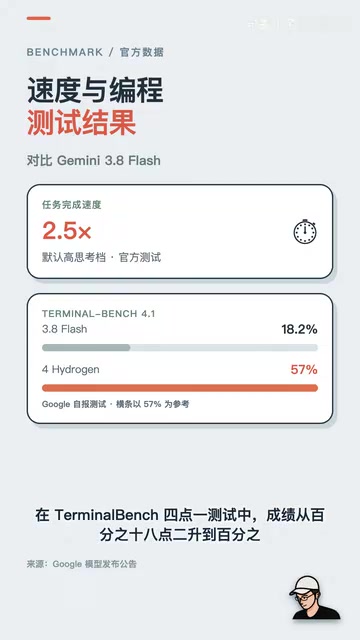
It should be clear that these are test results published by Google, and do not mean all tasks will achieve the same improvement, nor are they independently reproduced. Real-world performance also depends on specific tasks, configurations, and cost. Model answers can still be wrong, and key conclusions need source verification.

Terminal Bench is a benchmark that evaluates large language models' ability to execute tasks in a terminal (command-line) environment, typically involving file operations, script writing, system command invocation, and similar scenarios. It measures whether a model can correctly understand natural language instructions and translate them into executable terminal operations, rather than merely generating text. Terminal Bench 4.1 is a version of this benchmark; a score improvement from 18.2 to 57% means the model's success rate on terminal tasks has significantly improved, but note that this result was published by Google itself and has not yet been independently verified by third parties.
How to try Gemini 3 Hydrogen
Developers can try this model through the Gemini API and AI Studio. Google also announced it will bring it into Search, and free-tier Gemini users will have the system automatically select this model when appropriate—but this does not mean everyone can manually specify it. For users who want precise control over model selection, the API and AI Studio remain the primary channels.
Gemini API is a programming interface provided by Google that allows developers to call Gemini series models programmatically, and to specify parameters such as model version and thinking tier. AI Studio is Google's web-based development environment, offering interactive prompt testing, model comparison, and API key management, suitable for rapid prototyping. The difference between the two: the API is for automated integration, while AI Studio is for manual experimentation. For scenarios requiring precise control over model selection, specifying the model ID via the API is the most direct way, while the automatic selection mechanism in the free Gemini app does not offer a manual switch option.
Industry signal of layered model strategy
The release of Gemini 3 Hydrogen sends a signal: model competition is shifting from pure parameter scale to scenario-based efficiency. The division of labor between fast execution models and deep reasoning models may become a common pattern in future product iterations. For developers and enterprises, the focus should also shift from "which model is strongest" to "which model is best suited for the current task."
(This article is based on a share from Bilibili creator "可夫小子". For more AI news, follow the original author.)
Related articles

OpenAI to Shut Down Agent Builder and Two Other Services on November 30, Developers Must Migrate Urgently
OpenAI will shut down Agent Builder, the evals dashboard, and reusable prompts on November 30; evals is already read-only. Here's the scope, OpenAI's migration paths (Agent SDK, PromptFu, your own code), and what developers should export and rebuild this week.

RankSpot: A Pay-Per-Use SEO & AI Search Execution Layer That Lets Agents Write, Publish, and Build Backlinks for You
RankSpot is an SEO & AI search execution layer for AI Agents. Connect via MCP to Claude or ChatGPT to write, publish & build backlinks. Pay-per-use, $3/article.

Appxiom: Giving AI Coding Assistants Production Context
Appxiom gives AI coding agents production context—crashes, jank, memory leaks, failed network calls—across Android, iOS, Flutter, KMP, and Web, ranking bugs by Goal Friction Impact.