Google Releases Gemini 4 Argon Frontier Model, Initially Exclusive to Cybersecurity Defenders

Google debuts Gemini 4 Argon for enterprise long-horizon tasks; MCP accelerates as ecosystem standard.
Google officially launched Gemini 4 Argon with a 1-million-token output limit, initially restricted to cybersecurity defenders via the Fairwind Program at $2–$10 per million tokens. On the open-source front, Bilibili Index, Mai100, Cohere, and others released multilingual, local, and embedding models. MCP became the day's defining theme, with ChatGPT adding hosted MCP server support and Pi reversing its prior rejection of the protocol. OpenAI signed a multi-year strategic deal with EDA giant Synopsys, while the FTC reportedly launched formal investigations into OpenAI and Anthropic. The day's activity underscores converging trends: longer context windows, enterprise AI, MCP standardization, and rising regulatory pressure.
Gemini 4 Argon: A Frontier Model Built for Long-Horizon Tasks
Google has officially launched its next-generation frontier model, Gemini 4 Argon. Initially, access is limited to trusted cybersecurity defenders through the Fairwind Program, with plans to gradually expand to developers, enterprises, and consumers — prioritizing paid API customers and Google AI Ultra subscribers.
Argon is clearly positioned for enterprise-grade, complex long-horizon tasks in domains like software engineering, finance, and law, as well as cybersecurity use cases. Its single-output limit has been raised to 1 million tokens, enabling the model to process ultra-long documents, complete codebases, or large-scale data migration tasks in a single pass. Google has disclosed that thousands of employees have already been using it internally for coding, research, writing, large-scale code migrations, and data center memory optimization.
On pricing, the launch rate is approximately $2–$10 per million input/output tokens, with cached inputs eligible for up to a 95% discount. After the introductory period, pricing will shift to the $4–$20 range. Alongside frontier capabilities, Google has reinforced abuse protections — including prompt injection defenses, adaptive monitoring, and kill-switch isolation — consistent with the model's initial rollout strategy targeting security defenders.
The Fairwind Program is Google's controlled early-access initiative for high-risk, high-trust scenarios. Participants typically sign dedicated agreements and are subject to usage review. This phased release strategy has become increasingly common in the large model space — models are first deployed in restricted environments to gather real-world abuse cases and edge-behavior data before being opened to a broader audience, striking a balance between capability diffusion and safety control.
Prompt Injection is a classic attack vector against large language models: attackers embed malicious instructions within external content fed to the model (such as web pages, documents, or tool return values), attempting to override system prompts or induce unauthorized actions. In cybersecurity scenarios, models frequently process large volumes of raw data from untrusted sources, making prompt injection risk especially acute. Google listing this as a primary protection priority for Argon also explains why the model is being opened first to security professionals with expert judgment, rather than general consumers.
A Wave of Open-Source Translation and Local Models
Domestic and international vendors have been busy on the open-source front. Bilibili's Index LLM team released the Index Translate multilingual translation model series, covering 150 languages across multiple sizes, with support for terminology, style, and formatting instructions. The series also includes Index Native Long for long documents, Index Homura for syllable-controlled translation, and Index Echo for subtitle and voice dubbing. Model weights, code, demos, and a technical report are being progressively released under the Apache 2.0 license — a strong commitment to openness.
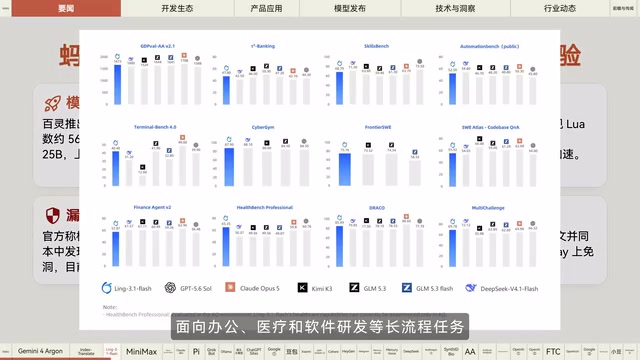
Mai100 has launched Lin3.1 Flash, targeting long-horizon tasks in office productivity, healthcare, and software development, with a two-week free trial offering a 256K context window. The model will be open-sourced after the trial period. On the local deployment front, Ollama has added native support for decision models, with Nimble, TAV14B, and TAV10.8B now available and callable via a new local interface.
OCR and embedding models also saw new releases: Z-Array Lab open-sourced a 0.8B Xiaomi OCR model capable of parsing document images into Markdown and JSON; Perplexity partnered with Turbopuffer to release a 9B contextual embedding model; and Cohere launched its Embedding 5 series in Pro and Fast variants, with the Fast version reportedly costing one-third less than Pro.
Subscription Plans and Developer Tooling Updates
MiniMax has introduced the M-Plan subscription offering three tiers — Go, Explore, and Build — building on and expanding the previous Token PlanAd. Text quotas and pricing remain unchanged, while Explore and Build tiers also include access to video models. The original Token Plan is no longer available for new purchases; existing subscribers with auto-renewal enabled will retain their current plans, though historical discounts will not carry over after upgrading to M-Plan. A 50% first-month discount on monthly billing runs through October 14, with standard monthly prices at ¥49, ¥119, and ¥469 for Go, Explore, and Build respectively.

MCP (Model Context Protocol) has become a recurring keyword in this round of updates. ChatGPT now supports hosted MCP servers — users simply describe a tool they want in conversation, and the system automatically creates and deploys an MCP server, which can then be installed as a plugin across web, mobile, and desktop. Pi, which had publicly rejected MCP, added MCP support in V0.99.0, with the team noting that MCP today is fundamentally different from what it was before — upgrading the app now enables MCP server connections. Anthropic, meanwhile, launched a new developer-focused site featuring in-depth engineering articles and experience-sharing around Claude Code and API usage.
MCP (Model Context Protocol) is an open standard proposed by Anthropic in late 2024, designed to establish a unified communication interface between large language models and external tools and data sources. Before MCP, every AI application required custom integration code for each tool, creating significant maintenance overhead. MCP's core value lies in standardizing tool calls — models interact with file systems, databases, APIs, and other resources through MCP servers, and developers need only implement the protocol once for it to be reused across all MCP-compatible models.
ChatGPT's support for hosted MCP servers marks a further acceleration of this ecosystem consolidation: users no longer need to manually deploy servers, as the platform handles the infrastructure layer automatically, significantly lowering the barrier to tool integration. Pi's reversal from explicit rejection to adoption also validates the significant progress MCP has made in engineering maturity and community adoption over the past several months — many of the security and stability concerns raised by early critics have been addressed in successive protocol iterations.
New Generative Model Features and Product Launches
Google has rolled out a Skills feature in Gemini, allowing users to save instructions for repetitive tasks as reusable skills, now available to personal users globally. Google says Skills will replace Gems, with the change taking effect for personal accounts starting in November and existing Gems migrating automatically. Doubao has launched a travel service, enabling users to book flights, train tickets, and arrange rides and navigation directly through conversation.
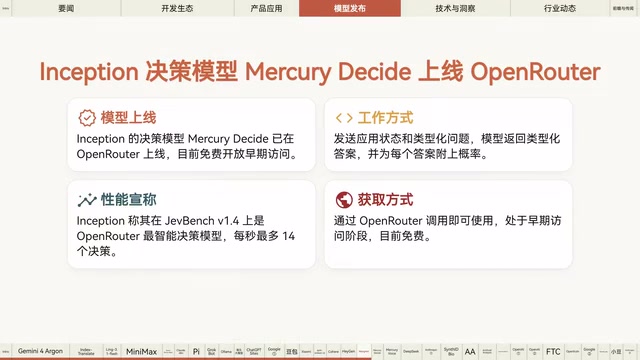
Image and video generation also saw a busy day. Ideogram released image editing model Ideogram 4.5, which the company says reduces scene drift across multiple rounds of editing and supports editing of high-resolution images. Heizheng released its first general-purpose video model, built on post-training of MiniMax's video model, supporting text-to-video, image-to-video, and reference-image-to-video, with audio generated within the same API call. Inception launched its decision model Mercury Decide on OpenRouter with free early access, and also released Mercury Voice — a Diffusion LLM for voice agents — with the company claiming a median first-token latency of under 320 milliseconds.
Industry Partnerships, Regulation, and Research
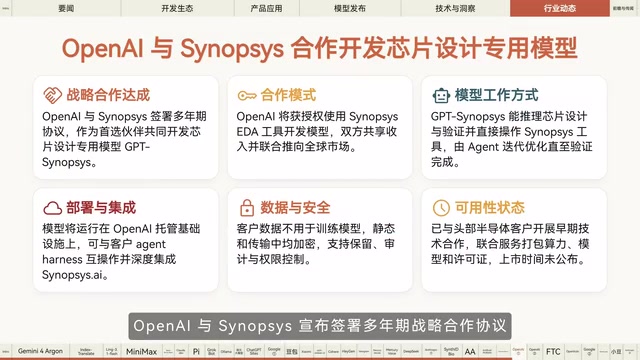
OpenAI and Synopsys have announced a multi-year strategic partnership to co-develop GPT Synopsys, a specialized model for chip design. The model is hosted and operated by OpenAI and directly interfaces with Synopsys's EDA tools. DeepSeekAd has open-sourced infrastructure components for Huawei's Ascend compute platform — including a high-level language compiler, compute libraries, and a distributed communication library — mirroring components previously released for NVIDIA platforms, with the company claiming performance approaching hardware limits.
On the regulatory front, reports indicate the U.S. Federal Trade Commission (FTC) is investigating leading labs including OpenAI and Anthropic, with an official confirming that civil investigative demands will be issued within the coming weeks. In research, Anthropic published a robotics exposure index report estimating that robots could complete 74% of physical tasks in the U.S., but only 0.3% at a cost lower than human labor. Google DeepMind released SynthID Bio, extending its watermarking technology to synthetic biology, with the associated methodology published in Nature.
On the capital side, ElevenLabs completed a $300 million employee stock tender at a $22 billion valuation — double its previous Series D valuation. Taken together, the day's industry activity points to several converging themes: frontier models continue advancing toward longer context windows and enterprise-grade tasks, MCP is rapidly becoming an ecosystem standard, competition in open-source and local deployment is intensifying, and regulatory and safety concerns are becoming increasingly unavoidable for leading AI companies.
EDA (Electronic Design Automation) tools are the core software infrastructure of chip design, spanning logic synthesis, physical layout, timing analysis, verification, and simulation. Synopsys is one of the world's largest EDA vendors, with a toolchain covering virtually the entire flow from RTL design to tape-out. Integrating large models directly with EDA tools represents a significant frontier for AI for Science/Engineering — models not only offer recommendations but can directly operate professional software to complete closed-loop tasks. This places far higher demands on tool-calling capability, domain knowledge depth, and output reliability than general-purpose scenarios. The OpenAI–Synopsys partnership also reflects a broader trend of leading model companies rapidly transitioning from general-purpose assistants to vertical industry "co-operators."
SynthID Bio extends Google DeepMind's SynthID watermarking framework — previously applied to images, text, and audio — into synthetic biology. The goal is to embed invisible markers in AI-generated DNA or protein sequences for source tracing and abuse prevention. Biosecurity risks in synthetic biology are considered among the hardest to control in the context of AI capability diffusion, since sequences that enter the physical world cannot be recalled. Watermarking technology thus carries substantive safety value here that goes well beyond copyright protection.
Related articles

Gaussian Process Bandit Optimization: Exploration Strategies and Inference Regret Guarantees
Cumulative regret guarantees in Bayesian optimization fail to reflect final recommendation quality. This article examines a new study that provides inference regret guarantees for Gaussian process bandit optimization through exploration query strategies and fill distance analysis, validated on hyperparameter optimization and control tasks.

The Most Detailed Codex Guide on Bilibili: From Installation to Real-World Practice
The most detailed Codex guide on Bilibili: from app store installation to daily work mode configuration, with a real coffee shop project demonstrating file organization, data extraction, dashboard creation, and other practical tasks. Learn to use Plan Mode and desktop pets to leverage Codex efficiently.

Appearance Compensation in Volume Rendering: Why RGB Accuracy Cannot Guarantee Density Correctness
Volume rendering research reveals that volumetric data perfectly reproducing external RGB views may still contain density errors: appearance compensation can double central density and keep external rays unchanged even when L2 error exceeds 14.52%. Density recovery depends on appearance capacity, spatial resolution, and measurement design.