Google Releases Gemini Omni 1.2 Flash Video Model: Price Cut by 37%
Google, OpenAI, Mistral, and NVIDIA release a wave of updates as enterprise AI competition shifts to workflow efficiency and unit cost.
The article summarizes releases from multiple AI vendors on November 5–6: Google's Gemini Omni 1.2 Flash supports up to 15-second videos with per-second duration settings at $0.07/second (37% cheaper); OpenAI's GPT-6Cyber scored 48.5% on a remote exploitation benchmark and found 81 high-severity vulnerabilities; Mistral launched Large 4 (LeTron) with managed agents and observability; NVIDIA open-sourced 4 Cosmos world models (~16B parameters each) and published VIR processor efficiency gains. Competition is shifting from raw model capability to workflow efficiency, unit cost, and hybrid deployment.
Google released its video generation model Gemini Omni 1.2 Flash in the early hours of November 6, making it fully available through the developer API, Google Cloud, and enterprise services. According to the company, the new version natively supports video generation of up to 15 seconds, 5 seconds longer than the previous version, and allows durations between 3 and 15 seconds to be set on a per-second basis. On pricing, 20P video costs $0.07 per second, a 37% reduction from the previous version.
Video Generation Capabilities and Pricing Strategy
The new model's workflow design emphasizes iteration efficiency: start with a low-resolution quick draft, refine details through multiple rounds of conversation, and finally upscale to 1080P or even 4K. The company says consistency of characters, products, and brand style across shot transitions is stronger, making it suitable for scenarios such as virtual try-on, product showcases, and brand advertising. This combination of pricing and capabilities is clearly aimed at high-frequency commercial use cases.
Cybersecurity Model GPT-6Cyber Debuts
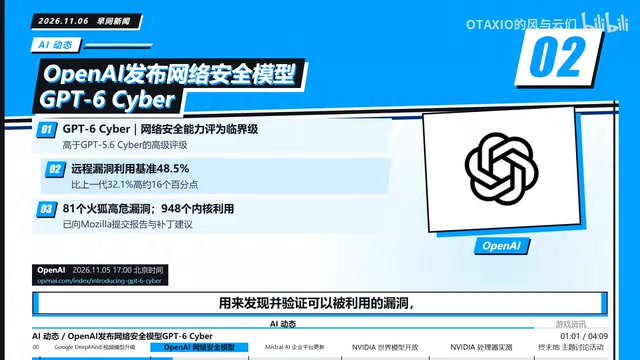
OpenAI released a dedicated cybersecurity model, GPT-6Cyber, on the afternoon of November 5, designed to discover and validate exploitable vulnerabilities while operating strictly within researcher-defined boundaries. Under OpenAI's safety framework, the model's cybersecurity capability is rated "Tier Zero," compared with "Advanced" for the previous generation. Official tests show it scored 48.5% on a remote exploitation benchmark, about 16 percentage points higher than the previous generation; it found 81 new vulnerabilities in open-source software rated high-severity by the Firefox browser developer, along with reproducible tests and patch recommendations; and it generated working exploit samples for 948 kernel vulnerabilities.
A remote exploitation benchmark is a standardized test set for evaluating AI models' cybersecurity capabilities, typically containing target programs or environments with known vulnerabilities and requiring the model to autonomously complete the full chain from vulnerability identification to constructing a valid exploit payload. The score reflects the proportion of vulnerabilities successfully exploited without human intervention, and is therefore used as a quantitative indicator of a model's "offensive capability." Precisely because such capabilities could be misused, OpenAI incorporates them into a tiered safety framework, with release strategy and access restrictions determined by capability level.
Mistral Enterprise Platform Update and LeTron Model
French AI company Mistral released an enterprise platform update on the evening of November 5, along with a new model, Mistral Large 4 (codename LeTron). The company says the new model excels at programming, defensive cybersecurity, and reasoning over complex documents and business tasks. The enterprise platform adds managed agents and application workflows, supporting triggers from enterprise system events and visual orchestration, with interrupted runs able to resume, and also adds observability and evaluation capabilities for enterprise agents. The platform can be deployed in the cloud, on enterprise networks, in on-premises data centers, or in hybrid environments.

NVIDIA Open-Sources Cosmos World Models and VIR Processor Benchmarks
NVIDIA published a blog post on Hugging Face adding 4 open-weight models to the Cosmos 3 world model family, each with roughly 16 billion trainable parameters, all obtained by post-training from Cosmos 3 Nano. Their uses differ: some can generate multi-view autonomous driving data under different weather, lighting, and times of day; some can simultaneously output camera imagery and LiDAR observations; some render control signals from a simulator into near-realistic video; and others predict upcoming frames based on the actions of a dual-arm robot. The company uses an open license permitting commercial use, releasing the weights along with the post-training recipe.

Another NVIDIA blog post presents measured performance of the VIR processor under agent workloads. According to the company, in a comparison at a 100-megawatt data center, a single VIR outperforms both the fastest x86 processor and the most power-efficient x86 processor: compared with the fastest x86, it supports 60% more agents per watt; compared with the most power-efficient x86, agents run twice as fast. In partner tests, search company Perplexity's agentic coding tasks were 50% faster, with plans to deploy in production systems later; cloud provider DeepInfer's agent orchestration was up to 2.2 times faster, also with plans for later production deployment; and data platform Datana cut the time to bring 1,000 agent sandboxes online from 88.4 seconds to 10.8 seconds.

A world model refers to a generative model that can learn and predict how environment states evolve with actions; unlike ordinary video generation models, it emphasizes modeling physical dynamics, viewpoint changes, and the consequences of actions. In autonomous driving scenarios, world models can synthesize multi-view, multi-sensor data based on control signals, for expanding training sets and closed-loop simulation; in robotics scenarios, they can predict the next frame based on joint actions, thereby supporting planning and policy learning. Open weights mean researchers can deploy, fine-tune, and evaluate on their own, reducing dependence on closed-source APIs.
Agents per watt and agent runtime speed are two complementary metrics for measuring energy efficiency under agent workloads: the former reflects the scale of agent instances that can run in parallel under a given power budget, while the latter reflects the completion latency of a single task. Compared with traditional evaluations focused on throughput or floating-point compute, these metrics are closer to the characteristics of agent workloads—many short-duration, highly concurrent tasks that depend on tool calls. The megawatt-scale data center comparison translates chip-level efficiency into deployment capacity at the rack or campus level, making it easier for enterprises to assess total cost of ownership.
Game Community Event Also Launched
On the evening of November 5, the weekend English official account launched a topic discussion event, with one theme each for the operators Minghe and Tangtang. Players can participate by choosing one of the themes and sharing their thoughts; after the event ends, 50 administrators who successfully participated will be randomly selected, each receiving 500 in-game currency. The event runs from the evening of November 5 Beijing time to 11:59 p.m. on November 20, and specific participation methods and rules must be checked on the official Discord server.
Industry Observations
Looking at these updates, competition in AI infrastructure is shifting from single-model capability to workflow efficiency and unit cost. Google is using price cuts and longer video durations to compete for the commercial video generation market, OpenAI is bounding its safety model's capabilities within controlled research environments, and Mistral is making agent orchestration and enterprise deployment flexibility its selling points. NVIDIA is betting on both open world models and specialized processors, seeking to establish an energy-efficiency advantage in agent workloads. Cross-referencing multiple sources shows that the focus of enterprise AI deployment is shifting toward observability, interruptible-and-resumable runs, and hybrid deployment.
Observability, in the context of enterprise agents, refers to the ability to record, trace, and evaluate an agent's execution trajectory, tool calls, decision chains, and resource consumption—similar to logs, metrics, and distributed tracing in traditional software. Interruptible-and-resumable runs require agents to save intermediate state when executing long tasks and resume from a checkpoint after an exception or human intervention, rather than restarting from scratch. Hybrid deployment means the same platform can run in public clouds, enterprise private networks, on-premises data centers, and other environments to meet data compliance and latency requirements. Together, these capabilities form the key threshold for enterprise agents moving from demos to production.
One-line Summary
Google, OpenAI, Mistral, and NVIDIA released a密集 wave of updates, with enterprise AI competition shifting toward workflow efficiency and unit cost.
Paragraph Summary
The article summarizes a concentrated set of releases from multiple AI vendors between November 5 and 6: Google launched the Gemini Omni 1.2 Flash video generation model, supporting up to 15 seconds with per-second duration settings, at $0.07 per second for 20P video, a 37% price cut; OpenAI released the cybersecurity model GPT-6Cyber, scoring 48.5% on a remote exploitation benchmark and finding 81 high-severity vulnerabilities; Mistral updated its enterprise platform and launched Large 4 (LeTron), adding managed agents, visual orchestration, and observability; NVIDIA open-sourced 4 Cosmos world models with roughly 16 billion parameters each and published energy-efficiency advantages of its VIR processor under agent workloads. The article argues that the focus of competition is shifting from single-model capability to workflow efficiency, unit cost, and hybrid deployment capability.
Related articles
 Tech Frontiers
Stylome Bot Slammed as Useless Junk: Why Do AI Detection Tools Keep Failing?
Reddit users test the Stylome AI detection bot: Gemini-rewritten text judged human-written, consistently low confidence. An analysis of AI text detection's technical dilemmas, privacy concerns, and credibility crisis in community governance.
 Tech Frontiers
When AI Becomes a Productivity Divide: Clarity or "AI Psychosis"?
A civil engineer's deep use of agentic AI boosted efficiency but bred contempt for peers who refuse to learn. Is this clarity or AI psychosis? An analysis of the cognitive and psychological challenges behind the AI productivity divide.
 Tech Frontiers
Opus 5.5 Benchmark Scores Climb, Community Says Its "Weights Are Blessed"
Reddit community discusses Opus 5.5's rising scores on the Benchmaxxing Bench, with users describing its performance as "weights are blessed." This article interprets the community reaction and cautions against conflating benchmark scores with real capability.