Google's AI Investment Pays Off: Search Query Volume Hits Record Growth
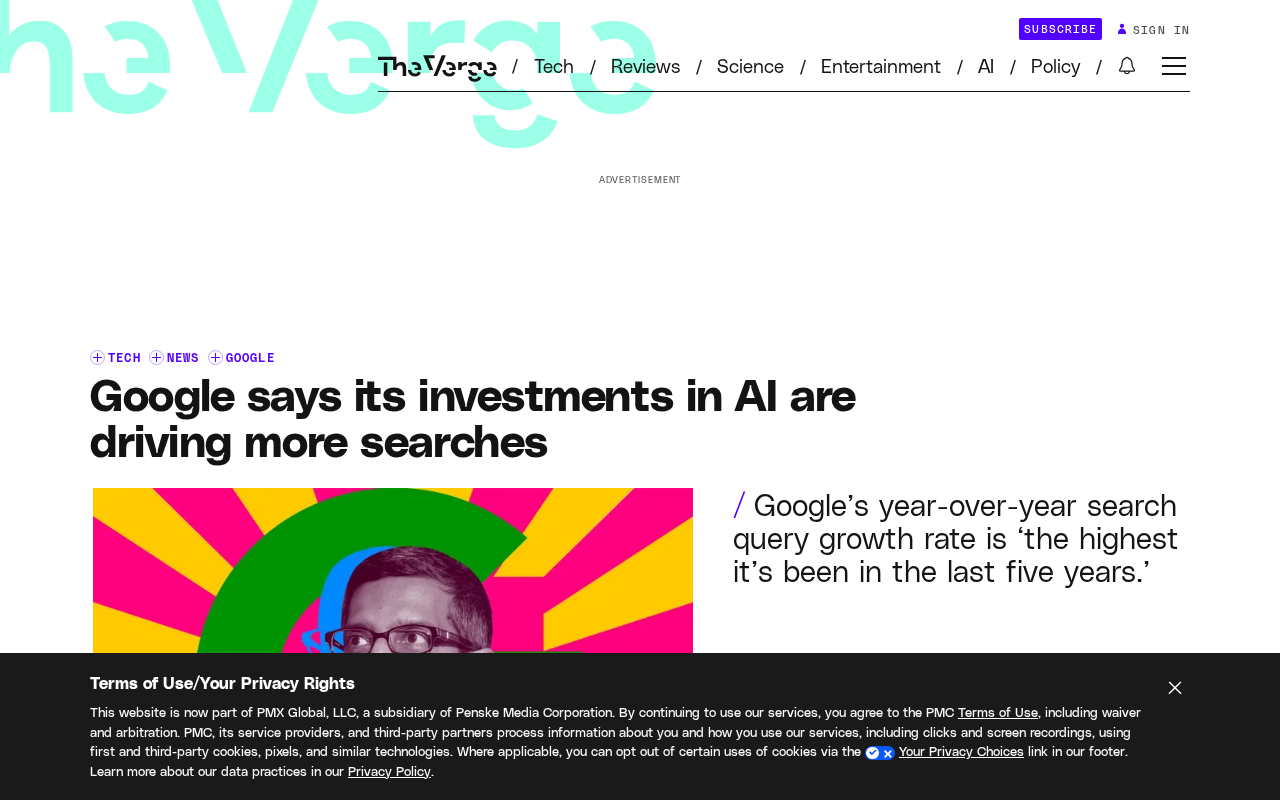
Alphabet says AI investment is driving record growth in search query volume and commercial queries.
Alphabet's Q3 2026 earnings reveal that AI investment is translating into growth momentum for search. CEO Pichai says AI spending is driving overall search query volume growth, with commercial queries also strong and year-over-year growth at historic highs. The article unpacks two implications: overall query volume reflects user activity, while commercial queries directly tie to ad monetization—the latter matters more to revenue. This also counters fears that generative AI will erode traditional search, suggesting AI expands rather than replaces it. Still, details on growth magnitude and commercial query share remain undisclosed, and whether AI brings incremental or shifted volume needs multi-quarter verification.
Alphabet's latest quarterly earnings release sent a notable signal: AI investment is translating into growth momentum for its search business. CEO Sundar Pichai explicitly stated that AI-related investments are driving growth in overall search query volume, with commercial queries also performing strongly.
How AI Investment Gives Back to Search
In the earnings statement, Pichai directly linked AI investment to search query growth, saying the company's "AI investments are driving growth in overall search query volume, including commercial queries." These two points deserve to be examined separately: overall query volume reflects user activity and usage habits, while commercial queries are directly tied to advertising monetization capability—the latter matters more to Alphabet's revenue structure.
More critical is the growth rate. Pichai revealed that the current year-over-year query growth rate is "the highest"—the original text cuts off here, but in context, this statement points to a level of growth the company has not seen within comparable periods. For a company whose search business is already highly mature, this signal carries considerable weight.
Commercial queries are a core concept in the search advertising system, typically referring to search terms with clear purchase intent, such as "price of a certain phone" or "repair shop nearby." What makes these queries so significant for Alphabet is that the search ad auction mechanism is essentially bidding on user intent: advertisers are willing to pay higher unit prices for clicks with higher conversion probability. The proportion of commercial queries in total query volume directly determines the average monetization efficiency per search (i.e., RPM, revenue per thousand searches). Therefore, when Pichai emphasizes that commercial queries are "also performing strongly," the implication is not just that traffic is growing, but that the density of monetizable traffic is increasing—a marginal impact on revenue structure far greater than growth in generic query volume. Understanding this is essential to judging whether AI-driven search growth is truly delivering results, not just hype.
What Growth in Commercial Queries Means
The commercial value of the search business depends heavily on the density of user intent. Commercial queries typically correspond to research behavior before a purchase decision and are the traffic type advertisers value most. Pichai specifically noted that commercial queries are also growing, indicating that AI is bringing not just generalized usage growth but simultaneous expansion of the portion of traffic with monetization value.
This logic also addresses a long-standing question: will generative AI erode traditional search? Based on Alphabet's statements, AI appears to be expanding search's entry points and usage frequency rather than replacing it.
The industry has long held two judgments about the relationship between generative AI and traditional search: the "substitution theory" and the "enhancement theory." The substitution theory holds that large models can directly provide answers, eliminating the need for users to click links, thereby eroding the value of search entry points—a concern that suppressed Alphabet's valuation after the explosion of products like ChatGPT. The enhancement theory argues that AI lowers the barrier to asking questions and supports more natural multi-turn conversations, which instead generates more queries. A typical example is AI Overviews, which generate summaries at the top of the results page while retaining links below. Alphabet's statement this time sides with the enhancement theory, but the strength of its argument depends on a key undisclosed metric: whether query growth comes from new users/new scenarios (true incremental growth) or from original queries being split into multiple interactions (a change in statistical methodology). This is exactly where the market needs follow-up data verification.
The Growth Narrative in Earnings Context
In this Q3 2026 earnings report, Alphabet positions AI investment as the core driver of search growth. This is a deliberate narrative choice—against the backdrop of massive AI infrastructure spending, the company needs to prove to the market that these investments are generating measurable business returns. Record query growth rate is one of the most intuitive pieces of evidence.
A note: currently, public information comes only from Alphabet's unilateral earnings statement. Quantitative details such as the specific magnitude of query growth and changes in the proportion of commercial queries have not been disclosed. Subsequent earnings calls and analyst Q&A may provide more granularity.
In the earnings context, "narrative" is not pejorative; it refers to how management frames performance attribution to influence investor expectations. Alphabet's current pressure lies in capital expenditure: to support AI infrastructure (data centers, TPU and GPU procurement, power and cooling), the company's capex has risen sharply in recent years, and the market keeps asking "when will these investments pay off." Directly linking AI investment to search query growth essentially provides a causal chain from input to revenue: AI investment → query growth → advertising inventory expansion → revenue growth. When evaluating such narratives, investors typically focus on three dimensions: whether the attribution is verifiable, whether the growth is sustainable, and whether it is accompanied by improved unit economics. Currently, public information covers only qualitative descriptions of the first link; quantitative evidence is still pending.
Implications for the Industry
Alphabet's statement has reference significance for the entire search and AI industry. If AI features can indeed increase search usage frequency, then pessimistic narratives about "AI replacing search" need to be re-examined. For advertisers, growth in commercial queries means expansion of search advertising inventory; for competitors, it means Google's moat at the search entry point may be further reinforced by AI.
Of course, a single quarter's statement is not enough to establish a long-term trend. Whether AI's impact on search is incremental or a transfer from existing volume still requires observation of data across multiple subsequent quarters.
One-line Summary
Alphabet says AI investment is driving growth in both search query volume and commercial queries, with growth rates at historic highs.
Paragraph Summary
Alphabet's Q3 2026 earnings release signals that AI investment is translating into growth momentum for its search business. CEO Pichai stated that AI-related investments are driving overall search query volume growth, with commercial queries also performing strongly and year-over-year query growth at historic highs. The article breaks down two implications of this statement: overall query volume reflects user activity, while commercial queries are directly tied to advertising monetization capability—the latter matters more to revenue structure. This logic also addresses the long-standing question of whether generative AI will erode traditional search, suggesting AI is more likely expanding search entry points rather than replacing them. However, current information comes only from Alphabet's unilateral statement; quantitative details such as specific growth magnitude and the proportion of commercial queries have not been disclosed, and whether AI's impact on search is incremental or a transfer from existing volume still requires multi-quarter data verification.
Related articles
Ollama Local Deployment Guide: Run Open-Source LLMs with Zero Experience
Ollama local deployment tutorial: what Ollama is, why choose it, how to download, install, and run open-source LLMs, and use its API for custom development. Beginner-friendly.

n8n: The 187K-Star Open-Source Automation Powerhouse That Turns Repetitive Work into Workflows
n8n is a 187K-star open-source visual workflow automation engine with 400+ nodes, Webhook/schedule/polling triggers, self-hosting for data security, and AI Agent support. Here's a guide to its core concepts, use cases, and pitfalls.

Self-Hosting n8n in Practice: Docker + PostgreSQL + Caddy Deployment Guide
A step-by-step guide to deploying a self-hosted n8n instance with Docker Compose, PostgreSQL, and Caddy automatic HTTPS, including env var pitfalls, Feishu alerting, and backup/upgrade/rollback tips.