Google's First Data Center Satellite Goes Live: TPU Writes Poetry in Space

Google's first data center satellite is online, with an in-orbit TPU running Gemma 4 inference—a validation step for space compute.
Google launched its first data center satellite into orbit and brought it online; its onboard TPU ran DeepMind's Gemma 4 model for end-to-end inference and even generated verifiable poetry. This marks space data centers' move from theoretical feasibility to engineering-operable status. Space compute can bypass terrestrial bottlenecks in power, cooling, and land, but it remains technical validation rather than commercial substitution, with in-orbit maintenance, radiation effects, and downlink bandwidth still unresolved. A single satellite writing poetry is news; constellation-scale operation and economic validation are what matter, and space data centers will ultimately be judged by cost per watt of compute and availability.
According to an RSS source, Google has launched its first data center satellite into orbit and successfully brought it online. The TPU onboard is running Google DeepMind's Gemma 4 model and has even started composing "cheesy poetry." The news seems lighthearted, but it points to a serious proposition: compute infrastructure is breaking past the boundaries of Earth.
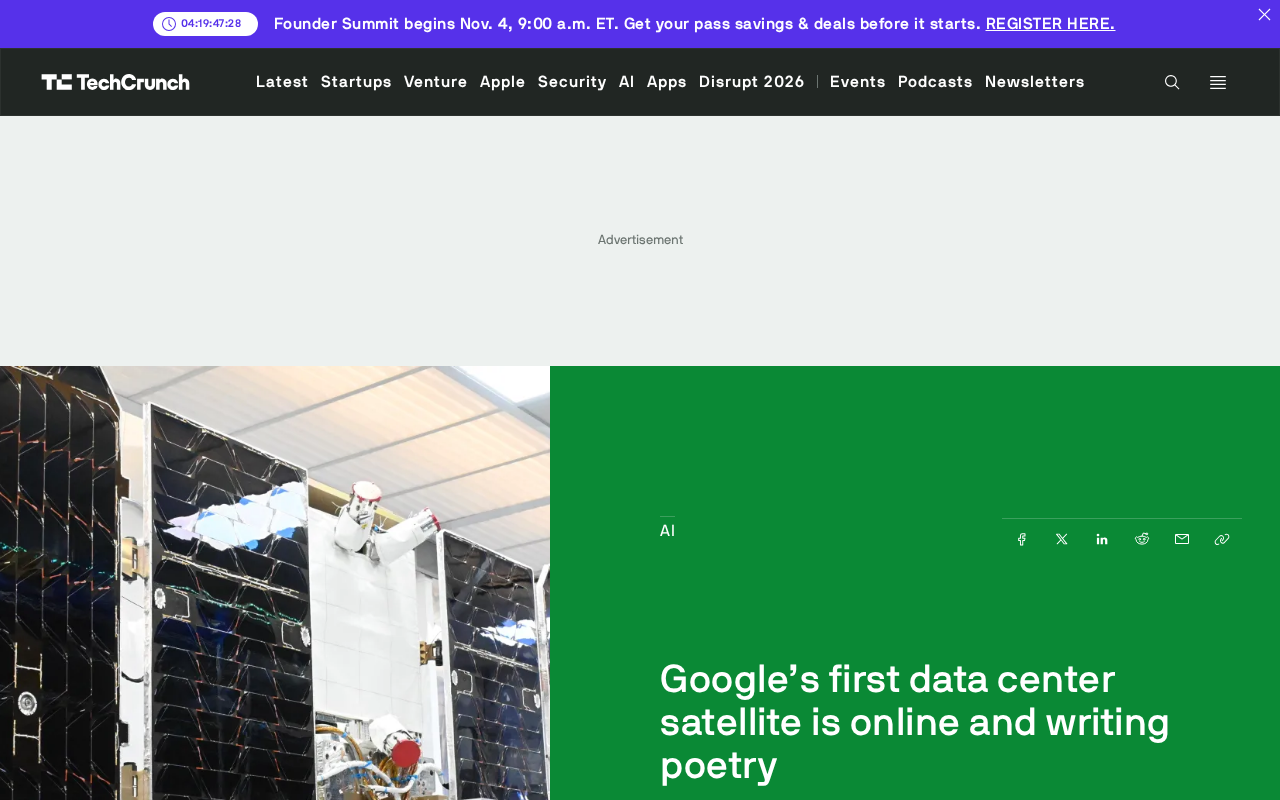
Space Compute: From Proof of Concept to "Can Write Poetry"
The key takeaway of this satellite is not the quality of the poetry, but that the in-orbit TPU completed end-to-end model inference. Gemma 4 is part of DeepMind's lightweight model family; choosing it over larger-parameter models suggests that the space environment still imposes strict constraints on power, thermal dissipation, and reliability. Getting the inference pipeline working in orbit means space data centers have moved from "theoretically feasible" to "engineering-operable."
The report describes the output as "cheesy poetry," and this slightly self-deprecating phrasing actually reinforces the signal: the system is genuinely working, and the output is verifiable generated content rather than preprogrammed telemetry data.
TPU (Tensor Processing Unit) is Google's custom-designed application-specific integrated circuit (ASIC), built specifically for machine learning tensor operations and offering higher energy efficiency than general-purpose GPUs on core neural network operations such as matrix multiply-accumulate. TPUs are typically deployed in terrestrial data centers, with Google offering TPU compute externally through its cloud services. Sending a TPU into orbit means solving radiation hardening, heat dissipation in a vacuum, and reliability under long-term unmanned operation. High-energy particles in space can cause single-event upsets, leading to computation errors or even permanent chip damage, so space-grade chips often use redundant designs or run at reduced clock speeds to gain stability. Whether the TPU on this satellite is a radiation-hardened version or a commercial version directly determines its compute ceiling and economic viability, and is also a key variable in judging whether space data centers can scale.
Why Send Data Centers into Space
Terrestrial data centers face multiple bottlenecks in power, cooling, and land, especially in high-density AI cluster scenarios where cooling costs keep climbing. Space offers nearly unlimited solar power and a natural low-temperature environment for heat dissipation, theoretically bypassing some terrestrial constraints. The deeper logic behind Google's move is to expand the siting question for compute infrastructure from "Earth's optimal solution" to "orbital feasibility."
However, the current stage is closer to technical validation than commercial substitution. In-orbit maintenance, radiation effects on chips, and downlink bandwidth limits are all questions the report does not yet answer. A satellite that can write poetry is not the same as one that can handle large-scale training workloads.
Gemma is an open-source lightweight large language model family released by Google DeepMind, with parameter sizes ranging from 2 billion to 27 billion, designed to run efficiently on a single GPU or TPU so developers and researchers can deploy it locally. Compared with flagship models with hundreds of billions of parameters, Gemma greatly reduces inference cost, memory footprint, and power consumption, making it a reasonable choice for resource-constrained environments such as space. Choosing Gemma 4 rather than a larger model is essentially a trade-off between in-orbit compute budget and model capability: space platforms typically provide only hundreds to thousands of watts of power, heat dissipation relies on radiative rather than convective cooling, and any power over budget becomes a thermal management problem. Therefore, the feasible boundary of in-orbit model inference is largely determined by model size and chip energy efficiency.
Potential Impact on the AI Infrastructure Landscape
If the space inference pipeline proves sustainable, the first beneficiaries are likely to be batch-processing tasks that are insensitive to latency and have controllable bandwidth requirements. For applications requiring real-time interaction, round-trip satellite-ground latency remains a hard constraint.
The more realistic observation window is whether Google will expand this validation into a multi-satellite constellation, and whether power and stability data for Gemma running in orbit will be made public. A single satellite writing poetry is news; constellation-scale operation is infrastructure.
Satellite-ground round-trip latency refers to the time required for signals to travel between a ground station and a satellite. For low Earth orbit (LEO) satellites, one-way propagation latency is about 2 to 7 milliseconds, which seems low, but the full link also includes ground station access, routing and scheduling, and on-satellite queuing and processing, so actual end-to-end latency often reaches tens of milliseconds or more. By comparison, fiber-optic latency between terrestrial data centers is usually in the single-digit milliseconds. This gap means space compute is unsuitable for real-time interactive applications such as online conversation and autonomous driving decisions, and is better suited to latency-insensitive batch tasks such as remote sensing image analysis, scientific data preprocessing, and offline model inference. In addition, downlink bandwidth is another hard constraint: the rate at which satellites can transmit data back to the ground is limited, and parameter synchronization required for large-scale training is almost impossible to complete in orbit, further limiting the positioning of space data centers to inference and edge preprocessing.
Editorial View
The informational value of this news centers on the fact of "first going live and completing inference"; the poetry is just a hook for dissemination. What is truly worth tracking is validation of the economics and reliability of in-orbit compute—the story of space data centers will ultimately be told by cost per watt of compute and availability, not by poetry.
One-line Summary
Google's first data center satellite is online, with an in-orbit TPU running Gemma 4 inference, marking a validation step for space compute.
Paragraph Summary
Google launched its first data center satellite into orbit and brought it online; its onboard TPU ran DeepMind's Gemma 4 model to complete end-to-end inference and even generated verifiable poetry. This marks space data centers' transition from theoretical feasibility to engineering-operable status. The article notes that space compute can bypass the power, cooling, and land bottlenecks of terrestrial data centers, but it remains technical validation rather than commercial substitution, with in-orbit maintenance, radiation effects, and downlink bandwidth still unresolved. A single satellite writing poetry is news; constellation-scale operation and economic validation are what matter, and space data centers will ultimately be judged by cost per watt of compute and availability.
Related articles

Mistral Large 4 Open-Sources a Trillion Parameters, Microsoft Offers Voluntary Severance to 60,000 Employees
Mistral Large 4 open-sources a trillion-parameter multimodal model with a coding agent score of 48; SanDisk earnings show AI inference reshaping NAND demand; Google Gemini adds in-app file editing, OpenAI raises Codex quotas, and Microsoft offers voluntary severance to 60,000 employees.
Mistral Large 4 Opens Its Weights: AI Morning Brief Roundup of Models and Ecosystem Trends
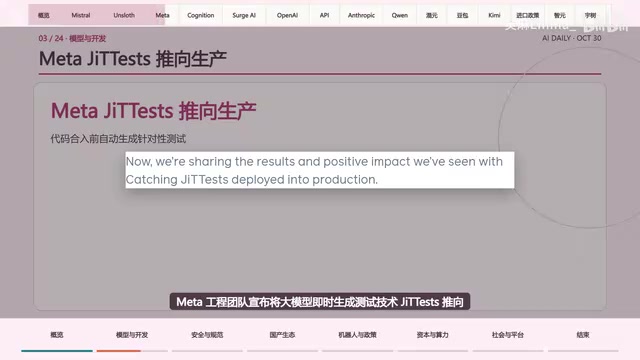
Mistral Large 4 opens its weights, a 1-trillion-parameter MoE architecture that can run locally on MacStudio; Meta's test-generation technology enters production; top tax benchmark pass rate only 10.8%; Canadian government takes a stake in Cohere; Doubao Work opens third-party model calls. This AI Morning Brief rounds up model, ecosystem, capital, and policy developments.

Mistral Large 4 Goes Open Source: A 1T-Parameter European Qwen Challenging DeepSeek
Mistral Large 4 is now open source: 1T total parameters, 52B activated, focused on coding and cybersecurity, with ~610G NVFP4 weights. We analyze its comparison with DeepSeek V4 Flash, API pricing, demo realism, and local deployment value.