Google's Week of AI Bombshells: 8th-Gen TPU, Dual Gemini 4 Releases, and a Robotics Model
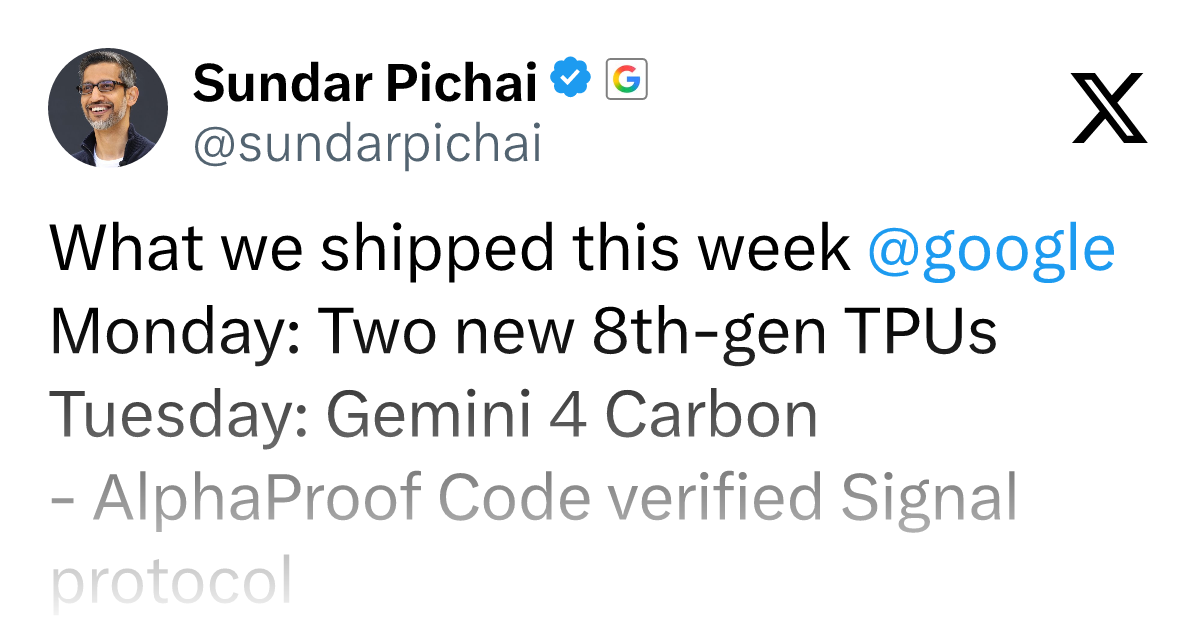
Google shipped TPUs, dual Gemini 4 versions, robotics, genomics, and API updates in one week, showing its full-stack AI play.
The article breaks down five consecutive Google AI updates over one week: two 8th-gen TPUs on Monday, showing finer training/inference customization; Gemini 4 Carbon and Gemini 4 Hydrogen on Tuesday and Thursday—the former for code verification and Signal protocol scenarios, the latter for broader use with the Gemini Decisions API in AI Studio and smart glasses pre-orders; and AlphaGenome 2 for disease research on Wednesday. Together they form a full-stack chain from compute to hardware, with the cadence itself the real signal.
Five Launches in One Week: Google's AI Cadence Has Never Been This Dense
When a company turns "shipping products" into something as routine as a weekly report, it usually means two things: the technical bench is deep enough, and the competitive pressure is real enough. Google's update list for this week circulated on social media—from Monday to Friday, something new every day, spanning chips, large models, robotics, genomics research, and the API ecosystem. The list came from tweets on Google's official account. Despite the lighthearted tone about a Friday "U2 new album," the first four days packed serious weight.
Let's break it down day by day to see what product logic and strategic intent sit behind these releases.
Hardware Foundation: Two 8th-Gen TPUs at Once
On Monday, Google announced two new 8th-generation TPUs. TPU (Tensor Processing Unit) is Google's custom AI chip, now in its eighth generation—a cadence that itself speaks to Google's long-term investment in compute infrastructure.
The emphasis on "two" rather than one suggests Google may have done more granular hardware design for the training and inference scenarios. In past TPU generations, Google has released versions aimed at training and versions aimed at inference. If the 8th generation continues and strengthens that approach, it means Google is customizing more deeply for the differentiated demands of large-model workloads. For teams relying on Google Cloud for AI training, the generational leap in new chips directly affects cost structure and iteration speed. Although the tweet didn't disclose specific performance figures, the act of "shipping two at once" already signals how seriously Google treats compute supply.
TPU (Tensor Processing Unit) is a custom ASIC Google has publicly developed since 2016, designed specifically for the massive matrix multiplications and convolutions in neural networks. Unlike the general-purpose parallel architecture of GPUs, TPUs use customized dataflow designs such as systolic arrays to complete tensor operations at lower power. Google typically offers TPU compute externally as instances through its cloud platform rather than selling chips directly. Training and inference are the two core AI chip workloads: training requires high-bandwidth memory and large-cluster interconnect, while inference emphasizes low latency and throughput-per-cost. Google has previously distinguished training- and inference-oriented variants in generations such as TPU v5e/v5p, and this "dual-version" strategy helps cloud customers select by workload.
Model Matrix: Gemini 4 Carbon and Hydrogen Strike on Two Fronts
On Tuesday and Thursday, Google released Gemini 4 Carbon and Gemini 4 Hydrogen, respectively. Splitting the same model generation into two named versions is uncommon in Google's product history and worth a closer look.
Carbon: The Version Leaning Toward Geeks and the Protocol Layer
Gemini 4 Carbon's release came with two pieces of information: AlphaProof Code verified Signal protocol, and Gemini Robotics 2.5. The former carries a lot of signal—AlphaProof is Google DeepMind's research achievement in mathematical proof, and now appearing alongside "Code verified" and "Signal protocol" may point to enhanced model capabilities at the code verification and communication protocol layers. Signal protocol is a protocol standard widely used for encrypted communication. If Gemini 4 Carbon has targeted optimizations in protocol understanding and implementation verification, the intent toward developers and security-sensitive scenarios is obvious.
Gemini Robotics 2.5, released the same day, pulls the view toward embodied intelligence. A robotics model iterating to version 2.5 shows Google's investment in vision-language-action models hasn't stopped. Combined with the Gemini 4 Carbon release cadence, Google seems to be simultaneously channeling large-model capabilities into the software protocol layer and the physical robotics layer.
The Signal protocol is an end-to-end encrypted communication protocol developed by Open Whisper Systems (now the Signal Foundation) and widely adopted by WhatsApp, Google Messages RCS, and others. Its core is the Double Ratchet algorithm, which provides forward secrecy and backward secrecy. If a model optimizes "protocol understanding and implementation verification," it usually means it can read protocol specifications, generate compliant implementation code, or perform formal/semi-formal verification of cryptographic implementations. AlphaProof is DeepMind's mathematical reasoning system combining large language models with the Lean theorem prover, which has reached medal level on International Mathematical Olympiad problems; its "Code verified" direction means model outputs can be machine-checked proofs or code, reducing hallucination risk. Such capabilities are significantly valuable for security-sensitive developer scenarios that require verifiable correctness.
Hydrogen: The Version for Broader Scenarios
Thursday's Gemini 4 Hydrogen also came with two moves: the Gemini Decisions API launching in AI Studio, and smart glasses opening for pre-order. An API entering AI Studio means developers can start experimenting immediately, while smart glasses pre-orders extend model capabilities to hardware endpoints. The name Hydrogen suggests a lighter, more universal positioning that complements Carbon.
This "dual versions of the same generation" strategy recalls Google's maturity in model productization: no longer chasing one model to rule them all, but differentiated packaging for different deployment scenarios.
Scientific Computing and Genomics: The Depth of AlphaGenome 2
Wednesday's release was relatively low-key but potentially far-reaching: AlphaGenome 2, aimed at disease research. The AlphaFold series established Google's benchmark in protein structure prediction, and AlphaGenome extends the AI for Science map to the genome level. The arrival of a second generation shows the first has proven out and entered an iteration cycle. Disease research is a data-intensive field with extremely high precision requirements, and advances in genomic models could provide new tools for drug target discovery and genetic disease analysis. This line doesn't draw traffic the way Gemini does, but it's an important pillar of the "long-term value" in Google's AI narrative.
AlphaFold is a protein 3D structure prediction system developed by DeepMind that dramatically improved accuracy in the CASP competition and is regarded as a milestone in AI for Science. AlphaGenome migrates a similar approach to genomic sequences: input a DNA sequence and predict functional genomic signals such as gene expression, splicing, and chromatin accessibility. The core challenges for genomic models are extremely long sequences (the human genome is about 3 billion base pairs), long-range action of regulatory elements, and the sparsity and noise of functional annotations in training data. In disease research scenarios, such models can be used to interpret non-coding variants, identify potential drug targets, and assist in analyzing pathogenic mechanisms of genetic diseases. A second-generation iteration usually means improvements in context window, multi-species generalization, or prediction accuracy, but deployment still needs to be closed-loop with wet-lab validation.
From API to Glasses: What Game Is Google Setting Up
Stringing this week's releases together, a clear chain emerges: at the bottom, TPUs provide compute; in the middle, two Gemini 4 versions cover different model needs; on top, APIs and hardware endpoints reach developers and consumers; and alongside, AlphaGenome and Robotics expand the boundaries of science and the physical world.
This isn't a scattered set of product updates but a concentrated display of full-stack capability. In particular, you may not have noticed the Gemini Decisions API entering AI Studio—AI Studio is Google's model testing ground for developers, and adding the API means a shorter path from "trying the model" to "integrating it into an app." Smart glasses pre-orders suggest Google is still betting on wearable AI hardware, trying to embed Gemini capabilities into everyday scenarios.
AI Studio is a browser-based model experimentation and prototyping platform Google provides to developers, supporting prompt debugging, parameter tuning, API key management, and code export, and connecting to paid Gemini API calls. Bringing the Gemini Decisions API into AI Studio means developers can complete the "try—evaluate—integrate" flow in one interface, reducing friction from demo to production. On smart glasses, Google previously explored an enterprise edition of Google Glass, and in recent years has partnered with eyewear brands such as Warby Parker and Gentle Monster to advance AI glasses on the Android XR platform, highlighting the Gemini voice assistant and multimodal perception. The key constraints for wearable AI hardware are power consumption, heat dissipation, privacy, and social acceptability, and the model side needs lightweight design and device-cloud collaborative inference to support them.
One Signal Worth Noting
Once this list spread, what impressed people most wasn't any single technology but the cadence itself. Within one week, it covered five layers—chips, models, science, APIs, and hardware—and each layer had substantive content, which demands extremely strong cross-team coordination. The joke at the end of the tweet about a U2 new album, in fact, highlights the density of the first four days.
Of course, tweets are a highly condensed information stream; specific parameters, availability, and pricing weren't detailed. For developers and enterprises, what to watch next is the actual rollout of these releases: when the new TPUs open on Google Cloud, the concrete capability differences between the two Gemini 4 versions, and the real-world experience of the smart glasses. Shipping is only the starting point; ecosystem feedback is what determines whether these updates translate into real productivity.
One-line Summary
Google shipped TPUs, dual Gemini 4 versions, robotics, genomics, and API ecosystem updates in one week, showcasing its full-stack AI layout.
Paragraph Summary
The article breaks down five consecutive AI updates from Google over one week: on Monday, two 8th-gen TPUs, showing finer customization for training and inference; on Tuesday and Thursday, Gemini 4 Carbon and Gemini 4 Hydrogen—the former focused on code verification and Signal protocol for developer and security scenarios, the latter toward universal applications, accompanied by the Gemini Decisions API launching in AI Studio and smart glasses pre-orders; on Wednesday, AlphaGenome 2 for disease research, extending AI for Science to the genome level. The article argues these releases form a full-stack chain from compute and models to APIs and hardware endpoints. What's really worth noting is the cross-team coordination behind the cadence, while specific parameters and real-world results remain to be seen.
Related articles
11 Tested Rules to Slash Claude Token Costs to the Bare Minimum
Claude Token costs too high? Creator Doobie rewrote 11 token-saving rules after 30 days of logs: keep effort at medium, use /clear when switching tasks, don't let cache expire, downgrade auxiliary agents to Haiku—with official Anthropic data and cost comparisons.

Build Your First AI Agent with Zero Code: A Claude Code Practical Guide
Build an AI agent in Claude Code with zero code. Learn the full workflow: folder setup, claude.md rulebook, plan-mode briefs, skills, and independent review.

Claude Code Advisor Mode Explained: How Fable 5.2 and Sonnet 5.5 Collaborate on Code
A deep dive into Claude Code's experimental Advisor mode: how Fable 5.2 and Sonnet 5.5 split the work, access requirements, version thresholds, three ways to enable it, Fable's special billing rules, and a fact-check of the "3.4x cost reduction" claim against official docs.