Google TabFM: The "GPT-3 Moment" for Tabular Data Has Arrived
Google TabFM enables zero-training tabular prediction; LLM agents fill its semantic blind spots for a new-generation data science architecture.
Google Research's TabFM is a foundation model for tabular data that treats your dataset itself as a prompt, completing predictions in a single inference pass with no training required. Trained entirely on synthetic causal graphs, it learns a cross-dataset meta-algorithm but cannot interpret column semantics. The TabFM Auto architecture addresses this by pairing TabFM with an LLM agent for semantic parsing and feature transformation, reaching top scores on the Tab Arena benchmark. Production deployment requires three pillars: column comments for semantic grounding, copy-on-write database branches for experiment isolation, and timestamp-based rollbacks to prevent data leakage — together signaling a fundamental shift in how tabular data is processed.
While Everyone Chased LLMs, Tabular Data Got Left Behind
The current AI boom revolves almost entirely around coding agents and chatbots. Large language models (LLMs) are genuinely impressive at handling text. But if you look at how real businesses actually operate, the engine running underneath isn't text — it's good old tabular data: transaction records, customer churn, sensor logs, fraud claims, inventory data, and so on.
The problem is that LLMs aren't the right tool when you need to predict an outcome from a table. Most teams still rely on classical machine learning, especially Gradient Boosted Trees. And that workflow has one glaring flaw: every new problem requires training a brand-new model from scratch. You clean data, hand-craft features, train a model, tune hyperparameters — then repeat the whole grind on the next dataset.
This is exactly how text used to work — one model for sentiment analysis, another for spam filtering, another for translation. Then GPT-3 arrived and changed everything: instead of training separate models, you just give a foundation model a few examples in a prompt, and it magically handles whatever you throw at it. Tabular data has been missing that "GPT-3 moment" — until now.
TabFM: Turning Your Dataset Into a Prompt
Google Research recently released TabFM, a foundation model built specifically for tabular data. Its most disruptive feature: you don't need to train it on your own dataset at all.
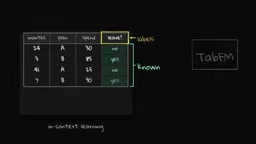
The approach is elegantly simple — feed it the rows you already have labels for, attach the unlabeled rows you want to predict, and the model uses the annotated data to infer the answers in a single pass. In other words, your dataset itself becomes the prompt. This effectively makes TabFM a general-purpose foundation model for tabular data.
How did Google pull this off? The research team trained the model entirely on endless synthetic data (essentially synthetic tables). For each table, they sampled a random causal graph, generated rows accordingly, and trained the model to predict masked cells. The clever part: the model can't memorize any specific dataset. Instead, it learns the meta-algorithm of "how to learn from a table."
One caveat: TabFM's weights are currently restricted to non-commercial research use. So it's better treated as an architectural blueprint than production-ready code.
The inference paradigm TabFM uses is known in ML as In-Context Learning (ICL), first demonstrated systematically with GPT-3. The core idea: during inference, the model infers the output for new samples from "example–answer" pairs provided in the input, without updating any model parameters. For tabular data, this means prepending rows with known labels as "examples" before the rows to predict. The model uses attention to capture statistical patterns across those rows. Training on synthetic causal graphs forces the model to learn not the distribution of any specific dataset, but the more universal skill of "given a handful of samples, how do I generalize the causal dependencies between variables" — which is precisely why it generalizes to real datasets it has never seen.
In Practice: Predicting Customer Churn With Zero Feature Engineering
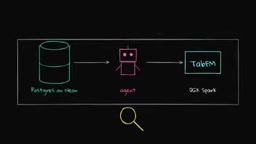
A foundation model is only half the story. The other half is where your live data lives and how you give an agent a workable runtime environment. In this demo, data lives in Serverless Postgres on Neon, TabFM runs locally on a DGX Spark, and the agent operates directly against the database engine.
The demo uses a synthetic SaaS company dataset containing customer profiles, product usage, invoices, and support tickets — with the goal of predicting which customers will churn. The flow: pull the raw customer table from Neon, feed the labeled history to TabFM, and let it score the remaining users — with zero training involved.
The results are compelling: on a single table with zero feature engineering, TabFM already outperformed a carefully tuned tree model the author had built previously. That said, a score of 0.60 isn't stellar — and that's precisely where TabFM's key limitation shows up.
TabFM's Achilles' Heel: It Can't Read Column Semantics
Because TabFM was trained entirely on synthetic causal graphs, it never encountered column names or labels during training. That means it has no way to distinguish between columns — one might represent monthly spend, another might be temperature, but to the model they're all just numbers.
Real-world tables are loaded with semantic meaning: a column might use 1, 2, 3 to represent different event types; 0 might mean "not measured"; missing values might be encoded with special markers. TabFM can't understand any of these semantic nuances. And understanding semantic context is exactly what LLMs are best at.
This motivated the new architecture called TabFM Auto: keep TabFM frozen as the inference engine, and let an LLM-powered agent take over the entire pipeline. The agent inspects column names, writes data transformation logic, selects context rows, and calibrates predictions. Research shows this combination can reach top rankings on the Tab Arena benchmark.
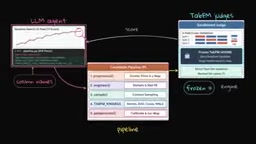
Since TabFM Auto's code hasn't been released yet, the author implemented their own version using Opus 5.5 with Gemini as the orchestrator.
The semantic gap is one of the central challenges in tabular foundation model research. In real tables, the same numeric value can carry entirely different meanings: the integer 3 is a categorical label in a "product tier" column, a count in a "number of purchases" column, and a Likert scale point in an "NPS score" column. Traditional ML practitioners manually encode these semantics through feature engineering — one-hot encoding for categorical columns, log transforms for skewed distributions. TabFM skips this step, at the cost of losing column semantics. Tab Arena is the leading public benchmark for evaluating tabular models' cross-dataset generalization, covering classification and regression across healthcare, finance, and industrial domains. TabFM Auto's top ranking there suggests that the LLM-driven semantic parsing layer effectively bridges this gap.
Robust Infrastructure Is Non-Negotiable for Autonomous Data Science
To support systems like TabFM Auto, a solid database architecture is critical. The author identified three key requirements:
Semantic Grounding
In Postgres, you can store a data dictionary directly as column comments. When the agent combines table schema with inline annotations, it can determine what kind of transformation code to write.
Sandbox Isolation
You should never let an autonomously running LLM touch production data. So for each experiment, the agent spins up an isolated branch on Neon — a full copy-on-write database clone that takes under a minute to create. It creates feature tables, tests joins, drops columns, and saves run results inside the branch. If something goes wrong, just delete the branch; production is completely untouched.
Preventing Data Leakage
This is the most critical piece. The author's dataset had a retention column that only gets populated after a customer initiates a cancellation. To an agent only looking at the current snapshot, this looks like a silver-bullet feature — but it actually reflects a future outcome and shouldn't be used. In testing, about half the runs saw the agent notice this correlation but miss the temporal risk, and simply feed it into the pipeline.
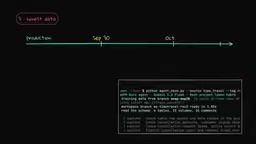
The fix: have the agent train on an isolated branch restored to the exact timestamp before the prediction window. Validation uses customers' actual behavior the following month. The result: the model that looked perfect (because it used the leaky column) performed worst, while the model without the leaky column performed excellently.
Neon is a Serverless PostgreSQL service built on a storage-compute separation architecture. Its Branch feature borrows Git's copy-on-write concept: each branch doesn't physically duplicate the entire dataset but shares the same underlying storage pages, only generating differential pages on writes. This makes creating a fully isolated environment with a complete dataset extremely fast (typically within seconds), with storage overhead proportional to actual changes rather than total dataset size. For AI agent workflows that require frequent experimentation, this is critical — it reduces the cost of "independent environment per experiment" to negligible levels without sacrificing data safety.
From One-Off Predictions to Scheduled Production Pipelines
In real business contexts, churn prediction isn't a one-time event. The author stored the agent-generated pipeline in the database and scheduled it to run via Neon functions: every night, features are built from Postgres and pushed to a job queue; DGX machines pick up the jobs, score each customer, and write results back to the database; the high-risk list lands in adjacent object storage.
In the experiment, the author advanced the clock by one month, loaded what actually happened, and generated a list — and the customers ranked highest did indeed mostly cancel their subscriptions. This vividly demonstrates the power of embedding TabFM inside an agent loop.
Three Takeaways Worth Remembering
First, tabular prediction no longer requires training a model first. Your data can be used directly as a prompt.
Second, LLMs are still essential here — but their role has changed. They're no longer the predictor; they're the layer responsible for reading column names and injecting domain knowledge.
Third, if you want agents to do data science, give them a truly actionable backend. Provide isolated branches for each experiment, put column meanings right next to the data, and let the agent see what the data actually looked like at the moment the prediction was being made.
TabFM's weights may be research-only for now, but the architectural pattern it represents likely signals a fundamental shift in how tabular data gets handled.
Related articles

CSS Anchor Positioning: A New UI Positioning Approach Without JavaScript
A deep dive into CSS Anchor Positioning: from anchor-name and position-anchor to the anchor() function, position-area shorthand, position-try-fallbacks, anchor-size, and upcoming anchor queries.

New AI Chart Interaction: Continuous Follow-up Questions and Visualization in Conversation
Explore a new AI interaction method for continuously generating charts in conversation. Use the /visualize command to ask follow-up questions and visualize answers in the same chat window, improving data analysis efficiency.

Cursor Merges Into X Subscription: Paid Plans Share Unified Usage Pool, Grok Model Coding Usage Doubled
Cursor joins The X Subscription with a unified usage pool and doubled Grok coding quota. Third-party models shift to API pricing. Existing users can keep or migrate plans.