Google Wallet Digital Home Key Launches: Unlock Your Door with a Tap
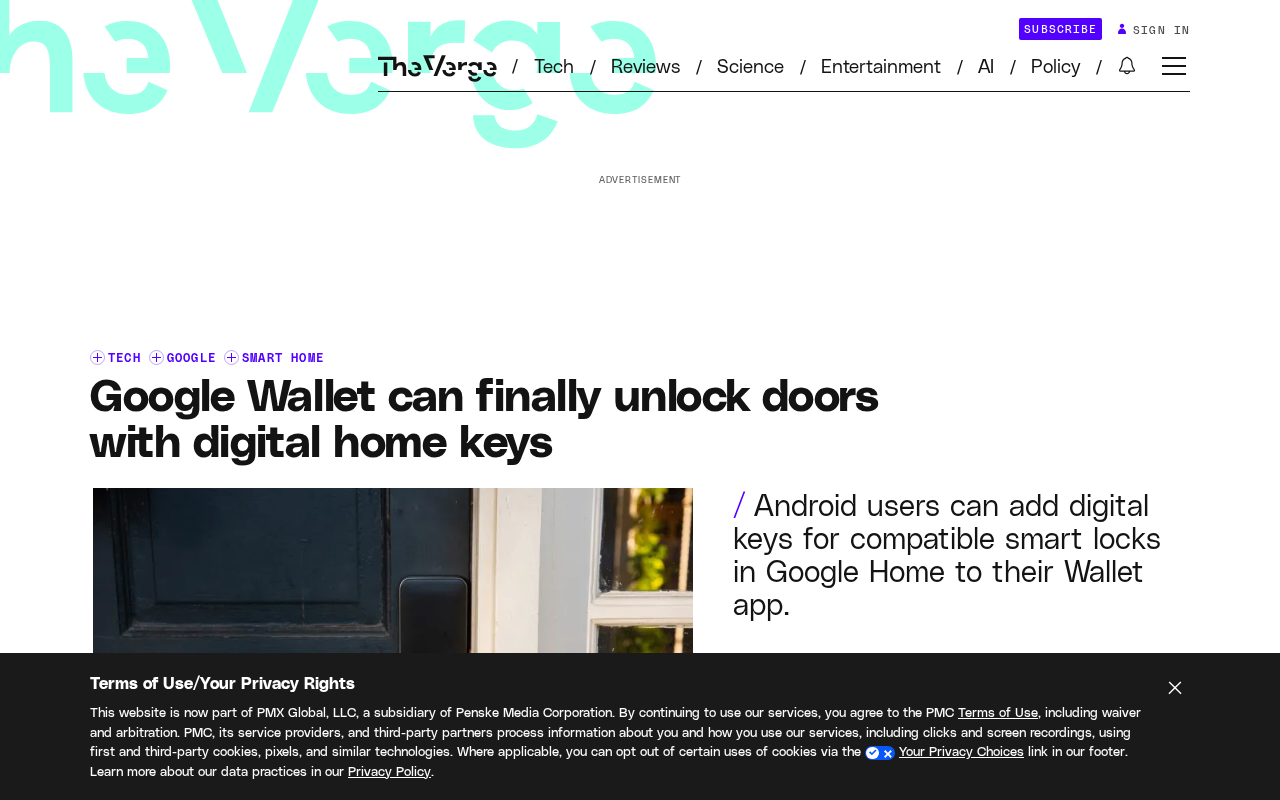
Google adds digital home keys to Wallet, letting Android users unlock smart locks by tap or approach.
Google has officially launched digital home keys in Google Wallet, allowing Android users to unlock smart locks by tapping or approaching. The feature is currently available as a public preview in the Google Home app and will roll out to all users in the coming weeks. Digital keys follow Wallet's credential management framework, belonging to the same security system as transit cards and car keys, and support both tap and approach modes to balance convenience and control. The article notes that public preview means core functionality is available but compatible device lists and exception handling are still being refined, with specific supported brands not yet disclosed. Compared to Apple's home key, Google's competitiveness depends on ecosystem openness and third-party lock manufacturers' adaptation progress. Implementation challenges include offline fallback solutions, permission management, and reliability in real home scenarios.
Smart home convenience takes another step forward—Google has officially added the digital home key to Google Wallet, allowing Android users to unlock their smart locks simply by holding their phone near or tapping it. The feature is currently available as a public preview in the Google Home app and will roll out to all users over the coming weeks.
From Wallet to Door Lock: How Digital Keys Work
According to Google's announcement, the digital home key supports two unlock methods: tap and approach. This means users don't need to pull out a physical key—or even fully wake their phone screen—to naturally unlock the door as they walk up. The feature relies on Google Wallet's existing secure chip and identity verification system, binding door access credentials to the phone's hardware and reducing the risk of keys being lost or copied.
From a technical standpoint, the digital home key belongs to the same credential management framework as transit cards, access cards, and car keys already in Google Wallet. The difference is that home scenarios demand higher security and response speed—you want it to unlock when you approach, but you don't want it to trigger accidentally when you just walk past the door. Google's choice to offer both "tap" and "approach" modes is essentially a layered approach balancing convenience and control.
Google Wallet Credential System: Digital keys in Google Wallet aren't simple QR codes or screenshots—they're encrypted credentials generated based on Secure Element or cloud tokenization mechanisms. Take transit cards and car keys as examples: credentials are stored in the phone's secure chip, and unlocking is completed through two-way authentication with the lock via near-field communication (NFC) or ultra-wideband (UWB). The phone itself doesn't directly expose the original key. The benefit of this architecture is that even if the phone is unlocked, credentials can't be easily copied or exported; meanwhile, credentials can be remotely revoked or reissued. The digital home key follows this framework, so its security ceiling depends on whether the phone hardware has a secure element and whether the lock supports the corresponding authentication protocols.
Technical Differences Between Tap and Approach: Tap typically relies on NFC, requiring the phone to be very close to the reader (within a few centimeters). It offers strong determinism and low false-trigger probability, but requires the user to actively perform a "tap" action. Approach is more likely to combine Bluetooth Low Energy (BLE) or ultra-wideband (UWB) technology, using signal strength or time-of-flight ranging to determine the distance between phone and lock, enabling automatic unlocking as you walk up. UWB positioning accuracy can reach centimeter level, effectively distinguishing "passing by" from "approaching," but requires both phone and lock to have UWB chips; BLE solutions cost less and offer broader compatibility, but ranging accuracy and interference resistance are weaker. Google offering both modes is essentially about accommodating locks and phones across different hardware tiers.
What Public Preview Means
A detail worth noting: this feature is currently labeled as public preview, not a full official launch. In Google's product cadence, public preview usually means core functionality is available, but details like compatible device lists, exception handling, and cross-brand integration are still being refined. The official statement is that it "will roll out to everyone in the coming weeks"—this window gives early adopters a chance to try it while preserving room to adjust strategy based on feedback.
For smart lock manufacturers, integrating with Google Wallet digital keys means an extra selling point, but also means adapting to Google's credential protocols. The announcement doesn't disclose which lock brands are supported—this may be the biggest uncertainty in the preview phase. The feature exists, but which doors it can be used on depends on how quickly manufacturers follow suit.
Public Preview's Place in the Product Lifecycle: In Google's product release system, public preview typically sits between internal testing (alpha) and general availability. It means the feature is open to some users, APIs and user experience are basically finalized, but compatibility gaps, performance fluctuations, or incomplete documentation may still exist. Compared to beta testing, public preview emphasizes "usability," but Google doesn't promise stability and long-term support. For developers or manufacturers, public preview is an important window for evaluating whether to invest in adaptation resources; for regular users, trying it out is fine, but it shouldn't be the only way to open the door.
Digital Key Competition Enters the Home Scene
Putting home keys into phones isn't a brand-new concept. Apple has previously advanced home key capabilities in its wallet app, and Android players like Samsung have been exploring similar directions. Google's move to bring digital home keys into Wallet fills in a piece of its home access puzzle and gives the Android ecosystem a comparable chip in the "keyless life" competition with Apple.
The real differentiator isn't "can you open the door with your phone" but ecosystem openness. Apple's home key is deeply tied to the HomeKit certification system, while Google's digital home key relies on the Google Home app and Wallet working together. If Google can attract more third-party lock brands, Android users will have noticeably more choices; conversely, if the compatibility list remains limited for a long time, this feature could easily stay at the demo level.
Apple Home Key and the HomeKit Certification System: Apple's home key feature launched in 2021 with iOS 15, relying on the Wallet app and HomeKit framework. Users can add keys for HomeKit-compatible smart locks to their wallet and unlock by tapping with iPhone or Apple Watch. Its core limitation is that locks must pass HomeKit certification and support the corresponding NFC protocols. This certification system ensures consistent experience but also raises the barrier for manufacturers, resulting in a limited number of compatible products. If Google's digital home key wants to differentiate itself, the key lies in whether it can embrace more third-party brands with a more open protocol, rather than replicating an equally closed certification wall.
Implementation Challenges and User Expectations
Smart locks are a product category extremely sensitive to reliability. Dead phone battery, system updates, Bluetooth or NFC handshake failures—any link in the chain going wrong means users get locked out. Google's announcement doesn't detail fallback solutions for offline scenarios, which is something to watch closely during the public preview phase.
Another implicit issue is permission management. Home keys often need to be shared with family members or temporary visitors. How digital keys are distributed, revoked, and time-limited directly determines whether they can replace physical keys. The Google Home app already has some user management foundation in this regard, but whether fine-grained control of key credentials is in place still needs real-world verification.
Looking at the trend, phones replacing physical keys is a certainty—Google Wallet adding home keys was just a matter of time. What really determines the success of this feature isn't how smooth the tech demo is, but whether it can work reliably in real homes with high frequency, multiple people, and multiple devices. Public preview is a pragmatic starting point; the rollout pace and manufacturer adaptation progress over the coming weeks deserve continued attention.
One-line Summary
Google adds digital home keys to Wallet, letting Android users unlock smart locks by tap or approach.
Paragraph Summary
Google has officially launched digital home keys in Google Wallet, allowing Android users to unlock smart locks by tapping or approaching. The feature is currently available as a public preview in the Google Home app and will roll out to all users in the coming weeks. Digital keys follow Wallet's credential management framework, belonging to the same security system as transit cards and car keys, and support both tap and approach modes to balance convenience and control. The article notes that public preview means core functionality is available but compatible device lists and exception handling are still being refined, with specific supported brands not yet disclosed. Compared to Apple's home key, Google's competitiveness depends on ecosystem openness and third-party lock manufacturers' adaptation progress. Implementation challenges include offline fallback solutions, permission management, and reliability in real home scenarios.
Related articles

Snapchat Opens AI Assistant Lens Building: Supports Claude Code and Cursor
Snapchat lets Lens creators describe AR filters in natural language, with AI assistants like Claude Code and Cursor handling the full build process, greatly lowering the AR creation barrier.

Is the Planck Length the Smallest Distance? Why Physicists Are Skeptical
The Planck length is often called the smallest distance in the universe, but science videos point out this claim has never been experimentally confirmed. This article explains the origins of the Planck length, the obstacles of microscope thought experiments, and what it really tells us—the scale at which quantum gravity becomes unavoidable, not spacetime pixels.

AI Agents Drive Spend Management: Payhawk Raises $280M
Payhawk raises $280M at a $2B valuation. The 2018-founded enterprise finance platform uses AI agents to track and manage expenses and procurement. This article analyzes its product evolution, valuation signals, and impact on the spend management space.