Governing AI Tool Sprawl: How Unity Gateway Controls Costs and Usage

Unity Gateway and Omnigent tackle enterprise AI sprawl with usage visibility, budget controls, and flexible tool governance.
As enterprises adopt more AI models, agents, and workflows, lack of visibility, runaway costs, and quality gaps have become critical pain points. This article covers two tools from a webinar: Unity Gateway aggregates cross-model and cross-agent call data into a unified view with real-time budget alerts, while Omnigent takes a dual-track approach — letting developers keep their existing coding agents and SDKs while centralizing governance for team leads. Together, they signal a broader shift: enterprise AI adoption is moving from "can we use it?" to "how do we use it responsibly?" — and governance infrastructure may now be more valuable than adopting the next new model.
More AI Tools, More Problems
As teams adopt more and more AI tools, a cascade of management questions follows: Who is using which model? How much are all these calls costing? And are they actually delivering results? In a webinar hosted by Matei Zaharia and Kasey Uhlenhuth, the two demonstrated the real-world capabilities of Unity Gateway and Omnigent — two tools designed to give enterprises visibility and control over their AI usage.
For any organization deploying AI at scale, these are not trivial concerns. The combinations of models, agents, harnesses, and workflows are growing increasingly complex. Without a unified way to observe and govern them, costs can spiral out of control and quality becomes impossible to guarantee.
Unity Gateway: Making AI Usage Visible and Controllable
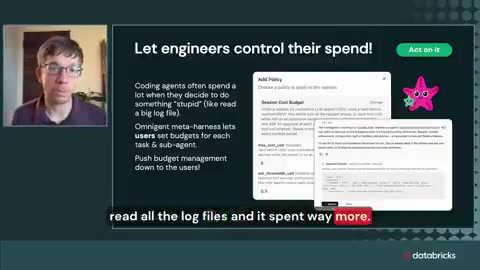
The core value of Unity Gateway is giving teams a unified view across models, agents, and workflows. In other words, it consolidates scattered AI calls onto a single observable plane, so administrators can clearly see where resources are flowing.
One standout scenario from the webinar demo was budget enforcement. The system can proactively send alerts when usage approaches or exceeds a set budget — as shown in the demo, the tool explicitly signals "I've run out of budget," providing an intervention trigger before costs get out of hand.
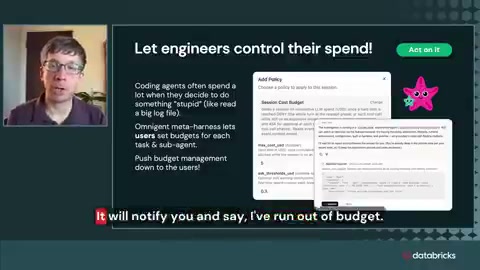
This mechanism has practical implications for both engineers and managers. From an engineer's perspective, you can check your remaining budget before kicking off an agent task. From a management perspective, you gain real-time cost control — rather than discovering the damage only when the bill arrives.
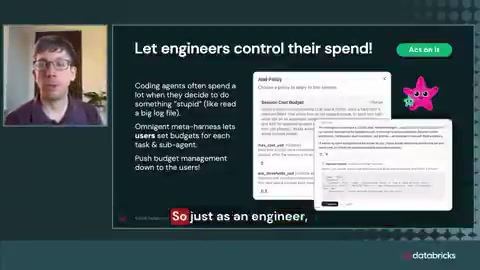
Observability is the underlying logic behind this category of tools. In distributed systems, observability refers to the ability to infer a system's internal state from the logs, metrics, and traces it exposes externally. Observability for AI calls extends this further: it's not just about recording which service was called, but also tracking which model was used (e.g., GPT-4o vs. Claude 3.5), how many tokens were consumed, what the latency was, and how output quality measured up. In environments where multiple teams and projects are running AI in parallel, the lack of this visibility layer leads to the classic "bill shock" problem — finding out you overspent only after the invoice arrives. Unity Gateway aggregates these dispersed call signals onto a unified plane, essentially bringing AI calls under the organization's existing infrastructure governance framework.
Omnigent: Reuse Existing Tools Without Sacrificing Governance
If Unity Gateway solves the problem of "seeing and controlling," Omnigent addresses "reuse and collaboration." It lets developers combine and share the coding agents and SDKs they're already using — without starting from scratch.
This is especially critical in practice. Organizations typically have already accumulated a variety of coding tools and agents internally. Forcing everyone onto a single platform almost always meets resistance. Omnigent's approach is to respect developers' existing tool choices, letting them continue working in familiar environments, while giving team leads centralized control over governance, costs, and quality.
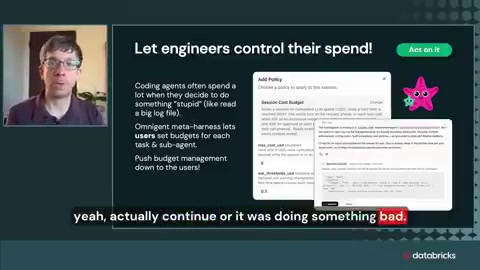
This dual-track design — developer freedom paired with management control — reflects a central tension in enterprise AI adoption today: enabling frontline staff to stay efficient and flexible, while preventing uncontrolled usage growth from creating cost and compliance risks.
Coding agents have proliferated rapidly over the past year or two. Prominent examples include GitHub Copilot, Cursor, and Devin. Unlike simple code completion, coding agents can autonomously break down tasks, invoke tools, read and write files, execute commands, and complete complex multi-step programming tasks. Inside enterprises, developers have typically adopted their own preferred coding agents and SDKs — such as execution frameworks like LangChain or LlamaIndex — resulting in de facto tool fragmentation. Omnigent's design philosophy of "coexist and integrate" rather than "force migration" directly addresses this reality: let developers keep their existing tool stacks, but add a shared governance layer on top. This gives team leads a way to centrally manage permissions, cost attribution, and quality baselines — without having to push through a tool unification policy that's nearly impossible to enforce in practice.
Enterprise AI Governance Is Becoming the New Frontier
The message coming out of this webinar is clear: AI tool adoption has entered a new phase. Early conversations were about "can we get AI at all?" — but the focus is increasingly shifting to "how do we use it well and keep it under control?" As models and agents become part of teams' daily workflows, observability, cost attribution, and quality assessment around them become non-negotiable.
Unity Gateway and Omnigent represent a tooling response to exactly this trend — treating AI usage as infrastructure that requires governance, rather than letting it grow unchecked. For teams scaling up their AI adoption, this kind of governance capability may ultimately be more valuable than adding yet another new model.
Note: This article is based on webinar promotional materials and demo screenshots. Specific feature details and real-world performance should be verified through official demos and hands-on use.
Cost attribution is one of the most pressing practical challenges in enterprise AI governance. The major large language models charge by the token, and a single complex multi-agent task can trigger dozens of model calls, making total costs difficult to estimate upfront. Without granular attribution mechanisms, organizations cannot determine which projects, teams, or workflows are generating high costs — nor can they conduct meaningful ROI analysis. Compliance risk is equally significant: certain industries (finance, healthcare, law) impose strict restrictions on sending data to third-party models. A unified call gateway can serve as a Policy Enforcement Point in this context, intercepting or anonymizing requests that involve sensitive data. This is a key driver behind enterprises choosing to build or purchase gateway products in the first place.
Related articles

Gaussian Process Bandit Optimization: Exploration Strategies and Inference Regret Guarantees
Cumulative regret guarantees in Bayesian optimization fail to reflect final recommendation quality. This article examines a new study that provides inference regret guarantees for Gaussian process bandit optimization through exploration query strategies and fill distance analysis, validated on hyperparameter optimization and control tasks.

The Most Detailed Codex Guide on Bilibili: From Installation to Real-World Practice
The most detailed Codex guide on Bilibili: from app store installation to daily work mode configuration, with a real coffee shop project demonstrating file organization, data extraction, dashboard creation, and other practical tasks. Learn to use Plan Mode and desktop pets to leverage Codex efficiently.

Appearance Compensation in Volume Rendering: Why RGB Accuracy Cannot Guarantee Density Correctness
Volume rendering research reveals that volumetric data perfectly reproducing external RGB views may still contain density errors: appearance compensation can double central density and keep external rays unchanged even when L2 error exceeds 14.52%. Density recovery depends on appearance capacity, spatial resolution, and measurement design.