GPEvac: Real-Time Evacuation Routing for Active Shooter Events Using GNN + PPO
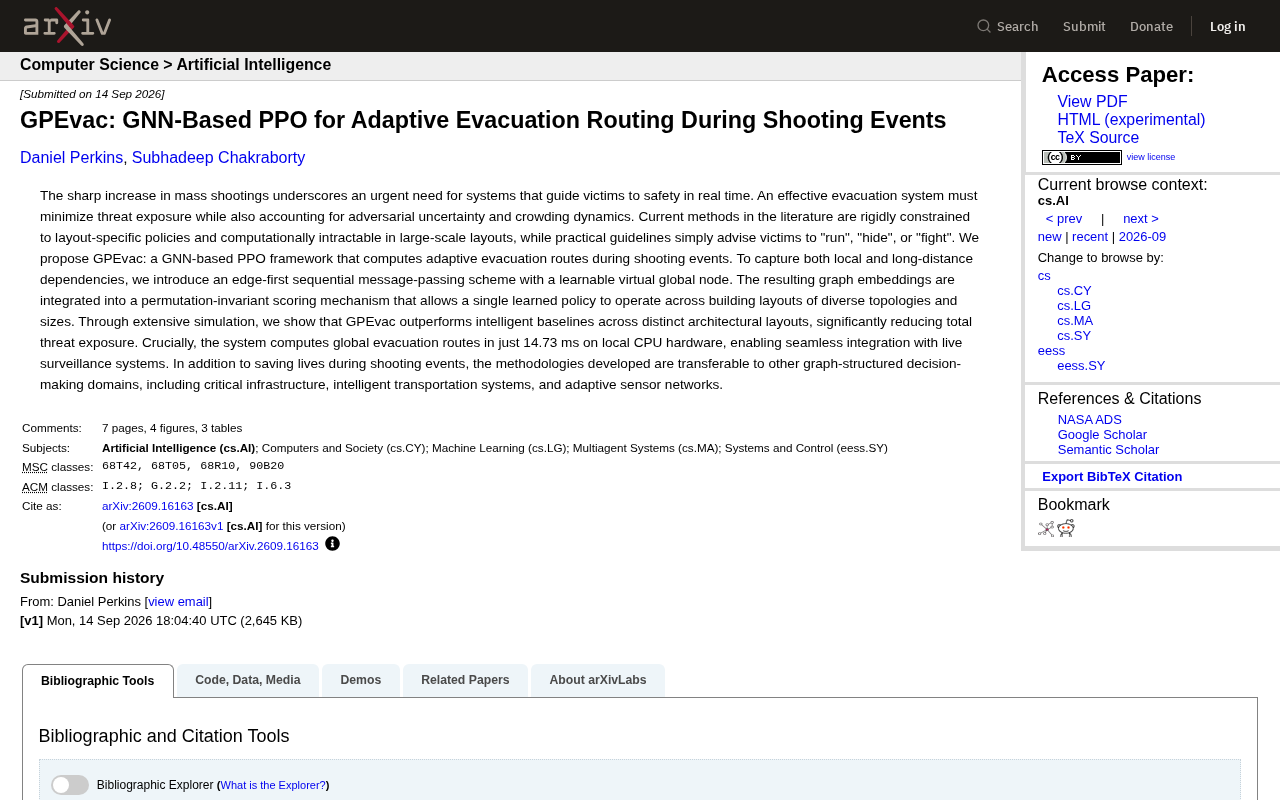
GPEvac uses GNN + PPO to generate building-agnostic real-time evacuation routes in under 15ms during active shooter events.
Addressing the limitations of the "Run, Hide, Fight" mantra, arXiv research introduces GPEvac — a system combining graph neural networks (GNN) with PPO reinforcement learning to compute adaptive evacuation routes in real time during active shooter events. Its core innovations include edge-first sequential message passing and a learnable virtual global node, enabling the model to capture both local corridor conditions and building-wide situational awareness. A permutation-invariant scoring mechanism allows a single trained policy to transfer across different building layouts without retraining. The system computes global routes in just 14.73ms on local CPU hardware and can integrate with existing surveillance infrastructure. The team also notes the framework's potential transferability to critical infrastructure, intelligent transportation, and sensor networks — though results currently remain at the simulation stage.
When "Run, Hide, Fight" Isn't Enough
When an active shooter event breaks out, official safety guidelines typically boil down to three words: Run, Hide, Fight. These principles are easy to remember, but they offer no dynamic awareness of the situation on the ground — victims have no way to judge which corridor is safer, nor can they anticipate the cascading risks of crowd congestion or a moving threat.
A newly published arXiv paper proposes a system called GPEvac that aims to fill this gap with artificial intelligence. It combines graph neural networks (GNN) with PPO (Proximal Policy Optimization) from reinforcement learning to compute adaptive evacuation routes in real time during active shooter events, with the goal of minimizing victims' exposure to threat.
The research team notes that existing evacuation routing methods suffer from two fundamental weaknesses: they over-rely on specific building layouts, meaning a strategy trained for one venue fails in another; and they carry prohibitive computational complexity, making real-time operation in large-scale floor plans nearly impossible. GPEvac is designed to address both pain points directly.
Technical Core: Edge-First Message Passing and a Virtual Global Node
Abstracting a building as a graph structure is the natural choice for this class of problems — rooms and corridors become nodes, and passage connections become edges. But standard GNNs often struggle to capture long-range dependencies, and evacuation decisions require awareness of both local corridor conditions and the macro-level state of the entire building.
GPEvac's key innovation is an edge-first sequential message-passing mechanism paired with a learnable virtual global node. This global node acts as an "information hub" for the graph, enabling distant nodes to exchange information efficiently and allowing the model to capture both local and long-range dependencies simultaneously.
The resulting graph embeddings are then fed into a permutation-invariant scoring mechanism. The significance of this design: a single trained policy can transfer directly to building layouts with varying topology and scale, without retraining for each new floor plan — directly solving the "fails in a new venue" problem that plagues traditional approaches.
Graph Neural Networks (GNNs) are a class of deep learning models specifically designed for graph-structured data. Unlike convolutional neural networks that process grid-like data (such as images), GNNs propagate information between nodes through a "message-passing" mechanism: each node collects features from its neighbors, aggregates them, and updates its own representation. After multiple iterations, this produces node embeddings that capture the graph's topological structure. However, standard message passing suffers from an "over-squashing" problem — as the number of layers increases, information from distant nodes gradually dilutes during propagation, limiting the model's ability to perceive global structure. GPEvac's edge-first mechanism prioritizes updating edge states before passing information to nodes, effectively making passage connections themselves a learnable information carrier. The virtual global node connects directly to all real nodes, providing a "fast lane" unconstrained by graph diameter — any two nodes can exchange information in at most two hops, fundamentally solving the long-range dependency attenuation problem.
Performance: 14.73ms Real-Time Response
The research team validated GPEvac through extensive simulation. Results show that across diverse building layouts, GPEvac outperforms intelligent baseline methods, significantly reducing the total threat exposure experienced by evacuees.
Even more practically valuable is its speed: the system computes a global evacuation route in just 14.73 milliseconds on local CPU hardware. This means GPEvac requires no expensive GPU clusters and can integrate seamlessly with existing real-time surveillance systems — as soon as a camera detects a threat location, the system can almost instantly generate corresponding evacuation plans for people in different zones.
For security applications, millisecond-level response capability is the dividing line between viable and useless. Any system that requires seconds or minutes to compute is meaningless in the rapidly evolving chaos of an active shooter situation.
PPO (Proximal Policy Optimization) is a widely adopted policy gradient algorithm in reinforcement learning, introduced by OpenAI in 2017. The core idea of reinforcement learning is to let an agent learn an optimal policy through trial and error guided by reward signals, but earlier algorithms frequently suffered from training instability due to excessively large policy update steps. PPO addresses this by introducing a "clipping" mechanism that limits the magnitude of each policy update, maintaining training stability while preserving high sample efficiency. In GPEvac, reinforcement learning handles the sequential decision problem of "how to select the optimal evacuation direction for each zone under a dynamic threat environment," while the GNN encodes the building's graph-structured features into representations that the policy network can directly utilize. The combination allows the system to both understand spatial topology and respond optimally to real-time changes in threat position.
Beyond Evacuation: A Transferable Graph Decision Framework
Although the paper's immediate motivation is responding to the rising frequency of mass shooting events, the research team emphasizes that the methodology underlying GPEvac has broader transferability. Any dynamic decision problem that can be modeled as a graph structure could in principle leverage this framework, including:
- Scheduling and protection of critical infrastructure
- Route optimization in intelligent transportation systems
- Resource allocation in adaptive sensor networks
In other words, the combination of edge-first message passing and a virtual global node is fundamentally a general graph learning paradigm for scenarios requiring "simultaneous local and global awareness with real-time decision-making" — and its application boundary extends well beyond evacuation scenarios.
A Measured Observation
As a simulation-stage study, GPEvac's results remain within a modeled environment. The chaos of a real active shooter scenario — irrational crowd behavior, uncertainty in threat location sensing, and countless other factors — is far more complex than any simulation. Translating "reduced threat exposure" from a simulation metric into actual lives saved still requires a substantial validation pathway.
But the value of this work lies in pushing a domain that previously offered only three-word slogans into the realm of the quantifiable, optimizable, and real-time computable. At a time when AI is increasingly intervening in public safety, GPEvac offers a compelling example that balances algorithmic innovation with engineering feasibility.
Related articles

Letting AI Build AI Tools: A 7-Day, 31-Commit Bootstrapping Post-Mortem
An engineer ran a fully autonomous AI-builds-AI pipeline for 7 days, 31 commits, with a 1-in-6 success rate. This post-mortem covers 5 failure types, 11 structural rules, and how every mistake became a permanent immunity gate.
Building an AI-Powered E-Commerce Business from Scratch: A Real-World Account of Multi-Agent Architecture for Print-on-Demand
A blogger builds a print-on-demand e-commerce company from scratch using AI agents — documenting specialized Agent profiles, GPT-5.6 vs Claude Fable multi-model orchestration, and reusable skill accumulation.

AI Agent Earns $10K in One Week: 3 Key Upgrades Explained
A blogger shares how he earned $10K in a week with an AI Agent — not by adding more skills, but through verification, approval gates, and subagents to raise trust and enable true automation.