GPT-3 Officially Retired: The End of an Era in Language Models
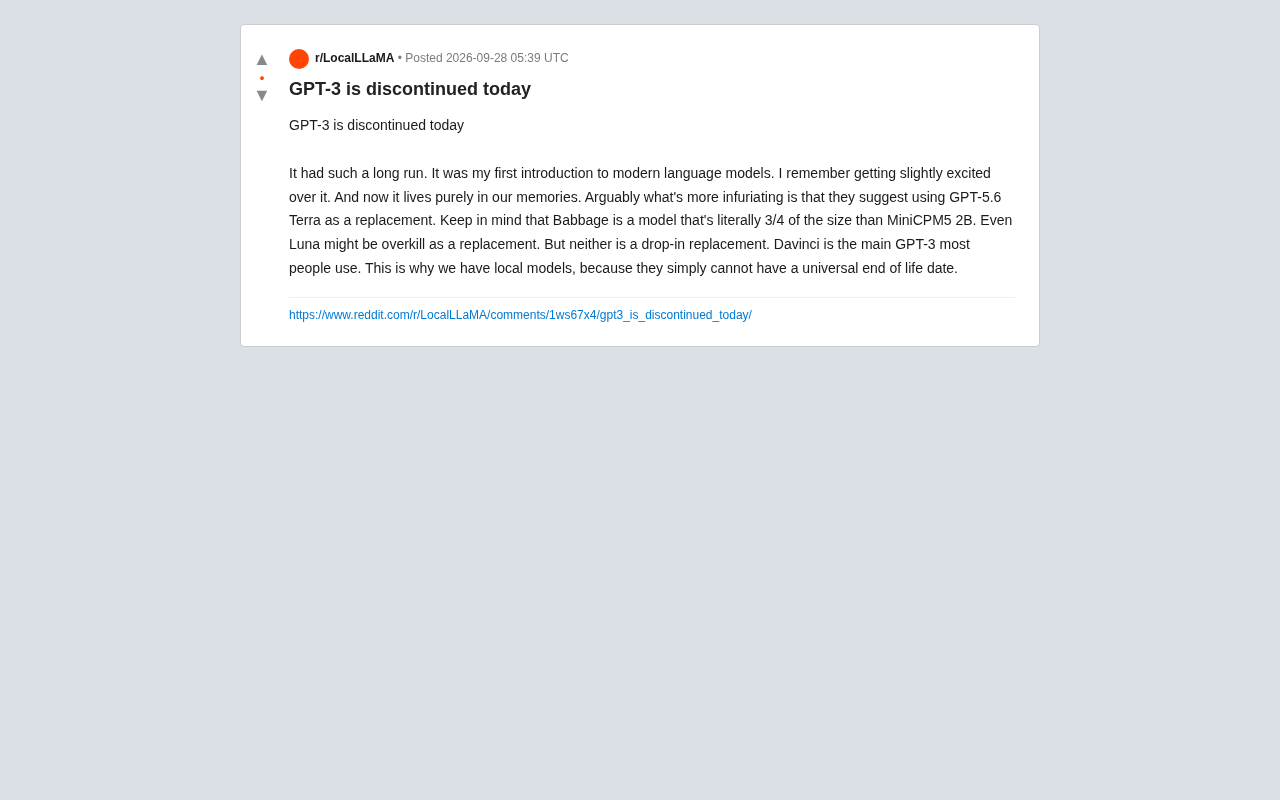
GPT-3's forced shutdown puts lifecycle risk and local deployment in the engineering spotlight.
GPT-3's retirement isn't just the end of a technology cycle — it exposes a structural flaw in closed-source cloud model ecosystems. The recommended replacements are too different in scale and design to serve as true drop-in substitutes, and the migration burden has frustrated many. Lightweight GPT-3 variants like Babbage served real production needs that flagship models simply can't cost-effectively fill. This episode elevates "lifecycle" and "controllability" as key model selection criteria, accelerating the shift toward local open-source deployments.
The Curtain Falls on GPT-3
A post on Reddit sparked a wave of reflection among AI practitioners: GPT-3 has officially been shut down. For many, this model wasn't just a piece of technical history — it was their first real encounter with modern large language models. The original poster wrote that GPT-3 once made them "a little excited," and that now it "lives only in memory."
This sentiment is far from isolated. GPT-3 set the industry benchmark for a long time, and Davinci — its most capable variant — was the default choice for the vast majority of developers. Its retirement marks the end of a technology cycle. From GPT-3 to today's larger, more efficient model ecosystems, the pace of iteration has been dizzying.
The Awkward Migration Path
What truly frustrated the community wasn't the shutdown itself, but the official migration guidance. According to the original poster, OpenAI recommended users switch to next-generation models like GPT-5.6 Terra as replacements. The problem is that these new models differ significantly from the GPT-3 series in terms of positioning, scale, and how they're called — making them far from a true drop-in replacement.
The post highlighted an telling comparison: Babbage, one of GPT-3's smaller models, has roughly three-quarters the parameter count of MiniCPM5 2B. In other words, a substantial portion of the GPT-3 family consisted of lightweight models suited for cost-sensitive and latency-sensitive workloads. Replacing them with a far more powerful model makes little sense — whether you're looking at compute overhead or engineering effort. The poster went so far as to say that even a model like Luna might be "overkill" as a replacement.
This exposes a structural contradiction in closed-source model ecosystems: vendors retire older models for reasons of maintenance cost and business strategy, yet user needs are genuinely diverse — some demand peak performance, while others just need something good enough, and cheap. A one-size-fits-all migration recommendation simply can't serve both camps.
Drop-in Replacement refers to swapping out an old component for a new one without modifying any calling code or interface layer — the system just works. In an API context, this means the new model must share the same interface format, parameter naming, output structure, and behavioral patterns as the old one. The reason GPT-3's variants (Davinci, Curie, Babbage, Ada) are so difficult to replace seamlessly with newer models is multifaceted: the prompt engineering paradigm has fundamentally shifted, so carefully tuned prompts for older models may behave very differently on newer ones. Output style, length tendencies, and formatting conventions may also differ, requiring downstream parsing logic to be rewritten. For teams that have deeply integrated GPT-3 into their products, "switching models" typically means a full regression testing cycle and prompt rewrite effort — not simply swapping out an API endpoint string.
Why Local Models Matter
The poster's conclusion was representative: "This is why we need local models, because they simply cannot have a single end-of-life."
This cuts to the core risk of closed-source cloud models — loss of control. When a model runs on a vendor's servers, every decision — whether to keep the service running, when to shut it down, how to price it — belongs entirely to the vendor. For a team that has deeply integrated a particular model into their product, a forced shutdown can mean rebuilding an entire business-critical pipeline.
By contrast, locally deployed open-source models (such as lightweight models like MiniCPM) may not always lead on raw capability, but they offer one irreplaceable advantage: as long as you want to run them, you can. No API deprecation notices. No forced migrations. No sudden price changes. For use cases that prioritize long-term stability, data privacy, or offline operation, this "never EOL" property is becoming increasingly attractive.
Bigger Isn't Always the Right Answer
This episode also reinforces a growing consensus: not every task requires a flagship-tier model. The smaller models in the GPT-3 family had users precisely because they offered better cost-performance ratios for specific tasks. The industry spent years chasing ever-larger parameter counts, but real production environments typically care more about balancing cost, latency, and controllability. The rise of lightweight open-source models is filling exactly the gap that major vendors have overlooked.
EOL (End of Life) is a standard term in the software and hardware industry, referring to the point at which a product or service officially ends maintenance and support. Cloud-based LLM EOLs have a unique characteristic: unlike local software, users cannot continue running the old version after EOL — once the server-side interface is shut down, every application depending on it breaks immediately, with zero buffer. This "forced EOL" is the defining risk that sets closed-source cloud models apart from traditional software subscriptions. Some vendors provide months of advance notice, but for small teams and independent developers, completing all the necessary engineering changes within that migration window is still an enormous pressure. This is precisely why locally deployed open-source models are inherently immune to this problem — once the model weights are downloaded locally, their availability is entirely under the user's control, completely decoupled from the original publisher's business decisions.
The tiered design within the GPT-3 family itself embodied an "right-tool-for-the-job" engineering philosophy: Davinci (~175B parameters) targeted high-quality generation tasks, while Curie, Babbage, and Ada progressively reduced parameter counts to serve classification, semantic search, and text embedding tasks respectively — with API costs decreasing accordingly. The logic behind this product matrix is that inference cost and model scale don't scale linearly; the curve is far steeper. Doubling the parameter count often more than doubles inference latency and compute consumption. So in scenarios demanding extremely fast response times (real-time dialogue, edge devices) or massive call volumes (batch text classification), choosing a smaller model isn't just about cost — it's an engineering necessity. The emergence of new-generation lightweight open-source models like MiniCPM finds its niche precisely within this set of requirements.
A Footnote for an Era
GPT-3's retirement is an inevitable consequence of technical progress — and a milestone worth documenting. It reminds us that any tech stack relying on third-party services carries the risk of involuntary obsolescence. When a model that once defined the direction of an entire industry gets a recommendation of "just switch to something newer," users naturally begin to reconsider: is handing control to someone else's servers really the optimal choice?
For developers, this may be a signal: when choosing a model, the capability leaderboard shouldn't be the only consideration. "Lifecycle" and "portability" deserve a place in that calculus too. Local deployment and open source are gradually moving from niche preferences among tech enthusiasts to serious engineering decisions.
Related articles

WorkBuddy Full Tutorial: Build an AI Office Automation Agent from Scratch
A complete WorkBuddy tutorial: installation, three working modes, multimodal picture book video practice, expert team agent building, and workflow configuration for low-cost AI office automation.

WorkBuddy Agent Complete Guide: From Beginner to Automation in 7 Days
Based on Bilibili's 256-episode WorkBuddy masterclass, this systematically breaks down Tencent's AI office workbench core capabilities: Agent principles, Skill encapsulation, cross-platform connectors, scheduled automation, knowledge bases, and zero-code development, with learning path recommendations.

8 AI Accounts, 7 Failed: An Honest Review of Using AI to Get Work Done
Only 1 of 8 AI-run Bilibili accounts succeeded. We break down the real difference between "performing AI" and "using AI to get work done."