GPT-4 Thinking In-Depth Review: Real-World Testing of Coding, Agent, and Writing Capabilities

GPT-4 Thinking integrates reasoning, coding, and Agent capabilities as a task-oriented intelligent collaborator
OpenAI's GPT-4 Thinking model significantly enhances deep reasoning, coding, Agent, and writing capabilities through systematic upgrades to its Chain-of-Thought reasoning mechanism. Positioned as the strongest coding LLM available, it excels at repository-level code comprehension and bug fixing. Its Agent capability autonomously decomposes complex tasks and dynamically adjusts strategies. It also demonstrates powerful document understanding and professional content generation in academic papers and business copywriting, making it ideal for complex professional work scenarios.
Overview: From Answer Machine to Intelligent Collaborator
OpenAI's latest GPT-4 Thinking model integrates reasoning, coding, and Agent capabilities while significantly enhancing its performance in spreadsheet processing, presentations, document understanding, and professional tasks. This is no longer just a simple Q&A tool—it's evolving into a true task-oriented intelligent collaborator.
The model's most fundamental improvement lies in how it handles complex problems: instead of rushing to provide quick answers, it excels at step-by-step thinking and layered reasoning, demonstrating stronger deep reasoning capabilities. Behind this feature is a systematic upgrade to the Chain-of-Thought (CoT) reasoning mechanism—a technique first formally proposed by the Google Brain team in their 2022 paper, with the core idea of having the model generate a series of intermediate reasoning steps before arriving at a final answer. OpenAI further developed this into the "Thinking Model" paradigm, where the model undergoes an internal reasoning process before responding to users, closely aligning with human "slow thinking" (System 2 Thinking) cognitive patterns. This mechanism dramatically reduces error rates when the model handles multi-step mathematical proofs, code debugging, and long-chain logical inference.
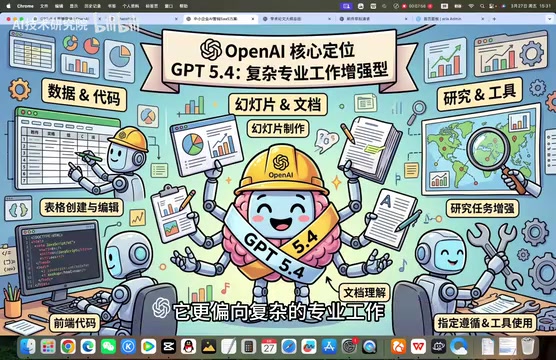
GPT-4 Thinking Coding Ability: Currently the Strongest Coding LLM
OpenAI has explicitly stated that GPT-4 Thinking is a version with significantly enhanced programming capabilities built upon GPT-3 Codex, positioning it as the strongest coding large language model available today.
The programming capabilities of large language models have gone through several key developmental stages. In 2021, OpenAI's Codex model (fine-tuned from GPT-3) was the first to push code generation into practical utility, becoming the underlying engine for GitHub Copilot and achieving a 28.8% pass@1 accuracy on the HumanEval benchmark. Since then, coding capabilities have gradually been integrated into general-purpose large models. The mainstream benchmarks for evaluating coding LLMs include: HumanEval (function-level code generation), MBPP (introductory Python programming), SWE-bench (real GitHub Issue fixes), and LiveCodeBench (dynamically updated competition problem sets). Among these, SWE-bench is closest to real-world development scenarios, requiring models to understand complete code repository context and fix actual bugs rather than just completing isolated algorithm problems. GPT-4 Thinking's improvement in such "repository-level code comprehension" tasks is precisely the core basis for its positioning as the strongest coding model.
Hands-On Test: Fixing a Vue Frontend Bug
In testing, GPT-4 Thinking was asked to act as a senior Vue frontend architect to handle code containing a typical bug. The model's performance was impressive:
- Precise Bug Location: Accurately identified the exact location of the problem in the code
- Root Cause Analysis: Provided detailed explanation of why the current structure causes the issue
- Detailed Tracing: Step-by-step tracing of the code execution flow
- Complete Solution: Delivered fix code along with best practice recommendations
- Knowledge Extension: Provided relevant development experience and precautions

Comparison with Gemini and Claude Coding Capabilities
Compared to competing models like Google's Gemini 3.1 Pro and Claude 4.6, GPT-4 Thinking demonstrates clear advantages in code comprehension depth and solution completeness. It not only provides fix code but also recommends the optimal repair approach with explanations—this "knowing not just what but why" output style offers higher practical value for developers.
Agent Capability Test: Understanding the AI Agent Industry in 15 Minutes
GPT-4 Thinking's Agent capability is demonstrated in its ability to act like a professional researcher, helping users quickly and thoroughly understand an unfamiliar industry.
AI Agent (intelligent agent) is not an entirely new concept—its theoretical roots trace back to Multi-Agent Systems research in the 1990s. However, in the era of large language models, AI Agent has taken on a completely new meaning: using an LLM as the "brain," combined with four core components—Tool Use, Memory, Planning, and Action—to form an intelligent entity capable of autonomously completing complex tasks. Current mainstream Agent frameworks include ReAct (Reasoning + Acting), AutoGPT, LangChain Agent, and others. GPT-4 Thinking's core advantage in Agent scenarios lies in its planning capability—the ability to automatically decompose vague high-level goals into executable sub-task sequences and dynamically adjust strategies during execution. This "task decomposition and autonomous planning" capability is the key indicator that distinguishes basic Q&A models from true Agent systems.
Test Process and Chain-of-Thought Display
In testing, the model was asked to act as a top-tier research industry analyst to help understand the AI Agent field in 15 minutes. GPT-4 automatically activated thinking mode based on the complexity of the question, reasoning for 39 seconds, with the detailed thinking process displayed on the right side.
The final output contained the following structured content:
- AI Agent Industry Quick Guide: Core concepts and technical architecture
- Monetization Models and Implementation Scenarios: Commercialization pathway analysis
- Core Moats and Critical Bottlenecks: Key industry challenges
- Two Biggest Commercial Pain Points: Deep insights
- One-Sentence Verdict for Investors: Concise summary
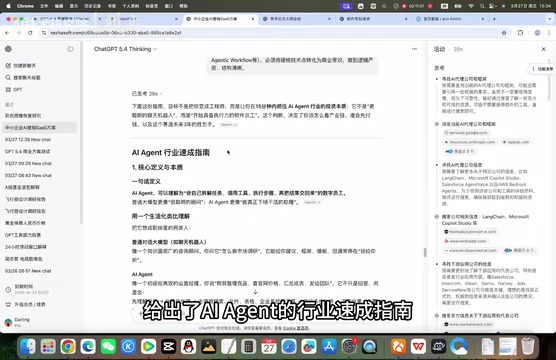
This structured, multi-layered output approach reflects the model's significant progress in complex research tasks.
AI Writing Capability: The Ideal Partner for Academic Papers and Business Copy
GPT-4 Thinking's improvement in writing scenarios is particularly notable, especially suited for the following tasks:
- Paper writing and outline generation
- Paper revision, rewriting, polishing, and expansion
- Long-form professional document writing
- Multi-step complex task processing
Real Test: Academic Paper Outline Generation
In testing, three PDF documents were uploaded, and GPT-4 was asked to summarize an academic paper outline based on the first document. This capability relies on advances in Multimodal LLM technology. Traditional document processing depends on OCR (Optical Character Recognition) to convert images to text, often losing significant semantic information when facing complex layouts, mathematical formulas, and charts. Modern multimodal models directly take document pages as visual input for end-to-end understanding, simultaneously perceiving text, layout structure, chart relationships, and visual hierarchy. GPT-4 Thinking can recognize the "Document Schema" of academic papers—abstract, introduction, methods, experiments, conclusion, and other fixed structures—and generate outlines conforming to academic standards accordingly, reflecting its systematic improvement in the Document Intelligence domain.
The model automatically activated thinking mode, reasoning for 39 seconds before delivering a complete academic paper framework:
- Paper Title
- Abstract
- Introduction
- Theoretical Foundations and Notation
- Problem Formulation
- Algorithm Design
- Theoretical Analysis
- Experimental Design and Results Analysis
- Conclusion and Future Work
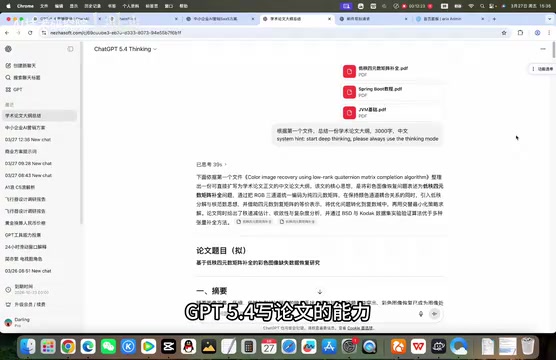
This output is not only structurally complete but also includes professional academic writing elements in each section, showcasing the model's powerful capabilities in document understanding and professional content generation.
Business Copywriting Capability
In the business writing test, GPT-4 Thinking was asked to write a highly persuasive project proposal—a core executive summary for an AI-automated marketing SaaS platform targeting SMEs. The model's output was extremely detailed and professional, concluding with a complete summary section, demonstrating its practical value in the business documentation domain.
Summary: Who Is GPT-4 Thinking For?
GPT-4 Thinking's positioning is very clear: it is oriented toward complex professional work scenarios. In spreadsheet creation and editing, frontend code development, document understanding, instruction following, tool usage, and research tasks
Related articles
 Product Reviews
The Programmer's Desk Setup Guide: Building a Workspace That Feels Like Home
Discover how programmers build productive, comfortable workspaces. From multi-monitor setups to ergonomic design, explore the desk philosophy that drives focus and flow.
 Product Reviews
Qoder vs Cursor Real-World Comparison: Which $20/Month AI IDE Is Better?
Hands-on comparison of Qoder vs Cursor AI IDEs: Agent autonomy, human interaction count, and architecture decisions. Qoder needed only 2 interactions vs Cursor's 8.
 Product Reviews
Cursor Cloud Agent Demo: Eliminating Bottlenecks Across the Entire Software Development Lifecycle
Deep analysis of Cursor's Cloud Agent demo showing how cloud VMs, automated test artifacts, and a full-chain control plane systematically eliminate human bottlenecks across the software development lifecycle.