GPT-5.6 Hands-On: Building a Shooter Game and a Premium Website from a Single Prompt, Plus GPT-Live Voice Experience

GPT-5.6 hands-on: a shooter game and premium website from one prompt, plus the new GPT-Live voice model.
A hands-on review of OpenAI's GPT-5.6 and the new GPT-Live voice model. Tests show it building a playable shooter game from a single prompt in 19 minutes, generating a premium animated website via multimodal image understanding, and enabling natural, emotional two-way voice conversation—reflecting the deep integration of ChatGPT and Codex.
The Highlight of This OpenAI Release: The Deep Merger of ChatGPT and Codex
OpenAI's latest release, GPT-5.6, isn't really about a bump in the model's raw intelligence—the truly noteworthy part is the deep integration of ChatGPT and Codex. In the new interface, Codex now lets you freely switch between "Chat mode" and "Codex development mode" in the top-left corner, and the original Codex icon has been unified into the ChatGPT icon.
Background on the evolution of Codex: Codex is a code-generation model OpenAI first introduced in 2021. It was originally fine-tuned from the GPT-3 architecture and trained specifically on billions of lines of open-source code from GitHub. As the underlying engine behind GitHub Copilot, it pioneered the entirely new paradigm of "AI-assisted programming." Unlike the early Codex, which existed as a standalone API, this deep merger with ChatGPT marks a major shift in OpenAI's product strategy—from a "specialized tool" toward a "unified intelligence platform." This integration means a single entry point can now invoke programming, conversation, visual understanding, and many other professional capabilities, so users no longer need to constantly switch between multiple products.
This means that when you open ChatGPT, it might simultaneously house a programmer, a data analyst, a designer, an operations assistant, and even an execution assistant that can operate your computer. AI is gradually evolving from a "tool you need to learn how to use" into an "intelligent partner that can complete tasks directly for you."
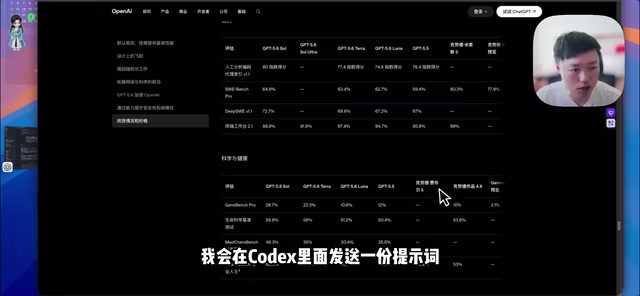
According to official data, the flagship GPT-5.6 model outperforms the flagship Claude model by about 13.1 points on coding ability, while costing only a quarter as much—an outstanding value proposition. This time, OpenAI has split the models into three tiers:
- Flagship tier (Soul): Suited for complex reasoning and long-chain tasks
- Balanced tier (Terra): Balances everyday work capability with cost
- Speed tier (Luna): Focuses on response speed and low pricing
This tiered pricing strategy has become a mainstream trend in the AI industry—combining models of different parameter scales or reasoning compute configurations to cover diverse needs ranging from individual users to enterprise-grade high-frequency usage. Essentially, it seeks the optimal Pareto solution between performance and computing cost.
The web version is divided into ChatGPT mode and Codex (Walk) mode, allowing flexible switching for different task scenarios. No matter how impressive the official numbers look, they still need real-world testing to verify.
Test 1: Building a Playable Shooter Game from a Single Sentence in 19 Minutes
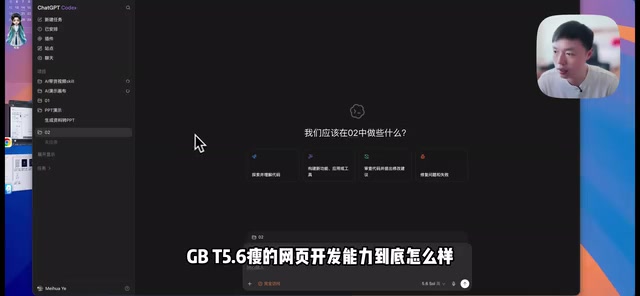
The tester first had ChatGPT automatically generate a development prompt to test Codex's game development capabilities, with the goal of independently building a shooter game.
After creating a new directory on the Codex page, the tester chose the GPT-5.6 Soul tier (without enabling ultra-high reasoning mode, to control consumption) and sent the prompt to execute. In just 19 minutes, GPT-5.6 completed the entire game's development and provided clear launch instructions.
The actual gameplay exceeded expectations: the game supports reloading with the R key, weapon switching via number keys (pistol, rifle, etc.), rifle spray fire, firing recoil feedback, and a complete health system. The level design also showed clear progression—the first level's enemies were fairly simple, while from the second level on, enemies would actively chase and deal damage, with later levels featuring boss fights and large numbers of infected enemies. When switching weapons, real-time operation hints even appeared on the right side.
Behind these 19 minutes lies a comprehensive test of AI's "long-chain task execution" capability. Traditional code-generation models could often only autocomplete code fragments, whereas Codex here demonstrated a complete engineering loop—from requirement breakdown, module design, and code generation to dependency management and debugging fixes. The industry calls this "Agentic Coding," meaning the AI autonomously plans and executes multi-step development tasks like a software engineer, rather than merely responding to a single instruction.
The tester put it bluntly: "You can achieve this kind of result from a single prompt—ordinary people really can develop games now." This reflects Codex's combined strength in requirement understanding, code generation, and autonomously completing long-chain tasks.
Test 2: Multimodal Image Understanding to Generate a Premium Website with Visual Animations
The second test focused on GPT-5.6's multimodal understanding capabilities. The tester provided two hand-drawn sketches (describing webpage requirements), a logo, and a phone product image, and with just a single prompt, asked it to generate a premium, long-scrolling website with visual animations.
Technical background on multimodal AI: Multimodal AI refers to models that can simultaneously process multiple types of input, such as text, images, and audio. GPT-4V (Vision) was an important milestone in OpenAI's introduction of visual understanding into the GPT series, and GPT-5.6 has further improved the accuracy of understanding unstructured visual content such as hand-drawn sketches and UI prototypes. The core challenge of this capability lies in "semantic alignment"—cross-modal matching of visual pixel information with the intent described in natural language, in order to drive code generation. Compared to processing standardized photos or charts, understanding hand-drawn sketches requires stronger abstract reasoning from the model, because sketches often have rough lines and distorted proportions, requiring contextual semantics to reconstruct the design intent.
This test simultaneously examined three key capabilities: image visual understanding, front-end design and development, and autonomous task completion.
The final level of completion was quite high: the generated website implemented scroll-based rotation animations, zoom transition effects, a color selection area, product demonstration animations, and a purchase/checkout module—overall largely reproducing the sketch requirements.
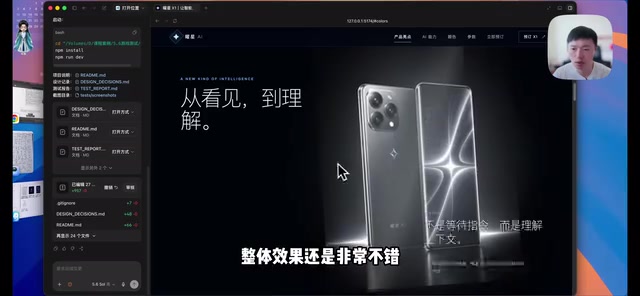
Of course, there were some flaws: the rotation effect required for the first poster wasn't fully realized, and a black parameter in one spot was mistakenly rendered as a bluish tone. Such color errors technically stem from how the model encodes image colors—the neural network encodes colors as high-dimensional vectors, and confusion can occur when they are semantically close, especially in distinguishing between dark colors (black, dark blue, dark gray), which is itself a known difficulty for multimodal models. But overall, the tester was impressed by the extent of the improvement: "Anyone who used 5.5 for front-end UI knows the results were very mediocre; now this front-end development capability is really quite good." Color coordination, animation demonstrations, parameter details, and the purchase flow were all presented quite well.
Test 3: The GPT-Live Voice Model—AI Starts to Speak Like a Human
Beyond coding capabilities, OpenAI simultaneously released a brand-new voice model, GPT-Live, which promises to completely transform the human-machine voice interaction experience.
GPT-Live's most core upgrade lies in making AI truly communicate like a human—its voice carries emotional ups and downs and supports real-time two-way conversation: it can listen to you while understanding your tone and context, and you can even interrupt at any time without waiting for it to finish each sentence.
Technical principles of real-time voice interaction: The real-time two-way voice interaction that GPT-Live represents technically requires solving three key challenges: low-latency speech recognition (ASR, Automatic Speech Recognition), streaming language model inference, and emotional modeling in natural speech synthesis (TTS, Text-to-Speech). Traditional voice assistants (such as early Siri and Google Assistant) used a serial pipeline architecture of "listen → understand → reply," which led to high conversational latency and an inability to handle interruptions. The streaming architecture introduced by GPT-Live allows the model to update its semantic understanding state in real time while the user is speaking, and to quickly generate a reply once it detects the end of an utterance—which more closely resembles the predictive processing mechanism of the human brain during conversation, and is the fundamental reason it sounds "more human." Emotional intonation is achieved through the TTS model's fine-grained control over prosody parameters, including speech rate, pitch variation, and pause rhythm.

The conversations during testing were quite interesting. When asked "Would you feel embarrassed?", it replied, "I wouldn't actually feel embarrassed, but I can describe that kind of scenario"; when asked to sing, it admitted it couldn't sing but could recite lyrics, and improvised a short original verse; it could even infer from context that the other party was conducting a "voice test." This kind of metacognitive ability—the model being aware of its own conversational situation—is one of the important emergent properties of large language models.
In terms of application scenarios, GPT-Live can serve as an English speaking coach, a real-time meeting transcription and translation tool, and can also be integrated into customer service systems, intelligent assistants, or robots to give them natural conversational abilities. However, the testing also exposed some shortcomings: occasionally it would fail to keep up with the conversation, or prompt "your voice is too soft to hear clearly," and it appeared rather evasive on certain sensitive comparison questions. Such evasive behavior is known in the industry as a side effect of "Safety Alignment"—after being trained with RLHF (Reinforcement Learning from Human Feedback), the model tends to respond conservatively when identifying potentially sensitive topics, sometimes triggering protective mechanisms in unnecessary scenarios.
Conclusion: GPT-5.6 Is Bridging the Complete Path from Idea to Product
Across all three tests, the core value of GPT-5.6 lies in bridging the complete path from idea to a launched product. In the past, completing professional work required separately learning programming, design, and development; now, with a single Codex prompt, end-to-end delivery becomes possible. GPT-Live gives us a glimpse of the prototype of future human-machine interaction—truly natural, emotionally rich two-way conversation.
From a broader industry perspective, this release also reflects the deeper logic of the AI competitive landscape: raw model capability scores are no longer a moat. True differentiation lies in "capability integration" and "product completeness." When programming, visual understanding, and voice interaction are unified in a single entry point, the barrier to using AI tools will keep falling, and the execution gap between ordinary people and professional engineers will narrow accordingly.
As the tester put it, AI won't replace everyone, but it will certainly change the efficiency and competitiveness of those who use AI well. What truly matters in the future isn't just knowing which AI models are available, but whether you can genuinely integrate these capabilities into your work, business, and daily life.
Key Takeaways
Related articles

Disaster and Glory of the Apollo Program: The History We Must Revisit Before Returning to the Moon
From the fatal Apollo 1 fire to Apollo 8's daring lunar orbit to Apollo 11's successful landing—revisiting the disasters, fears, and compromises of the Apollo program and their lessons for today's return to the Moon.

Netflix Trust Exercise Turns Into Firing Trap: Where Are the Boundaries of Corporate Trust?
A Netflix employee was fired after sharing private info in a trust exercise. We analyze the risks of corporate trust exercises and how employees can protect themselves.

AMD CDNA5 Architecture Deep Dive: Technical Evolution and the AI Computing Competition Landscape
Deep analysis of AMD's CDNA5 architecture covering Chiplet packaging upgrades, HBM memory evolution, and low-precision compute optimization, examining how AMD challenges NVIDIA's AI chip dominance.