GPT-5.6 Launch: Three Models Taking on Claude, and a Full Breakdown of the ChatGPT Work Super App

OpenAI's GPT-5.6 launches three Claude-rival models and the ChatGPT Work super app, betting on cost efficiency.
OpenAI has launched GPT-5.6 — a three-tier model family (Soul, Terra, Luna) mirroring Anthropic's Claude lineup — alongside ChatGPT Work, a desktop super app for agentic tasks. GPT-5.6 leads the Agent's Last Exam benchmark by 13 points at roughly one-quarter the cost of Claude, though it trails significantly on coding benchmarks like SWE-bench Pro. The release marks OpenAI's most direct challenge yet to Anthropic across both models and product surface area.
After a period of executive changes and regulatory negotiations, OpenAI has officially launched its next-generation model family — GPT-5.6. This release brings three distinctly positioned models and the highly anticipated "super app" ChatGPT Work. Drawing on official benchmark data, this article takes a deep dive into the key highlights and real competitive capabilities of this launch.
Three Models at Once, Lineup Aimed Squarely at Anthropic
The GPT-5.6 series launches with three models forming a clear tier structure: the flagship Soul targets the most complex tasks; the mid-tier Terra handles everyday work scenarios, balancing performance with cost; and the entry-level Luna prioritizes affordability for simpler tasks.
This structure mirrors competitor Anthropic almost exactly — which similarly offers the flagship Opus, mid-tier Sonnet, and efficient Haiku. From naming strategy to product positioning, OpenAI's intent is unmistakable: a direct challenge to the Claude lineup.
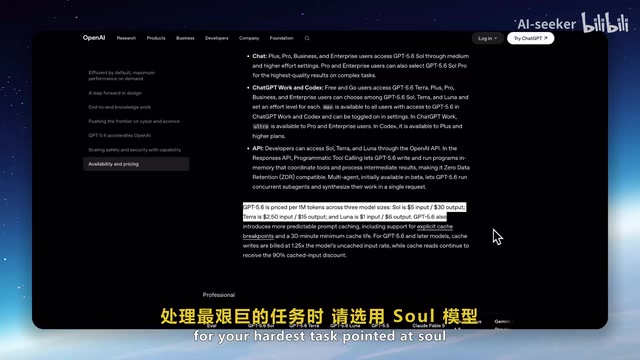
Pricing varies significantly across the three models:
- Soul (Flagship): $5 input / $30 output per million tokens
- Terra (Mid-tier): $2.5 input / $15 output
- Luna (Entry-level): $1 input / $6 output
Token Pricing and LLM Cost Structure: LLM API pricing is typically measured in "per million tokens." A token is the basic unit of text that a model processes — roughly equivalent to 0.75 English words or 1–1.5 Chinese characters. Input tokens (prompts) and output tokens (completions) are priced separately because generating output is far more computationally expensive than processing input — the model must generate tokens autoregressively one at a time, rather than processing them in parallel. As a result, output prices are generally 4–6× higher than input prices, a pattern reflected in the GPT-5.6 lineup: Soul's output price ($30) is exactly 6× its input price ($5). For enterprise users making frequent API calls, token cost directly affects the commercial viability of AI applications — which is precisely why OpenAI is positioning "cost efficiency" as a core selling point this cycle.
OpenAI emphasized in its official blog post that Luna can match the peak performance of the previous GPT-5.5 generation at less than half the cost — a generational price-performance leap that's highly compelling for developers.
Benchmarks: Differentiated Positioning Around "Efficient by Default"
OpenAI's central marketing concept this cycle is "efficient by default" — delivering peak performance on demand. This is also an implicit critique of Anthropic: while Claude models are undeniably powerful, users frequently hit rate limits in practice, making real-world efficiency less than ideal.
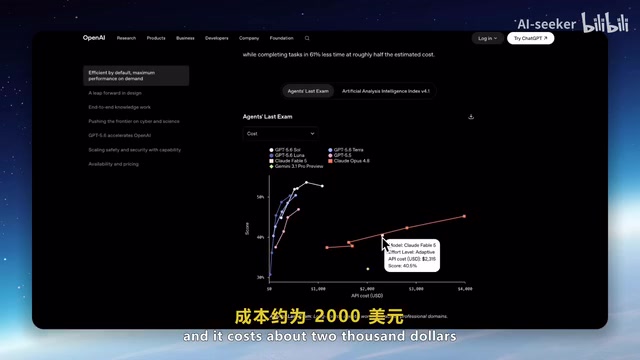
On the Agent's Last Exam benchmark (covering 55 domains and evaluating long-horizon professional task completion), GPT-5.6 set a new record with 53.6 points, outpacing Claude Opus 4.5 by 13.1 points.
Understanding the Agent's Last Exam Benchmark: Agent's Last Exam (ALE) is a class of "long-horizon agent benchmarks" that has gained prominence in AI evaluation. It specifically tests a model's ability to independently complete complex, multi-step, multi-tool tasks without human intervention. Unlike traditional QA benchmarks (such as MMLU or HumanEval), ALE covers 55 professional domains and requires models to complete coherent chains of reasoning and tool calls spanning dozens to hundreds of steps — far closer to real-world work scenarios. The core challenge is the "error compounding effect" — small mistakes at each step amplify downstream, ultimately causing the entire task to fail. GPT-5.6's 13.1-point lead on this test suggests meaningfully superior fault tolerance and planning capabilities in long-horizon tasks, and has direct implications for enterprise agentic workflow deployment.
OpenAI also noted that even at moderate reasoning levels, GPT-5.6 leads by 11.4 points while costing just one-quarter as much. The cost-efficiency comparison is even more striking: in agent benchmarks, achieving similar results with Claude costs roughly 8× more — GPT-5.6 at Extreme High settings costs around $63 for a 53.6% score, while Claude Sonnet in adaptive mode costs approximately $2,000 for just a 40.5% score. On the Artificial Analysis Intelligence Index composite benchmark, GPT-5.6 scores roughly 0.9 points below Claude Opus 4.5 — but at nearly half the cost.
This makes clear that OpenAI isn't chasing across-the-board dominance. Instead, it's firmly anchored to a single thesis: comparable results at lower cost.
Weaknesses and Strengths: Weaker at Coding, Leading on Security

Behind the impressive numbers, there are clear weaknesses. On the SWE-bench Pro software engineering benchmark, GPT-5.6 scored 64.6%, significantly trailing Claude's 80.3% — a wide gap that confirms a long-standing observation: OpenAI models have yet to catch up with Anthropic on pure software engineering tasks.
SWE-bench Pro and Software Engineering Evaluation: SWE-bench (Software Engineering Benchmark) is one of the most authoritative code capability evaluations in the industry, developed by the Princeton University team. Its Pro version is substantially harder than the standard version, requiring models to locate bugs in real GitHub repositories, understand context, and generate patches that pass test suites — not simply complete code snippets or solve algorithmic problems. This test closely mirrors what software engineers actually do: understanding large codebases, tracing logic across files, and generating changes that conform to project conventions. Claude has consistently led in this category, a result closely tied to Anthropic's extensive use of real-world code data in training and its deep optimization for tool use. The difference in training strategy between the two companies on "code comprehension and repair" is the fundamental reason for the 15.7-percentage-point gap.
In other areas, however, GPT-5.6 shines: it leads comprehensively on knowledge work benchmarks, and outperforms both Claude Opus and Opus 4.5 in science and health domains.
Most noteworthy is cybersecurity. On the CyberGym benchmark, GPT-5.6 edges ahead at 84.5% versus Claude's 83.8%.
CyberGym and the Regulatory Implications of AI Security Capabilities: CyberGym is a comprehensive benchmark for evaluating AI models on offensive and defensive cybersecurity tasks, covering vulnerability identification, penetration testing reasoning, malicious code analysis, and defensive strategy generation. High scores on these tests are a double-edged sword: they mean the model can serve as a powerful tool for security analysis and defense, but also that it has potential to assist in cyberattacks. This is precisely the central tension in the regulatory dynamics around frontier model releases. Organizations like the AI Safety Institute (AISI) require leading AI companies to submit safety evaluations before releasing high-capability models, and those with significant dual-use capabilities must pass rigorous red-teaming before going live.
This formidable offensive and defensive capability may well be the underlying reason why the GPT-5.6 Omni version was delayed — when a model's capabilities are strong enough to attract regulatory scrutiny, release timelines naturally get constrained, reflecting the governance challenges that come with frontier model advancement.
A "Step Change" in Frontend Design Capability
Frontend design has long been a traditional weak point for OpenAI's models. This time, the company claims GPT-5.6 has achieved a qualitative leap in "design judgment" — given only high-level direction, the model can now generate functional interfaces that are both aesthetically polished and ergonomically sound.
Official demos include examples such as interior design and a nautical simulation game. But from an objective standpoint, some demos still carry a certain "AI-generated roughness," and whether this can truly rival Anthropic's frontend generation capabilities requires more real-world validation. There is often a gap between curated official demos and the actual user experience, so a healthy dose of skepticism toward promotional data is warranted.
ChatGPT Work: A "Super App" for Everyday Users
The other major product in this launch is ChatGPT Work. Its core positioning is an agent that can operate across applications: it can pull from various files, stay focused on a single project over time, and given a single goal as input, generate a finished output directly — whether that's a presentation, a document, a spreadsheet, or a complete web application.
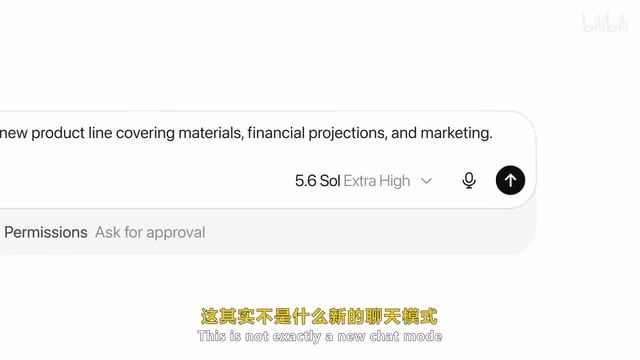
ChatGPT Work is not a new chat mode — it's a dedicated tab within the ChatGPT desktop app, sitting alongside the chat and Codex features. Behind this product decision is a telling data point: OpenAI found that Codex already has over 5 million weekly active users, more than 1 million of whom are not developers at all — they're simply using a coding tool to handle everyday tasks that have nothing to do with code.
Agentic Workflow and the Technical Background of Super Apps: Agentic workflow is one of the core paradigms for AI application deployment today. Rather than answering one-off questions, the AI model acts as an autonomous agent that continuously perceives its environment, calls external tools, breaks down subtasks, and iterates toward completing complex goals. Key technologies enabling this paradigm include function calling/tool use, long-context memory, multi-step planning, and interface integration with operating systems or third-party applications (such as file I/O and browser control). The competitive dimensions for both products aren't about single-turn conversation quality — they're about long-task stability, tool call success rates, error recovery, and depth of integration with local and cloud-based workflows. The organic adoption of Codex by over 1 million non-developers among its 5 million weekly actives is a textbook example of "real user demand preceding product definition," and represents OpenAI's most reliable market validation signal for ChatGPT Work.
It was precisely this spontaneous adoption by non-programmers that led OpenAI to build an agentic tool "anyone can use." ChatGPT Work's positioning is thus clear: it's not just for knowledge workers — it's designed to help ordinary people optimize daily workflows, advance personal projects, and meaningfully improve productivity.
Competitive Landscape: A Broad Confrontation with Claude
If ChatGPT Work sounds familiar, that's because Anthropic launched a strikingly similar product months ago — Claude Computer Use — with the same dedicated desktop tab next to the chat interface, an in-app code environment, file associations, task scheduling and background processing, and even its own plugin marketplace.
The two products are now in direct competition. OpenAI's overall strategy this cycle is clear: establish a differentiated advantage on benchmarks through "high efficiency, low cost," and on the product side, integrate web and Codex capabilities into a super app to comprehensively challenge Anthropic.
Who wins in the end will depend on real-world stability, ecosystem integration depth, and sustained price competition. But one thing is certain: as both leading companies continue to clash on the twin fronts of agentic workflows and price-performance, everyday users and developers alike stand to benefit.
Key Takeaways
Related articles
What Is Vibe Coding? The AI Programming Skill Every Developer Needs
What is Vibe Coding? Learn how AI programming is reshaping dev teams, why traditional programmers face displacement, and why Cursor & Claude Code matter.
Making Rocks Think: A Philosophical Exploration of Generative AI and Information Compression
From a viral Reddit post to deep AI theory: why compression equals understanding, the Library of Babel thought experiment, semantic compression, and the Hutter Prize.
Irregular Warns: Four AI Lab Security Breaches Traced to the Same Root Cause
Irregular reveals four AI lab security breaches share a single root cause, exposing systemic risks from technology stack homogeneity across the AI industry.