GPT-5.6 Now Widely Available: The Era of Three-Tier Models and Multi-Agent Orchestration Arrives

GPT-5.6 launches with three tiers and multi-agent orchestration, ushering in the AI agent era.
OpenAI releases the three-tier GPT-5.6 series (SOUL/TERRA/LUNA) with an Ultra mode coordinating four parallel agents. Meta counters with Muse Spark 1.1's million-token context. ChatGPT's desktop app unifies Chat, Work, and Codex, alongside a surge of agent tools, marking AI's shift into the multi-agent orchestration era.
OpenAI GPT-5.6 Now Widely Available: Three-Tier Models and Multi-Agent Orchestration
OpenAI has officially released its GPT-5.6 model series to the public, making it one of the most closely watched moves in the AI industry recently. The series is divided into three tiers: the flagship SOUL, the balanced TERRA, and the cost-effective LUNA, spanning the full spectrum of needs from complex workloads to cost-sensitive scenarios.
OpenAI's three-tier naming strategy continues the "Good-Better-Best" product portfolio logic of large-model commercialization, similar to the instance tiering of cloud computing providers. This layering is not just a graded allocation of compute resources, but also a fine-grained mapping of users' willingness to pay and usage scenarios. From an industry perspective, OpenAI, Anthropic, and Google have all established a three-tier structure of flagship reasoning models, balanced models, and lightweight models. The driving force behind this is the significant decline in inference costs—according to industry estimates, token inference costs have dropped by more than 90% over the past two years, making "flagship popularization" possible. This downward cost curve fundamentally stems from the maturation of model distillation (Knowledge Distillation) technology: transferring the output distribution of a large teacher model to a smaller student model, greatly compressing parameter scale while retaining most of the reasoning capability; as well as the acceleration of specialized inference hardware. For example, NVIDIA H100's Transformer Engine has been deeply optimized for mixed-precision matrix multiplication, boosting FP8 training and inference throughput nearly 4x compared to the previous generation.
The flagship SOUL sets new SOTA (State-of-the-Art, the current best) records across multiple benchmarks including coding and cybersecurity. SOTA is the core metric in the AI field for measuring whether a model reaches the industry's highest level on a specific evaluation set. Common coding benchmarks include HumanEval (testing function-level code completion accuracy), SWE-bench (simulating real GitHub Issue fixing scenarios, requiring the model to locate defects and generate patches that pass test cases), and CTF cybersecurity challenge sets. It's worth noting that "setting new SOTA" itself carries the risk of "Benchmark Overfitting"—a model may be specifically optimized for test set characteristics rather than genuinely improving generalization ability. This problem has long existed in the NLP field: shortly after the GLUE benchmark was released around 2018, top models' scores approached or even exceeded human-level performance, yet their performance on real language understanding tasks differed dramatically, forcing the community to successively introduce harder alternative benchmarks like SuperGLUE and BIG-Bench. This is also the background for the industry's growing emphasis on real-world work scenario evaluations (such as directly measuring improvements in developer productivity).
Even more noteworthy is the newly added Ultra mode—it coordinates four Agents by default to handle complex tasks in parallel, marking a shift in large models from a "single inference" paradigm to "multi-agent orchestration." Multi-Agent Orchestration refers to an architectural paradigm in which a complex task is decomposed and handed off to multiple specialized AI agents for parallel or collaborative execution: an "Orchestrator" is responsible for task allocation and result integration, while each sub-agent focuses on specific subtasks such as code generation, web search, or data analysis.
Multi-agent orchestration is not an entirely new concept. Its theoretical roots trace back to Multi-Agent Systems (MAS) research in the 1990s—when researchers were already exploring how to enable distributed autonomous programs to collaboratively complete tasks through communication protocols, with representative work including the ACL (Agent Communication Language) communication standard established by FIPA (the Foundation for Intelligent Physical Agents). The core difference between agent orchestration in the modern LLM era and classic MAS is that the former relies on language models as a "general reasoning core," interacting with the external environment through tool calls (Function Calling/Tool Use) rather than predefined finite state machines. This means agents can dynamically understand subtask descriptions in natural language form and adaptively adjust strategies mid-execution based on intermediate results, without needing to pre-write rules for every situation. Typical frameworks include OpenAI's Swarm (a lightweight multi-agent coordination prototype), Microsoft's AutoGen (an automation framework supporting conversational agent role-playing and code execution), LangChain's LangGraph (modeling agent workflows as directed graph state machines), and Anthropic's Model Context Protocol (MCP, aimed at standardizing the connection interface between agents and tools/data sources). Ultra mode's default parallel execution of four agents is the commercial productization of this evolution, and its key engineering challenge is state consistency among agents—when subtask results depend on each other, the failure or hallucination of any single agent can produce cascading errors. This architecture breaks through the context and capability bottlenecks of single models, but also introduces new challenges such as inter-agent state synchronization, error propagation, and unpredictable emergent behavior. OpenAI states that the series shows clear improvements in frontend design, document generation, and end-to-end knowledge work.
The models are gradually rolling out globally, with users on different plans having differentiated access permissions across products. This tiered strategy both preserves the scarcity of flagship capabilities and allows cost-sensitive developers to obtain usability through LUNA.
Meta Competes Head-to-Head: Muse Spark 1.1 Targets Large Codebases
At almost the same time, Meta Super Intelligence Labs released the multimodal reasoning model Muse Spark 1.1 and its API preview version. The model's biggest highlight is its million-token context window. The context window is the maximum text length a model can process in a single inference; a million tokens is roughly equivalent to 7.5 million English words, comparable to fully loading dozens of large code repositories.
Achieving a million-token context window requires fundamental innovation at the attention mechanism level. The self-attention computation complexity of standard Transformers is O(n²)—doubling the sequence length means a fourfold increase in computation, which under ultra-long sequences causes both memory and compute to explode. Mainstream solutions include: sparse attention (Sparse Attention, such as Longformer's sliding window mechanism, where each token only attends to local neighbors and global anchors), linear attention approximations (such as the state-space models drawn upon by the Mamba architecture, processing sequences recursively at O(n) complexity), ring attention (Ring Attention, which shards ultra-long sequences across multiple GPU nodes, with each node taking turns passing KV cache to achieve exact full-sequence attention), and the Flash Attention series of IO-aware exact attention algorithms (avoiding memory read/write bottlenecks through tiled computation, achieving 2-4x speedup over naive implementations). Additionally, the core engineering challenges of ultra-long context also include: KV Cache memory usage exploding linearly with sequence length (a single KV Cache under a million tokens can reach tens of GB), and the "Lost in the Middle" phenomenon—where a model's retrieval ability for content in the middle of long sequences is significantly weaker than at the beginning and end. Stanford University's 2023 research first systematically quantified this degradation curve, and mitigating it typically requires specifically designing long-distance retrieval tasks during the training phase, rather than solving it through architectural changes alone. Meta emphasizes that Muse Spark 1.1 shows significant improvements on "real tasks involving large complex codebases," meaning it has made engineering-level breakthroughs on the above problems, and can orchestrate multi-agent systems and navigate across application interfaces.
OpenAI and Meta have both, by coincidence, placed their focus on "long context + multi-agent orchestration," which has become the main battleground of frontier model competition. Developers can now build applications through the API, and the model has also gone live simultaneously on Meta AI apps and websites.
ChatGPT Desktop Restructured: Chat, Work, and Codex All in One
Alongside the model upgrade, OpenAI made an important consolidation of its product form. The new ChatGPT desktop app merges the three major functions of Chat, Work, and Codex, while supporting both macOS and Windows. Existing Codex apps can switch to the new version after updating, and all original tasks and projects are preserved—users can also keep Codex as the default launch interface in settings and choose the Codex icon.
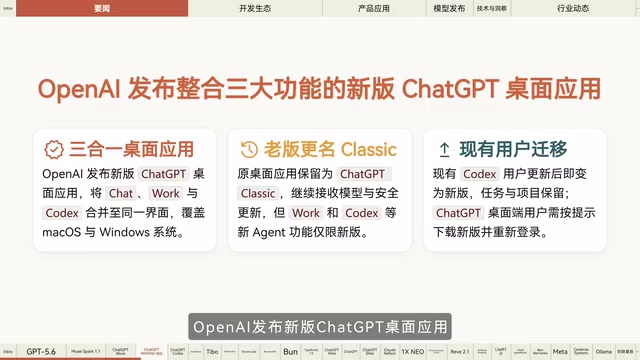
This consolidation reflects OpenAI's product philosophy of "one entry point connecting all workflows." Previously scattered scenarios of conversation, office work, and coding have been gathered into a unified application, greatly reducing the cognitive burden of users switching between multiple tools.
ChatGPT Work Agent Goes Live
The ChatGPT Work agent, jointly powered by Codex and GPT-5.6, has been officially released, supporting cross-application operations, generating interactive sites, scheduled tasks, and "computer use" capabilities. It is currently available on desktop to all plan users, and is gradually rolling out to paid users on web and mobile.
"Computer Use" refers to an AI Agent's ability to perceive screen state through screenshots and generate mouse click/keyboard input commands to control graphical interfaces—essentially converting GUI operations into a Vision-Action Loop. Its technical implementation is a "Vision-Language-Action" (VLA) closed-loop system: the model obtains screen state through screenshots (perception), parses UI element semantics using multimodal understanding capabilities (understanding), then generates structured action commands (execution), forming a continuous loop. The technical difficulty lies in the generalized recognition of UI elements—the visual languages of web pages, desktop applications, and command-line interfaces differ greatly, and interfaces change with version updates. Current mainstream implementations assist screenshot perception with the "accessibility tree"—the operating system's accessibility APIs (such as macOS's AXUIElement and Windows' UIAutomation) can describe the semantic role (button, text box, menu item) and hierarchical relationship of every interactive element in the interface as structured tree data, providing text-level semantic anchors for visual perception and greatly improving element localization accuracy. Anthropic was the first to publicly demonstrate this capability in Claude 3.5 Sonnet in 2024, followed by OpenAI and Google. The biggest difference from traditional RPA (Robotic Process Automation) tools is that AI Agents don't need preset fixed operation scripts and can dynamically respond to interface changes—this is a key step for agents to move from "conversational assistants" to "actual executors," though robustness still faces ongoing challenges.
Codex Feature Upgrades and Quota Reset
ChatGPT Codex received multiple upgrades simultaneously: it can now directly edit Markdown and code files, review GitHub Pull Requests within the app, and adds two new execution modes: Pro and Ultra.
Noteworthy is the industry chain reaction triggered by quota issues—Anthropic's account CloudDevs was the first to announce resetting user rate limits, followed by Codex lead Tibo announcing a comprehensive reset of ChatGPT Work and Codex usage quotas taking effect within an hour. The intensive adjustments to quota policies by both camps reflect the enormous pressure that agent-type products place on compute consumption—unlike single-turn conversations, multi-step agent tasks may trigger dozens or even hundreds of model calls within a single session, making the average per-user compute consumption one to two orders of magnitude higher than ordinary chat scenarios. This in turn forces service providers to dynamically rebalance between user experience and compute costs.
The AI Agent Ecosystem Blossoms Across the Board
Another major trend is the concentrated emergence of "agent observability and operations" tools, indicating that agents have moved from "can they be used" to a new stage of "how to manage them well."
AlphaEvolve, an AI code optimization agent developed by Google Cloud in collaboration with Google DeepMind, has been officially released, available to all customers through the Gemini Enterprise Agent Platform. ElevenLabs launched 11Agent Spotlight as a real-time monitoring layer, supporting continuous agent optimization through custom evaluations and proactive suggestions.
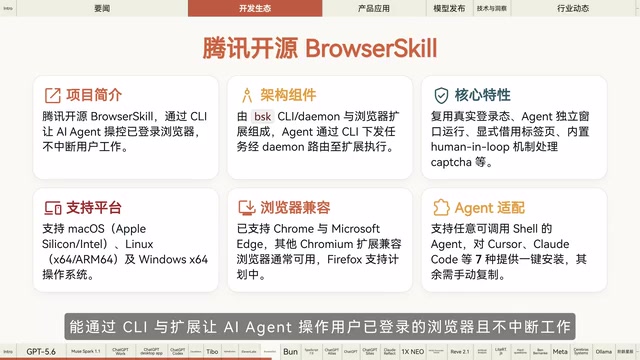
Tencent open-sourced the Brother Skills project, which can enable AI Agents to operate the user's already-logged-in browser through a CLI and extensions without interrupting work. It currently supports Chromium browsers on mainstream desktop systems.
Artificial Analysis, in collaboration with ServiceNow, released the standalone EnterpriseOps leaderboard, specifically testing AI Agents' ability to perform multi-step operations in enterprise systems. Unlike traditional academic benchmarks focused on code generation, EnterpriseOps anchors test scenarios in real enterprise scenarios such as ticket processing, cross-system data queries, and approval process automation. This shift in evaluation paradigm has profound background: academic benchmarks often use "average accuracy" as a single metric, while enterprise scenarios care more about "Task Completion Rate," "error recoverability," and "integration cost with existing IT systems"—dimensions that are nearly impossible to measure on static datasets and must be evaluated through dynamic sandboxes connected to real enterprise systems (such as ServiceNow's ITSM platform). The emergence of EnterpriseOps represents agent evaluation moving from "capability demonstration" toward standardized verification of "production readiness." The establishment of such benchmarks means that enterprise-level agent evaluation is becoming systematic.
Fundamental Changes in the Developer Toolchain
Developers should also pay close attention to several major updates to foundational tools.
The runtime Bun officially announced that it has rewritten its codebase from the Zig language to Rust and merged it into the mainline. V1.4.0 will be the first Rust version, currently available for early access through the Canary build. Bun originally chose Zig because of its low-level control capabilities and extreme performance characteristics—Zig provides an explicit programming model with no hidden control flow and no implicit memory allocation, allowing developers to finely control every system call and memory layout, which is crucial for building a high-performance JavaScript runtime. However, the Zig ecosystem is relatively niche, with few community contributors and a toolchain maturity that falls short of Rust. As Bun's user base grew, Zig's shortcomings became increasingly apparent: the number of community contributors is less than one-tenth of Rust's, the third-party library ecosystem is scarce, IDE support is weak, resulting in extremely high costs for accepting and maintaining external contribution PRs. Rust, with its "Ownership" memory safety model (eliminating dangling pointers and data races at compile time through the borrow checker, without needing a garbage collector), mature Cargo package management ecosystem (over 130,000 crates), and high-performance non-blocking I/O support provided by the Tokio async runtime, is becoming the mainstream choice for system software—this migration is a strategic tradeoff Bun made in engineering maintainability and community scalability, and is also a pragmatic choice of "engineering sustainability over technical purity" as open-source projects move toward scaling.
The TypeScript team released a Go-native port of TypeScript 7.0, with the team stating that build speeds improved by up to 10x. The TypeScript compiler has long been implemented in a "self-hosted" manner (in TypeScript/JavaScript itself), which has an inherent disadvantage in cold-start performance—the performance ceiling brought by Node.js interpreted execution is hard to break through. Even bundling tools like esbuild, written in Go, have demonstrated through comparison that natively compiled languages can be 10-100x faster than JS implementations in build tool scenarios. The Go version (codenamed "Corsa") uses static compilation to eliminate V8 startup overhead and achieves file-level parallel type checking through goroutines (type inference for each .ts file can execute concurrently as an independent coroutine, with the scheduler aggregating results), reducing incremental compilation for large monorepo projects from tens of seconds to seconds. It's worth noting that this migration is merely a change in the compiler's implementation language; the TypeScript language specification itself remains unchanged, and existing .ts code requires no modification. The lack of support for embedded language frameworks like Vue is because Vue Single File Components (SFC) need to inject custom language plugins into the compiler through a Programmatic API—the existing JS version of TypeScript exposes a complete compiler API for tools like Volar to extend, while the Go version rewrote internal data structures, and the corresponding plugin interfaces are still under development, expected to be gradually completed in subsequent minor versions.
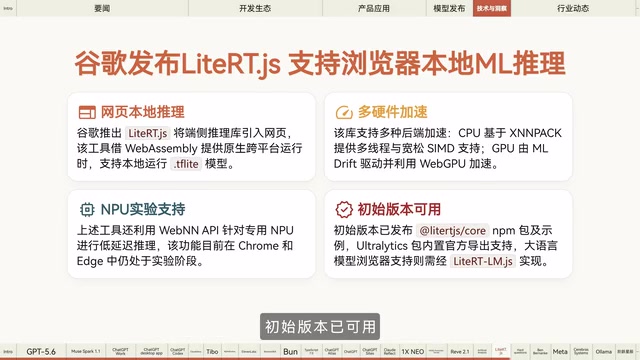
Google released LiteRT.js, bringing the on-device inference library to the web. On-device Inference refers to running machine learning models directly on user devices such as browsers and phones, without sending data to cloud servers. LiteRT (a brand rename of the former TensorFlow Lite, completed in 2024, reflecting Google's intent to elevate on-device AI to an independent strategic product line—raising it from a subsidiary position in the TensorFlow ecosystem to a core framework that can evolve independently) adapts to resource-constrained environments through optimization techniques such as model quantization (compressing floating-point weights to INT8/INT4, reducing model size to 1/4 to 1/8 of the original) and operator fusion (merging multiple consecutive operations into a single kernel call, reducing memory read/write counts). After being introduced to the web, LiteRT.js can access local compute through three hardware acceleration paths: WebGPU (providing low-level access to GPU shaders and supporting general-purpose parallel computing, far outperforming WebGL which was designed only for graphics rendering), WebAssembly SIMD (leveraging CPU vector instruction sets—such as x86's AVX2 and ARM's NEON—to batch-parallelize matrix operations), and WebNN (a W3C-standardized API that can directly call dedicated neural network hardware such as device NPU/DSP, with better power consumption and latency than the GPU path on supported platforms). These three paths bring three core values: user data never leaves the device (privacy protection), zero network latency (real-time response), and offline availability. This complements cloud-based multi-agent orchestration—simple tasks are processed locally, complex tasks are orchestrated in the cloud. Future agent orchestration systems are likely to form a hybrid topology of "local lightweight agent preprocessing + cloud heavyweight agent inference," constituting a more complete AI capability distribution system.
Anthropic's Exploration of AI Governance
Beyond the technology race, Anthropic demonstrates continued investment in AI governance.
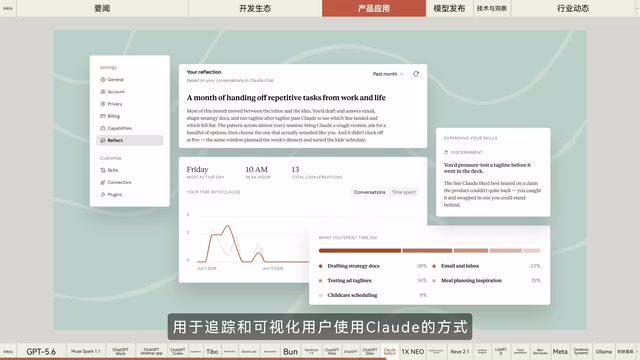
The company launched a beta version of the Claude Reflect feature, used to track and visualize how users use Claude. The dashboard can display peak usage times, topics, and collaboration patterns.
Anthropic also launched the new Hard Questions initiative, inviting the public to submit difficult questions about AI's impact, and pledging to publicly track reports on actions taken to address these questions as well as shortcomings.
The company also appointed former Federal Reserve Chairman Ben Bernanke as a new member of the Long-Term Benefit Trust (LTBT). The LTBT is the core governance mechanism through which Anthropic, as a Public Benefit Corporation, maintains balance between commercial financing and safety mission: its members hold no company equity and have the right to intervene in board decisions when the company deviates from its safety mission—similar to the "checks and balances" design in constitutions, and echoing the lessons of the failure of OpenAI's early nonprofit structure (the 2023 OpenAI board's removal of the CEO exposed the fragility of governance mechanisms, and Anthropic's LTBT design can be seen as an institutional response to this cautionary precedent). Ben Bernanke is renowned in academia for his research on the "Great Depression" and systemic financial contagion mechanisms. His core academic contribution is revealing how the collapse of financial intermediaries (banks) amplifies local credit shocks into global economic crises through information asymmetry and liquidity spirals—this "Cascading Failure" analytical framework is structurally highly isomorphic with the AGI safety field's concerns about "rapid propagation of capability loss of control": both focus on how local failures evolve into global irreversible collapse through tightly coupled system topologies. The addition of Bernanke, known for his research on the "Great Depression" and systemic financial risk, conveys a clear signal—Anthropic is treating AGI risk by analogy to systemic economic risk requiring macroprudential regulation, highly consistent with the overall framework of its "Responsible Scaling Policy," reflecting a high degree of attention to systemic risk governance.
Hardware, Compute, and Funding Developments
There is also frequent activity at the compute and hardware level. Meta announced it will invest over 13 billion Canadian dollars to build a data center in Alberta, Canada—its first data center in Canada. Cerebras plans to build data centers in France and the Nordic region, with total capacity expected to expand to 200 megawatts, part of which will be used to support OpenAI's workloads.
Local inference platform Ollama completed $88 million in funding, currently serving 8.9 million developers, with 85% of Fortune 500 companies using its products. In the robotics field, 1X Technologies launched a 25-degree-of-freedom tendon-driven hand designed specifically for the NEO humanoid robot, featuring native force control and high-resolution tactile sensing, with the company stating annual capacity can reach 10,000 units.
Conclusion: AI Officially Enters the Era of Multi-Agent Orchestration
Looking across this wave of intensive releases, one clear main thread runs throughout: AI has officially entered the era of multi-agent orchestration. GPT-5.6's Ultra mode, Muse Spark 1.1's million-token context, the three-in-one ChatGPT desktop app, and the endless stream of agent observability and operations tools all point to the same future—AI is no longer just an assistant that answers questions, but a digital workforce capable of autonomous execution and collaborative work. The migration of the underlying toolchain from Zig to Rust, from JS to Go-native, and LiteRT.js extending inference capabilities to the browser, together build the infrastructure foundation supporting this future. And Anthropic's active exploration at the governance level also reminds the entire industry: with greater capability comes greater responsibility.
Key Takeaways
Key Takeaways
Key Takeaways
Related articles

Gaussian Process Bandit Optimization: Exploration Strategies and Inference Regret Guarantees
Cumulative regret guarantees in Bayesian optimization fail to reflect final recommendation quality. This article examines a new study that provides inference regret guarantees for Gaussian process bandit optimization through exploration query strategies and fill distance analysis, validated on hyperparameter optimization and control tasks.

The Most Detailed Codex Guide on Bilibili: From Installation to Real-World Practice
The most detailed Codex guide on Bilibili: from app store installation to daily work mode configuration, with a real coffee shop project demonstrating file organization, data extraction, dashboard creation, and other practical tasks. Learn to use Plan Mode and desktop pets to leverage Codex efficiently.

Appearance Compensation in Volume Rendering: Why RGB Accuracy Cannot Guarantee Density Correctness
Volume rendering research reveals that volumetric data perfectly reproducing external RGB views may still contain density errors: appearance compensation can double central density and keep external rays unchanged even when L2 error exceeds 14.52%. Density recovery depends on appearance capacity, spatial resolution, and measurement design.