GPT-5.6 Price Cut Over 20%: A Complete Analysis of AI Competition from OpenAI, DeepSeek Multimodal, and More

GPT-5.6 cuts prices 20%+, Codex hits 20M users, DeepSeek launches multimodal model amid fierce AI competition.
OpenAI announces a 20%+ price cut for GPT-5.6 Sol, Codex surpasses 20 million active users and launches AI-powered security scanning integrating Anthropic's model. DeepSeek releases its V4 Flash Vision multimodal model with toolchain upgrades, while mysterious anonymous model OS Alpha dethrrones DeepSeek after 56 days atop API call volume rankings. The AI industry is entering multi-dimensional competition across pricing, ecosystems, security, and toolchains.
OpenAI Announces GPT-5.6 Sol Price Cut Exceeding 20%
Among the AI industry updates on August 22nd, the most noteworthy news was OpenAI's announcement that it will reduce the price of the GPT-5.6 Sol model over the next three months. This price cut covers both API usage fees and subscription prices, with reductions exceeding 20%.
According to the daily report, the adjusted pricing will be $4 per million input tokens and $20 per million output tokens. In the LLM API pricing system, tokens are the basic billing unit—one token is roughly equivalent to 0.75 English words or 1-2 Chinese characters. When a model processes a request, the input text (prompt) and generated output text are counted separately by tokens. Output tokens are typically more expensive than input tokens because generating output requires autoregressive inference token by token, with attention weights recalculated for each new token generated, resulting in greater computational overhead. This pricing adjustment reflects the intensity of competition in the current large model market—as open-source models and competitors continue to emerge, reducing inference costs and improving cost-effectiveness has become a core strategy for leading vendors competing for developers and enterprise customers.
What you might not have noticed is that for existing Pro, Plus, and other subscription plan users, usage remains unchanged. This means OpenAI is pushing forward with price cuts while maintaining stability in the existing user experience, avoiding confusion caused by pricing structure adjustments.
The Market Logic Behind the Price Cut
The GPT-5.6 Sol price reduction is not an isolated event. From an industry perspective, as model capabilities converge toward homogeneity, price wars have become an unavoidable competitive tool. When API costs drop to more accessible levels, the barrier to entry for developers decreases, which in turn expands the user base of the entire ecosystem—this is a classic strategy of trading volume for price and ecosystem for market share. Notably, the confidence behind this price cut comes from continuous optimization of inference efficiency: the maturation of technologies including model distillation, quantization compression, and Speculative Decoding has reduced the computational cost per inference call by several times over the past year, providing the technical foundation for commercial price reductions.
Codex Active Users Surpass 20 Million, Security Scanning Feature Launches
OpenAI's coding assistant Codex also brought multiple pieces of good news. Codex lead Typo announced that to celebrate the milestone of surpassing 20 million active users, the company will provide all users with a one-time storable and redeemable quota reset opportunity, with more good news to be shared later.

The scale of 20 million active users clearly demonstrates that AI programming tools have moved from the early adopter phase into large-scale adoption. Developers' reliance on AI-assisted programming continues to deepen, which explains why major vendors are doubling down on investments in coding tools. For reference, GitHub Copilot reported approximately 1.3 million paid users in early 2024, and the entire AI coding assistant market has achieved exponential user growth in less than two years, reflecting that these tools have transformed from a "nice-to-have" into a core component of developers' daily workflows.
Codex Security Scanning Feature Explained
Beyond user incentives, Codex also announced that its Codex Security scanning feature now supports use within Mithos 5. This feature can invoke Anthropic's most powerful security model to sweep code repositories for security vulnerabilities. It is currently available in public beta for Enterprise users.
This is particularly noteworthy: OpenAI's product integrates a competitor Anthropic's security model, reflecting cross-camp capability complementation in the critical field of AI safety. Traditional Static Application Security Testing (SAST) tools rely on rule matching and data flow analysis, which tend to produce numerous false positives and struggle to understand complex business logic vulnerabilities. LLM-based security scanning can understand the semantic intent of code, identifying deep-level security issues including SQL injection, Cross-Site Scripting (XSS), insecure deserialization, and privilege bypass. This AI-native security auditing approach is becoming the new standard for enterprise-grade code security assurance. For enterprise users, code security auditing is becoming an indispensable capability of AI programming tools.
DeepSeek Launches Multimodal Model V4 Flash Vision
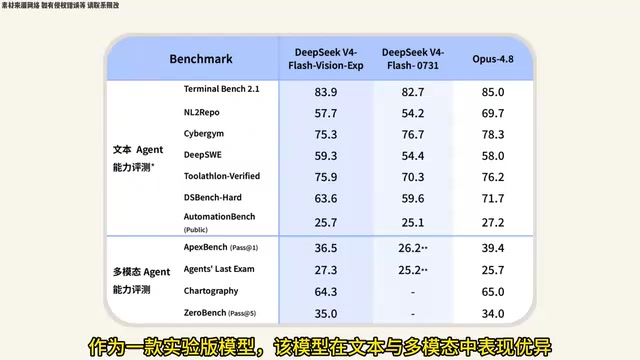
In the open-source and domestic model camp, DeepSeekAd has released its multimodal model DeepSeek V4 Flash Vision EXP. As an experimental model, it performs excellently in both text and multimodal tasks.
Multimodal models refer to AI models capable of simultaneously processing and understanding multiple data types (such as text, images, audio, and video). Unlike text-only models, multimodal models need to map information from different modalities into a unified representation space, typically using visual encoders (such as ViT, or Vision Transformer) to convert images into token sequences, which are then fed together with text tokens into a Transformer architecture for joint reasoning. The "Flash" naming typically implies the use of inference acceleration optimization techniques, such as FlashAttention and other efficient attention computation methods, significantly reducing inference latency and memory usage while maintaining model performance.
According to the introduction, this model not only achieves breakthroughs in multimodal capabilities but also shows improvement in text-only performance compared to the previous V4 Flash 0731 version. The model is now available on the DeepSeek API platform for developers to use.
Official Toolchain Upgrades in Sync
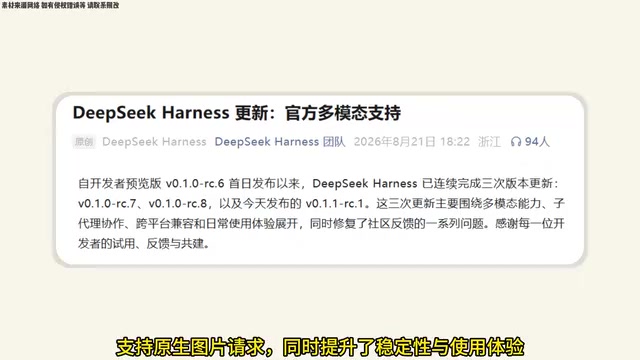
Accompanying the model release, the DeepSeek Harness team announced new official multimodal support, supporting native universal requests while improving operational stability and overall user experience. Users can experience the new features by updating to version V0.1.1 RC.1.
The simultaneous upgrade of model capabilities and supporting toolchain reflects DeepSeek's clear strategy for building a complete developer ecosystem—model capability alone is no longer sufficient to create a moat; a stable and user-friendly toolchain is the key to retaining developers. In the AI industry, a "Toolchain" refers to a complete development support system built around a core model, including SDKs, CLI tools, debugging environments, documentation systems, model fine-tuning frameworks, deployment tools, and more. Historical experience shows that developer ecosystem stickiness often lies not in the model itself, but in the completeness of the toolchain built around it—similar to how the competitive core between iOS and Android is not the operating system itself, but their respective developer ecosystems. DeepSeek Harness, as the official toolchain, provides standardized model invocation interfaces and multimodal support, reducing integration costs for developers. This is a critical step in the transformation from "model provider" to "platform company."
Anonymous Model OS Alpha Tops API Call Volume Rankings
This edition of the daily report also mentions an intriguing piece of news: the anonymous model OS Alpha has sparked widespread discussion in the community. According to OpenCode, this model dethroned DeepSeek from its 56-day reign at the top of the API call volume rankings, with yesterday's call volume reaching 2.6T. On the OpenRouter platform, its single-day call volume reached 1.99T, ranking first globally.
OpenRouter is a unified AI model API aggregation platform where developers can access models from OpenAI, Anthropic, Google, Meta, and other vendors through a single interface. The platform provides standardized usage statistics and performance rankings, making it an important barometer for measuring actual market interest in models. An anonymous model topping the charts often signals that a vendor is about to release a major new product—the industry typically conducts gray-scale testing in anonymous form on platforms like OpenRouter to collect real user feedback and preference data while avoiding the influence of brand effects on evaluation results. When an anonymous model defeats known leaders in call volume, it usually means it has earned organic endorsement from the developer community based on actual experience—more convincing than any official benchmark.
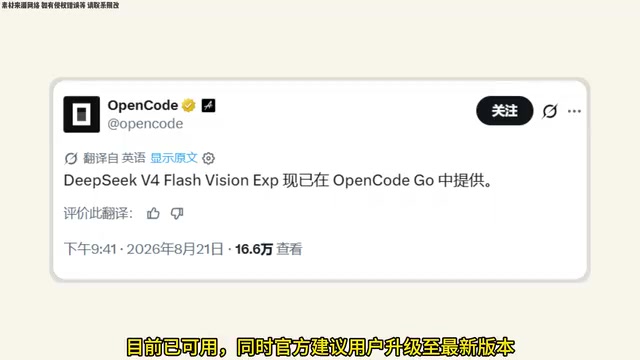
Additionally, OpenCode announced the addition of the V4 Flash multimodal model to its plans, which is now available, and recommends users upgrade to the latest version.
Summary: AI Competition Enters a Multi-Dimensional Battle of Price, Ecosystem, and Security
Looking at this edition's updates holistically, it's clear that competition in the current AI industry has evolved from a singular model capability race into a comprehensive multi-dimensional battle encompassing price, ecosystem, security, and toolchains. OpenAI consolidates its market through price cuts and strengthens its ecosystem through user milestones; DeepSeek fills capability gaps with multimodal breakthroughs; and the dark horse emergence of anonymous models signals the beginning of a new round of competition.
For developers and enterprise users, this competitive landscape is undoubtedly positive—lower costs, stronger capabilities, and more comprehensive security guarantees are forming a solid foundation for AI application deployment. From a more macro perspective, the AI industry is following a development trajectory similar to the early days of cloud computing: first a capability race driven by technological breakthroughs, then market penetration driven by price wars, and ultimately a mature competitive phase centered on ecosystem completeness and enterprise-grade reliability. We are currently at a critical juncture transitioning from the second phase to the third.
Related articles

Gaussian Process Bandit Optimization: Exploration Strategies and Inference Regret Guarantees
Cumulative regret guarantees in Bayesian optimization fail to reflect final recommendation quality. This article examines a new study that provides inference regret guarantees for Gaussian process bandit optimization through exploration query strategies and fill distance analysis, validated on hyperparameter optimization and control tasks.

The Most Detailed Codex Guide on Bilibili: From Installation to Real-World Practice
The most detailed Codex guide on Bilibili: from app store installation to daily work mode configuration, with a real coffee shop project demonstrating file organization, data extraction, dashboard creation, and other practical tasks. Learn to use Plan Mode and desktop pets to leverage Codex efficiently.

Appearance Compensation in Volume Rendering: Why RGB Accuracy Cannot Guarantee Density Correctness
Volume rendering research reveals that volumetric data perfectly reproducing external RGB views may still contain density errors: appearance compensation can double central density and keep external rays unchanged even when L2 error exceeds 14.52%. Density recovery depends on appearance capacity, spatial resolution, and measurement design.