GPT-5.6 Released: Codex Officially Integrated into ChatGPT, Ushering in a New Era of AI Programming

OpenAI launches GPT-5.6 and integrates Codex into ChatGPT, bringing Agent programming to the masses.
OpenAI has released the GPT-5.6 model and integrated Codex's programming capabilities directly into ChatGPT, enabling developers to generate and debug code within conversations without switching tools. This article analyzes the product logic behind the update, its impact on the AI programming tool ecosystem, and the key points developers should watch.
OpenAI Makes Another Move: Codex Comes to ChatGPT
OpenAI recently announced two major updates: the launch of the GPT-5.6 model, alongside the direct integration of Codex's programming capabilities into ChatGPT. This combined move means developers no longer need to repeatedly switch between separate tools—they can now invoke code generation and debugging capabilities directly within the familiar ChatGPT interface.
For developers who have long followed the AI programming space, this is not merely a routine version update. Codex started out as the underlying engine behind GitHub Copilot, later evolved independently into a specialized tool line for Agent-based programming, and has now returned to OpenAI's flagship product, ChatGPT. This marks a further consolidation and realization of OpenAI's product philosophy of "conversation as development."
Technical Background on Codex's Evolution: Codex was first released in 2021 as a standalone API product from OpenAI. Built on the GPT-3 architecture, it underwent large-scale fine-tuning on code data, with training corpora covering billions of lines of public code on GitHub. It was precisely this model that provided the initial power for GitHub Copilot, pioneering the commercialization of AI-assisted programming. As the GPT-4 series rose to prominence, Codex was gradually superseded by more powerful general-purpose models. However, OpenAI did not abandon the brand—instead, it repositioned Codex as a specialized tool line for Agent programming scenarios, emphasizing capabilities such as multi-step code execution, file system operations, and autonomous debugging. This reintegration into ChatGPT marks Codex completing a full cycle: from specialized API → branded tool line → built-in capability of a mainstream product.
The fundamental difference between Agent programming and traditional code completion lies in the shift in interaction paradigm. Traditional code completion (such as early Copilot) is essentially "next-line prediction"—the model receives the context before the cursor and outputs the most likely continuation, a single-turn, passive mode of interaction. Agent programming, by contrast, introduces a "plan-execute-feedback" loop mechanism: the model not only generates code but can also invoke a terminal to execute it, read error messages, analyze failure causes, revise its strategy, and try again—forming an autonomous multi-step workflow.
The realization of this loop mechanism depends on Function Calling technology—a capability OpenAI formally introduced in the GPT-4 API in 2023. It allows language models to recognize when external tools need to be invoked during a conversation, output the call parameters in structured JSON format, have the host program execute them, and then return the results to the model to continue reasoning. This mechanism breaks the limitation of language models as pure text generators, enabling them to genuinely interact with external environments such as code executors, file systems, and search engines. Anthropic refers to a similar capability as Tool Use—the two are similar in principle but differ slightly in API design. In Agent programming scenarios, Function Calling is the core infrastructure for realizing the "plan-execute-feedback" loop: the model invokes a terminal executor to run code, reads the stdout/stderr output, and adjusts its next step accordingly. The entire process is autonomously orchestrated by the model without requiring human intervention at every step.
In addition, Agent programming requires the model to have a sufficiently long context window (to accommodate key snippets of an entire codebase) as well as self-reflection capabilities. By integrating this capability into ChatGPT, OpenAI is transforming Agent programming from a high-barrier technology that requires a specially configured development environment into a general-purpose capability that can be triggered simply through conversation.
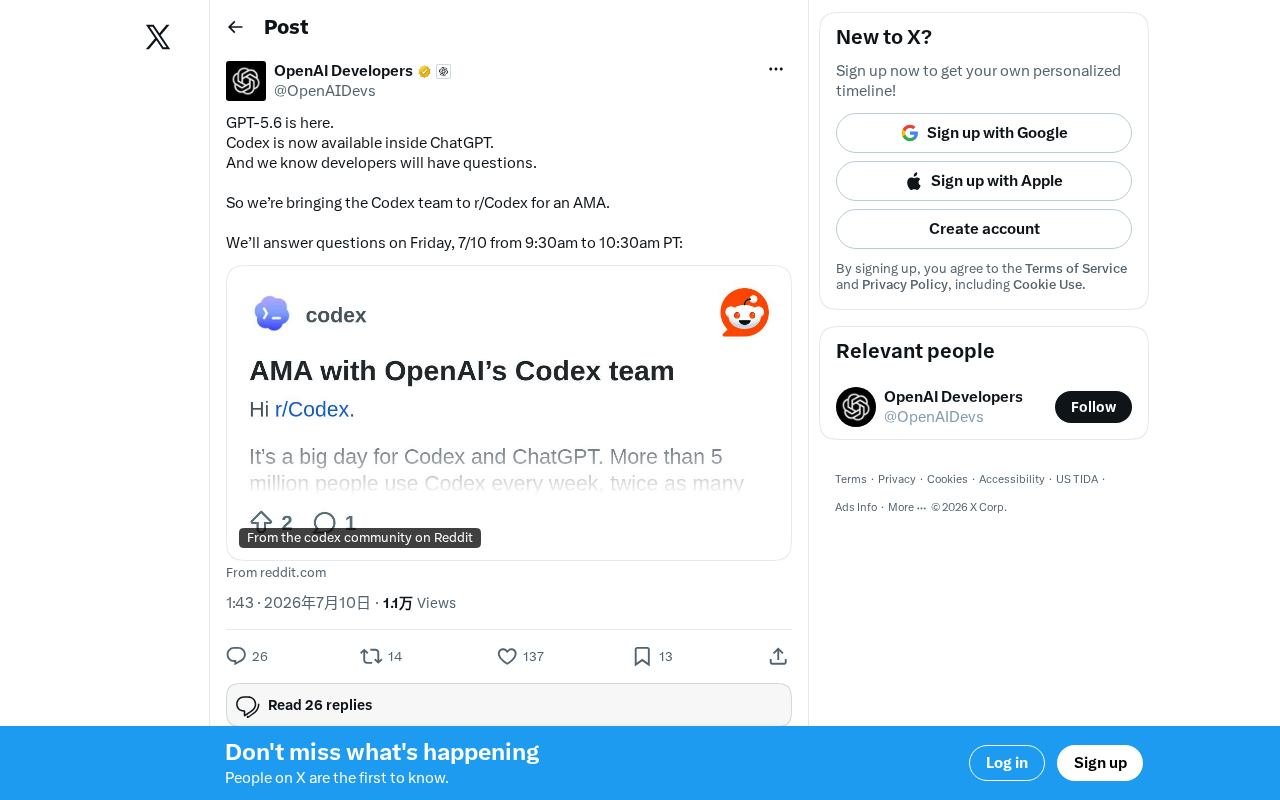
To address questions from the developer community, the OpenAI team announced it will hold an AMA (Ask Me Anything) session on Friday, July 10, from 9:30 to 10:30 AM Pacific Time on Reddit's r/Codex subreddit, with core members of the Codex team answering questions directly.
The Product Logic Behind Version Iterations
From GPT-5 to GPT-5.6
Decimal version numbers often warrant closer reading than major versions. Against the backdrop of accelerating large-model competition, major vendors have generally adopted more flexible version-naming strategies. OpenAI's decimal versions (such as GPT-4o, GPT-4.5, GPT-5.6) typically represent targeted capability improvements achieved through supervised fine-tuning (SFT), reinforcement learning from human feedback (RLHF), or domain-specific data augmentation—all while keeping the underlying architecture unchanged. This strategy mirrors the logic of Semantic Versioning in traditional software: the major version number represents significant architectural changes, while the minor version number represents feature-level enhancements.
Understanding these minor version iterations requires knowing the two main technical paths for improving large-model capabilities. Supervised fine-tuning (SFT) builds on pre-training by conducting targeted training with high-quality labeled data, aligning the model's performance on specific tasks (such as code generation or mathematical reasoning) with expert demonstrations. In code scenarios specifically, SFT's labeled data often comes from high-quality code examples written by senior engineers, code review records, and debugging logs. By imitating these demonstrations, the model learns to follow coding standards, choose appropriate algorithmic structures, and handle edge cases. RLHF goes a step further: by collecting human preference ratings on model outputs, it trains a Reward Model, then uses reinforcement learning algorithms (such as PPO) to continuously optimize the language model toward higher rewards. For code scenarios, this process is especially efficient, because the correctness of code can be objectively verified through unit tests, compiler feedback, and the like—providing a clearer reward signal than open-ended text. Code either passes tests or it doesn't; this binary feedback is far easier to quantify than "is this piece of writing good or not."
In recent years, OpenAI has also introduced the Process Reward Model (PRM), whose design fundamentally differs from the Outcome Reward Model (ORM) that only evaluates the final output. ORM only judges whether code passes tests, while PRM scores each intermediate step of the reasoning chain individually—for example, evaluating whether each stage of "analyze requirements → design data structures → implement core logic → handle edge cases" is reasonable. In the paper "Let's Verify Step by Step," OpenAI systematically validated PRM's superiority on mathematical reasoning tasks, and subsequently extended this methodology to code scenarios. PRM's core value lies in its ability to identify and reward "correct reasoning": even if the final output fails due to a minor error, a correct reasoning process still receives positive reinforcement; conversely, even if code happens to pass tests, if the reasoning path has a fundamental flaw (such as relying on an unreliable assumption), PRM will assign a negative score. For complex debugging tasks, PRM can identify and reinforce correct reasoning patterns such as "reproduce the problem first → isolate variables → locate the root cause," rather than merely checking whether the final patch passes tests—further improving performance on complex code-debugging tasks.
Judging from the naming pattern, GPT-5.6 is not a disruptive upgrade at the architectural level, but more likely a targeted enhancement and fine-tuning optimization of code understanding and generation capabilities built on top of GPT-5. For code scenarios, targeted fine-tuning is generally more efficient than general capability improvement, because code languages have clearer syntactic rules and quantifiable evaluation criteria (such as whether code executes correctly), making the signals for targeted optimization more explicit.
This "small steps, fast pace" release cadence reflects OpenAI's strategic shift during the white-hot phase of large-model competition: rather than storing up energy waiting for a perfect major version, it delivers incremental capabilities to users at a higher frequency, rapidly gathering real-world feedback and forming an iterative loop. For developers, this means AI programming capabilities will continue to evolve on shorter cycles.
Why Bring Codex Back to ChatGPT
Reintegrating Codex into ChatGPT is essentially a move to remove usage barriers. In the past, developers wanting to tap into Codex's advanced programming capabilities often had to rely on standalone CLI tools, IDE plugins, or specialized agent environments. Behind this lies the technical paradigm of Agent programming—unlike traditional single-turn code completion, Agent programming emphasizes the model's ability to autonomously plan multi-step tasks: reading the codebase, running tests, analyzing errors, modifying code, and re-verifying, forming a complete autonomous debugging loop. This requires the model to possess Tool Use capabilities, long-range contextual memory, and self-correction abilities—a relatively high technical bar. Now, ordinary ChatGPT users can directly obtain code capabilities approaching professional-tool level right within a conversation.
The strategic value of this integration lies in the fact that ChatGPT is OpenAI's largest entry-point product by traffic volume, home to a vast number of non-professional developer users. Bringing Codex capabilities down to this entry point both expands the reach of AI programming features and, through a broader range of real-world usage scenarios, accumulates training data—forming a virtuous cycle.
Impact on the Developer Ecosystem
Further Unification of the Toolchain
Over the past two years, AI programming tools have flourished in a diverse landscape that has now formed a multi-tiered competitive structure. The current market can be divided into three competitive tiers:
The first tier is the deep IDE integration layer: GitHub Copilot, backed by Microsoft's strategic investment in OpenAI and its monopolistic position in the VS Code ecosystem, has over 1.5 million paying users and is currently the most commercially mature product. JetBrains AI Assistant, meanwhile, focuses deeply on enterprise-grade language ecosystems such as Java/Kotlin. The core advantage of products in this tier is their seamless embedding into developers' existing workflows—developers don't need to switch environments, as AI completions appear right beside the cursor with extremely low friction cost. However, this embedding also brings a capability ceiling: constrained by IDE architecture, such tools can typically only perceive the context of the current file or a few open files.
The second tier is the AI-native editor layer: Cursor achieves cross-file global code understanding by vector-indexing the entire codebase—under the hood, it converts code snippets such as functions, classes, and modules into high-dimensional vectors via an Embedding Model, storing them in a local vector database. When a user makes a request, the system precisely retrieves the most relevant snippets to inject into the context via Approximate Nearest Neighbor (ANN) search. The technical essence of vector indexing is compressing and encoding the semantic information of code into points in a mathematical space, where semantically similar code snippets are closer to each other—enabling "retrieval by semantics" rather than "matching by keywords." This is precisely why the system can find relevant function implementations even when you describe a feature in natural language. This technology solves the fundamental problem of large codebases exceeding the model's context limit, allowing the model to precisely locate the most relevant few hundred lines for reference even in repositories with millions of lines of code. Its "Composer" feature allows users to describe requirements in natural language and directly generate code changes across multiple files, with the company's valuation once exceeding $9 billion. Windsurf (formerly Codeium) similarly emphasizes global code awareness and entered the market with a lower-pricing strategy.
By comparison, traditional IDE plugins (such as early Copilot) can only perceive the context of the currently open file, often falling short in enterprise-grade projects with complex cross-file dependencies—which is precisely the core reason the AI-native editor tier has been able to rise.
The third tier is the underlying model competition layer: Anthropic's Claude has consistently maintained a lead on SWE-bench (the software engineering benchmark), while Google's Gemini Code Assist is pushing into the enterprise market through Google Workspace integration. By integrating Codex into ChatGPT, OpenAI is effectively making moves in both the first and third tiers simultaneously, attempting to reassert its influence in the programming space through the combined advantage of "model + entry point."
Worth noting is that SWE-bench itself is an important benchmark for evaluating AI programming capabilities—launched by a research team at Princeton University, it draws 2,294 resolved issues from real GitHub repositories and requires models to automatically generate code patches that pass all relevant tests, given the state of the codebase and the issue description. SWE-bench's authority stems from the authenticity of its task sources: each test case corresponds to a bug or feature request that once troubled a real developer, and the patch validation standard is the test suite actually used by project maintainers, rather than artificially constructed algorithm problems. Unlike manually constructed algorithm problems, SWE-bench's tasks come from real open-source project maintenance scenarios, so they more authentically reflect a model's actual performance in production environments. Its curated subset, SWE-bench Verified, has had ambiguously described or unstable-test samples filtered out by human annotators, making it one of the most authoritative AI programming capability leaderboards in the industry today.
Tool unification is a double-edged sword for developers. The benefits are obvious: reduced tool-switching costs and improved workflow coherence. On the other hand, one must also guard against over-reliance on a single platform. Truly mature development teams often maintain strategic flexibility across multiple tools.
The Community Signal Conveyed by the AMA
The AMA (Ask Me Anything) originated from Reddit's community culture, originally an informal Q&A format for public figures to interact directly with netizens. When tech companies introduce it into their product launch processes, it essentially reflects the evolution of a Developer Relations (DevRel) strategy.
Developer Relations (DevRel) originated in the 1990s from Sun Microsystems' practice of promoting the Java ecosystem, later maturing through leading companies of the API economy era such as Twilio, Stripe, and AWS. Its core logic is that developers differ from ordinary consumers—they are both users of the product and builders who integrate the product into downstream applications, and therefore have higher demands for technical transparency, API stability, and community voice. Traditional DevRel primarily relied on technical documentation, developer conferences, and open-source contributions. Entering the large-model era, as model capability boundaries became hard to predict and API changes frequent, developers' demand for trust in vendors surged dramatically, and higher-frequency interaction formats such as AMAs and real-time Q&A in Discord channels have become standard tools of the new generation of DevRel. Notably, this rising demand for trust is no accident: when developers deeply embed AI models into production systems, an unexpected capability regression or API change can trigger cascading failures, with a risk exposure far exceeding that of ordinary SaaS tools—which fundamentally explains why technical transparency is so critical to this group.
Compared to the one-way broadcast of an official blog, an AMA has three key characteristics: transparency (questioners are publicly visible, and dodging questions gets noticed by the community), real-time responsiveness (able to quickly address the community's latest concerns), and a sense of community belonging (conversations take place in developers' own gathering places). Reddit's voting mechanism automatically pins the sharpest, most representative questions to the top, meaning that deliberately dodging sensitive questions will be quickly recognized by the community and generate negative sentiment—this mechanism effectively imposes an implicit constraint on participants, making AMAs more informative than company-led press conferences.
OpenAI's choice to hold the AMA in Reddit's r/Codex community, rather than merely broadcasting one-way through an official blog, signals that OpenAI is placing increasing importance on direct dialogue with the developer community. Previously, OpenAI faced a crisis of community trust over issues such as GPT-4 API pricing and capability degradation. Choosing to hold an AMA in r/Codex is, to some extent, a proactive gesture toward repairing that trust relationship.
The AMA format means the team is willing to directly address sharp questions from frontline developers—whether about model capability boundaries, pricing strategy, or sensitive topics such as code data privacy and enterprise compliance. Questions of broad developer concern may include: How significant is GPT-5.6's performance improvement on real programming tasks? Does the Codex integration affect how existing APIs are called? Is enterprise code used for model training? What availability and compliance safeguards exist for enterprise-grade scenarios? This open attitude carries real significance for building developer trust.
Viewing This Update Rationally
That said, publicly available information remains limited for now. This official announcement is, in nature, closer to a "teaser." Key details—such as GPT-5.6's specific capability metrics, the functional details of the Codex integration, and its availability scope (whether it covers all users or is limited to specific subscription tiers)—still await further disclosure from OpenAI, or answers during the AMA.
To assess the actual value of such updates, one can refer to data from standardized benchmarks like SWE-bench, but what matters more is the actual experience in real-world project scenarios—there is often a significant gap between benchmark tests and day-to-day development tasks, especially when dealing with legacy codebases, cross-language mixed projects, or specific frameworks, where the model's performance differences may be more subtle than benchmark numbers suggest. Legacy codebases are an especially telling litmus test: such code often lacks proper comments, mixes coding styles from multiple historical periods, and may even include third-party dependencies that are no longer maintained—posing challenges to both the model's contextual understanding and its knowledge cutoff date. These complex situations almost never appear in carefully designed benchmarks.
Therefore, we advise developers to stay attentive but avoid over-interpretation. What determines the actual value of this update is not the height of the version number, but how much efficiency improvement it brings to real programming tasks, and whether it can maintain stable, reliable performance in complex project scenarios.
Conclusion
The release of GPT-5.6 and the integration of Codex into ChatGPT are OpenAI's latest moves in its ongoing bet on the AI programming space. They clearly convey two product trends: an accelerating pace of model iteration, and the descent of developer capabilities toward mainstream entry points.
For the developer community, the July 10 AMA is a rare window to obtain firsthand information and ask the core team questions directly. In an era where AI-assisted programming is increasingly becoming a development standard, deeply understanding the capability boundaries and best practices of these tools will become a mandatory course that no developer can avoid.
Key Takeaways
- GPT-5.6 is a targeted enhancement based on SFT and RLHF, not an architectural rebuild. PRM (Process Reward Model), by scoring intermediate reasoning steps individually, can identify and reinforce correct debugging reasoning paths rather than relying solely on final test results, making optimization for complex code-debugging tasks more precise.
- The reintegration of Codex marks the descent of Agent programming capabilities from a high-barrier professional tool to a mass-market entry point, with Function Calling technology serving as the core infrastructure for realizing the multi-step "plan-execute-feedback" workflow.
- The competitive landscape has formed three tiers—the IDE integration layer, the AI-native editor layer (with vector indexing as its core technical advantage, using embedding models to map code semantics into a high-dimensional vector space for cross-file global understanding), and the underlying model layer—with OpenAI now pushing on multiple tiers simultaneously.
- SWE-bench is currently the most authoritative benchmark for evaluating AI programming capabilities. Its design based on real GitHub issues reflects production-environment performance better than algorithm problems, but a significant gap remains between benchmarks and complex scenarios such as legacy codebases and cross-language mixed projects.
- The July 10 AMA is a key window for obtaining firsthand information. Reddit's voting mechanism and the evolution of DevRel strategy together ensure that the sharpest developer questions receive direct responses. The frequent API changes and unpredictable capability boundaries of the large-model era have caused developer demand for trust to surge, and the AMA is precisely the high-frequency interaction mechanism for meeting this demand.
- The value of an update should be assessed based on real-world project scenarios, rather than relying purely on benchmark numbers.
Related articles

WorkBuddy Step-by-Step Tutorial: Get an Automated Workflow Running in Half an Hour
A step-by-step breakdown of the WorkBuddy automated workflow: why most people only use it as a chat app, how the 27-anchor course and 12 templates help beginners get up and running in half an hour, plus notes on usage boundaries.

The Truth About Free Claude Code: Three Legitimate Paths and One Scam
Is free Claude Code possible? We break down the real cost of Pro and Max (with exchange rates and taxes), how community free methods work and their privacy trade-offs, plus fake installers and phishing traps—and three legitimate free paths.
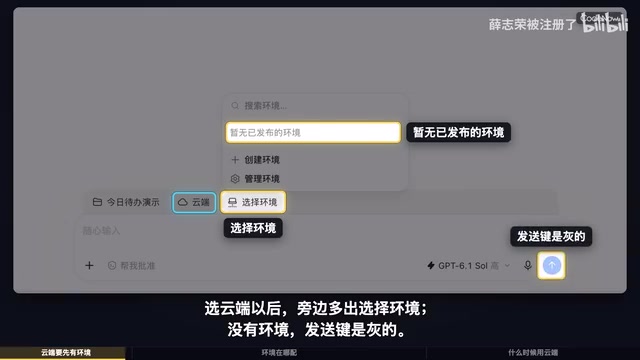
Codex Cloud Mode Explained: Environment Setup and Use Cases
This article explains how Codex cloud mode works, environment setup steps, and use cases, including how to create environments, connect GitHub repositories, set scheduled tasks, and compare cloud vs. local mode.