GPT-5.6 Released: Hands-On Analysis of Programmatic Tool Calling and Autonomous Agents
GPT-5.6 debuts with programmatic tool calling, autonomous subagents, and a three-tier API strategy.
GPT-5.6 is officially released, focusing on Agentic execution over raw parameters. Key upgrades include programmatic tool calling that bypasses ReAct's context loop, intelligent subagent delegation based on hierarchical policies, higher token information density, and a three-tier API model. A hands-on card game build in Claude Code showcases its end-to-end autonomy.
GPT-5.6 Officially Released: Stronger Reasoning and Tool-Calling Capabilities
The GPT-5.6 series of models is now officially available to the public. Compared to its predecessor, the company emphasizes that the core upgrade of this generation lies in the higher information density carried by each token—even when a user's prompt is vague and open-ended, the model can still maintain clear reasoning, accurately understand intent, and produce stable output.
A token is the basic unit through which large language models process text, typically corresponding to a word, subword, or punctuation mark. From a technical architecture standpoint, modern LLMs employ tokenization algorithms such as Byte Pair Encoding (BPE) or SentencePiece to split raw text into subword units from a fixed vocabulary—for example, "tokenization" might be split into two tokens, "token" and "ization," while Chinese is typically tokenized into single- or double-character units. An increase in information density means that, given the same number of input tokens, the model can extract and infer richer semantic context.
Behind this capability lies the combined optimization of pre-training data quality, model architecture design, and the RLHF (Reinforcement Learning from Human Feedback) alignment phase—the model learns, through training on massive amounts of human preference data, to proactively complete logic and infer implicit intent under ambiguous input, rather than merely executing literal instructions. Worth understanding in depth: the improvement in token information density is the result of synergy across multiple technical layers. At the data level, the filtering and denoising of high-quality pre-training corpora directly affect how well the model learns semantic boundaries, and low-quality data can lead the model to acquire incorrect semantic association patterns. At the architecture level, ongoing improvements to attention mechanisms (such as Grouped-Query Attention, GQA, and Rotary Position Embedding, RoPE) enable the model to more precisely capture long-range semantic dependencies, extending "contextual understanding" from local scopes to a broader textual range. At the alignment level, RLHF uses human preference data to guide the model toward implicit intent inference, while newer alignment algorithms such as DPO (Direct Preference Optimization) further enhance the model's consistency under open-ended instructions while reducing training costs. The synergistic optimization of these three layers collectively forms the technical foundation of the macro-level capability that is "increased information density."
Prompt engineering, as a systematic discipline, has spawned a large body of best practices over the past few years—from Chain-of-Thought prompting to Few-shot Examples, developers have had to invest considerable effort in designing structured instructions. Chain-of-Thought prompting improves accuracy on complex tasks by guiding the model to spell out intermediate reasoning steps, while few-shot examples help the model quickly adapt to specific task formats by providing input-output samples within the prompt—both techniques essentially compensate for the model's insufficient ability to understand intent. GPT-5.6's claim to lower this barrier essentially means the model has acquired stronger intent-inference capabilities during pre-training and alignment, able to compensate for ambiguity and missing information in user input through richer implicit semantic representations.
For developers, the practical value of this improvement should not be underestimated. In the past, we often had to repeatedly refine prompts and add context to steer the model onto the right track. GPT-5.6's goal is to lower the barrier of "prompt engineering," allowing the model to proactively complete logic and infer requirements even when information is incomplete.
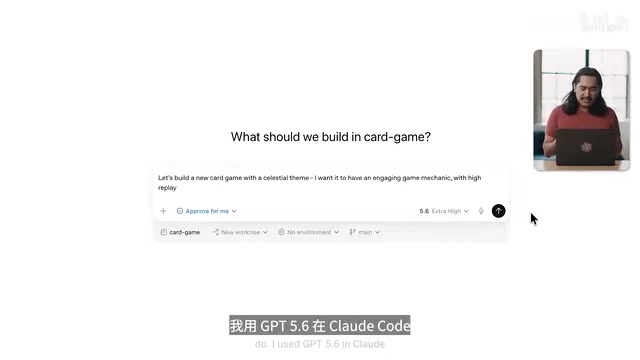
One highlight of this release is that the company demonstrated the model's capabilities through a real-world case: within the Claude Code environment, building a complete card game from scratch using only a brief, open-ended prompt.
Hands-On: Building a Card Game from Scratch in Claude Code
Claude Code is an AI-assisted programming environment introduced by Anthropic that allows AI models to directly access the file system, execute terminal commands, and iteratively modify codebases. Its underlying implementation relies on the Tool Use protocol and a sandboxed execution environment, allowing the model to interact with operating-system-level resources through a structured API, rather than remaining confined to text generation. The sandboxed execution environment uses containerization technology (such as Docker) to isolate the model's runtime privileges, preventing code execution from causing unintended damage to the host system while providing a controlled view of file system access—this is a key piece of infrastructure for the safe deployment of AI agents.
Notably, OpenAI's GPT-5.6 runs within the Claude Code environment, reflecting the openness of the current AI ecosystem—interoperability between models and toolchains from different vendors is increasing, partly thanks to the promotion of open protocol standards such as MCP (Model Context Protocol). Introduced by Anthropic in 2024, MCP aims to define a unified protocol specification for interactions between AI models and external tools and data sources—analogous to a "USB interface standard" in the AI tooling ecosystem: any model that follows the protocol can seamlessly connect to any compatible tool, breaking the previously closed, siloed ecosystems maintained by individual vendors. On a deeper technical level, MCP's design draws on the success of LSP (Language Server Protocol)—which standardized communication between IDEs and language services, allowing editors like VS Code, Vim, and Emacs to avoid implementing syntax highlighting and autocomplete logic individually, instead connecting uniformly to LSP-compliant language servers. MCP applies the same decoupling philosophy to AI tool-calling scenarios: a tool provider only needs to implement an MCP server once, and it can then be invoked by all MCP-supporting models, greatly reducing the cost of ecosystem integration. Developers can freely combine the most powerful models with their preferred development environments, without being locked into a single vendor's all-in-one solution—this decoupling trend is reshaping the competitive landscape of AI toolchains.
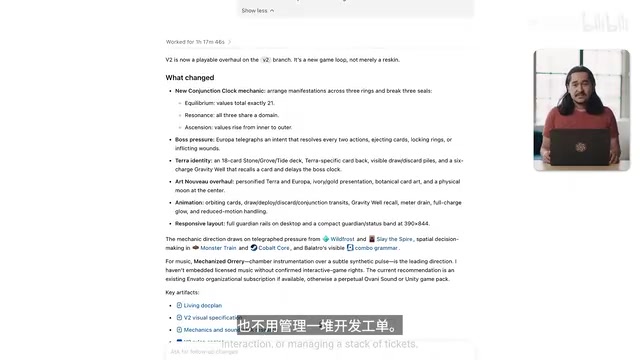
The demonstrator gave an open-ended prompt, asking GPT-5.6 to independently create "a game it genuinely wanted to play." The result was impressive: the model not only designed the core gameplay mechanics but also automatically generated art assets, ultimately delivering a directly runnable version.
Even more crucial was the subsequent iteration process. Whenever the demonstrator had a new idea, they simply issued another instruction, and the model could add levels, refine gameplay, customize the art style, and even independently compose a soundtrack. Throughout the entire process, the developer did not need to design each interface or define interaction details personally, nor manage cumbersome development tickets.

This "end-to-end" autonomy embodies the evolution of AI programming assistants from "code completion tools" toward autonomous execution agents—the model is no longer just answering questions, but has taken over the complete pipeline from requirement understanding to finished product delivery.
Core Upgrade One: Programmatic Tool Calling
One of the most noteworthy technical improvements in GPT-5.6 is the introduction of Programmatic Tool Calling capabilities.
In the traditional mode, every time the model calls an external tool, it must return the result to the context window before the model decides on the next step—this back-and-forth process is both time-consuming and consumes a large number of tokens. The context window is the maximum number of tokens the model can process in a single inference, and it is one of the core bottlenecks of current large model architectures. The traditional ReAct (Reasoning + Acting) framework requires the model, after each tool call, to write the tool's returned result back into the context, then re-"read" the entire conversation history to decide on the next action—this loop leads to exponential token consumption and accumulated latency when the call chain grows long. Take a task requiring 20 external tool calls as an example: under the ReAct framework, the context length grows linearly after each call, and the number of tokens to process in later inferences may reach several times the initial value, with inference cost rising quadratically. In some implementations, an excessively long context can also trigger "attention dilution," causing the model's weighting of early critical information to decline, thereby affecting decision quality.
At the underlying implementation level, programmatic tool calling resembles the standardization of a function calling convention—the model outputs structured tool-call instructions, and the runtime environment is responsible for routing execution and injecting results into the inference flow in a deterministic manner, rather than serializing them back into the context via natural language. This mechanism shares a similar spirit with compiler intermediate representation (IR) optimization: by reducing the conversion loss of information between different representation layers, it lowers the overall execution overhead of the computational graph. Specifically, traditional tool calling requires the complete loop of "model outputs text → parse tool instruction → execute tool → serialize result into text → write back to context → model re-reads," with each step introducing additional encoding/decoding overhead. Programmatic tool calling bypasses this serialization and deserialization of intermediate states by introducing direct call semantics similar to functional programming—the model can obtain tool execution results directly, like calling a local function, without writing the intermediate state fully into the conversation history. This reduces the overall overhead of Agentic workflows at the architectural level, with especially significant efficiency gains in complex tasks that require chaining dozens of tool calls.
This improvement delivers value on two fronts: efficiency gains and cost savings. For complex Agentic tasks that require frequently calling multiple tools, reducing context round-trips can significantly lower latency and token consumption. Combined with the newly added Advanced Reasoning Tier, GPT-5.6 further strengthens its depth of thinking and can handle more complex multi-step reasoning scenarios. The Advanced Reasoning Tier essentially lets the model, before generating a final answer, engage in multi-step thinking and self-verification through an internal "scratch space"—similar to the internalized chain-of-thought mechanism of OpenAI's o-series models, but integrated into a general-purpose model in a more lightweight manner, seeking a new balance between reasoning quality and response latency. This "think before answering" mechanism technically corresponds to the concept of Test-Time Compute Scaling: by investing more computational resources in self-correction during the inference phase, it compensates for long-tail scenarios that the training phase cannot cover, allowing the model's performance on complex reasoning tasks to keep improving as compute investment increases.
Core Upgrade Two: Smarter Autonomous Delegation to Subagents
The second important capability is that, within environments like Claude Code, GPT-5.6 is better at delegating work to subagents.
Multi-Agent Systems are a classic research direction in the AI field, with the core idea of decomposing complex tasks into subtasks that can be executed in parallel, handing them off to specialized subagents, and finally having a coordinator agent aggregate the results. In software engineering, this resembles a microservices architecture—the master model acts like an API gateway, and each subagent acts like an independent functional microservice. Subagent delegation is not an entirely new feature; it has already been implemented in frameworks such as AutoGPT and LangGraph, but earlier implementations relied heavily on developers explicitly defining task decomposition strategies within the prompt. LangGraph allows developers to manually orchestrate dependencies and execution order between agents via a directed acyclic graph (DAG); AutoGPT, on the other hand, attempted to let a single agent autonomously loop through planning, but was plagued by the "infinite loop" problem due to the lack of an effective task termination mechanism.
GPT-5.6's key breakthrough lies in the intelligence of its subagent delegation—it has been specially trained to autonomously judge when to delegate a task, what kind of task to delegate, and how to manage dependencies between subagents. The underlying principle of this capability corresponds to the concept of Hierarchical Policy in reinforcement learning: the high-level policy (master agent) is responsible for task decomposition and resource scheduling, while the low-level policy (subagent) handles concrete execution. By introducing large amounts of synthetic data on multi-agent collaboration scenarios during the training phase, the model has acquired the metacognitive ability to identify task parallelizability and evaluate the trade-off between delegation benefits and communication overhead—for example, when the speedup from parallelization is sufficient to offset the additional coordination overhead between agents, and when strong dependencies between tasks make parallelization not worthwhile. This internalized task-planning capability is fundamentally different from the traditional approach requiring developers to manually write DAG scheduling logic, marking an important milestone in the evolution from single models to multi-agent orchestration systems.

During the creation of the card game, the model used subagents precisely to break down the task and execute in parallel—having art generation and sound-effect creation proceed simultaneously, thereby greatly boosting overall efficiency. This parallelized task decomposition is the core of accelerating complex projects. Of course, the key challenges still lie in controlling task decomposition granularity, managing dependencies between subagents, and rollback strategies upon failure—all of which need further validation in real production environments.
API Three Tiers: Flexibly Covering Different Scenarios
GPT-5.6 offers three tiers at the API level to suit different use cases:
- Flagship model: Aimed at high-difficulty Agentic tasks, pursuing maximum performance;
- Balanced model: Strikes a balance between capability and cost, suitable for most routine needs;
- Fast and inexpensive model: Low cost and low latency, suitable for high-frequency lightweight everyday calls.
Tiered Pricing for models has become a mainstream business model in the AI API field, with OpenAI, Anthropic, and Google all adopting similar architectures. The technical foundation of this strategy includes techniques such as Model Distillation and Speculative Decoding—model distillation has a small "student model" fit the output distribution of a large "teacher model," retaining core capabilities while drastically reducing parameter count; speculative decoding uses a small model to generate multiple candidate tokens in parallel, then has the large model verify them in batches, multiplying the effective throughput of a single inference several-fold while keeping output quality equivalent to the original large model.
Understanding this tiered system also requires attention to the cost structure logic behind it: the inference cost of large models mainly comes from the amount of matrix multiplication operations (positively correlated with parameter count) and memory bandwidth usage (the read/write overhead of the KV Cache), so differences in parameter count directly map to differences in operational cost. Taking the GPT-4 series as an example, the price gap between the flagship model and the lightweight model can reach 10 to 20 times. Tiered pricing makes a hybrid architecture possible—using the flagship model for complex reasoning and the lightweight model for high-frequency simple calls. For instance, an intelligent customer service system can use a lightweight model to handle 90% of standard Q&A, only escalating to the flagship model when it detects complex complaints or technical issues, thereby keeping overall API costs within an acceptable range while maintaining high-quality responses in critical scenarios. This tiered strategy aligns with industry trends, allowing developers to choose flexibly based on task complexity and budget, avoiding paying flagship-model prices for simple tasks.
Observations and Reflections
Judging from this release, GPT-5.6's core direction is clear: rather than merely stacking parameters or conversational ability, it comprehensively strengthens Agentic execution capability. Programmatic tool calling solves the efficiency bottleneck, autonomous subagent delegation solves the orchestration problem of complex tasks, and the combination of the two enables the model to truly complete end-to-end project delivery independently.
Although the card game demonstration is a carefully designed showcase, the capability direction it reveals is of universal significance: in future development workflows, humans will increasingly play the roles of "product manager" and "source of creativity," handing execution stages such as design, implementation, asset generation, and iterative optimization over to AI agents. From a more macro perspective, this trend echoes software engineering's long-standing pursuit of "declarative programming"—developers only need to describe "what they want" rather than step by step defining "how to do it." AI agents are extending this philosophy from the code level to the entire project delivery level, and the division of labor boundary in human-machine collaboration will undergo structural reshaping accordingly. This transformation is not the first in history: from assembly language to high-level programming languages, from imperative SQL to declarative query optimizers, each rise in abstraction level has redefined the meaning of "developer" work while lowering the barrier for more people to participate in software creation. What AI agents bring may be the largest leap in this process to date.
Of course, there is still a gap between official demonstrations and stable performance in real production environments. The reliability of programmatic tool calling, error handling in parallel subagent execution, and consistency maintenance in complex projects all need more real-world project validation. But what is certain is that AI programming is moving from "assistance" toward "autonomy," and GPT-5.6 is a step worth watching on this path.
Key Takeaways
- Increased information density: Through the synergy of pre-training data quality optimization, architectural improvements (GQA, RoPE), and RLHF/DPO alignment, GPT-5.6 achieves automatic intent inference under vague prompts, systematically lowering the barrier of prompt engineering.
- Programmatic tool calling: Bypasses the context serialization loop of the ReAct framework, using function-call-like semantics to inject tool results directly, significantly reducing token consumption and inference latency in multi-step Agentic tasks.
- Intelligent subagent delegation: Based on internalized training of hierarchical policies, the model can autonomously identify task parallelizability and dynamically schedule subagents, shifting from passive execution to active planning—an important milestone in the endogenization of multi-agent orchestration capabilities.
- Three-tier API: A cost gradient built on model distillation and speculative decoding, supporting hybrid call architectures and systematically optimizing the API cost structure of large-scale deployments.
- Ecosystem openness: The promotion of the MCP protocol allows GPT-5.6 to run seamlessly in third-party environments such as Claude Code, and the enhanced interoperability of cross-vendor tools is reshaping the competitive landscape of AI toolchains.
Related articles
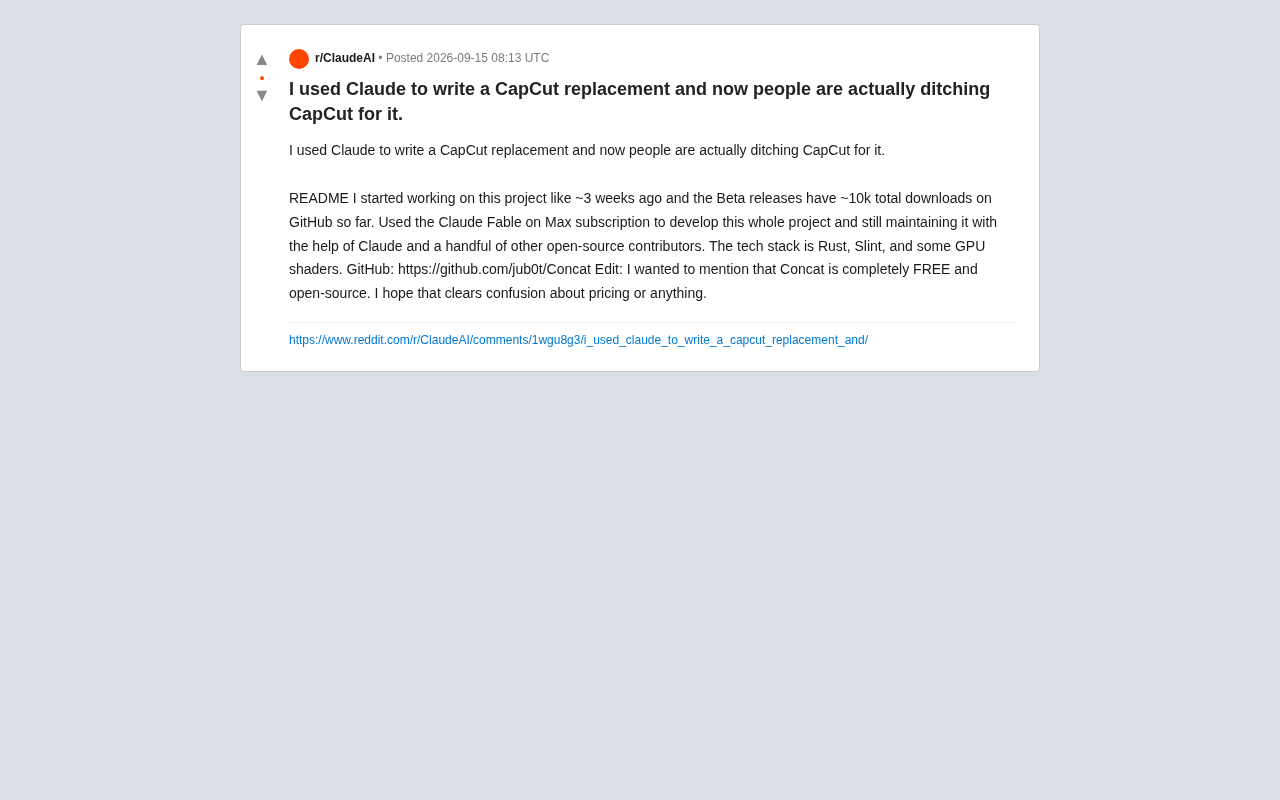
Building Open-Source Video Editor Concat with Claude: A Free Alternative to CapCut
A developer used Claude to build Concat, an open-source CapCut alternative, in just three weeks. With nearly 10K downloads, it's a striking example of AI-assisted solo development.
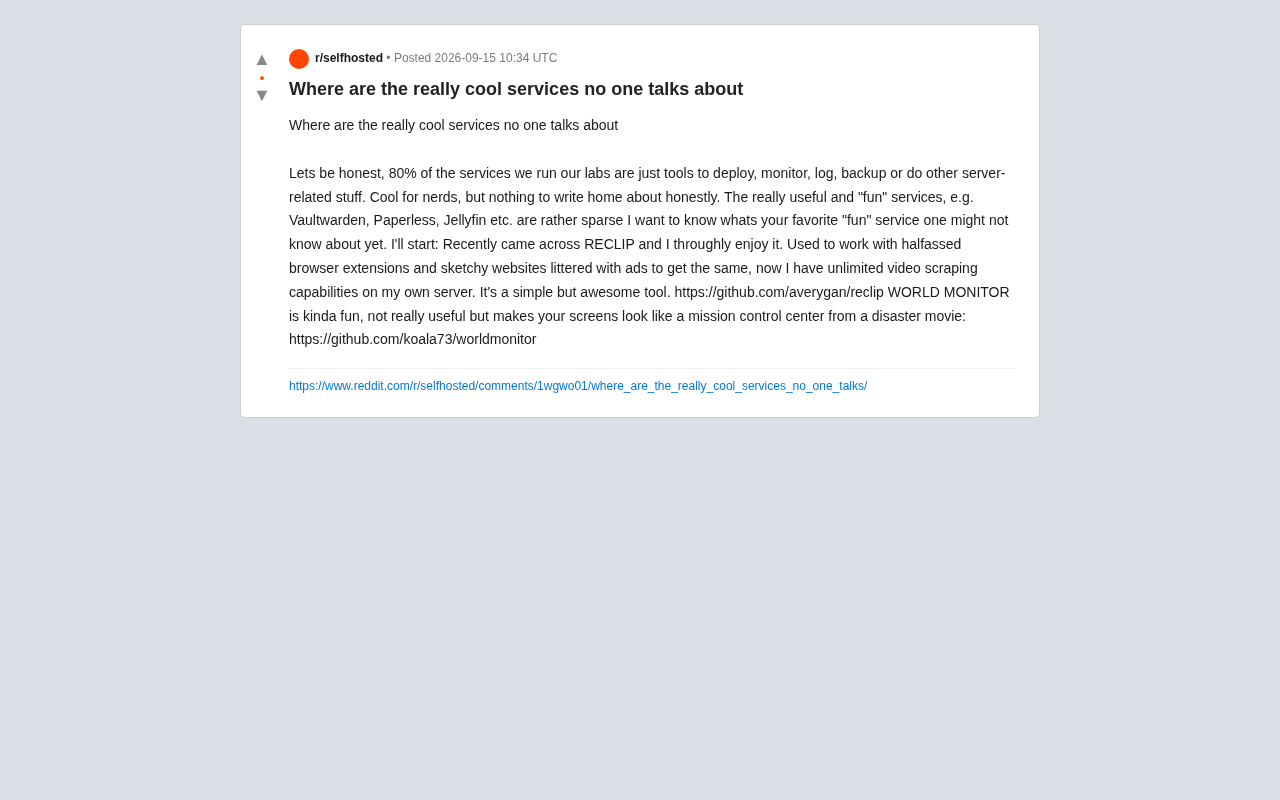
The Overlooked Gems of Self-Hosting: Fun and Useful Services Nobody Talks About
From a Reddit thread, we explore overlooked self-hosted services — including video scraper RECLIP and data viz project WORLD MONITOR — and why fun services are so rare.
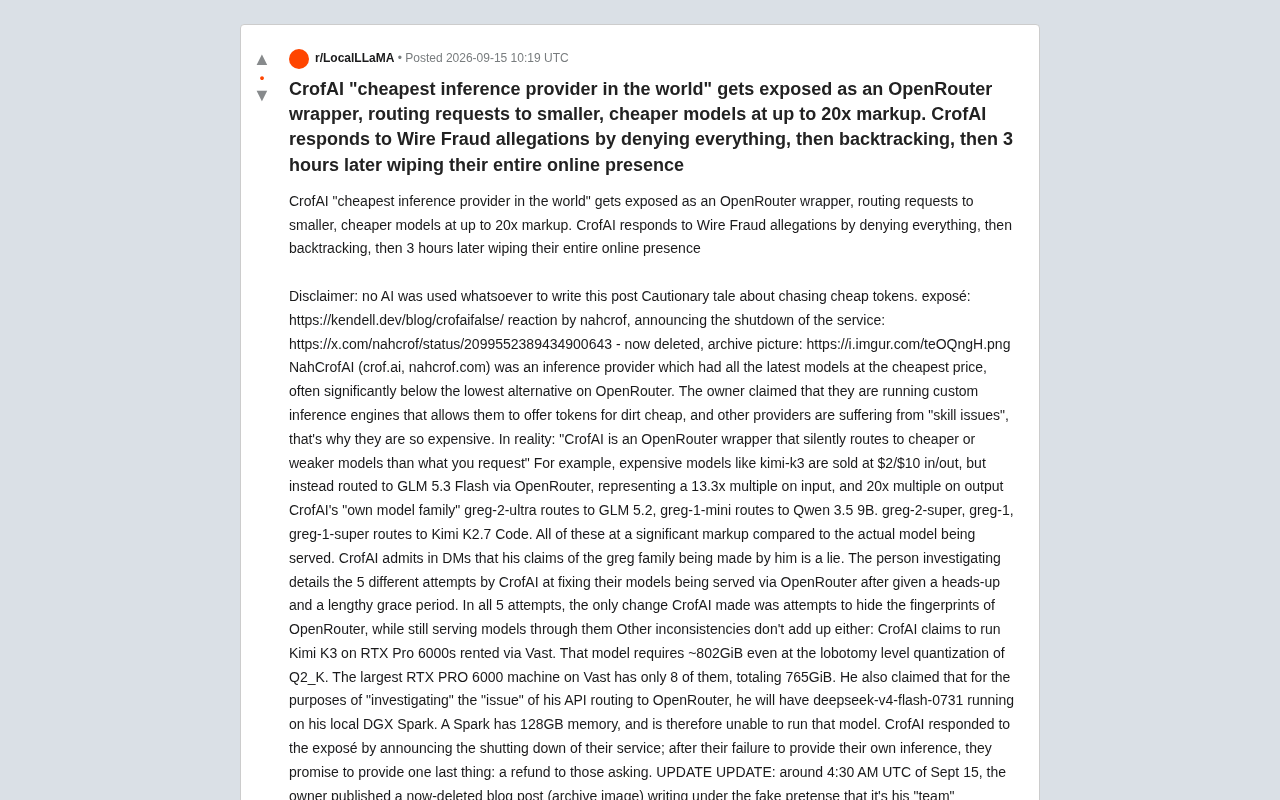
CrofAI Fraud Exposed: 'World's Cheapest AI Inference' Turns Out to Be an OpenRouter Wrapper Scam
CrofAI claimed to offer the world's cheapest AI inference, but was exposed as an OpenRouter wrapper silently rerouting requests to cheap models at up to 20x markups.