GPT-5.6 Sol vs Grok 4.5: Same $20 Subscription — Which One Is Actually Worth It?

A deep-dive comparison of GPT-5.6 Sol vs Grok 4.5 at the same $20/month price point.
At the same $20/month price, OpenAI's GPT-5.6 Sol and xAI's Grok 4.5 offer very different value propositions. This article breaks down the real differences — from GPU cost economics and benchmark reliability to Grok's X platform data advantage and Cursor's model routing architecture — to help users make a smarter AI subscription decision based on their actual needs.
A Battle of Value at the Same Price Point
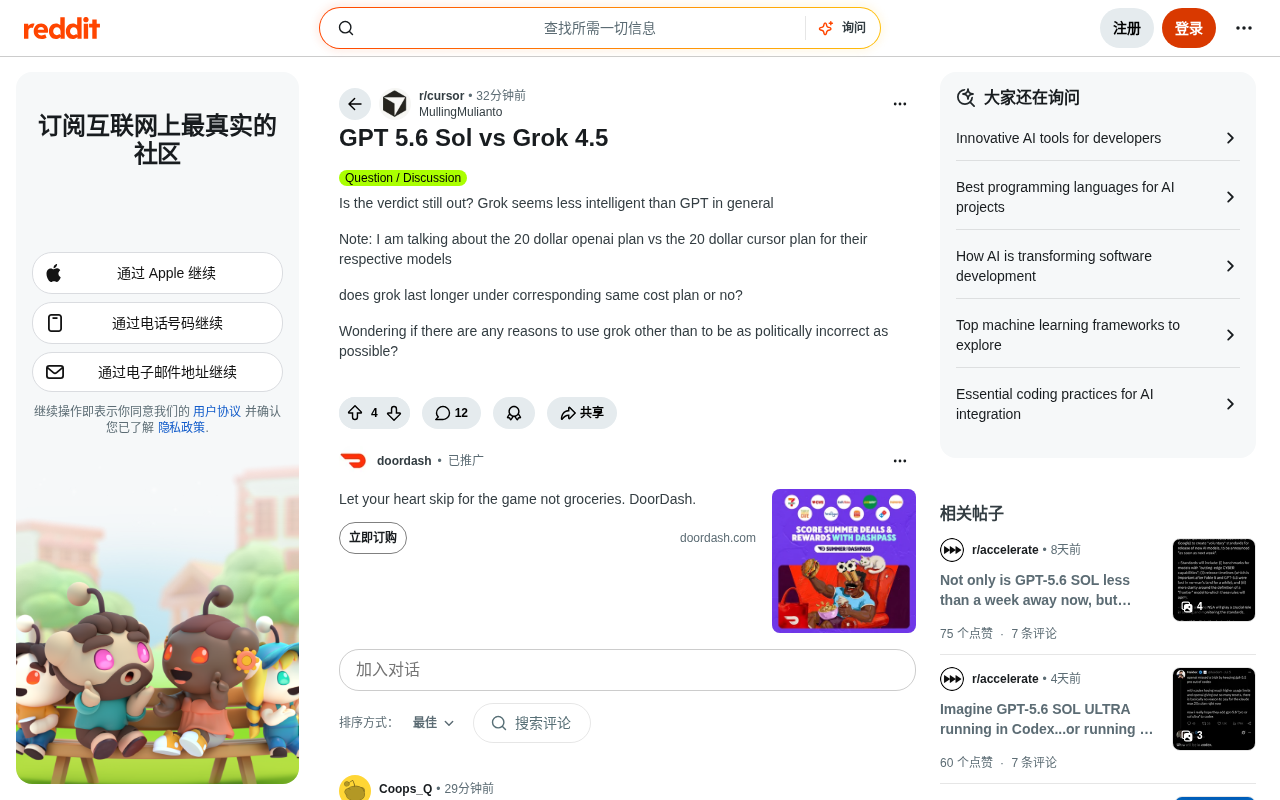
A recent Reddit discussion sparked widespread debate in the AI community: at the same $20/month subscription tier, which is the better choice — OpenAI's GPT-5.6 Sol or xAI's Grok 4.5?
The question sounds simple, but it cuts to the heart of today's AI model competition. As the capability gap between flagship models becomes increasingly apparent to everyday users, what people actually care about is: "How much intelligence am I getting for every dollar I spend?" The original poster put it bluntly: between a $20 OpenAI subscription and a $20 Cursor plan (which integrates Grok models), Grok seems to fall short of GPT in terms of raw intelligence.
It's worth noting that since OpenAI set ChatGPT Plus at $20/month back in 2023, this price point has become the de facto standard for consumer AI subscriptions. Behind it lies a sophisticated marginal cost calculus: every inference request requires billions of floating-point operations across GPU clusters. Understanding this cost structure requires some grasp of inference hardware economics — an NVIDIA H100, the dominant inference chip today, costs around $30,000–$40,000 per card and rents for roughly $2–4/hour in the cloud. Inference costs scale super-linearly with parameter count and sequence length; a single complete conversation with a GPT-4-class model can involve hundreds of billions of FLOPs in matrix multiplications. Companies continuously compress inference costs through techniques like KV Cache, Speculative Decoding, and Batching, but hardware investment remains the most rigid constraint behind the $20 price tag. For a GPT-4-class model, per-inference hardware costs range from fractions of a cent to several cents, depending on output length and model scale. The $20/month price wasn't set arbitrarily — OpenAI needs to strike a precise balance among user acquisition costs, GPU rental, operational overhead, and long-term sustainability.
This pricing also reflects actuarial reasoning about usage patterns: user activity follows a long-tail distribution, where a small number of heavy users effectively subsidize a large population of light users, keeping the business model viable. This also explains why virtually every model provider implements usage quotas rather than truly unlimited access. As Anthropic's Claude Pro, Google's Gemini Advanced, and xAI's Grok all converge on this price band, $20 has effectively evolved into an industry psychological anchor — shaping consumer comparison frameworks and defining the competitive strategy boundaries for every player in the space.
Two $20 Plans — But What Are We Actually Comparing?
Here's an important nuance: this isn't a pure "model vs. model" technical benchmark. It's really a competition between two subscription ecosystems.
The OpenAI $20 Plan
ChatGPT Plus has long been the benchmark for consumer AI. At this tier, users get access to the latest flagship model (GPT-5.6 Sol, as mentioned in the original post), higher usage quotas, faster response times, and integrated tools like Code Interpreter and web search. For general-purpose tasks — writing, reasoning, coding assistance — GPT has consistently maintained a strong reputation.
Grok 4.5 Inside Cursor's $20 Plan
On the other side, the original poster was comparing Grok 4.5 as accessed through the Cursor editor on a $20 subscription. Cursor is a developer-favorite AI-native code editor built by Anysphere, based on the open-source VS Code (Code - OSS). Its core architecture employs a model routing layer design — meaning the editor isn't locked to any single AI backend. Instead, it aggregates capabilities from multiple model providers (GPT, Claude, Grok, etc.) through a unified API abstraction layer, letting developers switch between them within the same interface.
This "model routing layer" design represents an important architectural paradigm for AI-native developer tools. Unlike traditional IDE plugins that were tightly coupled to a single model (such as early versions of GitHub Copilot), Cursor decouples the editor from the model service through a unified abstraction layer, enabling rapid integration of new models without touching core code. The engineering challenges here are significant: code completion tasks are extremely latency-sensitive (ideal response time <200ms), while different model providers vary considerably in API latency, token limits, and billing granularity. The routing layer must handle complex state management including Fallback, Retry, and Streaming, and requires custom prompt engineering and context compression strategies for each provider.
This "model-neutral" architecture also complicates the comparison. When a user invokes Grok 4.5 through Cursor, the actual experience is shaped by three compounding factors: Grok's intrinsic code capabilities, the API rate limits xAI exposes to Cursor, and Cursor's own context window management strategy. This means the same model may behave systematically differently in Cursor versus direct API calls — making cross-platform comparisons genuinely complex. At its core, accessing Grok 4.5 through Cursor means evaluating this model specifically in a programming context.
This introduces a certain "apples-to-oranges" quality: one is a general-purpose assistant scenario, the other is a vertically-focused coding environment. But from the user's perspective, this reflects real-world decision-making logic — people aren't running benchmark suites in a lab; they're making trade-offs inside the products they use every day.
Where Does Grok's Differentiated Value Actually Lie?
The original poster posed a pointed question: beyond being "as politically incorrect as possible," what reason is there to choose Grok?
This slightly tongue-in-cheek framing highlights a genuine aspect of Grok's market positioning. xAI has consistently emphasized Grok's less filtered, more "outspoken" conversational style, positioning it against models criticized for being overly cautious. For a segment of users, this "unconstrained" conversation experience genuinely constitutes a unique selling point.
Beyond tone, Grok holds a structural data advantage: xAI has data access to the X platform (formerly Twitter). Technically, this means Grok's training corpus and real-time retrieval mechanisms can incorporate social media post streams, retweet chains, and user interaction data. This grants Grok two potential advantages:
- Training data recency: Emerging vocabulary and breaking events often surface on X first, well ahead of traditional web crawlers with their months-long delays.
- Real-time information injection for Retrieval-Augmented Generation (RAG): Particularly notable for time-sensitive queries and trending topic analysis.
However, this advantage comes with a non-trivial data quality trade-off. The signal-to-noise ratio of social media data is far lower than editorially curated text — misinformation, emotionally charged language, and decontextualized fragments are pervasive. The hallucination rate of large language models — how frequently a model generates factually incorrect or fabricated content — is one of the most critical reliability metrics in the LLM field. Research consistently shows a strong correlation between training data quality and hallucination rates: low signal-to-noise data causes models to learn incorrect factual associations. The highly fragmented, decontextualized nature of X platform tweets (where a single event often generates large volumes of mutually contradictory descriptions) may systematically elevate error rates on fact-intensive tasks.
For code generation tasks, the cost of hallucination is particularly steep: a plausible-sounding but nonexistent API function name can cost a developer hours of debugging — far more damaging than a minor factual slip in creative writing. This is why code generation benchmarks place exceptional emphasis on functional correctness. HumanEval tests basic code generation through algorithm problems, while SWE-bench represents a higher-order evaluation standard — developed by Princeton researchers, it draws real Issues and corresponding fix Patches from actual open-source GitHub projects, requiring models to locate bugs, write fixes, and pass the original test suites in real repository contexts. This makes it nearly impossible to game through training data memorization. Even top-tier models currently achieve pass rates below 60% on the SWE-bench Verified subset, revealing the true ceiling of LLMs on complex software engineering tasks. This partly explains, on a technical level, why users perceive Grok's "intelligence" as weaker than GPT's in Cursor's coding environment — not necessarily because the model is smaller, but because of a natural mismatch between its training data structure and the demands of programming tasks.
Key Dimensions You Can't Ignore When Evaluating AI Models
A single user's subjective experience isn't enough to draw conclusions. It's worth noting that AI model evaluation has long relied on standardized benchmarks like MMLU, HumanEval, and GSM8K — but both academia and industry are increasingly aware of benchmark contamination: training data for mainstream models may already include answers or near-identical variants of these benchmark questions, inflating scores and disconnecting them from real-world capability.
The more fundamental challenge is that benchmarks measure static performance on specific question types, while the "intelligence" users perceive in practice is dynamic and context-dependent. A model that leads on MMLU may struggle with context tracking across multi-turn code debugging sessions; a model with mediocre benchmark scores might produce stunning results in specialized creative writing. Reddit community feedback captures exactly this kind of perceived intelligence — the aggregated sentiment of large numbers of users often reflects genuine product quality gaps more accurately than any single benchmark score, which is why word-of-mouth in tech communities has such a profound impact on AI products' market standing.
A comprehensive evaluation should also weigh:
- Task type: Coding, reasoning, creative writing, long-context processing — different models excel in different areas. Grok has a native advantage in real-time information retrieval (leveraging X platform data).
- Response speed and quotas: How many requests does $20 actually buy, and how fast are the responses? These directly shape daily experience.
- Context length and tool ecosystem: Can it handle long documents, access the web, and call external tools?
- Iteration velocity: xAI moves fast. Today's gap isn't necessarily tomorrow's gap.
"Who's Better" Has No Universal Answer
Returning to the original poster's question — "Is the verdict still out?"
The answer is: yes, and it may never have a definitive resolution.
GPT, Grok, Claude, Gemini, and other leading models are in a constant arms race, with new versions dropping every few weeks and benchmark rankings shifting frequently. In this highly dynamic environment, expecting to find a single "forever best" model is unrealistic.
For everyday users, the more pragmatic strategy is:
- Clarify your core use case. If you primarily code, compare model quality directly inside Cursor; if you need a general-purpose assistant, ChatGPT Plus remains a robust all-around choice.
- Don't rely on any single review. Community feedback is useful as a reference, but try both for a period before making a call.
- Focus on overall value, not just "intelligence scores". Response speed, reliability, and ecosystem integration often matter more to real productivity than a few percentage points on a benchmark.
Conclusion: The AI Consumer Market Is Maturing
This $20-tier model showdown is ostensibly a contest between GPT-5.6 Sol and Grok 4.5, but it reflects something deeper: the maturation of the entire AI consumer market. Users are shifting from asking "which model has more parameters" to "which subscription is more cost-effective" — a rational evolution with significant industry signal value. When consumers begin evaluating AI products through a cost-benefit framework rather than a technical metrics framework, the competitive battleground shifts from research labs to product experience and pricing strategy.
Based on current community sentiment, GPT maintains a perceived advantage in general intelligence, while Grok is carving out its niche through a differentiated conversational style, real-time data capabilities, and rapid iteration. As for the final choice — that still comes down to each user's individual needs. After all, in a field evolving this fast, the only certainty is change itself.
Key Takeaways
- $20 has become the industry's psychological anchor: The consumer AI subscription pricing standard set by OpenAI reflects a precise balance among GPU costs (H100 at ~$2–4/hour), user distribution patterns, and commercial sustainability.
- The comparison involves a scene mismatch: ChatGPT Plus (general assistant) vs. Grok in Cursor (coding environment) — these aren't like-for-like evaluations under equal conditions.
- Grok's X platform data advantage is a double-edged sword: Strong recency, but low signal-to-noise ratio — which may systematically affect hallucination rates on fact-intensive tasks like code generation.
- Benchmarks ≠ real intelligence: Benchmark contamination continues to widen the gap between academic scores and perceived user intelligence; real-world engineering benchmarks like SWE-bench are becoming more credible evaluation dimensions, with community reputation serving as a critical complement.
- There is no "forever best" model: In a fast-iterating AI competitive landscape, the practical strategy is to clarify your use case and prioritize holistic value over any single metric.
Related articles
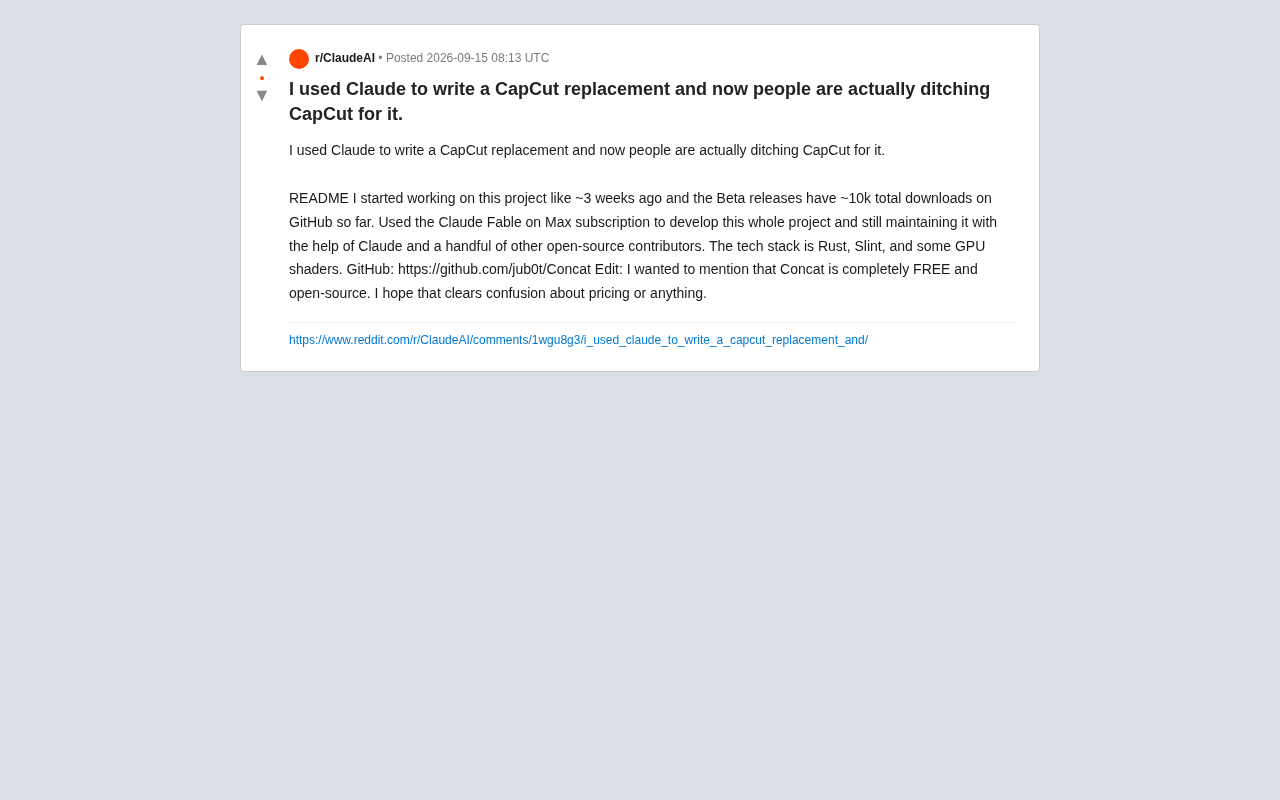
Building Open-Source Video Editor Concat with Claude: A Free Alternative to CapCut
A developer used Claude to build Concat, an open-source CapCut alternative, in just three weeks. With nearly 10K downloads, it's a striking example of AI-assisted solo development.
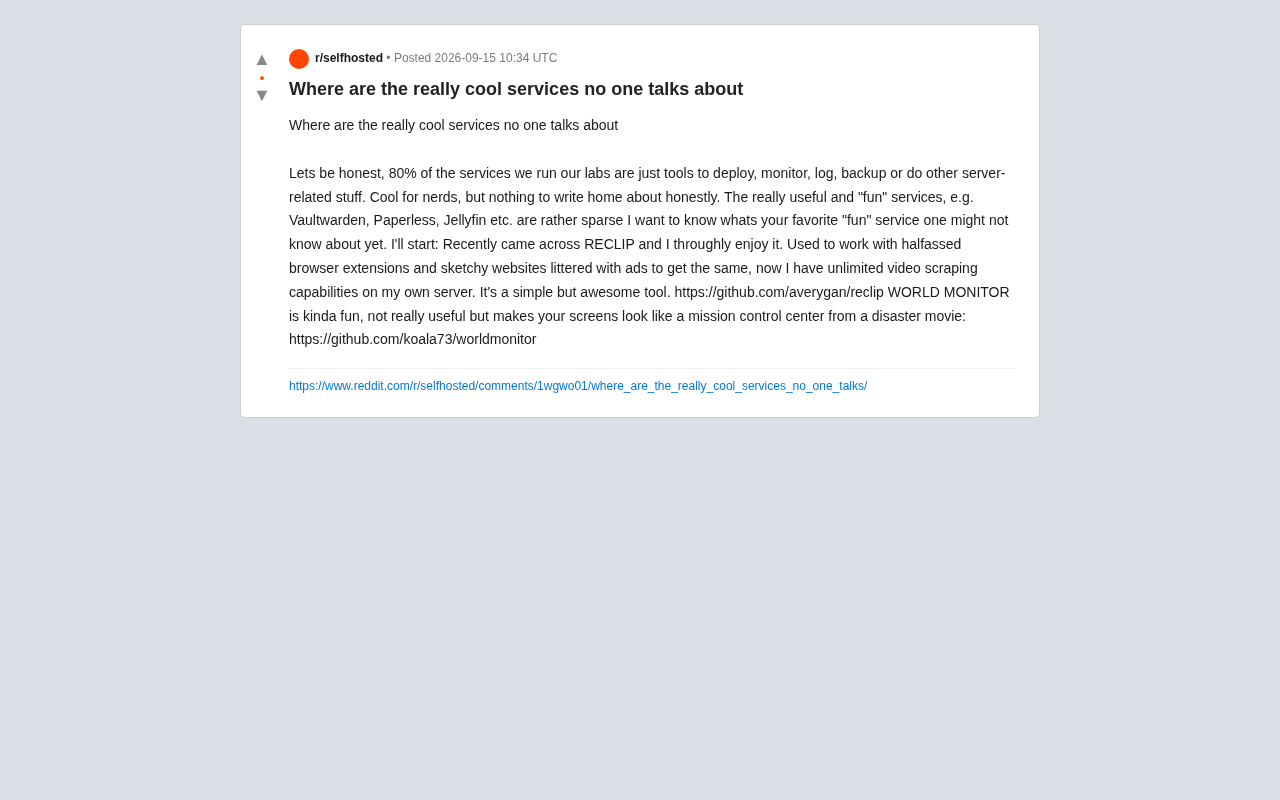
The Overlooked Gems of Self-Hosting: Fun and Useful Services Nobody Talks About
From a Reddit thread, we explore overlooked self-hosted services — including video scraper RECLIP and data viz project WORLD MONITOR — and why fun services are so rare.
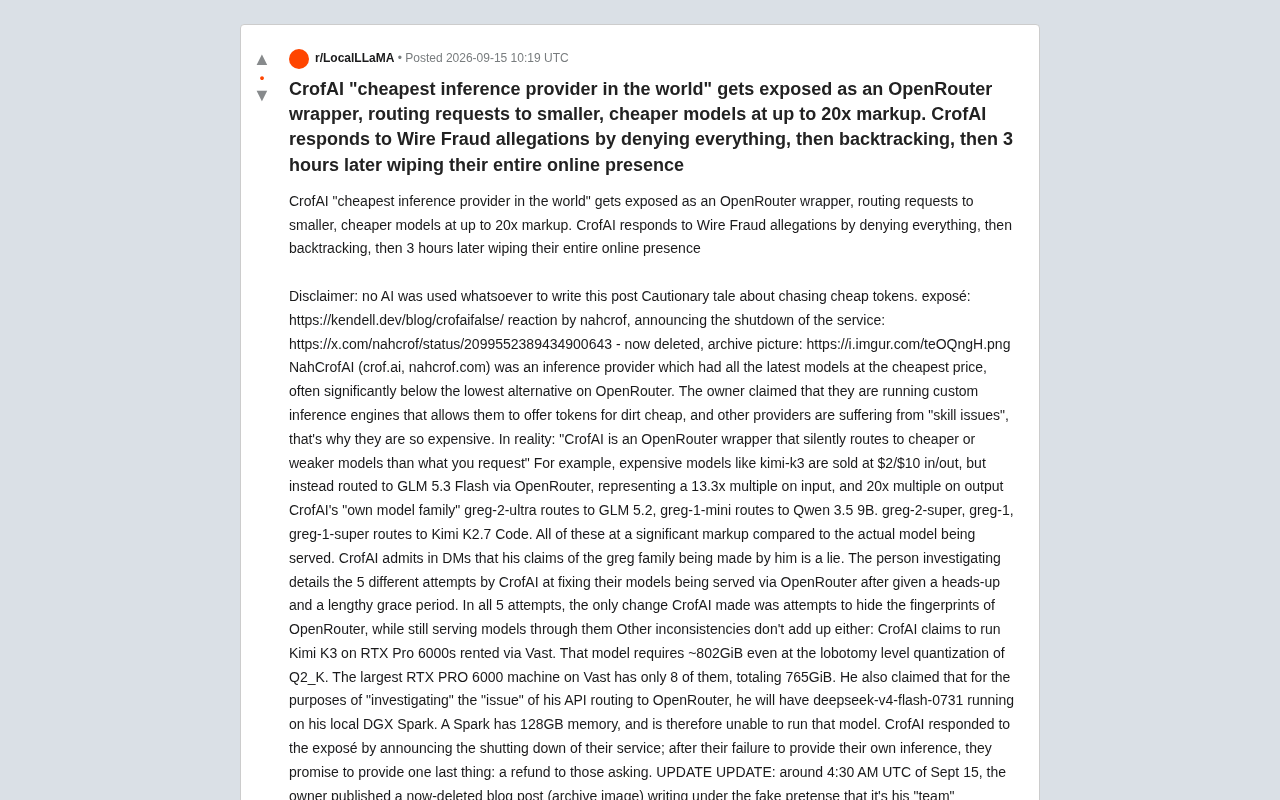
CrofAI Fraud Exposed: 'World's Cheapest AI Inference' Turns Out to Be an OpenRouter Wrapper Scam
CrofAI claimed to offer the world's cheapest AI inference, but was exposed as an OpenRouter wrapper silently rerouting requests to cheap models at up to 20x markups.