GPT-5.6 Three-Tier Model Lineup Leaked, OpenAI May Delay IPO to Next Year

OpenAI's three-tier GPT-5.6 lineup leaks as the industry shifts from capability races to deployment and pricing strategy.
OpenAI is gray-testing a three-model GPT-5.6 family (Sol, Terra, Luna) with tiered performance and pricing. Codex officially launches on mobile, while Claude Code v2.1.193 improves MCP reconnection. SenseTime is building U1 Pro targeting 8K image generation to rival GPT Image 2. Google deepens Gemini integration across Play Store and Android Automotive. OpenAI's IPO may be delayed to next year with a $1 trillion valuation target.
Another Wave of Dense AI Updates
The AI industry is seeing another wave of rapid developments. From OpenAI's leaked next-generation GPT-5.6 model family, to SenseTime quietly building out image generation capabilities, to capital markets scrutinizing OpenAI's IPO timeline — here's a breakdown of the key dynamics.
OpenAI Gray-Testing GPT-5.6: A Three-Tier Model Strategy
OpenAI has begun limited previews of the GPT-5.6 series, comprising three models codenamed Sol, Terra, and Luna — a clear tiered strategy. The naming itself is telling: all three are celestial bodies, implying a brightness gradient from "sun" to "moon" that maps neatly onto the performance and pricing hierarchy.
Sol is the flagship, with enhanced focus on code, bioworkflows, and cybersecurity, and will gradually roll out across ChatGPT, Codex, and the API. Terra targets the value segment — reportedly matching GPT-5.5 in performance at half the price. Luna goes even further, targeting the most cost-sensitive use cases.
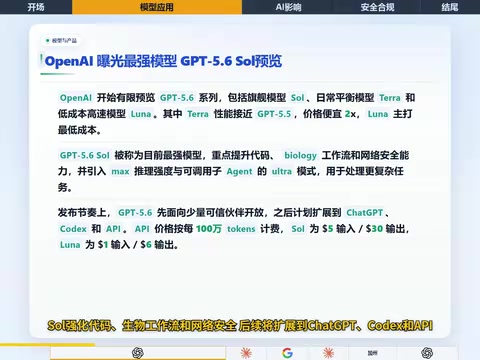
This "flagship + value + budget" three-tier matrix reflects OpenAI's attempt to use finer segmentation to serve users across different budget and performance needs. It also mirrors a broader industry pattern as large model commercialization matures: in the early days, the core competitive edge centered on parameter scale and benchmark supremacy; as model capabilities plateau and gaps narrow, price tiering and use-case segmentation become the main battleground for market share.
This mirrors the cloud computing industry's trajectory — AWS entered as a technology leader, then built out a multi-tier pricing system (Spot, Reserved, On-Demand instances) that mapped the same underlying compute to the full range of customer needs. The essence of that system wasn't simple feature stripping, but precise mapping to users' risk tolerance, cash flow, and workload characteristics. OpenAI's Sol/Terra/Luna structure is, at its core, replicating this mature SaaS pricing philosophy. Terra's positioning — "near-previous-gen performance at half the price" — is a direct response to open-source models (Meta Llama, Mistral) and competitors' cheaper APIs (Anthropic Haiku, Google Flash), and marks a clear inflection point where large model pricing shifts from "technology race" to "market cultivation."
Codex Goes Live on Mobile, Claude Code Keeps Iterating
On the AI coding tools front, OpenAI announced that Codex is now officially available in the ChatGPT mobile app, with a new one-to-one device pairing feature. Users can launch coding tasks directly from their phones, review outputs, and approve next steps on the go.
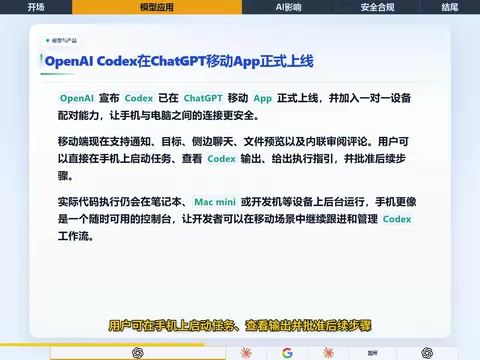
Noteably, just last month mobile Codex was still in preview. Reaching general availability within a single month signals how aggressively OpenAI is pushing AI coding tools into mobile. Enabling developers to monitor and manage AI coding tasks without being tethered to a desktop is becoming a new work paradigm.
Meanwhile, Anthropic released Claude Code v2.1.193, improving command handling and terminal experience with automatic command classification, path completion, and enhanced MCP (Model Context Protocol) authentication reconnection.
MCP is an open standard Anthropic proposed in late 2024 to address the fragmented integration between AI models and external tools and data sources. The design philosophy is analogous to the USB interface: previously, every AI tool required custom adapters for different databases, APIs, and IDEs. MCP provides a standardized communication protocol — built on JSON-RPC — that lets models access file systems, code repositories, browsers, and other context resources in a uniform way. It standardizes three core primitives: Resources (reading context), Tools (invoking actions), and Sampling (model requests). This mirrors how LSP (Language Server Protocol), introduced by Microsoft in 2016, unified code intelligence across VS Code, Neovim, Emacs and dozens of other editors through a standard interface. The reconnection mechanism improvement addresses a key pain point: context disconnections caused by network instability during long-running coding sessions, directly impacting developer continuity on complex engineering tasks. The neck-and-neck competition between these two vendors is accelerating the maturation of the entire AI coding assistant space.
SenseTime Develops U1 Pro: Internal Benchmark Is GPT Image
On the domestic front, SenseTime is reportedly developing a multimodal image generation model called U1 Pro, benchmarked internally against GPT Image 2.
U1 Pro targets design workflows, supporting a long-horizon generation review loop and offering up to 8K resolution output. This positioning suggests SenseTime is aiming to build a differentiated edge in professional design and high-resolution image generation niches rather than competing head-on with general-purpose image models.
It's worth noting that 8K image generation is a significant engineering challenge for diffusion models. Mainstream image generation models (Stable Diffusion, DALL-E) natively operate in the 512×512 to 1024×1024 range — constrained by the compression ratio of their latent space and the quadratic complexity of attention mechanisms with respect to sequence length. Doubling image dimensions quadruples memory and compute requirements. The industry has developed several approaches to break through this ceiling: SDXL uses a two-stage base + refiner cascade; Google Imagen Video uses spatiotemporal attention decomposition; Adobe Firefly and similar professional tools use patch-based generation with global consistency constraints. If U1 Pro achieves true native 8K generation with multi-round review-and-edit capabilities, it would require meaningful architectural innovation in sparse attention or latent space compression — making its technical approach the key indicator of whether its internal GPT Image 2 benchmarking claim holds water.
For domestic large models, targeting professional vertical scenarios (like design and review workflows) is a pragmatic path. High-resolution output and iterative generation-review capabilities are exactly what professional design users need — and where general-purpose models often fall short.
Gemini Deepens Ecosystem: Google Play Store and In-Car Systems
Google continues to push Gemini deeper into its ecosystem. Gemini is now integrated into the Google Play Store, enabling in-conversation app search and game recommendations. It's also rolling out to Android Automotive systems, extending the AI entry point from phones into vehicles.

Google's move to bring Gemini into Android Automotive is built on Android Automotive OS (AAOS) — a complete Android system that runs directly on vehicle hardware, independent of the phone. This is fundamentally different from Android Auto, which mirrors phone apps onto the car display. AAOS makes the car's head unit a standalone computing node with its own app store, driver layer, and system services — it can run navigation, media, and other core functions independently without a connected phone.
In the AAOS environment, AI models must be adapted to the compute constraints of automotive-grade chips like Qualcomm Snapdragon Ride and NVIDIA Orin, and must meet ISO 26262 functional safety certification — the auto industry's highest safety standard, requiring graceful degradation rather than hard crashes on hardware failure. Embedding Gemini into vehicles means the AI assistant must meet extremely stringent latency and reliability requirements: drivers can't tolerate more than 1–2 seconds of response delay, and the model must maintain basic functionality even with unstable connectivity. To address this, Google has specifically optimized Gemini Nano — a 1.8B–3.25B parameter on-device model — for automotive scenarios, supporting voice command understanding and navigation intent recognition offline, while using hybrid inference (routing simple commands to Nano locally and complex reasoning to cloud when connectivity allows) as the core architectural strategy. Google's early investment in custom TPU chips and on-device Gemini Nano is precisely the infrastructure foundation that makes this possible.
Taken together, these moves show Google is trying to make Gemini the unified AI layer across its massive Android ecosystem. Rather than competing purely on model capabilities, Google's advantage lies in ecosystem penetration across phones, app stores, and automobiles — and when an AI assistant is everywhere, user stickiness and usage frequency become a powerful moat.
AI Usage Patterns and Employment Impact: Two Reports Worth Watching
On the application and societal impact front, two data points are worth noting.
An Anthropic report found that Claude usage follows a distinct "weeknight and weekend" rhythm — weekend personal conversations account for nearly half of all usage, and high-income professional users are more likely to use AI outside working hours. This suggests AI is gradually moving from a pure work tool into personal life and leisure contexts.
Meanwhile, California launched the nation's first AI unemployment tracking dashboard, monitoring unemployment claims among occupations with high AI exposure.
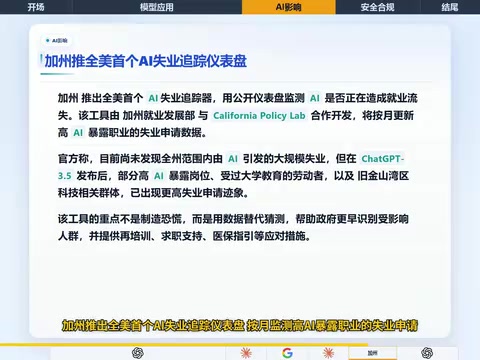
Methodologically, the dashboard draws on the "automation exposure" quantitative framework from labor economics — systematically developed by economists Daron Acemoglu and Pascual Restrepo in 2019 — which decomposes each occupation into task units and scores their replacement probability based on codifiability, repetitiveness, and cognitive complexity. California's dashboard incorporates revised scores specifically targeting generative AI capabilities, since LLMs can replace "cognitive, non-repetitive" tasks at rates that far exceed predictions from prior automation models based on industrial robots and RPA. Occupations once considered highly safe — legal document drafting, journalism, junior software development — have seen their exposure scores substantially revised upward. The core methodological challenge is distinguishing "AI displacement unemployment" from "normal cyclical unemployment" — the 2023–2024 tech layoff wave heavily overlapped with rising interest rates, and separating the two requires difference-in-differences estimation: comparing unemployment rate changes between high- and low-AI-exposure occupations to net out macroeconomic shocks and isolate AI's contribution. Officials report no statewide mass AI unemployment detected yet, but tech-adjacent groups are already showing elevated claim rates. This is the first time a government has used an official data tool to quantitatively track AI's employment impact — its precedent-setting effect is likely to prompt other states to build similar monitoring systems.
Copyright Litigation and IPO: OpenAI's Dual Legal and Capital Challenges
On the legal front, nearly 400 U.S. newspaper publishers have jointly sued Microsoft and OpenAI, alleging unauthorized use of news content to train Copilot, ChatGPT, and related products.
The core legal dispute centers on the boundaries of the "fair use" doctrine under Section 107 of the U.S. Copyright Act, and its four-factor test — purpose and character of use (transformative?), nature of the work (factual vs. creative?), amount used (excerpt vs. full copy?), and market impact (does it substitute for the original?). The 2015 Authors Guild v. Google precedent established that large-scale digital indexing can qualify as fair use — the core logic being that indexing creates new search value rather than substituting for original consumption. However, AI training differs fundamentally from search indexing: search stores metadata and snippets, while AI training internalizes content into model weights, permanently embedding copyrighted material as "memory" in model parameters. When ChatGPT can instantly generate summaries highly similar to original articles, user incentive to visit the source site is directly diminished — squarely implicating the fourth fair use factor. The New York Times filed a similar suit against OpenAI in late 2023; this 400-publisher collective action escalates the scale and plaintiff diversity considerably. An adverse ruling could force the entire industry to rethink pre-training dataset construction and drive the formation of a licensed data acquisition market — potentially a landmark copyright precedent for the generative AI era.
On the capital side, OpenAI is reportedly leaning toward delaying its IPO to next year. There are reportedly significant internal disagreements over valuation, with CEO Sam Altman targeting a $1 trillion valuation at listing. The combination of ambitious valuation expectations and the delay decision reflects both confidence in the company's value and the reality that reaching internal consensus in the current market environment will take more time.
Summary
From GPT-5.6 model tiering and AI coding tool mobilization, to ecosystem penetration and employment impact tracking, today's developments sketch an AI industry transitioning from a "capability race" to an "deployment race." As the technical gap narrows, pricing, ecosystem reach, scenario fit, and compliance are becoming the new variables that determine who wins.
(Note: This article is based on publicly available information. Some features remain in limited preview or early stages; refer to official announcements for confirmation.)
Related articles
What Is Vibe Coding? The AI Programming Skill Every Developer Needs
What is Vibe Coding? Learn how AI programming is reshaping dev teams, why traditional programmers face displacement, and why Cursor & Claude Code matter.
Making Rocks Think: A Philosophical Exploration of Generative AI and Information Compression
From a viral Reddit post to deep AI theory: why compression equals understanding, the Library of Babel thought experiment, semantic compression, and the Hutter Prize.
Irregular Warns: Four AI Lab Security Breaches Traced to the Same Root Cause
Irregular reveals four AI lab security breaches share a single root cause, exposing systemic risks from technology stack homogeneity across the AI industry.