GPT-5.6 Ultra Fast Mode Explained: The Technology and Real-World Impact Behind a 14x Inference Speed Boost

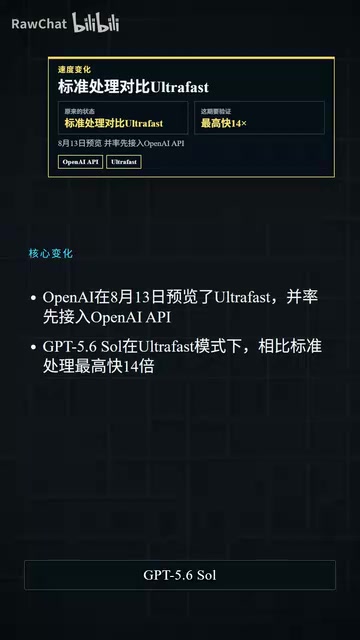
GPT-5.6 Ultra Fast mode leverages Cerebras hardware to boost inference speed up to 14x, reaching 750 tokens/sec.
OpenAI's GPT-5.6 Ultra Fast mode, powered by Cerebras's wafer-scale chip architecture, delivers up to 14x faster inference at 750 tokens per second. Currently in Limited Preview, this capability targets the memory-bound bottleneck of autoregressive generation. While availability is restricted and cost/quality tradeoffs remain unclear, the partnership signals a shift toward specialized inference hardware and could reshape real-time AI application development.
OpenAI's Major Update: GPT-5.6 Inference Speed Up to 14x Faster
Recently, the AI community was buzzing over an official announcement from OpenAI—GPT-5.6 in its new Ultra Fast mode delivers up to a 14x speed improvement compared to standard processing. For developers and product teams long constrained by large model inference latency, this is an incredibly compelling development.
Large model inference latency is one of the core bottlenecks in deploying AI applications today. Unlike the training phase, which can leverage massive parallelism, the inference phase (especially autoregressive text generation) requires sequential token-by-token output—each new token depends on the attention computation results of all preceding tokens. This sequential dependency means that even stacking more GPUs won't linearly reduce latency for a single request. The industry commonly refers to this as being "memory-bound," because generating each token requires reading the entire model's weight parameters from memory, rather than being limited by floating-point computation capacity. This is precisely why a 14x speed improvement is so remarkable.
According to analysis combining OpenAI's official materials, this capability was officially previewed on August 13 and was first made available through the OpenAI API. In other words, this isn't merely a demonstration-level tech showcase—it's a productized capability with real invocation conditions.

To clarify, the 14x figure isn't a universal performance gain across all scenarios, but rather the peak improvement of Ultra Fast mode compared to standard mode. In real-world applications, performance will vary depending on task type, context length, concurrency, and other factors. Even so, an order-of-magnitude speed boost still represents a qualitative transformation in interaction experience.
What Makes Ultra Fast Mode So Fast? Cerebras Hardware Deep Dive
Behind the speed improvement, hardware plays a crucial role. Official materials indicate that Ultra Fast mode is powered by Cerebras, achieving throughput of up to 750 output tokens per second.

Why Cerebras Is the Key
Cerebras Systems, founded in 2016, is renowned for its unique wafer-scale chip architecture. Its core product, the WSE (Wafer-Scale Engine), is currently the world's largest single-chip processor. The latest generation WSE-3 is manufactured from an entire 12-inch wafer, integrating approximately 4 trillion transistors, 900,000 AI-optimized cores, and 44GB of on-chip SRAM memory.
Compared to traditional GPU clusters, the WSE has inherent advantages in on-chip memory bandwidth and data transfer efficiency. Specifically, on-chip SRAM provides access speeds and bandwidth far exceeding HBM (High Bandwidth Memory), eliminating the data transfer bottleneck between the chip and external memory. Additionally, all cores are directly connected through an on-chip interconnect network, avoiding the communication overhead between multiple GPUs in a cluster.
The bottleneck in large model inference often isn't compute power itself, but rather the memory access latency during token-by-token generation. Cerebras's architecture is deeply optimized precisely for this pain point, enabling output rates during inference that far exceed conventional solutions.
What 750 Tokens Per Second Actually Means
To understand this number, you first need to understand the concept of tokens. A token is the basic unit by which large language models process text, but it doesn't equate to a complete word. Using the BPE (Byte Pair Encoding) tokenizer employed by the GPT series as an example, one English word typically corresponds to 1-3 tokens, and one Chinese character typically corresponds to 1-2 tokens. For instance, "artificial" might be split into "artific" and "ial"—two tokens. Therefore, 750 tokens/second is roughly equivalent to outputting 500-600 English words per second, or 375-500 Chinese characters per second.
Using human reading speed as a reference, an average person processes about 3 to 5 words per second, while 750 tokens/second means the model's response appears almost instantaneously. For comparison, ChatGPT's standard mode typically outputs around 50-100 tokens/second, and human typing speed is approximately 2-4 words per second. For high-frequency scenarios like code completion, real-time conversation, and long-form content generation, this speed fundamentally changes the rhythm of human-AI interaction.
Who Can Use It? The Reality and Expectations of the Limited Preview Phase
Despite the impressive numbers, one reality must be acknowledged: Ultra Fast mode is currently in a Limited Preview stage available only to select customers.
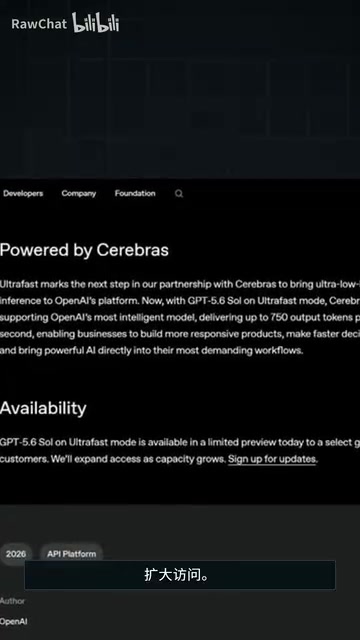
This means not all OpenAI API users can immediately access this capability. Staged rollout is standard practice in cloud computing and AI services, driven by multiple considerations: First, hardware supply constraints—Cerebras WSE manufacturing is complex, with limited yield and production capacity that cannot support full-scale concurrent access in the short term. Second, system stability validation—collecting real-world performance data and failure modes under limited testing to avoid large-scale outages. Third, commercial pricing exploration—OpenAI needs to validate market acceptance of different pricing models during the limited preview period. Google's Gemini and Anthropic's Claude similarly employ waitlist or invitation-only mechanisms when launching new capabilities.
OpenAI has stated that access will gradually expand as underlying capacity grows. This phased rollout strategy has become industry standard—inference services backed by specialized hardware like Cerebras genuinely require time to scale deployment and supply capacity.
Short, Medium, and Long-Term Impact for Developers
- Short-term: If you're not on the preview list, you won't be able to reliably use the 14x acceleration in production environments for now. Keep an eye on official rollout timelines.
- Medium-term: Once capacity expands and access becomes broadly available, ultra-low-latency inference will open entirely new product spaces for real-time AI applications (such as voice assistants, real-time translation, and interactive agents).
- Long-term: The deep integration of specialized inference hardware with mainstream large models could reshape the cost structure and competitive landscape of the entire inference services market.
Beyond Speed: A Rational Look at Cost, Quality, and Deployment
Faced with numbers like 14x, developers should still exercise caution. The following dimensions deserve close attention:
- Peak ≠ Norm: Peak speed doesn't equal average experience. Real-world performance needs to be validated through testing in your own scenarios.
- Availability Constraints: Ultra Fast mode's current availability is limited. Any decision to incorporate it into product planning must account for uncertainty around access permissions and capacity.
- Cost and Quality TBD: Whether the speed improvement comes with pricing changes or affects output quality—these critical details haven't been fully clarified in current public materials and are worth tracking through OpenAI's subsequent updates.
Competition and Trends in the Specialized Inference Hardware Market
It's worth noting that Cerebras isn't the only player targeting AI inference acceleration. The current inference hardware market shows diverse competition: Groq's LPU (Language Processing Unit) also targets ultra-low-latency inference, having achieved output speeds exceeding 500 tokens/second; Google's TPU v5e is cost-optimized for inference scenarios; NVIDIA continues to squeeze GPU inference performance through its TensorRT-LLM software stack. Additionally, companies like SambaNova and Graphcore are also positioning themselves in this space.
OpenAI's choice to partner with Cerebras signals that it's no longer fully dependent on the NVIDIA ecosystem at the inference hardware layer—a landmark move for diversifying the AI infrastructure supply chain. In the future, competition in inference services may no longer revolve solely around model capabilities; underlying hardware selection and heterogeneous computing architecture combinations will also become important dimensions of competitive differentiation.
Conclusion: A Critical Step from "Usable" to "Fast"
From standard processing to Ultra Fast, GPT-5.6 has achieved an order-of-magnitude leap in inference speed through Cerebras's specialized hardware. This represents large models' continued evolution from "usable" toward "great to use and fast to use."
For developers focused on AI deployment, this is both an exciting capability breakthrough and an opportunity requiring rational assessment. The real dividends will often only be fully realized when the limited preview transitions to broad availability. Until then, staying informed and building technical readiness is the most pragmatic strategy.
Related articles

Gaussian Process Bandit Optimization: Exploration Strategies and Inference Regret Guarantees
Cumulative regret guarantees in Bayesian optimization fail to reflect final recommendation quality. This article examines a new study that provides inference regret guarantees for Gaussian process bandit optimization through exploration query strategies and fill distance analysis, validated on hyperparameter optimization and control tasks.

The Most Detailed Codex Guide on Bilibili: From Installation to Real-World Practice
The most detailed Codex guide on Bilibili: from app store installation to daily work mode configuration, with a real coffee shop project demonstrating file organization, data extraction, dashboard creation, and other practical tasks. Learn to use Plan Mode and desktop pets to leverage Codex efficiently.

Appearance Compensation in Volume Rendering: Why RGB Accuracy Cannot Guarantee Density Correctness
Volume rendering research reveals that volumetric data perfectly reproducing external RGB views may still contain density errors: appearance compensation can double central density and keep external rays unchanged even when L2 error exceeds 14.52%. Density recovery depends on appearance capacity, spatial resolution, and measurement design.