GPT-5.6 vs Grok 4.5 on the Same Day: A Packed Week of Flagship AI Model Launches

GPT-5.6 and Grok 4.5 launch the same day, kicking off a packed week of flagship AI model releases.
OpenAI's GPT-5.6 debuts with three sub-models (Sawa, Terra, Luna) the same day as Musk's Grok 4.5, while Anthropic, Meta, and NVIDIA respond. This week highlights three converging trends: compute autonomy, multimodal expansion, and unified audio models, alongside a maturing developer tool ecosystem.
Flagship Models Launch en Masse, July 9 Becomes the Pivotal Date
The AI industry is experiencing a rare surge of flagship product launches. This week alone saw multiple heavyweight models debut in quick succession, with July 9 emerging as the most contested date of all—OpenAI's GPT-5.6 and Elon Musk's Grok 4.5 both chose this day for their official public releases.
OpenAI's GPT-5.6 has received approval from U.S. regulators, and Sam Altman personally previewed the launch's biggest highlight: three sub-models will go live simultaneously, named Sawa, Terra, and Luna, covering three differentiated use cases—high-difficulty reasoning, everyday office work, and lightweight high-speed responses. Behind this "one flagship, three product lines" strategy lies the inevitable logic of large model commercialization—early large models aimed to be "one model fits all," but as application scenarios deepened, user demands for reasoning precision, response latency, and invocation cost became clearly stratified.
This tiered commercialization logic has deeper roots at the industry level. The early large model race was driven primarily by leaderboard benchmark competitions, but as enterprise procurement grew as a share of the market, customer decision dimensions shifted from "capability ceiling" to "total cost of ownership (TCO)" and "scenario fit." The differentiation embodied by the Sawa, Terra, and Luna sub-models is essentially an explicit exposure of the engineering trade-offs between inference latency, context window length, and API pricing—allowing users to pay as needed and thereby achieve profit-maximizing market segmentation under a unified brand.
Notably, this tiered strategy is highly isomorphic to the instance-type systems of the cloud computing industry—AWS EC2 offers differentiated instances across compute-optimized, memory-optimized, and general-purpose categories, essentially engineering the underlying compute capability into modular pieces to match user groups with different willingness to pay and performance needs. In the large model context, high reasoning precision often means longer chains-of-thought or larger activated parameter scales, with latency and cost rising accordingly; lightweight high-speed models, by contrast, trade off response efficiency through distillation, quantization, or architectural simplification. Running three product lines in parallel allows OpenAI to serve the full user spectrum from enterprise-level complex reasoning to individual lightweight assistants under one unified brand, while also providing reasonable justification for a differentiated pricing strategy. This marks OpenAI's shift from a single-large-model mindset toward a more refined, scenario-based product matrix, seeking the optimal balance among reasoning capability, cost control, and response speed.
On the other side, Musk announced that Grok 4.5 would launch on the same day. The model is explicitly positioned to compete with Anthropic's Claude Opus tier, built on a V9 architecture with 1.5 trillion parameters, and specifically enhanced by incorporating Cursor's programming data into its training. Trillion-scale parameter counts are typically co-designed with the Mixture of Experts (MoE) architecture—first proposed by Hinton's team in 2017, whose core idea is that not all parameters are activated during each inference. Instead, a gating network dynamically selects the most relevant Top-K "expert" feed-forward network (FFN) sub-modules to participate in computation, while the rest remain dormant. This gives the model powerful "knowledge capacity" while keeping actual inference cost correlated with the number of activated parameters rather than total parameters, striking a balance between capability and efficiency.
It should be specifically noted that the engineering implementation of the MoE architecture is far from simple. One of its core challenges is the expert load balancing problem—if the gating network routes most tokens to only a few experts, it causes "expert collapse," degrading the remaining experts' parameters into ineffective weights, which must be constrained by introducing auxiliary loss functions. Furthermore, the All-to-All communication overhead during multi-GPU parallelism (i.e., exchanging expert outputs across different GPUs) is a fundamental reason why such models are more challenging to implement in engineering. From real-world deployment cases, GPT-4 is widely speculated to have adopted a similar design, Mistral's Mixtral 8x7B was among the first publicly available MoE open-source models, and DeepSeekAd-V3 pushed MoE to the frontier of hundred-billion-parameter engineering practice. Domain-specific reinforcement training with Cursor programming data further amplifies Grok 4.5's vertical advantage in coding scenarios—by conducting targeted supervised fine-tuning (SFT) or reinforcement learning (RLHF) on real development-scenario data such as high-quality code completions and debugging dialogues, the model develops behavioral preferences with a more accurate understanding of programming intent. Officials emphasized its faster speed and lower cost, targeting the enterprise-level programming and reasoning market.
Anthropic Extends Its Trial Period as the Multimodal Race Heats Up
Facing frontal assaults from its two major rivals, Anthropic chose a different strategy. Anthropic announced it would extend the trial period for Claude Fable 5 to July 12, with Pro and Max paying users receiving up to 50% additional invocation quota each week, usable directly without manual claiming. This "extend benefits to retain users" approach is clearly designed to stabilize its own paying user base during the launch window of GPT-5.6 and Grok 4.5. From a product operations perspective, this is essentially a "defensive usage lock-in" strategy—by proactively boosting user stickiness metrics (such as DAU retention rate and average monthly invocation frequency) before and after competitors' new product launches, it reduces the probability of users migrating to competing products out of curiosity. This practice is highly consistent with the SaaS industry's customary tactics of extending trial periods or temporarily expanding quotas during competitors' launch windows.

Competition is equally fierce in the multimodal space. Meta's MUSE Image image-generation model was officially released, along with a preview of MUSE Video's video-generation capabilities. The model supports invoking search and code tools, and has been integrated into multiple entry points including the Meta AI app and Instagram Stories, demonstrating the clear trend of tech giants deeply embedding generative AI into their existing product ecosystems. MUSE's technical approach is worth noting: unlike the denoising generation paradigm of diffusion models such as Stable Diffusion, Meta's prior research has leaned toward exploring generation architectures based on masked autoencoding, which offer unique advantages in inference efficiency and controllability. Embedding image-generation capabilities directly into social products like Instagram Stories, with hundreds of millions of daily active users, means Meta is attempting to leverage its distribution advantage to compensate for the gap between its model capabilities and professional tools like Midjourney and DALL-E 3, forming an "ecosystem lock-in" rather than pure technical competition.
Talent movement also reflects the evolving industry landscape. Former OpenAI researcher Tian Yonglong has joined Tencent's Hunyuan multimodal team and is expected to lead the vision-language model direction. This researcher, a graduate of Tsinghua University, was deeply involved in cutting-edge work such as supervised contrastive learning and autoregressive image generation.
Supervised Contrastive Learning is a core paradigm of vision-language pre-training models such as CLIP and ALIGN: in the embedding space, it pulls together the representations of semantically similar samples and pushes apart the representations of semantically different samples. Unlike the self-supervised version (such as SimCLR), which treats only different augmentations of the same image as positive pairs, the key improvement of the supervised version proposed by Khosla et al. in 2020 lies in fully leveraging label information to treat all samples of the same category as mutual positive pairs, allowing semantically similar samples in the embedding space to form tight clusters over a broader range, significantly raising the performance ceiling for cross-modal retrieval and zero-shot classification. This technique is crucial to vision-language models because it provides an efficient metric-learning framework for image-text alignment: whether it's OpenAI CLIP's 400 million image-text pairs of pre-training or Google ALIGN's 1.8 billion noisy image-text pairs of training, both essentially use contrastive loss to "align" the visual feature space and the language feature space into the same geometric structure, so that the image embedding vector of "an orange cat" lands close to the text embedding vector of "an orange cat" in high-dimensional space. Autoregressive image generation, by contrast, treats an image as a two-dimensional sequence of discrete tokens, compressing pixels into a finite discrete codebook index via vector-quantized encoders such as VQ-VAE, then generating sequentially through the Transformer's next-token prediction—DALL-E 1, Parti, and LlamaGen all belong to this category. This paradigm is naturally compatible with language model architectures, making unified multimodal modeling possible, and forms the key technical foundation for building powerful vision-language models (VLMs). The combination of these two capabilities is precisely the key technical reserve for building powerful VLMs, and the core reason Tencent's Hunyuan team recruited him. His joining is seen as a signal of domestic tech giants' continued investment in the multimodal field.
Audio AI Moves Toward Unified Models, Domestic Speech Recognition Accelerates Adoption
This week, a noteworthy technical shift emerged in the audio AI field—unified models are replacing traditional multi-system cascade approaches. NVIDIA's newly launched AUDEX-310 unified audio model has 30 billion total parameters, but only 3 billion activated parameters, adopting a typical sparse activation architecture. It supports multiple tasks such as speech recognition, translation, and sentiment analysis, and can replace complex audio processing pipelines that previously required multiple independent systems.
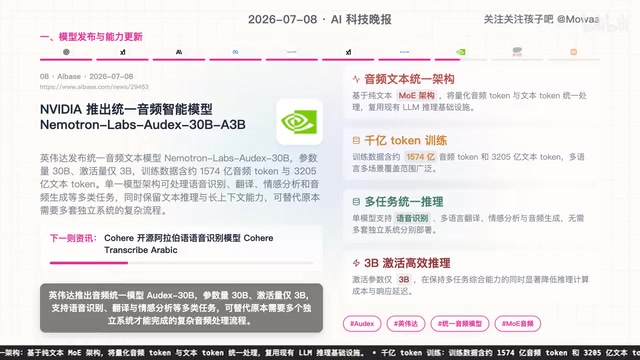
The "large parameters, small activation" design philosophy is becoming the mainstream direction for reducing costs and improving efficiency in current large models. The core logic of sparse activation technology lies in the following: unlike dense models, which invoke all parameters during each inference, this architecture activates only the subset of parameters most relevant to the current input through a conditional computation mechanism. Understanding the value of this design from the hardware level requires recognizing that the inference bottleneck of modern GPUs often lies not in peak compute but in HBM memory bandwidth—the speed of loading weights from memory to compute units is far lower than the processing speed of the compute units themselves, forming a "memory wall" effect. Take NVIDIA's H100 as an example: its FP16 peak compute reaches 989 TFLOPS, while HBM3 memory bandwidth is only 3.35 TB/s, resulting in a severe imbalance in arithmetic intensity (FLOPs/Byte), leaving many compute units idle while waiting for data. Sparse activation directly reduces the amount of weight data that must be loaded from HBM during each inference, thereby reducing FLOPs while more effectively alleviating the bandwidth bottleneck, achieving significant compression of end-to-end latency. AUDEX-310 compresses 30 billion total parameters down to 3 billion activated parameters (an activation ratio of about 10%), and further extends MoE's sparse computation concept to cross-task scenarios: different audio tasks (ASR, translation, sentiment analysis) share underlying parameters but activate different task-specific experts through a routing mechanism, balancing parameter efficiency with task coverage breadth—a representative application of this architectural concept to multi-task audio scenarios. Compared with previous dense audio models such as Whisper, this design also naturally offers better multi-task scalability—adding new task types only requires training the corresponding expert modules, without retraining the entire model backbone.
Domestic vendors are equally active in the speech recognition track. Xiaomi's MIMO opened up the API for its latest MIMO 2.5 ASR speech recognition model, supporting high-precision real-time speech-to-text in multiple languages including Chinese and English, billed by audio duration. In addition, some vendors open-sourced a Transcribe Arabic model targeting Arabic, supporting transcription of multiple dialects and mixed English-Arabic speech, focused on enterprise compliance and government scenarios. Arabic dialect recognition is a long-underestimated challenge in the speech AI field: Arabic has more than 25 major dialects (such as Egyptian, Gulf, and Maghrebi dialects), whose differences are so great as to approach separate languages, while the writing system uniformly uses Modern Standard Arabic (MSA), making spoken recognition require simultaneously handling the mapping between dialect variants and formal written conventions, with data scarcity being particularly acute. The positioning in these niche tracks shows that speech AI is penetrating deeply from general capabilities into vertical industries.
Compute Autonomy Becomes the Focus as Domestic Vendors Race to Develop Their Own Chips
At the compute infrastructure level, the most striking development this week was the news that domestic large model vendors are developing their own AI chips. According to reports, DeepSeek is independently developing an AI inference chip, aiming to reduce dependence on NVIDIA GPUs and cut compute costs. This trend cannot be understood apart from the macro context of the U.S.-China tech rivalry—since the U.S. Department of Commerce added high-end GPUs such as the A100 and H100 to its export control list in 2022, and further restricted the A800 and H800 (down-clocked replacement versions specifically designed for the Chinese market) in 2023, Chinese AI companies have faced continued pressure in acquiring high-compute chips.
It is worth noting that inference chips and training chips differ fundamentally in their design goals, which is the key premise for understanding the feasibility of domestic vendors developing their own chips. The training stage requires backpropagation over massive datasets, with extremely demanding requirements for peak FP16/BF16 compute, high-bandwidth interconnects (such as the 600GB/s bidirectional bandwidth provided by NVLink/NVSwitch), and large-capacity memory, areas in which NVIDIA's H100 holds a near-monopolistic advantage. The requirements of the inference stage are completely different: batch sizes are often small, computation graphs are fixed, and gradients need not be stored, so the core metrics shift to time to first token (TTFT), P99 tail latency, and token generation throughput per unit of energy (Token/Watt). This shift in characteristics allows inference chips to achieve significant cost advantages through specialized optimization of KV Cache memory access patterns, operator fusion, and FP8/INT8 quantization, without competing head-on with NVIDIA on peak compute. Google's TPUv5 and Amazon's Inferentia2 have both proven this path, providing a real-world reference for domestic vendors' breakthroughs on the inference side. If the reports are true, this would further strengthen DeepSeek's long-term strategic positioning in compute autonomy.
Similarly, Zhipu was reportedly in contact with domestic chip design companies, discussing customizing dedicated AI processors for its GLM series of large models. The direct driving force behind this is quite clear—its daily average token usage surged roughly 27-fold over the past year, and existing compute supply can no longer meet actual demand, making custom chips an option that must be seriously considered from an economic standpoint. Understanding this decision logic from the perspective of unit economics: once model inference invocation volume reaches sufficient scale, the high upfront R&D cost of custom chips (typically in the range of hundreds of millions to billions of RMB) can be amortized through the marginal compute cost savings per inference request, with a clear break-even point. Google's early practice in TPU development provides the most compelling financial validation: it is estimated that TPUs reduced Google's cost per large-scale AI inference by roughly 30%-60% compared to purchasing NVIDIA GPU solutions—a figure that translates into extremely considerable annual savings at a daily invocation volume of hundreds of billions of tokens.

This trend forms a subtle echo with market sentiment. Affected by external concerns over whether GPU demand can sustain high growth, NVIDIA's total market value has recently shrunk sharply, falling below the $1 trillion mark and retreating to valuation levels before the AI boom took off. Domestic vendors' moves toward self-developed chips are, to some extent, a real-world footnote to market concerns—when top AI companies are all seeking compute autonomy, the certainty of NVIDIA's growth naturally faces re-examination.
Developer Tool Ecosystem Continues to Improve, Security and Compliance Move Up the Agenda
Developer-facing AI tools also saw several noteworthy updates this week. GitHub announced that the Copilot desktop app is now officially available to users of all plans, including free and education tiers, allowing AI coding assistance without a paid subscription, further lowering the barrier to entry for developers. The strategic intent of this decision is to accelerate developers' habituation to AI-assisted programming workflows—once free users develop a dependence on Copilot in their daily coding, the friction of converting them into paying users or enterprise subscriptions will be greatly reduced. This is highly consistent with the "freemium" growth flywheel logic of SaaS products such as Atlassian and Notion: offering zero-marginal-cost features to acquire a massive user base, then monetizing through enterprise-grade features (such as team collaboration, code security auditing, and private repository support).
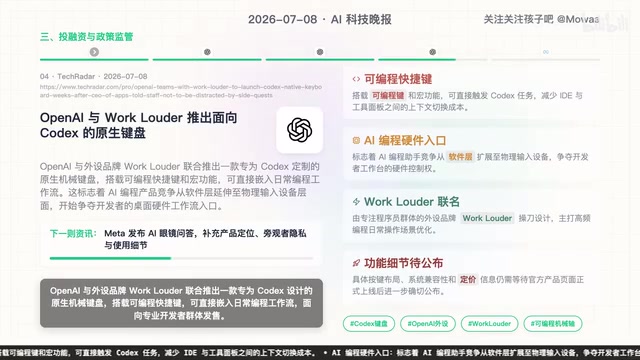
OpenAI, in collaboration with a peripherals brand, launched a native mechanical keyboard designed specifically for Codex, featuring programmable shortcut keys that can be directly embedded into daily programming workflows, sold to professional developers.
However, the flourishing tool ecosystem also comes with security risks. CNVDB, a vulnerability platform under the Ministry of Industry and Information Technology, issued a risk alert warning of a security backdoor vulnerability in the AI coding tool Claude Code, which could lead to malicious tampering of code, and advised developers to immediately investigate and upgrade to the latest version.
This warning reflects an underestimated systemic risk behind the rapid proliferation of AI coding tools: AI tool supply chain security. Unlike traditional software vulnerabilities, security threats in AI coding assistants are more insidious and present a multi-layered attack surface. Indirect prompt injection is the most representative threat vector: attackers hide malicious instructions in external content the model might read (such as code comments, README files, dependency library documentation, or web content), inducing the AI to carry out malicious operations while performing legitimate tasks—a process that is completely transparent and invisible to users. Deeper data poisoning attacks implant triggers during the model training stage, causing the model to generate code snippets containing classic vulnerabilities such as CWE-89 (SQL injection) or CWE-78 (command injection) under specific code contexts, which developers find difficult to detect through conventional code review—research by Stanford University and ETH Zurich has demonstrated the practical feasibility of such attacks. Moreover, as AI coding assistants gain increasingly powerful "agent" capabilities—able to autonomously execute terminal commands, read and write file systems, and call external APIs—the permission boundaries attackers can exploit are expanding accordingly, elevating the potential harm of a single prompt injection vulnerability from "generating bad code" to "executing arbitrary commands on the developer's machine." As tools such as GitHub Copilot and Cursor surpass tens of millions of daily active users, the amount of code generated daily by AI coding assistants has reached billions of lines, and the impact radius of a single model vulnerability has expanded from the individual to the entire downstream code ecosystem. Traditional SAST (Static Application Security Testing) tools struggle to effectively cover security auditing of LLM-generated code, and the entire developer community urgently needs to establish targeted AI code security frameworks. Meanwhile, Codex Remote in the ChatGPT iOS version received a feature update, adding a task management panel, SSH key connection support, and multi-dimensional DIFF filtering, further improving the mobile remote code collaboration experience.
A Turning Point in the Reshaping of the Landscape
Looking across this week's developments, the AI industry is at a clear stage-shifting turning point. The head-to-head competition among flagship models, the mass proliferation of multimodal capabilities, the unification trend in audio models, and domestic vendors' strategic pursuit of compute autonomy together sketch a panorama of increasingly fierce competition and an increasingly mature ecosystem.
Particularly worth noting is the fundamental shift in the compute narrative—from "frantically hoarding GPUs" to "seeking autonomous control," and from NVIDIA's market value soaring to falling below the trillion-dollar threshold. These signals may foreshadow the entry of AI infrastructure competition into an entirely new phase. The deeper logic of this shift lies in the fact that as model architectures gradually shift from a "compute-intensive training race" to "inference efficiency and deployment cost optimization," the core node of value creation is migrating from chip manufacturers to model developers and the application layer. Historically, every transition period in computing paradigms (from mainframes to PCs, and from PCs to cloud computing) has been accompanied by compression of profit margins at the infrastructure layer and an explosion at the application layer. Whether the AI industry is undergoing a similar structural evolution is worth continued attention. For developers and enterprises, model choices are becoming more diverse and tool barriers continue to lower, but the importance of security and compliance is rising in tandem and cannot be ignored.
Related articles

Gaussian Process Bandit Optimization: Exploration Strategies and Inference Regret Guarantees
Cumulative regret guarantees in Bayesian optimization fail to reflect final recommendation quality. This article examines a new study that provides inference regret guarantees for Gaussian process bandit optimization through exploration query strategies and fill distance analysis, validated on hyperparameter optimization and control tasks.
The Most Detailed Codex Guide on Bilibili: From Installation to Real-World Practice
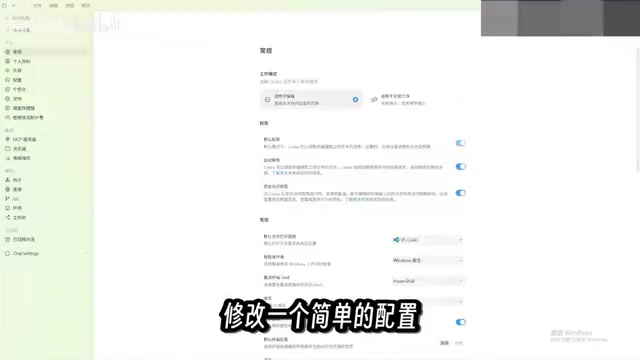
The most detailed Codex guide on Bilibili: from app store installation to daily work mode configuration, with a real coffee shop project demonstrating file organization, data extraction, dashboard creation, and other practical tasks. Learn to use Plan Mode and desktop pets to leverage Codex efficiently.

Appearance Compensation in Volume Rendering: Why RGB Accuracy Cannot Guarantee Density Correctness
Volume rendering research reveals that volumetric data perfectly reproducing external RGB views may still contain density errors: appearance compensation can double central density and keep external rays unchanged even when L2 error exceeds 14.52%. Density recovery depends on appearance capacity, spatial resolution, and measurement design.