GPT-6.1 Sol Hands-On Review: Same Price as Claude Sonnet 5.5 — Who Wins at 3D and Coding?
GPT-6.1 Sol matches Claude Sonnet 5.5's price — great at static modeling, weaker on dynamic 3D games.
OpenAI launched GPT-6.1 Sol at its developer day, with the biggest story being its pricing — identical to Claude Sonnet 5.5 at $2/$10 per million tokens — putting the two models in direct competition for the first time. After a full day of hands-on testing across 3D game generation, C++ programming, and Blender modeling, Sol shows clear capability tiers: static scene recreation (Seinfeld apartment, RuneScape UI, Saab 900) is impressively detailed, coding is fast and efficient with low token consumption, but dynamic 3D game visuals are noticeably outclassed by Sonnet 5.5. The author remains cautious, suggesting Sol's true potential may lie in unexplored non-visual domains.
OpenAI unveiled GPT-6.1 Sol at its developer day, hot on the heels of the underwhelming GPT-6.0. What's turning heads this time isn't a leap in capability — it's the pricing: $2 per million input tokens and $10 per million output tokens, identical to Anthropic's Claude Sonnet 5.5. One creator spent an entire day running intensive benchmarks in their browser OS environment, covering 3D game generation, C++ programming, Blender modeling, and more. The verdict? Neither bad nor remarkable.
Pricing Becomes the Headline: Sol Goes Head-to-Head with Sonnet for the First Time
The most significant shift this release is commercial positioning, not raw performance. The author notes that GPT-6.1 Sol is marketed as approaching the intelligence of OpenAI's flagship model, Astra, at roughly one-fifth the cost. More critically, its pricing is a perfect match for Claude Sonnet 5.5: $2/million input tokens and $10/million output tokens.
Looking back, in the GPT-5.6 and early Sonnet era, the Sol lineup wasn't a direct Sonnet competitor — it was generally seen as a higher-tier product closer to Opus. But with identical price tags, the two models are now on the same starting line. That reframes the evaluation: this isn't about who's stronger, it's about who delivers more value for the same dollar.
On the technical specs side, Sol features a context window of over 1 million tokens, a maximum output of 128K tokens, supports text and image inputs, and has a knowledge cutoff of April 30, 2026. On the DeepSWE benchmark, it performs best at the high reasoning effort level — the author also touches on a growing industry trend where models at higher reasoning tiers (Max or Ultra) don't necessarily produce better or more efficient results, and can sometimes score lower on benchmarks due to "overthinking."
DeepSWE is a benchmark specifically designed to measure a large model's ability to autonomously solve software engineering tasks — evaluating whether a model can independently handle code generation, debugging, and multi-step programming reasoning. Compared to earlier benchmarks like HumanEval, DeepSWE emphasizes end-to-end completion rates in real engineering scenarios rather than simple code completion accuracy.
Reasoning Effort is a parameter that has emerged in mainstream model APIs in recent years, allowing callers to specify how deeply a model engages in internal chain-of-thought computation before responding. Common levels include Low, Medium, High, and Max/Ultra. Higher effort typically consumes more tokens and increases latency, theoretically improving accuracy on complex reasoning tasks — but the "overthinking" phenomenon described here reveals a counterintuitive pattern: for well-structured benchmark problems, excessive reasoning can introduce unnecessary doubt and backtracking, actually interfering with correct answer generation.
3D Game Tasks: Competent, but Crushed by Sonnet 5.5
A recurring line throughout the review: "This is really hard to judge, because Sonnet 5.5's results were just 24 hours ago." That admission basically sets the tone for the entire comparison.
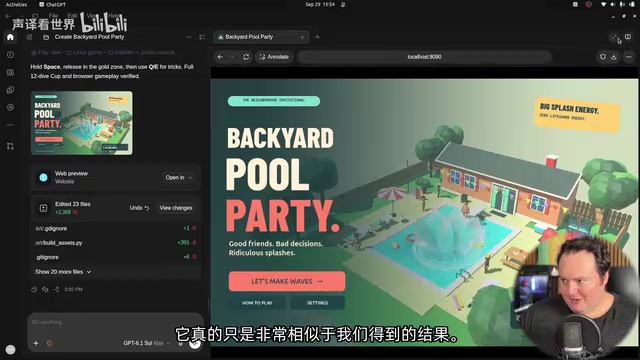
In the freshly introduced "backyard pool party" test (generating a diving 3D game using Blender and Godot), the author cleared all caches and temporary files to ensure no prior contamination. Sol generated results quickly, with water effects and character models that were "respectable" — but visually, it fell noticeably short of Sonnet 5.5. The author called that earlier result a "crushing victory" and didn't want to sugarcoat the comparison.

The browser OS "Halo OS" generation was more impressive — a macOS-style command center with adjustable seeds, a launchpad, a GTA-style game launchable from a mail app, and a "relive the world" time capsule feature. This kind of multi-app, emergent behavior is increasingly a common capability across frontier models. That said, the GTA clone still had the classic model-flavored logic bug of police cars teleporting directly into the player's face.
C++ Programming and Cinematic Replay: Noticeably Improved Usability
One standout addition this time came from a community suggestion: a "cinematic replay" feature. The author requested a self-contained C++ skateboarding game set in a New York neighborhood that didn't rely on Raylib, with a Z-key replay triggered after completing a trick.
Sol's first version had weak graphical fidelity — the author described it as feeling like "a GPT-6-era test model." But after relaxing the single-file constraint (the author suspects Sonnet 5.5's strong results used a multi-file structure anyway) and asking the model to go all out, the second version showed marked improvement: water reflections, building mirror effects, and a replay camera that accurately identified the start and end of each trick and captured the full sequence. The author called it "extreme sports showcase mode."

The subway FPS test was similarly solid: completed in 46 minutes, with decent graphics, wet floor reflections, bendable train carriages, and correct boarding/alighting logic — all following the given instructions. The author had "almost nothing to complain about" — clean, competent, and fast. The shared weakness was a lack of pedestrian interaction, leaving the city feeling empty.
In a robotic arm car-grabbing physics task, Sol (at high effort mode) made more precise, less destructive movements than Sonnet 5.5 — but ultimately chose to give up, explicitly concluding it couldn't complete the task and stopping. By contrast, Sonnet 5.5 barely managed through "destructive moves and luck." Interestingly, the author gave Sol some credit for this "knowing when to quit" decision-making.
Blender Modeling and Scene Recreation: Where Sol Actually Shines
If 3D games are Sol's weak spot, static scene recreation and modeling are where it truly excels.
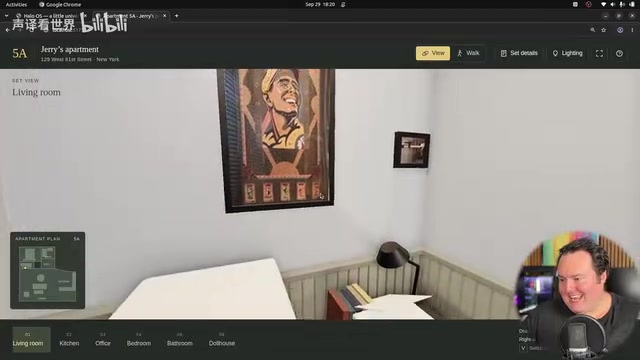
The Seinfeld apartment recreation was one of the most impressive results of the entire session. Multiple locks on the door, clean model geometry, Easter egg text on the TV screen, neighboring buildings visible through the window, a green bicycle and airplane, a Porsche poster and mini-map in the bedroom, an adjustable warm-toned desk lamp, and window light controls — the author called it "a massive leap forward compared to before," noting that the model even annotated the sources of set design details. The only disappointment was that the layout still differed from reference photos of the actual set — a challenge no model has cracked yet.
The RuneScape 2007 Grand Exchange PVP scene recreation was equally stunning: from a single prompt, UI elements, weapon icons, shark potions, and inventory interfaces came out near pixel-perfect. The author half-jokingly wondered whether the model had scraped real game assets. Shortcomings included a distant camera angle, unrealistic player characters, and an inability to trigger special attacks.
The interactive 3D modeling of a Saab 900 Turbo tested the model's ability to recreate a "quirky, distinctive vehicle." The result wasn't pixel-accurate, but the front air dam, iconic bumper strip details, headlight textures, an openable hood (revealing strut towers and battery), manual transmission interior, switchable paint colors, and multi-angle view presets were all impressively handled. The author called it "a nice interpretation."

The Seinfeld apartment is a well-established reference point for AI modeling tests: the show's long run, extensive episode catalog, and heavily documented set details mean the web is saturated with annotated images and fan documentation, giving models plenty of training material to draw from. It's commonly used to evaluate how accurately a model can reproduce a specific, real-world scene with abundant public references — rather than assessing creative generation. Whether it can nail the multiple door locks or specific prop placement has become a dividing line for measuring a model's memory depth and spatial understanding.
RuneScape 2007 (also known as OSRS, Old School RuneScape) is a classic pixel-art MMORPG relaunched by Jagex in 2013 based on the 2007 version of the game, with a highly active player community deeply familiar with the original pixel assets. The Grand Exchange is the game's central trading hub, with fixed pixel-level standards for its UI style and item icons — making it an ideal test case for whether a model can precisely reproduce existing visual assets rather than generating generic approximations.
Token Efficiency and Overall Assessment
Worth noting is resource consumption. After a full day of heavy testing — much of it at extreme or max effort settings — the author had consumed only about 3% of their monthly quota (dropping from 98% to 95%). He suspects the model has strong Token efficiency, which is genuinely good news for paying users.
One failed experiment was also illuminating: the author attempted to connect an old Pentium III Red Hat laptop via USB and ethernet, reinstall its OS, and set up a camera so the model could "physically see" the screen. After switching to the more permissive Daybreak model, the model was unexpectedly downgraded back to GPT-6, and ultimately couldn't get past a login screen that remained stuck at the laptop's port — forcing the test to end. The author admitted that his persistence in searching for non-visual tasks stemmed precisely from Sol's relative weakness on visual 3D tasks compared to Sonnet 5.5. He wanted to find out whether Sol had untapped strengths in unexplored areas like low-level software or physical device control.
Overall, GPT-6.1 Sol is a competent, Token-efficient, competitively priced model. It excels at static 3D modeling and scene recreation, and handles programming tasks capably and quickly. But on visual impact in dynamic 3D games, it's noticeably outclassed by Claude Sonnet 5.5 at the same price point. The author's final take is measured: he doesn't want to draw firm conclusions based on visually-biased tests alone. Sol's real strengths may be hiding in territory that hasn't been fully explored yet.
Related articles

Linux Kernel's AI Civil War: Anti-AI Activist Elected to TAB, Torvalds Scraps AI Disclosure
Anti-AI activist Laurent Pinchart elected to the Linux kernel TAB as Linus Torvalds scraps AI code disclosure. A rundown of the kernel community's AI civil war, both sides' positions, and the impact on open source.

When Did Paid Childcare Become the Norm? Working Mothers and the Evolution of Childcare
When did paid childcare become the norm? This article traces the evolution from the rise of childcare centers in the 1970s–80s and the 1990s linking of federal subsidies to work requirements, to declining stigma and rising costs, and explores advocates' 25-year effort to catch up with other countries on childcare and paid parental leave.

Red Flags for Product-Market Fit: A Practical Guide from Top VCs and the Superhuman Founder
Investors from Iconiq and Sapphire Ventures and Superhuman founder Rahul Vohra share PMF red flags and practical methods, including the 40% disappointment rule, retention curves, and acquisition costs.