GPT-6.2 and Gemini 4 Carbon Leaked: The Large Model Arms Race Escalates Again

Frontier models break records in rapid succession as agents, small models, compute, and capital advance on all fronts.
This AI industry roundup shows competition accelerating: Gemini 4 Carbon set a Wonder benchmark record, traces of OpenAI's GPT-6.2 Beetlejuice were captured, and Musk teased the 2.5-trillion-parameter Grok 4.8. SenseTime's Loop 9B beat 27B models, Xiaomi's 0.8B model hit 95.24% accuracy, and Microsoft's 4B computer-use model scored 66.0% on OS World. Cursor plugin poisoning and AI-weaponized attacks were confirmed, Google sent TPUs to space, and Alphabet's trillion-dollar AI commitments sent its market value plunging.
The pace of competition in the AI large model arena is visibly accelerating. On one side, Gemini 4 Carbon is breaking records on evaluation benchmarks; on the other, traces of OpenAI's internal model GPT-6.2 Beetlejuice have been captured, and with Musk himself teasing the 2.5-trillion-parameter Grok 4.8, the ranking battle among frontier models has entered a new round of reshuffling. At the same time, agents, open-source small models, compute infrastructure, and commercialization are all advancing in parallel — the entire industry chain is speeding up.
Frontier Large Models: Benchmark Records Broken and Next-Gen Flagships Surfacing
According to a roundup from the Bilibili program AI早知道, Perplexity's CEO released measured data for Gemini 4 Carbon, which set a new all-time record on the broad-and-deep research benchmark Wonder, and confirmed it will be fully rolled out to Pro and Max users in Computer. Community rumors also suggest that Google has been secretly testing its next-generation flagship Gemini 4, scoring near-perfect results on multiple public and private benchmarks with inference costs dropping sharply — however, there has been no official response to this claim yet, so it should be treated with caution.
On OpenAI's side, a Discord tracker captured traces of the internal model GPT-6.2 Beetlejuice, confirming that the next-generation flagship codenamed Bell is accelerating toward readiness. In a public interview, Altman revealed that OpenAI has invested hundreds of millions of dollars in fundamental mathematics research, and that the team holds a large number of unpublished mathematical discoveries that will directly reshape the depth-reasoning boundaries of the next-generation model. This point is worth noting: it hints that the next phase of model competition may shift from "stacking parameters" to "fundamental scientific breakthroughs."
Musk personally teased the scale of Grok 4.8 — a total of 2.5 trillion parameters, developed on an entirely new training architecture, with pre-training now successfully completed and the team fully focused on reinforcement learning tuning. Meanwhile, SpaceXAI officially launched the first stable version of Grok Bot and brought a task center online, allowing developers to centrally manage multiple parallel tasks, with SMS configuration options appearing in settings, foreshadowing integration with the iMessage ecosystem.
Reinforcement Learning Tuning (RLHF/RLVR): The article mentions that Grok 4.8's "pre-training has successfully concluded, and the team is fully focused on reinforcement learning tuning" — this is the core stage of post-training for current large models. Pre-training lets a model acquire general language capabilities from massive text, while reinforcement learning tuning uses reward signals to guide the model toward aligning with human preferences or improving specific capabilities (such as mathematical reasoning and code generation). Common approaches include Reinforcement Learning from Human Feedback (RLHF) and Reinforcement Learning from Verifiable Rewards (RLVR) — the latter uses rules or compilers to automatically judge answer correctness as the reward in tasks with objective right-or-wrong answers, such as math and code, without manual annotation. This stage directly determines a model's "usability" and "reasoning depth," and is also the key to how flagships differentiate themselves.
Open-Source Camp: Small Models Punching Above Their Weight and On-Device Breakthroughs
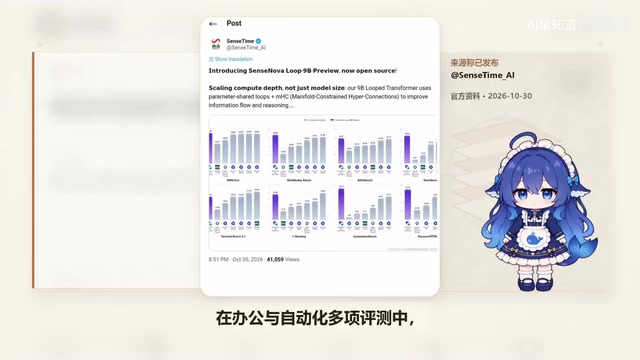
The domestic open-source camp has produced a dark horse. SenseTime has officially open-sourced Loop 9B Preview, which, through parameter-sharing loops and manifold-constrained hyper-connections, beats traditional large models of 27B scale in multiple office and automation benchmarks. On-device small models have also seen breakthroughs: Xiaomi open-sourced the 0.8B on-device model Zionio C20, which took first place among sub-1B models on the comprehensive document leaderboard with a real-world accuracy of 95.24%, and is now fully integrated into Super Xiao Ai.
The authoritative evaluation organization Artificial Analysis launched the AaDominations V1.1 knowledge and hallucination benchmark, with the question bank streamlined to 3,000 high-difficulty items, a correlation coefficient of 0.99 between the public and private sets, and even stricter anti-hallucination testing. On the inference optimization front, Unslough released DeepSit V4.1 Flash, whose new Dynamic V3.1 quantization took first place on most mainstream leaderboards, running full local inference smoothly on ordinary 64G memory with a threefold speed increase. NVIDIA showcased a tiny killer on the open-source side — the Nimetron Labs team open-sourced the multilingual speech enhancement model Reuse, with only 9.6 million parameters, capable of removing background noise and echo at extremely low compute cost.
Parameter-Sharing Loops and Manifold-Constrained Hyper-Connections: The core technical points of SenseTime's Loop 9B Preview. Parameter-sharing loops mean the model reuses the same set of weights across multiple layers, simulating a "deeper" network through repeated iterative computation, thereby improving expressive capacity without increasing parameter count — this is also an important foundation for the 9B model's ability to challenge 27B models. Manifold-constrained hyper-connections are a connection topology design that restricts inter-layer connections to specific geometric manifolds to stabilize gradient propagation in deep loops and avoid training divergence. Combined, the two allow a smaller model to approach or even surpass traditional architectures three times its size in office and automation tasks, representing a new open-source philosophy of "trading architectural efficiency for parameter scale."
Multimodal and Video Generation: Open Source and Industrialization in Parallel
The video arena is booming. Developers discovered Google's brand-new video model OmniFlash 1.2, which supports up to 4K ultra-HD output and integrates reference-image generation, frame interpolation, and lossless extension. The Pika team went straight to open source with Pika H3 Flex, trained on MiniMax H3, which can simultaneously generate video and dual-channel stereo sound effects with just 6 sampling steps, for up to 15 seconds. In authoritative testing, Hyperflow H3 open weights developed on the MiniMax base beat its own base model to take third place on the video editing leaderboard, held steady at fifth in image-to-video, and cost over 50% less than commercial competitors. Domestic video leader Clean AI has launched film industry industrialization with the Clean Originals original plan, its first Halloween short film produced entirely with Clean 4.0.
Agents and Developer Tools: From Operating the Desktop to Taking Over the Browser

Microsoft open-sourced a 4B hybrid computer-operation model on Hugging Face, where a single policy can autonomously decide when to click the mouse and when to write scripts, scoring 66.0% on OS World and crushing agents of 30B scale. Perplexity Computer can now take over a user's local Chrome browser through the desktop app — install the extension once to authorize the agent to perform local scraping and interaction, confirming the decisive value of caching technology for agent deployment.
Anthropic restructured its subscription system: the top tier Max 20X is officially renamed Ultra, with the monthly fee unchanged at $200, and more importantly, verified Ultra accounts immediately have their 5-hour limits completely removed, so high-intensity work is no longer blocked. Community confusion over usage was also clarified with fine print — the so-called 20x refers only to the original 5-hour short-term limit; the new Ultra's total weekly quota remains 10 times that of Pro. Code copyright regulation is tightening in parallel: Anthropic issued restrictions to Claude Code via a server-side switch, allowing original and similar-mechanic games to be written but strictly prohibiting any form of replication of existing specific games, and web-wide image generation cannot be disabled.
On the toolchain front, coding agent platform Factory announced the acquisition of TatDev, natively integrating the context layer and data lineage technology into the Droid engine. Editor Z received the Delta V0.22 version, removing the limit of a single terminal per thread and allowing multiple terminals to be opened seamlessly in parallel across different worktrees. OpenCode announced that users can directly use their own Claude subscription accounts without repeatedly buying third-party APIs, and launched a Phase 4 campaign in which the bundled DeepSit V4.1 Flash usage surged to $100; version 2.2.3 also includes a built-in image generation tool, connecting to image models such as OpenAI, Gemini, and Grok. On the design side, Baoyu's released Biodesign V2.1 added an element comment system — users mark up the canvas and PPT, and the agent can read the comments and implement image edits.

Personal cloud assets are also being activated by agents: Quark Cloud Drive launched a new skill where AI can directly read through cloud drive albums, voice, and video, and supports automatically archiving and backing up conversation-generated results in reverse.
Computer-Operation Models and the OS World Benchmark: Microsoft's open-source 4B hybrid computer-operation model falls under the category of "Computer-Use Agent," meaning the model directly observes screen screenshots and outputs actions such as mouse clicks, keyboard input, or script execution to operate desktop software on behalf of humans. OS World is the authoritative benchmark for evaluating this capability, with tasks covering real-world scenarios such as cross-application file operations, web form filling, and system settings, scored by task completion rate. A score of 66.0% means this 4B model autonomously completed operations in nearly two-thirds of tasks, surpassing much larger general-purpose agents. Its "hybrid strategy" means the model itself decides when to use GUI clicks and when to directly write scripts to call APIs, balancing flexibility and efficiency — a key step for agents moving from conversation to actual execution.
Security Offense and Defense: Plugin Poisoning and AI Weaponization
AI code editor Cursor ran into a security crisis: a tampered fake Claude plugin in the extension marketplace was found to contain malware, affecting up to 5,000 users, and the company urgently investigated and pushed patch version 2.1.314. Even more alarming, AI-weaponized attacks have been confirmed: CrossTrack released a major report showing that the hacker group VaporPanda used an open-source AI attack-and-defense framework to conduct automated penetration against more than 200 targets in 14 countries within 11 days, consuming up to 1.4 billion tokens in a single attack planning session. In response to the risk of models being used for cyberattacks, the DeepSweep open platform quietly tightened permissions, with the latest code showing the platform is advancing the CyberP security pool, where applications must pass facial and real-name verification with no violations within 90 days.
Compute Infrastructure: TPUs in Space and Domestic Super Nodes
Google's Project Suncatcher sent four TPUs into space orbit, and this week the company officially confirmed that the chips successfully booted, ran prompt computations, and transmitted results back to Earth in the extreme space environment. Domestic compute is also racing ahead at extreme speed: Wuhan launched the first Huawei Ascend 950DT thousand-card liquid-cooled super node, with 1 EFLOPS of compute, going from project approval to lighting up in just 11 months; it is reported that DeepSeekAd also plans to deploy at least 160,000 Ascend chips for inference. European and American giants have opened a compute financial war: according to The Information, NVIDIA is in talks to provide billions of dollars in credit guarantees for Nscale's $45 billion data center project, thereby locking in Anthropic's long-term purchases of its flagship chips.
Liquid-Cooled Super Nodes and EFLOPS: The Huawei Ascend 950DT thousand-card liquid-cooled super node launched in Wuhan is a landmark form of domestic compute infrastructure. A "super node" refers to connecting a large number of accelerator cards into a single logical computing unit via a high-speed interconnect bus, enabling a thousand cards to train ultra-large models cooperatively like a single chip and reducing cross-node communication overhead. Liquid cooling is the mainstream solution for high-density cabinet heat dissipation, using coolant to directly carry away chip heat and supporting per-cabinet power densities far beyond air-cooling limits. 1 EFLOPS means one quintillion floating-point operations per second, a common unit for measuring the scale of intelligent computing centers. The project went from approval to lighting up in only 11 months, reflecting the domestic compute sector's catch-up pace in engineering delivery speed.
Commercialization and Capital: Financial Pressure Behind the Boom

OpenAI officially launched its Private Intelligence private service, giving government and enterprise clients the highest level of control over sensitive data while calling on the most powerful base model, directly attacking the high-value enterprise market. Major partnership news came from the domestic device side: Apple Intelligence's entry into China has been officially finalized, with Alibaba's Tongyi fully integrated into Siri and system-level writing tools, set to begin developer testing on November 4 and roll out to mainland China users with iOS 27.3 in December.
Behind the boom lies heavy capital pressure. Alphabet's latest disclosure revealed over $1 trillion in AI commitments and warned that generative AI is cannibalizing traditional search profits, sending Wall Street sentiment plunging and Google's market value down about $500 billion in a single day. Amazon's quarterly report disclosed that it has finalized supplier financing channels, allowing it to borrow up to $80 billion against eligible procured hardware assets. S&P Global Ratings officially downgraded Meta's credit outlook to negative, citing extremely high AI capital expenditures and pressured financial statements. Manufacturing giant Foxconn offered a strikingly different vote of confidence: it confirmed it is in talks with OpenAI on a major new partnership and publicly stated that there is absolutely no so-called bubble in the AI industry, and that hardware manufacturing demand remains extremely real and strong.
A public rift has emerged in the chip geopolitical game: according to The Information, Anthropic is pushing in Washington for further tightening of chip export restrictions to China, a move fiercely opposed by several major tech giants. Under heavy pressure, the domestic base has received strategic support: reports say that in DeepSeek's new $16 billion funding round, the share of state capital rose sharply to 27%, while Blackwell B300 server quotes have been driven up to $2.85 million, five times the overseas price.
Domestic Commercialization Overview
IPC released its H1 2026 report: China's large model MaaS market revenue soared nearly 9 times in half a year, exceeding 10.63 billion yuan, with Alibaba Cloud firmly in first place at 46.6%, followed by Zhipu and Volcano Engine. To capture the developer ecosystem, Baidu launched an ultra-low-price breakout battle for search APIs, with Baidu Search API limited-time promotional pricing as low as 4.9 yuan per thousand calls, while fully upgrading its AI camera and interactive experience. Baidu World Conference 2026 is officially set for November 12, with a special 6,000-square-meter exhibition area to showcase Doomate, Coco, and other products for intelligent organizations.
Judging from this highly information-dense industry roundup, large model competition has evolved from a single capability contest into a comprehensive battle spanning compute, capital, security, ecosystem, and geopolitics. The release timetable for next-generation flagships remains uncertain, but one thing is certain: whoever can turn model capabilities into a scalable commercial loop will be the one to stay at the table in this long race.
One-line Summary
Frontier large models are densely breaking records, agents, open-source small models, compute, and capital are advancing on multiple fronts, and AI competition has entered a comprehensive contest.
Paragraph Summary
This AI industry roundup shows that large model competition is clearly accelerating: Gemini 4 Carbon set a record on the Wonder benchmark, traces of OpenAI's internal GPT-6.2 Beetlejuice were captured, and Musk teased the 2.5-trillion-parameter Grok 4.8. In the open-source camp, SenseTime's Loop 9B beat 27B models, and Xiaomi's 0.8B on-device model reached 95.24% accuracy. Multimodal and video generation are advancing in parallel with open source and industrialization, and Microsoft's 4B computer-operation model scored 66.0% on OS World. On security, Cursor plugin poisoning and AI-weaponized attacks were confirmed. On compute, Google's TPUs went to space and Wuhan's Ascend super node lit up; on the capital side, Alphabet's trillion-dollar AI commitments sent its market value plunging, S&P downgraded Meta's outlook, and the domestic MaaS market grew nearly 9 times in half a year.
Related articles

AI Can Read Neural Network Weights Directly: Do Models Already Exceed Expectations?
A Reddit developer experiment shows language models can directly read neural network weights and infer their function. Astra, Opus 5.5, and Muse Spark 1.3 all passed the test, sparking discussion on model generalization and training sources.

India's Microdrama Market Explodes: EloElo Secures $80M Investment from NBCUniversal
EloElo secures $80M from NBCUniversal to boost StoryTV, its microdrama platform with over 33M monthly active users, as India's microdrama market draws global capital.

Acoustic Detection of Multi-Rotor UAVs: Fusing Handcrafted Features with Pre-Trained Embeddings
Study reveals data leakage from random splits in UAV acoustic detection, proposes source-disjoint protocol with stacked ensemble of handcrafted features and YAMNet embeddings, achieving 95.29% accuracy for low-cost drone detection.