GPT-6.2 Astra Achieves a Perfect 100% Score on ARC-AGI-3

GPT-6.2 Astra claims a perfect 100% on ARC-AGI-3, but details are missing and the community is waiting.
A Hacker News headline claims GPT-6.2 Astra scored a perfect 100% on ARC-AGI-3, drawing attention. The ARC-AGI series is regarded as a hard metric for generalized reasoning due to its focus on few-shot abstract rule induction, making a perfect score highly symbolic. The version naming suggests a reasoning-oriented iterative update. However, only the title is available, with key details such as evaluation configuration, number of attempts, and tool use missing, and the post has low discussion volume, with the community leaning toward waiting for reproduction. The article suggests treating it as a signal worth tracking rather than a definitive conclusion.
A Perfect Score That Lit Up the Feed
A short but hard-hitting post appeared on Hacker News: GPT-6.2 Astra scores 100% on ARC-AGI-3. The post itself contained only a title, 18 points, and 3 comments—very little information—but the combination of "100%" and "ARC-AGI" is enough to make anyone tracking AI reasoning ability stop and take a second look.
The ARC-AGI family of benchmarks is particularly sensitive because it is designed as an abstract reasoning test that is hard to crack through memorization or pattern matching. If a model achieves a perfect score on such a benchmark, it usually means it has crossed a threshold in generalized reasoning rather than simply memorizing its training data more thoroughly.
What This Result Means
The Weight of a Perfect Score
ARC-AGI tasks are primarily visual grid transformations where the rules are not given in advance; the model must infer the transformation logic from a small number of examples and then apply it to new problems. Such tasks are extremely hostile to rote memorization, which is why scores have long been treated as a hard metric for abstract reasoning. If GPT-6.2 Astra truly achieved 100%, it would mean the model can now reliably cover the entire test set at the level of few-shot rule induction.
Signals from the Version Number
The naming "GPT-6.2" suggests this is an iterative update rather than an entirely new generation, while "Astra" reads like a specialized capability branch or codename. Combined with ARC-AGI-3, a relatively new version of the benchmark, one can infer that this release markets reasoning ability as its main selling point rather than simply piling on parameters or multimodal features.
ARC-AGI was proposed by François Chollet in 2019, with a design philosophy that the essence of intelligence is not a store of knowledge but the ability to induce new rules from very few samples and apply them. Each problem is a unique grid-transformation puzzle, and at test time the model has never seen the same kind of rule in its training set, so it cannot win through retrieval or memorization. ARC-AGI-1 and ARC-AGI-2 problems are mainly pure visual reasoning, while ARC-AGI-3 further introduces interactive, multi-step environments that require the agent to dynamically infer rules through exploration, raising both difficulty and evaluation dimensions beyond previous generations. For this reason, the series has long been regarded as a touchstone for distinguishing "scaled memorization" from "genuine generalized reasoning," which is why a perfect score is especially eye-catching.
The Restraint We Need to Maintain
The Information Gap Remains Large
It must be acknowledged that all we have right now is a single title. There are no evaluation details, no run configuration, no indication of whether additional tools or multiple samplings were used, and no official technical report. ARC-AGI evaluation is highly sensitive to prompt style, number of attempts, and whether program synthesis is allowed—and with different conditions, scores are far less comparable.
ARC-AGI's official evaluation imposes strict constraints on the "compute budget": the inference cost of a participating system on each problem must be kept within a defined range, to prevent brute-forcing answers through massive sampling or search. In addition, the evaluation distinguishes conditions such as "whether external program synthesis is allowed" and "whether multiple attempts are permitted before taking the best result," and scores under different settings cannot be directly compared across the board. Therefore, when seeing numbers like 100%, the first thing to confirm is whether the evaluation protocol matches the official leaderboard and whether it was completed under the same compute constraints; otherwise, a perfect score can easily be misread as an absolute leap in capability.
The Community Reaction Is Lukewarm
Eighteen points and three comments is a fairly low level of discussion on Hacker News. This may mean the post was timed poorly, or it may mean the community has grown somewhat fatigued by "yet another perfect-score claim" and prefers to wait for reproduction results before commenting.
Follow-ups Worth Watching
If this result can be independently reproduced, it will shift the discussion from "can models do abstract reasoning" to "where are the boundaries of this reasoning ability." For developers and researchers, the more practical question is whether this capability can transfer to real engineering tasks, rather than only holding on benchmark grids. Until the official evaluation details are published, it is safer to treat this news as a signal worth tracking than as a settled conclusion.
One-line Summary
GPT-6.2 Astra claims a perfect 100% score on ARC-AGI-3, but details are missing and the community is waiting.
Paragraph Summary
A Hacker News headline claims GPT-6.2 Astra achieved a perfect 100% score on the ARC-AGI-3 benchmark, drawing attention. The ARC-AGI series centers on few-shot abstract rule induction and has long been regarded as a hard metric for generalized reasoning, so a perfect score carries high symbolic significance. The version naming suggests an iterative update oriented toward reasoning ability. However, currently only the title is available, lacking key details such as evaluation configuration, number of attempts, and whether tools were used, and the post's discussion volume is low, with the community leaning toward waiting for reproduction. The article recommends treating it as a signal worth tracking rather than a settled conclusion.
Related articles

Jingle Jam 2026 Registration Opens: Lewis Uses Old Footage to Rally Volunteers for Fundraising
Jingle Jam 2026 fundraising registration is open. Lewis uses old footage edited into a new video, calling on viewers to create fundraising pages at jingle jam.tiltify.com to support eight charities. The event takes place in the first two weeks of December.

Gemini 4 Neon Hands-On Test: Can It Replace Claude Opus 5.5?
A Bilibili creator tests Gemini 4 Neon, Claude Opus 5.5, and GPT 6.2 across three coding Agent challenges—pelican animation, 3D racing, and code-generated video—to see if Gemini can replace Opus.
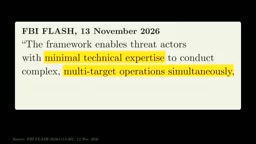
FBI-Warned Artex: How an AI Attack Framework With No In-House Model Pries Open Enterprise Doors
The FBI-warned open-source AI attack framework Artex has no model of its own—it plugs into Claude, GPT, and other external LLMs to drive an agent loop, turning ordinary tools like Nmap into an automated attack pipeline. This article examines three real cases—South Korean finance, ConnectWise, and Barracuda—analyzes the three drivers of speed, cost, and noise, and outlines defenses such as exposure inventory and short-lived credentials.