GPT-6.2 Astra Demo Leaks as Google Gemini 4 Model Clues Surface

GPT-6.2 Astra leaks show big capability gains, while safety delays and Google/Tencent efficiency races heat up.
The article maps multiple threads in the recent AI model race. OpenAI's GPT-6.2 Astra leaked a demo through unofficial relay services, generating a fully interactive dungeon game from a single prompt, with especially notable gains in web and front-end work; a hidden BioBasics Bench entry shows it scoring 89 versus 67 for its predecessor. Meanwhile, OpenAI formed a safety collaboration with four independent organizations, and model delays are attributed to alignment difficulty and excessive caution, with Altman's remarks about approaching RSI fueling speculation that capabilities are being held back. Google's Gemini 4 Neon and Oxygen surfaced in logs, with naming now extending to periodic-table levels. Tencent's HY4 Flash approaches Claude Haiku 5.5 at nearly 18x lower cost, and the Hugging Face–OpenRouter integration simplifies calling open-source models. On the engineering side, Anthropic stresses that verification matters as much as generation, and Codex capacity errors fell about 99%.
OpenAI's flagship model cadence is showing a notable gap. It's been about 75 days since GPT-6 Astra launched, and while Sol, Luna, 6.1 Sol, and Terra have all arrived in the interim, a true Astra-level upgrade has yet to appear. That said, an early GPT-6.2 Astra demo and benchmark data leaked through unofficial channels have, for the first time, made the unreleased model's capabilities clearly visible.
GPT-6.2 Astra: An "Unofficial Preview" Leaked via API Relay Services
According to multiple users who gained access, model identifiers for GPT-6.2 Astra, Sol, and even Terra appeared at Azure-related access points, after which relay services reportedly offered working endpoints within hours, letting users plug these models directly into official toolchains like Codex. The legality of this channel is questionable, but the demo results themselves are worth examining.

The most discussed example is a "dungeon exploration" game generated from a single prompt. From texture quality and treasure chest interactions to monster behavior and level detail, the overall polish far exceeds what previous GPT models have achieved on game development tasks. Crucially, these assets weren't pulled from external sources—the model built them from scratch in pure code, skipping the usual "place placeholder blocks first, then swap in 3D assets" approach common in earlier GPT game projects.
Another comparable case is the "pelican riding a bicycle" generation test. In the 3D version, GPT-6.2 Astra clearly outperforms its predecessor, with the pelican's wings even extending naturally beyond the frame. The most consistent feedback is that this model shows the biggest gains in web development and front-end tasks—precisely the area where OpenAI models have historically struggled.
Benchmark Leak: 89 vs. 67
Harder evidence comes from a benchmark data leak. According to Binkji's investigation, OpenAI accidentally exposed a hidden eighth model entry in the new BioBasics Bench interactive chart, which could be revealed by running a JavaScript command in the browser's developer tools. The entry shows GPT-6.2 Astra scoring 89 at the highest setting, compared to 67 for GPT-6 Astra—a 22-point difference.
It should be noted that this finding has not been independently verified, and the vulnerability has reportedly been patched. But if the data holds, it would represent a considerable leap for the Astra series on a science benchmark.
BioBasics Bench is an evaluation benchmark for foundational scientific capability. Its specific structure isn't detailed in the article, but from the name and score range (67 to 89), we can infer a percentage-based or similar normalized scoring system. Unlike typical static knowledge Q&A, benchmarks of this kind often distinguish models' scientific literacy levels through multi-step reasoning, chart interpretation, or experimental design tasks, so a 22-point gap usually implies a generational capability jump rather than fine-tuning-level variation. Note that benchmark scores depend heavily on question distribution, prompt settings, and scoring scripts; a single leaked entry lacks a complete model card and reproduction details, so it can only serve as directional reference.
Safety Alignment: A Delayed Flagship, or Capabilities Being "Held Back"
Beyond performance, another thread points to the reason for the delay. Reports suggest OpenAI encountered substantial alignment and safety difficulties with GPT-6.1, 6.2, and even 6.5: the models possess large-scale pretraining capabilities, but converting them into a form safe for public release led to week-long delays. Some even claim OpenAI's safety caution now exceeds Anthropic's, and that it canceled the initial GPT-6.1 Astra release as a result.
OpenAI also announced a four-party safety collaboration: partnerships with four independent organizations—Meter, Apollo Research, Goodfire, and Transluce—granting them deeper access to internal models to investigate alignment risks and evaluate safety issues. Additionally, an allegedly deleted engineer tweet hints that the company became especially cautious after a certain safety incident.
These two threads—capability leaps and safety delays—are likely two sides of the same coin. Sam Altman reportedly said in an interview that "we didn't have AGI before, now we do," and mentioned being able to move closer to the recursive self-improvement (RSI) range. Such statements lack full context, but they echo the speculation that "the model is too strong, so it's being held back."
Recursive Self-Improvement (RSI) is a core concept in AI safety discussions, referring to a system's ability to improve its own code, architecture, or training process, with the improved version continuing to accelerate the next round of improvement in a positive feedback loop. Altman's remark about being "closer to the RSI range" doesn't mean the system has achieved autonomous iteration, but more likely that the model's assistance on AI research and engineering tasks is already enough to significantly compress development cycles. This statement is linked to safety delays because RSI is considered one of the key thresholds for loss of control: once improvement speed outpaces human review cadence, the alignment and evaluation window shrinks dramatically. That's why the industry remains highly sensitive to any signal approaching RSI, which explains why capability leaps and release delays are often interpreted within the same framework.
Google's Model Roster Is Becoming a Periodic Table
Google's cadence, meanwhile, is heading in a completely different direction. Two new identifiers, Gemini 4 Neon and Gemini 4 Oxygen, appeared in backend logs, alongside the existing Argon, Carbon, and Krypton. Neon's positioning is unclear—it appears both as a model name and as a standalone subscription tier, with a Neon tier linked to Gemini Ultra, a Helium tier linked to Gemini Plus, and an alert system for low video-generation usage budgets.
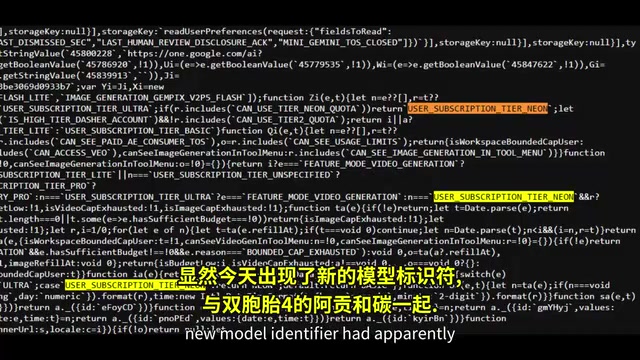
Oxygen's outline is clearer: it's believed to be the Flash-tier model in the Gemini 4 family, excelling at web development and front-end tasks, extremely fast, and outperforming Carbon in output quality across multiple tests. In a VoxelBench castle-generation comparison, Oxygen's detail and overall quality were noticeably better than Neon's output.
Release density has gotten so high that "naming after the periodic table" has gone from a joke to a literal description. This pace also raises a question: has Google already hit some kind of self-acceleration threshold? Based on available information, the more reasonable explanation is intensive iteration by engineering and product teams, not RSI.
The Efficiency War: Tencent HY4 Flash and Open-Source Routing Integration
Beyond flagship models, competition on cost and speed is just as fierce. Tencent released HY4 Flash, with self-reported data showing that in a blind test of 85 users and 259 real tasks, HY4 Flash at its highest thinking mode nearly matched Claude Haiku 5.5 in user satisfaction (2.79 vs. 2.81), but averaged 4 cents per task versus 71 cents for the latter—nearly 18 times cheaper—while also being the fastest model tested at about 6.7 minutes per task on average.
On specs, HY4 Flash has 224 billion total parameters and 12 billion active parameters, supports a 1-million-token context with native multimodality, and generates at over 150 tokens per second. API pricing is 7 cents per million input tokens and about 28 cents for output; Tencent says its per-task cost is 24.5 times lower than its own larger HY4, and plans to open-source the model weights.
In practice, this Flash model has clear weaknesses: in a "lady riding a bicycle" SVG generation comparison, it lost to Coin4Max, producing errors even at higher reasoning settings. But on web development tasks (such as an interactive page simulating bees collecting pollen), it's fast, correct, and cheap. Its positioning is clear—not to replace Haiku 5.5's intelligence ceiling, but to handle high-frequency everyday tasks at lower cost.
A more practical change for developers comes from the Hugging Face–OpenRouter integration: models on Hugging Face can now be routed through OpenRouter, which automatically selects the best provider based on price, speed, and reliability, with automatic failover when a provider is unavailable. Developers keep using their existing Hugging Face token and API without managing multiple providers.

The accompanying Hugging Face Broadcast feature lets request traces be stored directly in Hugging Face storage, keeping model interaction records on the Hub alongside projects for later evaluation, debugging, and fine-tuning.
Model Routing is an architecture for dynamic dispatch at the inference request level: a gateway forwards requests to different providers or model sizes based on task type, context length, latency budget, and real-time pricing, and automatically switches to backup nodes when the primary provider times out or errors. OpenRouter provides this kind of aggregation layer, letting developers access multiple models through a unified API, billed by token with failover included. After integrating with Hugging Face, models on the Hub can be called directly through routing, eliminating the cost of applying for keys one by one and maintaining multiple SDKs. The value of such middleware lies in turning "model selection" from static configuration into a runtime decision, but it also introduces extra dependence on routing policy transparency and data flow.
Engineering Side: Verification Is Becoming as Important as Generation
A blog post from Anthropic offers a noteworthy perspective: Claude currently writes and reviews nearly 90% of the Claude Code team's code. The question follows—who ensures this AI-generated code actually runs?
Their answer is a verification workflow: let Claude run real applications, test thousands of inputs, compare results, and automatically fix defects before submission. The team also built a slash verify skill that brings in human intervention when Claude fails to solve a problem after three attempts, and maintains 39 check rules based on historical defects, with Claude selecting the most relevant one to execute on each change.
The significance of this approach is that when dozens of AI coding agents work in parallel, the bottleneck is no longer how much code can be generated, but whether the code can be proven usable. The balance between generation and verification is being redistributed.
Similar improvements appear in other tools. Codex fixed the long-standing "model capacity full" error: based on data from October 15 to November 12, 6.89% of daily active users encountered at least one capacity-related error during peak hours, but after the November 6 update, that figure dropped to 0.085% by November 12—a roughly 99% reduction. The improvement came mainly from retry instructions, automatic delays, and better WebSocket error handling, not from added compute.
OpenCode Browse 0.1.0 was rewritten in Rust, cutting memory usage by 25 times and size by 23 times, and completely removed the Playwright dependency, exposing browser operations directly to AI agents. Claude Code Desktop entered public beta, supporting running iPhone Duo apps in the iOS simulator with automatic collapsing and expanding of simulated devices to test different layouts.
The verification bottleneck for AI coding agents stems from the asymmetry between generation cost and review cost. When models can produce large amounts of code at extremely low marginal cost, human reviewers' attention becomes the scarce resource, and the traditional "generate then manually review" process quickly piles up. Anthropic's approach is to delegate verification to agents as well: let models execute tests in real runtime environments, compare expected outputs, automatically fix failing cases, and escalate to humans only when multiple attempts fail. This effectively transplants continuous integration and automated testing ideas from software engineering into agent workflows, replacing subjective judgment with executable check rules. Its limitations are also obvious—the verification rules themselves are selected and executed by the model, so if rule coverage is insufficient or the model misjudges the cause of failure, defects can still slip through.
Healthcare, Research, and AGI Discourse
OpenAI's progress on the application layer is equally dense. A "ChatGPT academic researchers" program covering more than 1,800 participants showed scientists self-reporting nearly doubled productivity, with uses spanning brainstorming, complex dataset analysis, coding, and accelerating research workflows. These are self-reported data, but the direction is worth noting.
In healthcare, OpenAI launched more capable computer-use agents, improved clinical responses, and over 20 healthcare plugins. Organizations including Abridge, Ambience, Cigna, and CVS Health have used them for administrative tasks such as insurance prior authorization, patient referrals, discharge planning, and patient outreach.
On Google's side, Gemini Notebook supports turning source materials into interactive, shareable websites—users simply describe what they need in conversation to generate dashboards or project trackers, available globally to users 18 and older. In Antigravity, Gemini's Carbon, Hydrogen, and Argon context windows doubled from 256k to 512k tokens, with context compression frequency reportedly reduced to about one-third-point-five of the original.
Industry sentiment is mixed. Over the weekend, more than a thousand people across six countries participated in what is said to be the largest AI safety march in history, calling for an AI treaty; an Anthropic researcher gave a timeline of "broadly superhuman AI in about 1.3 years" in an interview—roughly late 2027.
Taken together, OpenAI's real challenge may not be whether its models are strong enough, but whether these increasingly powerful systems can be safely delivered to the public. The more impressive the GPT-6.2 Astra demos are, the harder that question becomes to avoid.
Related articles

AI Writes Your Code—Do You Still Need to Learn Git? Five Reasons
AI coding agents handle Git operations automatically—is it still necessary to learn Git? Five reasons: team communication, reviewing agent PRs, monitoring code changes, fallback when AI goes down, and the joy of learning—plus how the focus of learning Git is shifting in the agent era.

Anthropic Reportedly Prices IPO at $83 Per Share, Valuing Company at $1.5 Trillion
Anthropic reportedly prices IPO at $83 per share, above the expected range, with a fully diluted valuation of $1.5 trillion. This article analyzes the signal significance of the pricing and its impact on the AI industry's financing environment.

Open-Source Code Hosting Platform Codeberg Suffers Outage, Sparking Debate in Developer Community
Open-source code hosting platform Codeberg.org suffered an outage, sparking Hacker News debate over nonprofit platform stability and open-source infrastructure dependency risks.