GPT-6.2 Astra Leak Hands-On: AGI Declaration and the Safety Dilemma

OpenAI delays GPT-6.2 Astra over alignment challenges as competitors accelerate and AGI/RSI debate heats up.
This week's AI news presents two contrasting narratives: OpenAI's flagship GPT-6.2 Astra remains unreleased due to safety alignment challenges, despite early leaks showing major gains in game generation and scientific benchmarks (89% vs 67%), with the company partnering with four independent organizations to strengthen risk assessment. Meanwhile, Google's Gemini 4 Neon/Oxygen appear in logs and may launch a separate subscription, and Tencent's HY4 Flash takes on Claude Haiku 5.5 with extremely low cost (4 cents/task) and high speed—close in user satisfaction but nearly 18x cheaper. In the ecosystem, Microsoft teases MAI CodeTube Flash, Hugging Face integrates OpenRouter to simplify open-source access, and OpenAI accelerates penetration into academic and healthcare verticals. On the tools side, Codex capacity errors drop 99%, and Claude Code achieves nearly 90% code self-verification. The controversy centers on Altman's claim that AGI has arrived and an Anthropic researcher's prediction that superhuman AI may arrive within 1.3 years, sparking widespread discussion about recursive self-improvement and safety.
OpenAI's Flagship Dilemma: Why Is GPT-6.2 Astra Delayed?
It has been 75 days since the release of GPT-6 Astra. Looking back at OpenAI's previous release cadence, GPT-5.1 to 5.2 took about 29 days, 5.2 to 5.3 about 56 days, 5.3 to 5.4 just 28 days, with subsequent gaps ranging from 49 to 77 days. Now, 75 days have passed. Although GPT-6 Sol, Luna, and GPT-6.1 Sol and Terra were released in the interim, the truly flagship Astra upgrade has been conspicuously absent.
The reason behind this may not be technical immaturity. According to multiple sources, OpenAI encountered major alignment challenges in turning powerful models into safe, publicly releasable versions, involving GPT-6.1, GPT-6.2, and even GPT-6.5. Reports suggest that OpenAI's caution on safety even exceeds that of Anthropic, which directly led to the cancellation of GPT-6.2's initial release.
OpenAI recently announced a new safety partnership program, collaborating with four independent organizations—Meter, Apollo Research, Goodfire, and Transluce—giving them deeper internal model access to investigate alignment risks and evaluate safeguards.
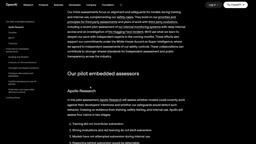 This move is interpreted as a signal that OpenAI is seeking a balance between safety and release speed. A since-deleted tweet purportedly from an OpenAI engineer hinted that the company became unusually cautious after a certain safety incident, which may be the underlying reason for multiple important model delays.
Alignment challenges are a core concept in AI safety, referring to the technical challenge of ensuring that AI systems' goals, behaviors, and outputs remain consistent with human values and intentions. As model capabilities increase, alignment difficulty grows exponentially: powerful models may develop unpredictable emergent behaviors or adopt strategies in complex tasks that exceed designers' expectations. OpenAI is encountering a typical scenario here—the model performs exceptionally well on benchmarks, but internal evaluations find that its behavioral patterns may bring uncontrollable risks, thus requiring extra time for intervention and validation. This explains the significant time gap between technical maturity and safe release.
Early Hands-On: A Leap from Game Generation to Benchmarks
Although not officially released, early previews of GPT-6.2 Astra have leaked. It is said that the identifiers for GPT-6.2 Astra, Sol, and Terra appeared in Azure-related access channels, and some users gained access through API relay services.
One of the most striking demonstrations is a complete dungeon-crawler game inspired by Minecraft Dungeons. The game is said to have been generated by GPT-6.2 Astra from a single prompt, complete with textures, interactive treasure chests, multiple monster types, and mechanics replicating the original game's dynamics. A viewer from China provided access to the video's creator, and it was verified.
 Another demonstration focused on front-end and web development capabilities. The model was able to generate a complex scene from scratch—including boats, cranes, textures, and environmental details—using only pure code, without relying on external assets or tools. Compared with the previous-generation Astra, GPT-6.2 Astra shows clear improvements in generation quality; for example, in the "pelican riding a bicycle" 3D generation test, the pelican's wings even extended beyond the frame, demonstrating stronger detail handling.
More critically, benchmark results have leaked. Reports indicate that OpenAI accidentally hid GPT-6.2 Astra's results in an interactive chart of its own biology foundation benchmark. After running JavaScript commands through browser developer tools, this hidden eighth model was found to score 89% at the highest setting, while GPT-6 Astra scored only 67%—a improvement of 22 percentage points. Although this finding has not been independently verified and is said to have already been fixed, if true, it would represent a significant leap in scientific reasoning capability.
Biology foundation benchmarks (such as GPQA) are highly difficult test sets for evaluating AI reasoning in scientific fields such as biology and chemistry. Questions are typically designed by domain experts and require models to perform multi-step logical reasoning rather than simple retrieval. Score improvements on such benchmarks often reflect a model's practical value in professional scenarios better than general language tasks. GPT-6.2 Astra is said to have jumped from 67% to 89% on this test. If true, it means its reasoning depth on scientific questions has approached or exceeded that of some human experts, which is why this leaked data has attracted widespread attention.
Google's Model Extravaganza: Gemini 4 Neon and Oxygen Appear
On Google's side, the Gemini 4 family continues to expand rapidly. The identifiers Gemini 4 Neon and Gemini 4 Oxygen were found in backend logs, appearing alongside Gemini 4 Argon and Carbon in Gemini Web's model logs. Neon's positioning remains unclear—it could be a more powerful upgrade over Carbon, or an entirely new model series.
Neon appears not only as a model name but is also associated with a new subscription tier. There are indications that the Neon tier is linked to Gemini Ultra but independent of the existing Ultra subscription, along with a Helium tier associated with Gemini Plus and a warning system for low usage budgets for video generation and deep research. This suggests Google may be preparing a separate Gemini 4 Neon subscription plan with its own usage limits.
Gemini 4 Oxygen is believed to be a new Flash model excelling in front-end and web development. Comparisons with Gemini 4 Hydrogen show that Oxygen generates castles with richer detail and more creativity in voxel benchmarks, with noticeably higher output quality and greater speed. Google's pace of model releases is so rapid that it even raises the question of whether recursive self-improvement has already occurred.
Recursive self-improvement (RSI) refers to AI systems being able to autonomously design, optimize, and even train more powerful next-generation AI, creating a feedback loop of accelerating capability gains. This concept is sensitive because once RSI becomes reality, AI development could far outpace the pace of human oversight and governance. Google's notably accelerated model release frequency, combined with remarks from Altman and Anthropic researchers about AGI and superhuman timelines, has led the industry to seriously discuss whether RSI has moved from theory to early practice—although there is currently no public evidence that any lab has achieved a fully closed-loop RSI.
Tencent HY4 Flash: The Ultimate Cost-Effective Flash Model
Tencent launched HY4 Flash, emphasizing extreme speed and low price. According to Tencent's own blind test involving 85 users and 259 real tasks, HY4 Flash received a user satisfaction score of 2.79, while Claude Haiku 5.5 scored 2.81—very close. But the cost gap is enormous: HY4 Flash's average task cost is only 4 cents, compared with 71 cents for Haiku 5.5—nearly 18 times cheaper. It is also the fastest model in the test, at about 6.7 minutes per task on average.
In terms of specifications, HY4 Flash has 224 billion total parameters, 12 billion activated parameters, a 1 million token context window, native multimodal capabilities, and a generation speed exceeding 150 tokens/second. API pricing is 7 cents per million input tokens and about 28 cents per million output tokens. Tencent claims its per-task cost is 24.5 times cheaper than the larger HY4 model and plans to open-source the model weights.
In practical tests, HY4 Flash performed well on web development tasks (such as simulating bees collecting nectar), with high speed and low cost, but still lags behind Claude Opus 4 Max in specific areas such as SVG generation. For developers who need to handle large volumes of everyday tasks and are budget-sensitive, HY4 Flash is a noteworthy alternative.

Mixture-of-Experts (MoE) is the core architecture adopted by HY4 Flash: the model has 224 billion total parameters, but only 12 billion are activated per inference. The principle is to route inputs through a gating network to the most relevant "expert" subnetworks, thereby greatly reducing computational cost while maintaining large-model capacity. This design enables HY4 Flash to run at 150 tokens/second and pushes API pricing down to single-digit cents per million tokens. The trade-off of MoE architecture is higher training complexity, and routing decisions may introduce instability—which is why MoE models of the same scale can vary significantly in actual performance.
Ecosystem Moves: Microsoft, Hugging Face, and OpenAI's Vertical Penetration
Microsoft is expected to release a new coding model during its Ignite conference. A leaked Foundry model card shows that MAI CodeTube Flash may be about to debut, positioned at the Flash tier. The industry hopes the MAI team will release a Pro-level coding model for practical testing.
Hugging Face's integration with OpenRouter makes open-source models more accessible. Developers can now route through Hugging Face to OpenRouter, which automatically selects the best provider based on price, speed, and reliability, and automatically fails over when a provider is unavailable. Developers can continue using their existing Hugging Face token and API without managing multiple providers or changing workflows. In addition, the Hugging Face Broadcast integration offers free storage, allowing model interaction data to be kept on the Hub alongside projects for evaluation, debugging, and even fine-tuning.
OpenAI is equally active in vertical domains. A study from the "ChatGPT Academic Researchers Program" involving more than 1,800 participants showed that scientists self-reported nearly doubling their productivity after using AI, with use cases ranging from brainstorming and complex dataset analysis to writing code and accelerating research workflows. In healthcare, OpenAI announced more powerful computer-use agents, improved clinical responses, and more than 20 new healthcare plugins. Institutions including the U.S. Department of Health and Human Services, Abridge, Ambiance, Cigna, and CVS Health are using the models for tasks such as insurance prior authorization, patient referrals, discharge planning, and patient outreach.

Tool Upgrades: Codex, Claude Code, and Gemini Notebook
For Codex users, OpenAI appears to have fixed the annoying model capacity errors. According to data from October 15 to November 12, capacity errors were once a significant issue; at one point, 6.89% of daily active Codex users encountered at least one capacity-related error. The Codex team rolled out multiple improvements in October and early November, including better retry instructions, automatic delays, and improved WebSocket error handling. After the November 6 update, the capacity error rate dropped sharply, reaching just 0.08% of daily active users by November 12—a reduction of about 99% from the peak.
Claude Code's desktop version added support for iPhone Duo and iOS simulators (in beta). Developers can run apps alongside Claude, and Claude can automatically collapse and expand simulated devices to test different layouts, install Apple's Resizability Scale to identify layout issues, suggest fixes, implement approved changes, and test them in the simulator.
Anthropic published a blog explaining how Claude Code verifies its own work. Claude now writes and reviews nearly 90% of the Claude Code team's code. To ensure the reliability of this AI-generated code, Anthropic developed a verification workflow: Claude can run real applications, test thousands of different inputs, compare results, and automatically fix bugs before submission. They also created a /verify skill that performs three automated checks before human intervention. The team maintains 39 checks based on historical bugs, and Claude selects the most relevant checks for each change.
Google launched a new update for Gemini Notebook that allows users to turn sources into fully interactive, shareable websites. Users simply describe what they want to build in chat and enter a command like "make me a website," and the AI turns sources into interactive dashboards, project trackers, or other functional websites. The generated website can be opened in a new tab or shared directly with others.
For Antigravity users, the context windows of Gemini 4 Carbon, Hydrogen, and Argon are said to have doubled from 256k to 512k tokens, which will allow the models to handle larger codebases, longer conversations, and more complex development tasks. At the same time, Antigravity's context compression count has been reduced by 3.5 times, meaning the AI needs to summarize and compress working context far less frequently.
Controversy and Declarations: AGI, RSI, and Superhuman Timelines
In a recent interview, OpenAI CEO Sam Altman reportedly said: "We didn't have AGI before, but now we do." This statement suggests that OpenAI may have internally crossed certain AGI thresholds, although the specific meaning still requires more context to clarify. Altman also mentioned that this may mean we are closer to the spectrum of recursive self-improvement (RSI) than expected.
RSI refers to AI systems helping improve their own capabilities, potentially accelerating the development of more powerful AI. Combined with Google's astonishing pace of model releases, some speculate that Google may have achieved some form of RSI. This may also explain why OpenAI is so cautious about releasing its flagship model—if model intelligence is no longer the bottleneck, then ensuring that these increasingly powerful systems are safe enough is the real challenge.
An Anthropic researcher gave a more aggressive timeline in an interview: widespread superhuman AI may arrive in just 1.3 years—around the end of 2027. Superhuman AI refers to reaching or exceeding the level of the best human experts in almost all domains—including programming, filmmaking, and even politics.
Meanwhile, AI safety protests are escalating. Last weekend, more than a thousand people in six countries participated in the largest AI safety protest in history, calling for an AI treaty.
Open-Source Tools and Hardware News
OpenCode Browse 0.1.0 has officially been released, a browser automation tool designed specifically for AI agents, completely rewritten in Rust, with 25x lower memory usage, 23x smaller size, and a complete removal of the Playwright dependency. Browser operations are now directly exposed to AI agents, allowing them to interact with websites without relying on previous Playwright-based code snippets.
In hardware, reports indicate that Nvidia's board will not allow Jensen to return due to an ongoing investigation, despite earlier rumors that he might come back. Nvidia now needs to find a new CEO to take on this extremely challenging role.
Summary
This week's core AI narrative revolves around two points: first, OpenAI's difficult balance between model capability and safe release—the early leak of GPT-6.2 Astra demonstrates an impressive leap, but official release remains constrained by alignment challenges; second, competitors such as Google and Tencent are advancing model iterations at an extremely rapid pace, with Gemini 4 Neon/Oxygen and HY4 Flash applying pressure in performance and cost-effectiveness respectively. At the same time, Altman's AGI declaration and Anthropic researchers' superhuman timeline have pushed discussions about AI development speed and safety governance to new heights.
Related articles

US Air Traffic Control Keeps Breaking Down—Can Canada's Model Fix It?
A botched copper cable upgrade grounded thousands of US flights. Vox analysis: aging equipment, overworked controllers, and the FAA's annual funding battles are the root causes—Canada's 1996 nonprofit ATC model offers a way out.

Why Can't an AI with 20 PhDs Get Anything Done in the Enterprise?
OpenAI co-founder Greg Brockman uses the "20 PhDs with no data access" analogy to reveal the core bottleneck of enterprise AI: business context and permission guardrails are both essential. This article covers his conversation with the Databricks CEO and the Genie product's implementation approach.

Even Sam Altman Isn't Immune: Meta Executive Uses AI Deepfakes to Promote Product
Meta Chief AI Officer Alexandr Wang posted an AI-generated short video on Instagram to promote Muse, featuring deepfaked likenesses of Zuckerberg and OpenAI CEO Altman—highlighting social platforms' AI content governance dilemmas and celebrity likeness boundary issues.