GPT-6.2 Astra Preview Leaks, But OpenAI Hits the Safety Brakes

GPT-6.2 Astra appears to have leaked with a capability leap, but release is delayed—safety alignment is the main cause—while Tencent HY4 Flash disrupts the market at extremely low cost.
OpenAI's flagship GPT-6.2 Astra leaked before release through Azure channels and domestic API relays. Early demos show it can generate a complete dungeon game from a single prompt, with significantly improved frontend capabilities, and an analyst claims to have found hidden benchmark scores (89% vs. 67%), though unverified. Safety alignment is cited as the main cause of delays, with OpenAI announcing partnerships with four institutions. Google's Gemini 4 Neon and Oxygen appeared in logs. Tencent HY4 Flash emerges as a value dark horse at 4 cents per task. Codex and Claude Code saw updates. Altman declared AGI has arrived, while an Anthropic researcher gave a 1.3-year timeline.
OpenAI's flagship iteration cadence has long been the industry's yardstick for tracking AI progress. From GPT-5.1 to 5.2 took about 29 days, 5.2 to 5.3 about 56 days, and 5.3 to 5.4 just 28 days, with subsequent intervals roughly between 49 and 77 days. But according to a Bilibili creator's latest AI news roundup, it's been about 75 days since GPT-6 Astra launched. In that time there were minor iterations—Sol, Luna, and the GPT-6.1 series—but the real flagship upgrade, GPT-6.2 Astra, has yet to arrive.
Interestingly, the model hasn't officially launched, but a preview has already leaked out.
GPT-6.2 Astra: From API Relay Leak to Game-Grade Code Generation
According to community information cited by the creator, the model identifiers for GPT-6.2 Astra, Sol, and even Terra previously appeared in Azure-related access channels. Shortly after, a domestic API relay service provided access within hours, and some users hooked it into Codex for direct calls. Early feedback centered on two points: first, it's clearly better than GPT-6 Astra in efficiency and output quality; second, GPT-6.2 Sol's responses were described as having "less defensiveness and fewer restrictions."

The most telling demonstration of the capability leap is code generation. A viewer provided the creator with a "Minecraft: Dungeons"-style dungeon crawler, apparently generated in a single shot by GPT-6.2 Astra, complete with openable treasure chests, multiple monster types, detailed material textures, and full game mechanics. The creator emphasized that all these elements were generated purely from code, with no external assets or tools. In the past, GPT-series models making games would use placeholder objects and then swap in 3D assets—this time, the placeholders themselves were already close to finished asset quality. Improvements in frontend and web development capabilities were mentioned repeatedly, which happens to be an area where OpenAI models previously struggled.
Another widely circulated comparison is the "pelican riding a bicycle" generation test, where GPT-6.2 Astra outperformed the previous generation in 3D generation quality—there was even a detail of the pelican's wing extending beyond the frame. The creator also conceded that token efficiency remains a weak point to watch, despite improvements in the 6.1 and Sol series.
API relay services: With OpenAI's official API imposing access restrictions in most regions or requiring enterprise-level qualifications, domestic developers often call models indirectly through third-party proxy (relay) services. These services typically build their own reverse proxies, forwarding requests to Azure OpenAI or official OpenAI endpoints while hiding the true call source from users. Relay providers can onboard new models faster often because they hold enterprise accounts or have partnerships with cloud vendors—their "early launch" itself constitutes a leak channel. Such behavior violates OpenAI's terms of service, and user data passes through third-party servers, posing privacy and compliance risks.
Hidden Benchmark: An Accidental Developer Tools Discovery
According to an analyst named Benkji, OpenAI accidentally exposed undisclosed GPT-6.2 Astra scores in an interactive chart for a new benchmark. The official blog said 7 models were tested, but someone executed JavaScript commands through browser developer tools and claimed to have found a hidden 8th model. The result showed GPT-6.2 Astra scoring 89% at the highest setting, versus 67% for GPT-6 Astra—a 22 percentage point gap.
It should be noted that the creator explicitly stated they did not independently verify this finding and believed the vulnerability may have already been patched. So this data should be treated as unconfirmed information from a single source. Still, together with the code generation demo, it points in one direction: this generation of models shows considerable improvement on complex reasoning and scientific tasks.
Browser developer tools and frontend data exposure: The frontend code of modern web applications (JavaScript, JSON configs, API responses) is fully visible in the browser. Developers can press F12 to open DevTools and execute JavaScript commands in the Network panel or Console to read page data. If a site sends all model data to the client at once without on-demand loading or permission filtering, observers can bypass UI restrictions to "see" hidden entries. In this incident, the analyst exploited exactly this principle to extract undisclosed model scores from the underlying data of an interactive chart. Strictly speaking, this isn't a "hack" in the traditional sense but an information leak caused by a frontend design oversight. The fix is usually to render server-side based on permissions or encrypt transmission.
Has Safety Alignment Become the Real Bottleneck for Release Cadence?
According to reports cited by the creator, OpenAI has encountered significant resistance in safety and alignment, affecting the progress of GPT-6.1, GPT-6.2, and even GPT-6.5. The models' pretraining capabilities are ready, but turning them into publicly safe products requires weeks of delay. Some say OpenAI is now even more cautious about safety than Anthropic, which is one reason the initial GPT-6.1 Astra release was canceled.
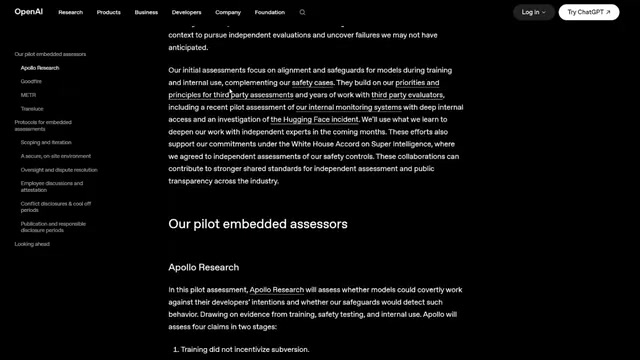
Echoing this, OpenAI announced new safety partnerships that day: collaborations with four independent institutions—Metre, Apollo Research, Goodfire, and Transluce—giving them deeper model access to investigate alignment risks and evaluate safeguards. The creator also mentioned that a related tweet from an OpenAI engineer appeared to have been deleted, interpreted as a signal of extreme caution inside the company.
There's a divergence worth discussing here: one view holds that the delay stems from the model "not being good enough," another that it's precisely because it's "too good" to release. The creator's judgment is that both are true—there are real difficulties in alignment engineering as well as considerations about competitive pacing.
Google's Model Naming Is Catching Up with the Periodic Table
Google continues its high-frequency release cadence. According to the creator's observations, Gemini 4 Neon and Gemini 4 Oxygen appeared in backend logs, alongside Gemini 4 Argon and Carbon. Neon's positioning is unclear—it could be a stronger version above Carbon, a completely new series, or even come with its own subscription plan. Oxygen is judged to be a Flash-tier model in the Gemini 4 family, performing well in frontend and web development, faster than Hydrogen with better output quality. In voxel-style generation benchmark comparisons, Oxygen's castle output was clearly superior to Hydrogen's in detail and creativity.
The creator joked that if they keep naming after the periodic table, they might as well just put a periodic table in the model directory. Behind the quip is a real question: when model iteration density becomes too high for the naming system to bear, how do users decide which one to pick?
Tencent HY4 Flash: Approaching Claude Haiku at Extremely Low Cost
Tencent's HY4 Flash is this issue's most compelling value proposition. According to Tencent's own blind test with 85 users and 259 real tasks, HY4 Flash scored 2.79 in user satisfaction at its highest thinking mode, close to Claude Haiku 5.5's 2.81—while averaging just 4 cents per task versus the latter's 71 cents, nearly 18 times cheaper. It was also the fastest model in the test, averaging about 6.7 minutes per task.
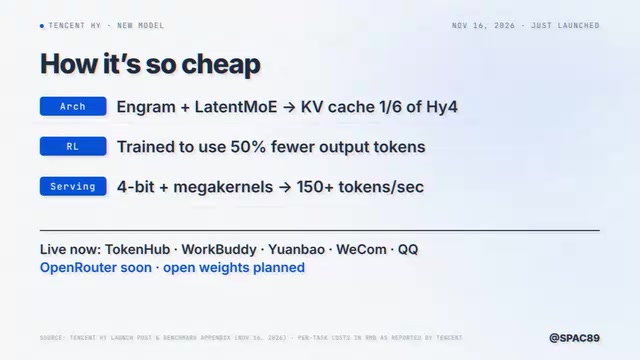
On specs, HY4 Flash has 224 billion total parameters and 12 billion activated parameters, supports a 1 million token context with native multimodality, and generates at over 150 tokens per second. API pricing is 7 cents per million input tokens and about 28 cents for output. Tencent says its per-task cost is 24.5 times lower than the larger HY4, and plans to open-source the model weights.
Note the applicable boundaries: the creator explicitly cautioned against judging a Flash model harshly on programming ability. On tasks like SVG generation, HY4 Flash trails comparison models significantly; but in a web development task simulating bees collecting nectar, it delivered usable results quickly and cheaply. For developers running large volumes of everyday tasks who are sensitive to cost and speed, this is an option worth testing alongside Haiku 5.5.
Total parameters vs. activated parameters, MoE architecture: Total parameters refer to the total number of weights in a model; activated parameters refer to the number of parameters actually involved in computation during each forward inference. A large difference between the two (e.g., 224 billion total, 12 billion activated) usually means the model uses a Mixture of Experts (MoE) architecture: the model consists of multiple expert sub-networks, and each token is routed to only a few experts, greatly reducing the compute cost of a single inference while maintaining large knowledge capacity. This is exactly the technical basis for HY4 Flash offering satisfaction close to larger models at extremely low prices—the smaller the activated parameters, the lower the per-token inference cost and the faster the generation speed. But MoE also brings engineering challenges such as routing load balancing and expert utilization.
Developer Toolchain: From Codex Stability to Claude Code's Verification Loop
According to the creator's roundup, the Codex team made multiple improvements to errors like "model capacity has reached its limit," including better retry instructions, automatic delays, and WebSocket error handling. Data shows that in the statistical period from mid-October to mid-November, the share of such capacity errors among daily active users dropped sharply from its peak, reaching very low levels by the end. The team emphasized this wasn't compute expansion but optimization of overload and retry handling mechanisms.
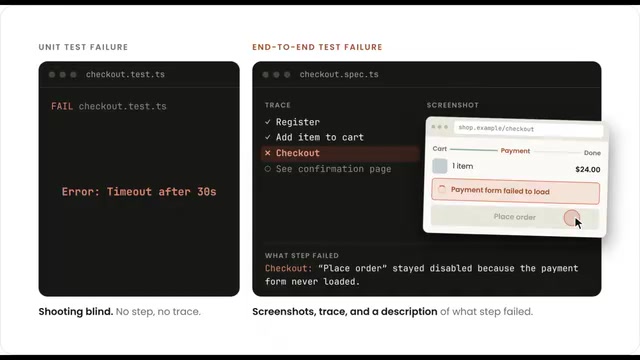
Anthropic, meanwhile, disclosed Claude Code's self-verification workflow: Claude currently writes and reviews nearly 90% of the team's code, with mechanisms that let Claude run real applications, test thousands of inputs, compare results, and automatically fix defects. There's also a slash-command-style verification skill that hands off to a human if three attempts still fail. When generation volume reaches this level, verification capability is as important as generation capability.
Other developments include: Microsoft preparing MAI-series coding models around its Ignite conference; Hugging Face models now routable through OpenRouter, automatically selecting the provider with the best price, speed, and reliability with failover support, using existing tokens; OpenCode Browse 0.1.0 rewritten in Rust, cutting memory usage by 25x and size by 23x while removing the Playwright dependency; Gemini Notebook supporting one-click conversion of materials into interactive, shareable websites; and in Antigravity, the context window of Gemini 4 series models doubling from 256K to 512K, with context compression frequency reduced by about 3.5x.
The AGI Declaration and the 1.3-Year Timeline
The most controversial statement came from Sam Altman. According to an interview cited by the creator, Altman said "we didn't have AGI before, now we do," and mentioned that a path closer to recursive self-improvement (RSI) was possible, but safety considerations prevented it. The creator noted that this statement needs more context to interpret accurately, but if true, it explains the slowdown in release cadence.
Set alongside this is a public judgment from an Anthropic researcher: broadly superhuman AI could arrive in about 1.3 years—around 2027—when AI reaches or exceeds top expert levels in almost all domains. Such timelines are personal opinions, but together with Altman's wording they form the current industry atmosphere: capability curves and safety constraints are accelerating simultaneously.
On another front, over a thousand people took to the streets in six countries calling for an AI treaty, described as the largest AI safety protest in history. Capability, capital, and public sentiment are pulling on the same timeline at once—perhaps more noteworthy than any single model release.
Recursive self-improvement (RSI): Refers to AI systems being able to autonomously improve their own architecture, training processes, or code, thereby accelerating next-generation capability gains and forming a positive feedback loop. Altman's mention of a "path closer to RSI" implies OpenAI has internally explored techniques letting models participate in improving models themselves, but deliberately slowed down due to loss-of-control risks and alignment difficulty. RSI is seen as a key watershed in the AGI race: once achieved, capability growth could shift from linear to exponential, and the window for safety evaluation and regulation would narrow sharply. This is also one of the core tensions in how leading labs repeatedly weigh capability against safety.
One-line Summary
GPT-6.2 Astra appears to have leaked with a capability leap, but release is delayed—safety alignment is the main cause—while Tencent HY4 Flash disrupts the market at extremely low cost.
Paragraph Summary
OpenAI's flagship GPT-6.2 Astra leaked before its official release through Azure channels and domestic API relays. Early demos show it can generate a complete dungeon game from a single prompt, with significantly improved frontend and web development capabilities, and an analyst claims to have found hidden benchmark scores (89% vs. 67%) in an official website chart—though unverified independently. Safety alignment resistance is cited as the main cause of release delays, and OpenAI simultaneously announced partnerships with four institutions to deepen risk assessment. Google continues its high-frequency releases, with Gemini 4 Neon and Oxygen appearing in logs. Tencent HY4 Flash emerges as a value dark horse with a 4-cent average task cost and satisfaction close to Claude Haiku 5.5. On the developer toolchain, Codex optimized capacity error handling, and Claude Code achieved an automated verification loop. Sam Altman declared AGI has arrived, an Anthropic researcher gave a 1.3-year timeline for superhuman AI, and the industry keeps pulling between capability, safety, and public sentiment.
Related articles

AI Writes Your Code—Do You Still Need to Learn Git? Five Reasons
AI coding agents handle Git operations automatically—is it still necessary to learn Git? Five reasons: team communication, reviewing agent PRs, monitoring code changes, fallback when AI goes down, and the joy of learning—plus how the focus of learning Git is shifting in the agent era.

Anthropic Reportedly Prices IPO at $83 Per Share, Valuing Company at $1.5 Trillion
Anthropic reportedly prices IPO at $83 per share, above the expected range, with a fully diluted valuation of $1.5 trillion. This article analyzes the signal significance of the pricing and its impact on the AI industry's financing environment.

Open-Source Code Hosting Platform Codeberg Suffers Outage, Sparking Debate in Developer Community
Open-source code hosting platform Codeberg.org suffered an outage, sparking Hacker News debate over nonprofit platform stability and open-source infrastructure dependency risks.