GPT 6.2 Astra/Sol Community Use Cases and In-Depth Review
GPT 6.2 is lopsided: stunning 3D modeling and Computer Use, weak intent understanding and aesthetics.
GPT 6.2 (Astra/Sol) reviews are polarized. It excels in 3D modeling, assembly animations, and Computer Use—even beating Claude Fable 5.2 when goals are clear—but is weak in aesthetic alignment and intent understanding: defensive, stops early on complex tasks, rigid style. Sol offers great value at 1/5–1/10 the cost. Use Astra for deterministic grunt work; Claude for aesthetics-sensitive tasks.
Official Narrative vs. Community Experience
OpenAI's GPT 6.2 series (Astra and Sol) has generated intense community discussion since its release, but reviews are sharply polarized. Bilibili creator A-Zhen compiled a detailed use-case collection and review based on domestic and international sources plus hands-on testing. This article distills the core findings: the model is extremely "lopsided"—it shines in 3D modeling, assembly animations, and Computer Use, yet has clear weaknesses in aesthetic alignment and understanding human intent.
Official charts show GPT 6.2 Astra scoring higher than its predecessor while reducing task costs, with a similar trend in comparisons against Claude. OpenAI also emphasizes its token efficiency, claiming lower overall spend when completing well-defined tasks.
But A-Zhen points out that official charts may be "selectively presented." Community testing diverges from official conclusions, especially regarding aesthetic quality and intent understanding. Official Arena scores show GPT 6.2's intelligence slightly below Claude's top models, but with significantly lower task time and cost—about $1 per task versus $26 for the latter.
Arena scores and LMArena are key background for understanding the comparison data in this article. Arena (typically referring to LMSYS Chatbot Arena) is a platform where community users anonymously blind-test model outputs in pairwise comparisons, aggregated into leaderboards via Elo-like rating systems, widely regarded as a reference for models' "felt intelligence." LMArena is its extended community for creators and evaluators; the "44 minutes, nearly 100 scenarios" creator evaluation mentioned in the article comes from this kind of crowdsourced real-world testing. Note that Arena scores reflect relative rankings of human preference, not directly task completion rates or cost efficiency. Therefore, the official narrative of "slightly lower intelligence but far lower cost" does not contradict community experiences in specific tasks—they measure different dimensions.
Community Favorite Use Cases
3D Modeling and Industrial Simulation
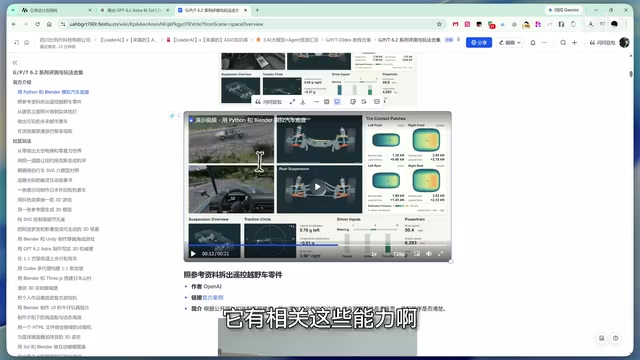
This is the most community-recognized strength of GPT 6.2. Official demos show the model completing car chassis design, RC off-road vehicle part disassembly and assembly animations, and even generating 3D-printed lamps from building photos.
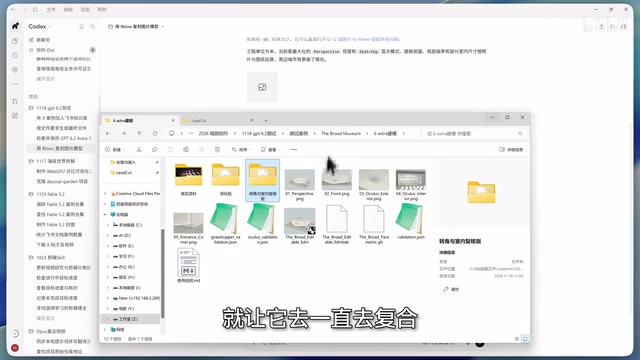
When A-Zhen replicated complex models from building photos, GPT 6.2 Astra was almost "one-shot," needing only one revision to restore roof details and site environment—far more precise than the previous generation. Community consensus: when goals are very clear (e.g., with reference images), Astra's modeling precision even exceeds Claude's Fable 5.2. For scenarios like furniture assembly or electronics manuals, AI-generated assembly videos cut costs from tens of thousands of yuan in rendering fees to just a few hundred.
Computer Use refers to a model's ability to directly operate graphical interfaces (clicking, dragging, typing, reading the screen) to complete software tasks, rather than interacting only via API or text. It typically relies on combining visual understanding with action-sequence planning, and is valuable in industrial software, assembly testing, robotic arm control, and similar scenarios. The article mentions Astra completing "robotic arm assembly and motion testing," a typical Computer Use application. The challenge lies in long-horizon action fault tolerance: single-step errors accumulate and amplify, so the model must self-verify during execution. Combined with the earlier description of "highly defensive and prone to stopping prematurely," it's understandable why Computer Use, despite progress, remains constrained by the model's handling of uncertainty.
Interactive Content and Games
Community works include space elevator simulations, interactive storybooks, stylized 3D games, Notre-Dame walkthroughs, and more. These cases demonstrate the model's ability to build walkable 3D scenes in the browser.
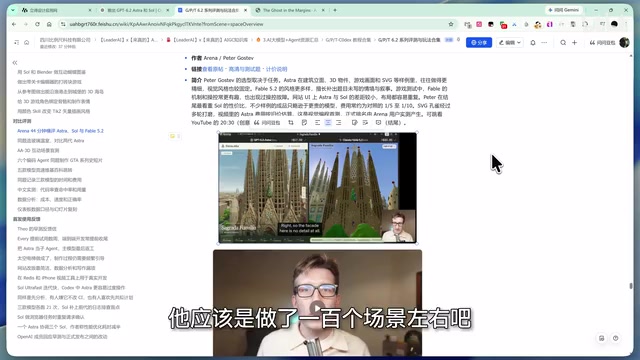
However, compared to Fable 5.2, games generated by Astra are somewhat rigid in mechanics and camera work. In comparison tests like racing and mech walking, Fable excels in physical feel and visual richness.
SVG and Computer Use Progress
When drawing complex graphics like peacocks with SVG, Astra shows impressive detail. Computer Use has also improved notably, handling industrial tasks like robotic arm assembly and motion testing.
Core Weaknesses: Not Speaking "Human" and Rigid Aesthetics
Early feedback from the community and X platform focused on Astra "not understanding human intent." A typical example: a user wants to export a 1-2GB 4K video, but the model asks about underlying encoding technology—the question itself isn't wrong, but ordinary users simply can't answer. A-Zhen analyzes this as stemming from the model's extreme defensiveness: once it predicts potential errors, it refuses to execute or stops the task prematurely.

Aesthetically, Astra leans plain and conservative, lacking the diversity and narrative imagination of Fable 5.2. In tasks requiring a "premium" feel without explicit standards, Fable better fills in unstated context, while Astra demands extremely precise instructions.
A-Zhen's controlled experiment is telling: replicating a forest cabin scene with the same open-source prompt, Fable 5.2 ran 18 hours with iterative optimization, producing a complete 127KB file; GPT 6.2 Astra delivered an 11KB half-finished product in just 23 minutes, with six camera angles and scene transitions incomplete. For complex long-horizon tasks, Astra's reliability is questionable.
Intent alignment refers to a model's ability to accurately infer users' true goals rather than merely following literal instructions. When a user says "export 4K video," the underlying meaning is "complete it with default parameters I can understand." If the model asks about encoding format, bitrate, and other low-level details, it shifts the execution burden onto the user. Insufficient intent alignment is often related to a model's "defensive" strategy: to reduce error probability, the model tends to stop or ask questions when uncertain. In explicit tasks, this is caution; in ambiguous tasks, it manifests as "not speaking human." This is the root of community criticism of Astra, and OpenAI's statement that it is "working on improving intent alignment" points to exactly this layer.
Cost-Effectiveness and Applicable Boundaries
LMArena's creator evaluation—44 minutes across nearly 100 scenarios—provides a reference conclusion: the Sol version offers outstanding value, with many outputs only slightly inferior to more expensive models at about 1/5 to 1/10 the cost. If the task is "grunt work" rather than assisted thinking and planning, Sol is a cost-effective choice.
Overall, GPT 6.2 suits: deterministic tasks with clear goals centered on 3D modeling/assembly/Computer Use. It does not suit: complex projects with high aesthetic demands, requiring the model to understand ambiguous intent, or needing long autonomous execution. A-Zhen suggests switching directly to Astra for modeling—quality is notably better than the previous Sol generation at a lower price; for aesthetics-sensitive work, switch to Claude without hesitation. OpenAI has responded to community criticism, stating it is improving intent alignment.
One-line Summary
GPT 6.2 is clearly lopsided: stunning in 3D modeling and Computer Use, but weak in intent understanding and aesthetics.
Paragraph Summary
The GPT 6.2 series (Astra and Sol) has polarized reviews since release. Bilibili creator A-Zhen's review shows the model excels in 3D modeling, assembly animations, and Computer Use—precision even surpassing Claude Fable 5.2 when goals are clear, cutting assembly video costs from tens of thousands of yuan to hundreds. But it has clear weaknesses in aesthetic alignment and human intent understanding: highly defensive, prone to stopping early on complex tasks, with conservative, rigid style. In a controlled experiment, Astra delivered an 11KB half-finished product in just 23 minutes, while Fable 5.2 produced a complete 127KB file over 18 hours. The Sol version offers outstanding value at about 1/5 to 1/10 the cost. The article recommends Astra for deterministic "grunt work" and Claude for aesthetics-sensitive tasks.
Related articles

How the Grok Team Hits 11,000 PRs a Month: Replacing Manual Review with Deterministic Constraints
Inside the Grok team's formula for 11,000 monthly PRs at a 0.5% rollback rate: Lint rules, type systems, and formal verification as deterministic constraints.

Is Spacetime Made of Something? Six Possible Answers from Quantum Gravity
Is spacetime made of something? This article surveys the main candidate answers from quantum gravity: spacetime may be fundamental, geometry quantized, causal relations prior to distance, spacetime an emergent state of matter, geometry derived from string theory, or no spacetime atoms needed at all.
After GTA 6, Where Does the Game Industry Go?
The Vergecast talks with Game File's Stephen Totilo about GTA 6's impact on gaming: billion-dollar budgets, console market struggles, cloud gaming tests, and the future of microtransactions—and whether it marks the end of an era.