GPT-6.2 Astra Solves the 1808 Anonymous Sketchbook Mystery in 22 Minutes

GPT-6.2 Astra solved a 200-year-old cold case in 22 minutes, heralding a new paradigm for history.
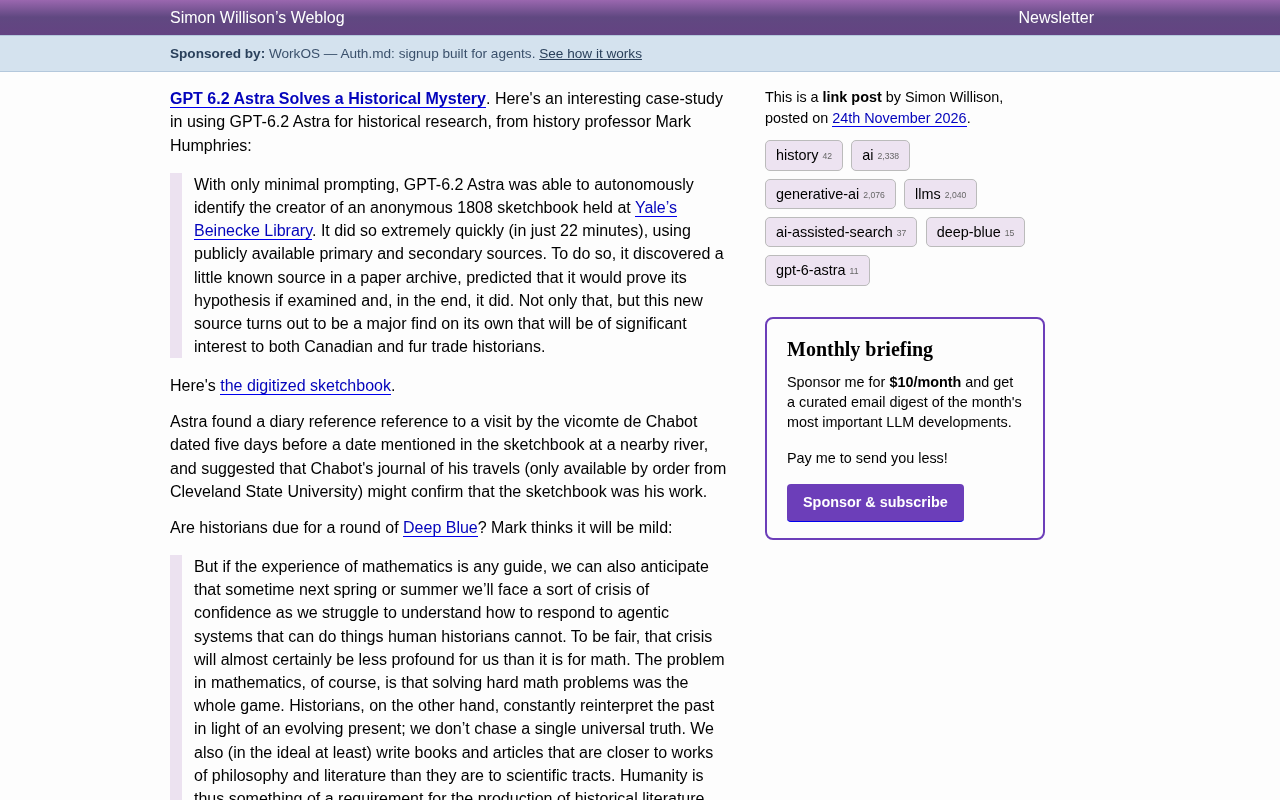
History professor Mark Humphries shares how GPT-6.2 Astra, with a minimal prompt, identified the author of an anonymous 1808 Yale sketchbook as the vicomte de Chabot in 22 minutes and uncovered a new document of value to Canadian and fur trade history. Humphries argues AI's impact on history will be smaller than on math, as history doesn't pursue a single truth.
Title
GPT-6.2 Astra Solves the Mystery of an 1808 Anonymous Sketchbook's Author in 22 Minutes
Meta Description
History professor Mark Humphries shares a case: GPT-6.2 Astra, using only public materials, autonomously identified the author of an anonymous 1808 sketchbook held at Yale—and unexpectedly uncovered a new document of significant value to Canadian and fur trade history. How will AI agentic systems reshape historical research?
Article Content
Historical research is undergoing a quiet revolution. History professor Mark Humphries recently shared a striking case: with only a minimal prompt, GPT-6.2 Astra autonomously identified the author of an anonymous 1808 sketchbook. The entire process took just 22 minutes and relied entirely on publicly available primary and secondary sources.
Solving a Two-Century Cold Case in 22 Minutes
The sketchbook is held at Yale University's Beinecke Library, and its authorship had long been unknown. Professor Humphries documented Astra's workflow in detail on Substack: the model first locked onto a little-known clue in archival literature—a diary recording a visit by the vicomte de Chabot near a certain river, dated exactly five days before the time mentioned in the sketchbook.
From this, Astra formed a hypothesis: Chabot's travel journal (obtainable only by ordering through Cleveland State University) might confirm that the sketchbook was indeed his work. Subsequent verification confirmed this inference. Throughout the process, the model autonomously discovered the clue, predicted the verification path, and ultimately completed the verification—without step-by-step human guidance.
What excites the historical community even more is that the new source Astra unearthed is itself an important discovery, holding significant value for research on Canadian history and the history of the fur trade. A question of attribution for one sketchbook unexpectedly led to a document of independent scholarly significance.
Agentic systems (or agent systems) refer to AI systems capable of autonomously perceiving their environment, formulating plans, executing tasks, and dynamically adjusting strategies in the process. Unlike traditional single-turn question-answering models, agentic systems exhibit goal-directed, sustained behavior: they can decompose complex problems into subtasks, autonomously invoke external tools (such as databases, search engines, and APIs), and reason and make decisions based on intermediate results. In the historical research case, GPT-6.2 Astra demonstrated exactly this capability—it did not wait for step-by-step human instruction, but autonomously proposed hypotheses, sought verification paths, and carried out verification, forming a complete "predict-verify" loop. This autonomy is a key characteristic of the shift from "retrieval tool" to "research agent," and it is one of the frontiers of current AI research.
What Agentic Systems Bring to History
Humphries compares this moment to the impact of Deep Blue on chess and of AI on mathematics. He predicts that a confidence crisis similar to what the mathematics community experienced will arrive in history in the near future—when agentic systems can do things human historians cannot, the discipline will need to rethink its own positioning.
However, he judges that this crisis will have a far smaller impact on history than on mathematics. The core reason: mathematics's "whole game" is solving difficult problems, whereas history does not pursue a single universal truth. Historians continually reinterpret the past from a changing present, and their works are closer to philosophy and literature than to scientific papers.
"Humanity is therefore a necessary condition for the production of historical literature."
This judgment is worth savoring. It means that AI's role in history is more likely to be that of a "super archivist" and "clue excavator" rather than a replacement. What Astra truly demonstrated was the ability to make cross-repository associations across a vast sea of public materials—stringing together a date in one archive, the location of a river, and a travel journal obtainable only by special order into a verifiable chain of evidence. This combination of search and reasoning is precisely the most time-consuming and luck-dependent part of traditional historical research.
A New Paradigm for AI-Assisted Research
The value of this case goes beyond the novelty of "AI solving a mystery." It demonstrates a path for human-AI collaborative research: humans provide the problem framework and scholarly judgment, while AI handles high-speed clue discovery and hypothesis generation across public materials. Twenty-two minutes stands in stark contrast to the weeks or even months of archival work a historian might invest.
According to Simon Willison's blog, this case sparked widespread discussion in the AI research community, with the focus on agentic systems' ability to autonomously discover "unknown known sources"—the model not only searched known literature but also predicted what information an unconsulted document would contain and pushed for its acquisition. This "predict-verify" loop is a key marker of the leap from retrieval tool to research agent.
For historians, the pragmatic response may be to incorporate such tools into their workflows as early as possible, while holding to the bottom line Humphries emphasizes: the meaning of historical writing lies in humanity's understanding of the present, and this will not change because of faster archival excavation.
"Unknown known sources" refers to documentary materials that objectively exist and are publicly accessible but have not yet been discovered or utilized by researchers. In traditional historiography, the discovery of such sources often depends on a scholar's broad reading, archival sensitivity, and sheer luck. Agentic systems, however, can actively predict what information a certain class of unconsulted documents might contain through cross-repository association and pattern recognition, and push for their acquisition and verification. For example, Astra started from date and location clues in a diary, inferred that a certain travel journal (obtainable only by special order through a particular university) might contain key evidence, and ultimately confirmed this. This capability not only accelerates the process of document discovery but also reduces reliance on chance in research, providing a new tool for systematically excavating the "unknown knowns."
One-line Summary
GPT-6.2 Astra cracked a two-century cold case in 22 minutes, heralding a new paradigm for history from AI agentic systems.
Paragraph Summary
History professor Mark Humphries shared a case: with a minimal prompt, GPT-6.2 Astra autonomously identified the author of an anonymous 1808 sketchbook held at Yale as the vicomte de Chabot within 22 minutes, and unearthed a new document of independent value to Canadian and fur trade history. Humphries believes the AI impact on history will be smaller than on mathematics because history does not pursue a single truth, and humanity is a necessary condition for historical literary production. The case showcases AI's ability in cross-repository clue association and hypothesis generation, marking a leap from retrieval tool to research agent, with a new paradigm of human-AI collaboration taking shape.
Related articles

Unkernel: Compiling the Linux Kernel to WebAssembly
The Unkernel project compiles a real Linux kernel to WebAssembly, making it possible to run a complete kernel in the browser. This article covers its technical principles, challenges, and prospects.
New Claude Sonnet Model Tested: Performance Approaches Opus with Less Thinking
Anthropic quietly tests a new Sonnet model in Claude Code—performance approaches Opus 5.5 with far fewer thinking tokens, plus Codex transfer optimization, xAI's low-level rewrite, Google Antigravity updates, and the AI science understanding gap.
Building a Reasoning Model from Scratch: Making Complex AI Algorithms Accessible
Mike Finley, author of Build a Reasoning Model from Scratch, shows how a few hundred lines of code, single-sample training, and code reuse make complex AI algorithms like RL and verifiers accessible to all.