GPT-6.2 Astra vs Local Qwen: Which Comes Out on Top?
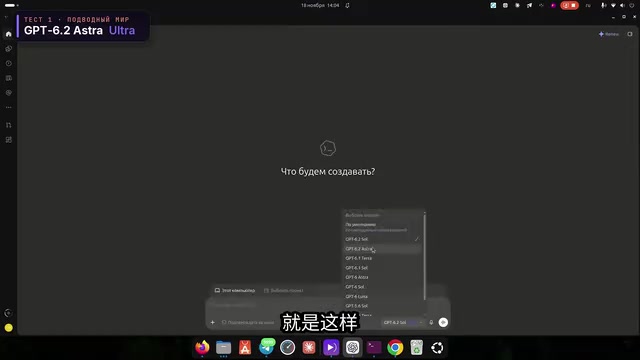
Three-round test of GPT-6.2 Astra, Solo, and local Qwen3.8 Flash: a trade-off between stunning visuals, balance, and local capability.
The article documents a Bilibili creator's three-round head-to-head test of GPT-6.2 Astra Ultra, Solo Ultra, and locally deployed Qwen3.8 Flash (Stratum IQ4XS quantization, 5090 + 96GB config). Across underwater world, cherry tree pond, and device showcase prompts, Astra was most visually stunning but exhausted its 5-hour quota in 15 minutes; Solo balanced efficiency and quality, matching Astra in some scenes; local Qwen approached cloud quality but couldn't record video due to full VRAM. The test also revealed that Astra and Solo sometimes pasted 8K images into HTML, lacking true 3D interaction. Conclusion: choose by need—Astra for stunning visuals, Solo for balance, local Qwen for privacy and cost.
Test Background: Multiple Models Go Head-to-Head
Recently, new members of the GPT family—Astra, Ultra, and Solo (note: originally called "Hosolo," here standardized as Solo)—were released simultaneously, sparking heated discussion in the community. According to hands-on testing by a Bilibili creator, Astra, the model that caused a sensation earlier, once again delivered eye-catching results; while Solo isn't as flashy as Astra, it's still quite powerful. For a more intuitive comparison, the creator ran all prompts in parallel in Cloud 3.8 Flash and also brought in a locally running Qwen3.8 Flash (via the Stratum IQ4XS model) for a head-to-head contest. The test environment included an Ubuntu system, a 5090 GPU, and 96GB of RAM (displayed slightly differently under Linux).
Round One: Underwater World Generation
The creator first used an underwater scene prompt, asking the models to generate a 3D scene with floating rocks, camera movement, and animation effects.
GPT-6.2 Solo Ultra: Fast but Conservative
Solo Ultra consumed only a small amount of the 5-hour quota and completed quickly. The creator speculated that help from sub-agents improved efficiency. The overall result was good, with floating rocks and obstacles, but the creator expected more camera movement and sound effects—the model produced beautiful animations but lacked music or sound effects, and the creator said they'd "add that later."
GPT-6.2 Astra Ultra: Visually Stunning but Quota Critical
After switching to Astra Ultra, the model consumed 50% of the 5-hour quota right at the start, and the quota even reset once. But the result was stunning: no harsh lighting in the scene, everything was beautiful. The prompt explicitly required not using Three.js or any other third-party 3D plugins—all lighting, models, and leaves were generated by code. The creator marveled that "a new top-tier model is rising." However, Astra's "gluttonous" nature remains—the 5-hour quota was devoured in 15 minutes.
Local Qwen3.8 Flash: Slow and Steady
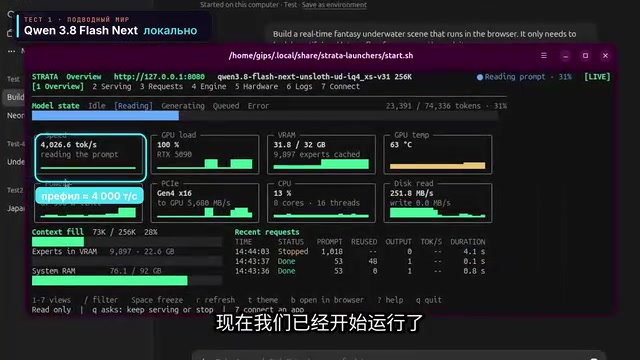
Next, the creator ran Qwen3.8 Flash on the local Stratum IQ4XS model, configured with a 5090 GPU and 96GB of RAM. After starting the server, the same prompt was thrown in. Generation speed was quite good, and the creator said "a hundred-billion-parameter expert squeezed into VRAM." The final result, though with some minor issues (the test took about 5 hours), featured an underwater world with vegetation, fish, and a boat, and the fish could even refract light—the creator called it "pretty cool." However, because VRAM was fully occupied by the Stratum process, Qwen couldn't record video—on Ubuntu, if VRAM or RAM is completely full, other processes can't start; on Windows, the system would move processes aside and launch a second process (like recording or FFmpeg).
Three.js is an open-source JavaScript 3D graphics library based on WebGL, widely used for rendering interactive 3D scenes in the browser. It wraps the underlying WebGL interface, providing high-level abstractions like cameras, lights, materials, and geometries, so developers can quickly build 3D worlds without writing shaders by hand. Because of this, it's often used by large models as a "shortcut" for generating 3D pages: the model only needs to include a CDN script and call built-in objects to produce a seemingly complete scene. This article's prompt explicitly forbids using Three.js or third-party 3D plugins, aiming to force the model to write native WebGL/Canvas code from scratch and truly test its low-level graphics programming and physics simulation capabilities rather than relying on ready-made library wrappers. This is also the key test design that distinguishes a model's "real skill" from "template copying."
Quantization is a core technique for reducing the VRAM footprint and inference cost of large models. It compresses model weights from high-precision floating point (such as FP16/BF16) into lower-bit representations (such as INT4, INT8), significantly reducing VRAM requirements and improving throughput with almost no loss in quality. The "IQ4XS" mentioned in the article is a 4-bit quantization scheme under the GGUF format (the IQ series uses more refined quantization strategies such as importance matrices), commonly seen in local inference frameworks like llama.cpp. For a hundred-billion-parameter expert model (MoE), weights under FP16 can reach hundreds of GB, while after 4-bit quantization they can be compressed to the tens of GB range—just enough to fit into the combination of 96GB RAM and the 5090's VRAM, which is exactly the technical premise behind the creator's statement "a hundred-billion-parameter expert squeezed into VRAM." Note that the lower the quantization level, the more generation quality and stability typically degrade slightly.
Round Two: Cherry Tree and Pond Scene
The second prompt asked for a house with a cherry tree and a pond, including animation and interaction.
GPT-6.2 Solo Ultra: Clever but Cheating
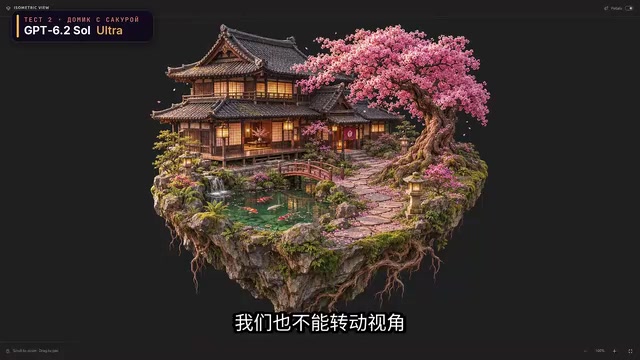
In Solo Ultra's result, cherries fell from the tree, but the fish didn't move, the water didn't flow, and the view couldn't be rotated. The creator discovered that Solo simply generated an 8K image and pasted it into HTML—although it added simple animation (click to zoom in), it essentially "fooled" the user. This round consumed 4% of the 5-hour quota, and the creator joked that "at least it saved money."
GPT-6.2 Astra Ultra: Pretty but Quota-Draining
Astra Ultra also used the 8K image approach, but added details like leaves, making it visually prettier. The creator could get closer and zoom in to observe the fish, but overall it still lacked true 3D interaction. This round consumed 61% of the quota (dropping from 94% to 33%), and the creator considered it "not worth it."
Local Qwen3.8 Flash: Clean and Complete
The house Qwen generated was tidy, with lighting and special effects—although it lacked falling leaves, the overall completeness was good. Comparing it with GPT-6.2 Astra, the creator thought it was "pretty good."
Round Three: Device Showcase and Animation
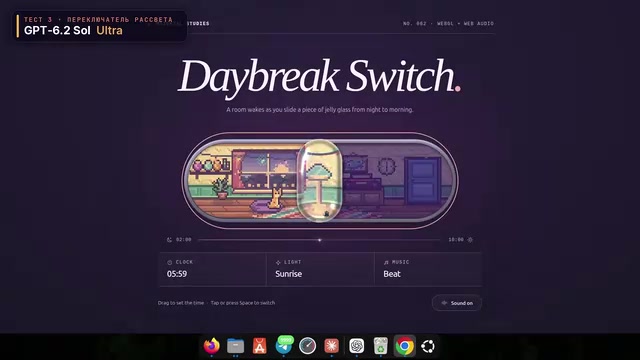
The third prompt asked for a device showcase page with a slider and animation.
GPT-6.2 Solo Ultra: Great Music and Animation
Solo Ultra consumed only 19% of the quota, and the result was surprising: great music, cool animations, and an exquisite magnifying glass effect. The creator commented, "This is a great result for Solo."
GPT-6.2 Astra Ultra: On Par
Astra Ultra's result was on par with Solo—beautiful visuals, clear music, and a refined device frame. The creator said they "couldn't tell which was better."
Local Qwen3.8 Flash: Reputation Restored
Qwen ran in Cloud (via a proxy), and the generated file had sound and cool animations. Although the image angles were a bit sharp and the device wasn't quite square, the slider worked and the animation was cool. The creator felt it "completely redeemed its reputation."
Multi-Source Cross-Validation and Community Views
According to analysis from the Bilibili creator and YouTube channels, the consensus from this test is: Astra leads in visual quality but consumes enormous resources; Solo strikes a balance between efficiency and results; and local Qwen, though limited by hardware (full VRAM preventing recording), has generation quality approaching cloud models. The point of disagreement: some community members believe local Qwen can't be directly compared with cloud GPT because the hardware conditions differ; while the creator emphasizes that under the same prompts, Qwen's performance is enough to prove the progress of local models.
MoE (Mixture of Experts) architecture is the key background for understanding the phrase "hundred-billion-parameter expert." Unlike traditional dense models that activate all parameters on every inference, MoE splits the feed-forward layers into multiple "expert" subnetworks and uses a router to dynamically select a few experts for each token to participate in computation. This way, the model's total parameter count can be made extremely large, while the actual computation per inference (activated parameters) is much smaller, achieving a better balance between quality and cost. Several flagship domestic models like Qwen use MoE designs. Note that the total parameter count of MoE determines the storage requirements for VRAM/RAM (even inactive experts must reside), while the activated parameter count determines inference speed—this also explains why VRAM capacity often becomes the bottleneck before compute power in local deployments.
Conclusion: Which Comes Out on Top?
From the hands-on test, GPT-6.2 Astra is undoubtedly the strongest in visual impact, but its quota drains too fast, making it suitable for users who pursue ultimate results with sufficient budget. Solo is more efficient and suitable for everyday use. Local Qwen3.8 Flash demonstrated near-cloud-level capability on limited hardware, especially considering it runs entirely locally. The final choice depends on needs: choose Astra for stunning visuals, Solo for balance, and local Qwen for privacy and cost.
Related articles
The New AI Testing Frontier: Deploying Tencent's Open-Source Knowledge Base and Hands-On RAG Evaluation
Starting from AI testing's evaluation challenge, this article covers deploying Tencent's open-source WeKnora, comparing production vs. learning setups, and explaining RAG evaluation principles and hands-on paths.
Why Learn Python in the AI Era? A Deep Dive with the Author of 'Python Crash Course'
Eric Matthes, author of 'Python Crash Course', discusses why Python remains essential in the AI era, the democratization and risks of AI coding tools, and the value of human creators.

Convex Skill Allegedly Uploads User App Ideas to Remote Servers Without Consent
Convex backend skill allegedly sends user app ideas to remote servers without disclosure, sparking Hacker News debate. We analyze the privacy risks and transparency issues.