GPT-6.2 Dual Models, Microsoft MAI Code 2: Six Major AI Stories Explained

Six AI stories share one principle: read vendor report cards with an eye on test conditions and statistical methodology.
The article reviews six recent AI stories: OpenAI's Astra and Sol dual models, Microsoft's MAI Code 2 coding model, NVIDIA Singapore subsidiary's hundred-billion-dollar book revenue, Kling Clean Image 4.0, JPMorgan's agent FX transfer proof of concept, and the rumored Xiaomi MiMo spin-off funding. The author notes that all these numbers come with specific conditions—benchmark configurations, billing-hub methodology, promotional-pricing cost comparisons, and test-environment proofs of concept—and advises readers to verify independently through their own blind tests, methodology checks, authorization boundaries, and official evidence rather than trusting flashy figures.
When AI Starts Competing on "Cost-Effectiveness," Can You Still Trust Vendor Benchmarks?
Things have been lively in the AI world lately: OpenAI released two models at once, GPT-6.2 Astra and Sol; Microsoft rolled out its own coding model MAI Code 2 alongside a lightweight Flash version; NVIDIA's Singapore subsidiary posted hundred-billion-dollar revenue on its books; Kling released Clean Image 4.0; JPMorgan and Handicard completed a proof of concept for agent-driven automated FX fund transfers; and there's a rumor about an independent funding round for Xiaomi's MiMo. According to a rundown by Bilibili creator Manmei, these six stories all point to the same question: how exactly should we read the report cards vendors hand out?
Astra and Sol: One a Consultant, One a Partner
OpenAI took a dual-model approach this time. Astra is positioned closer to a "senior consultant," aimed at complex research and professional deliverables; Sol is more like a "more efficient everyday partner." According to OpenAI's published test data, Astra scores 5.2 points higher than GPT-6 Astra on Agent's Last Exam, a multi-step professional work benchmark, while costing less than one-third per task; Sol scores less than half a point below Astra on Cognition's Frontier Code 2.0 coding test, but costs about one-fifth as much.
These numbers look appealing, but Manmei's caveat is crucial: these are results from benchmarks and configurations selected by the vendor, and they don't mean every real project will save the same proportion of cost. A more practical approach is to run blind tests on your own three categories of tasks—complex deliverables, routine repetitive work, and code changes—recording accuracy, response time, and total cost for each, then deciding which model should be deployed. Don't start by treating the most expensive model as a universal key.
Benchmark refers to standardized evaluation sets used to measure AI model capabilities, such as Agent's Last Exam (multi-step professional work) and Frontier Code 2.0 (coding tasks) mentioned in the article. Vendor-published results are typically obtained under specific benchmarks, specific prompts, and specific configurations; switch to a different evaluation set or adjust the inference budget, and the rankings can change. Moreover, benchmarks themselves may suffer from data contamination—test questions mixed into training data—leading to inflated scores. So "5.2 points higher" only means better performance under that benchmark's configuration; it can't be directly extrapolated to real business scenarios, which is why the article recommends blind testing with your own tasks.
Microsoft MAI Code 2: A Good Power Drill, Not the Whole Building
Microsoft claims that Code 2 achieves 98% of GPT-6.1 Soul's average performance across four everyday enterprise coding benchmarks at about 40% of the cost; against Cloud Opus 5.5, it's 96% performance at 5% of the cost. Sounds impressive, but this average likewise comes from specified benchmarks and configurations, and the cost comparison also uses what Microsoft calls promotional pricing.
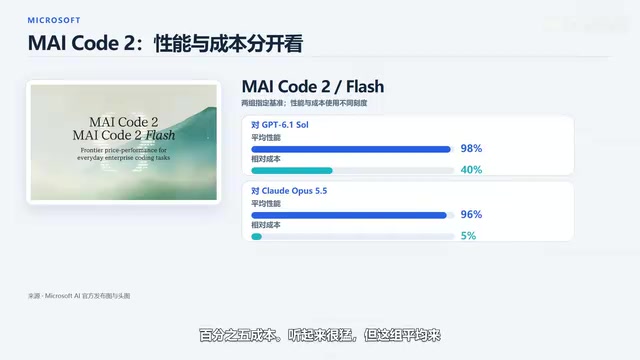
More interesting is Microsoft's own disclaimer: MAI Code 2 hasn't yet been tuned for basic scientific research or ultra-long-horizon agent tasks. It's more like a good power drill for everyday repairs—it doesn't mean it can build the whole building for you. Before considering migration, development teams should pick three to five real tasks and run a round under the same repository, tests, and pipeline, verify whether patches can be merged and whether anything was missed, then calculate whether the budget still makes sense after the promotional pricing ends.
NVIDIA Singapore's $104 Billion: Book Revenue Doesn't Equal Chip Flow
NVIDIA's Singapore subsidiary accounts are the most easily misread figures in this news roundup. According to Financial Times, which reviewed the local company's books, the subsidiary recorded about $104 billion in revenue in 2025, or roughly $117.8 billion on a 12-month basis through January 2026, including $13.6 billion in sales to another NVIDIA group company; net profit for the period was about $53 million.
NVIDIA previously disclosed that most products corresponding to revenue billed to Singapore customer addresses were actually shipped elsewhere, and goods sent to Singapore accounted for less than 2% of total company revenue in fiscal 2025. So this figure reflects the subsidiary's book revenue and billing hub, not local chip consumption in Singapore, and certainly not the final destination of the chips.

When you see a multinational's revenue for a certain location, Manmei suggests asking three questions first: Whose address is it calculated by? What period is counted? Where do the goods ultimately go? If the three methodologies don't align, the number may be wrong no matter how big it is.
Multinational tech companies often use a billing hub model: they set up a subsidiary in a location that signs contracts and issues invoices to regional customers centrally, while goods actually ship directly to end customers from other warehouses or contract manufacturers. Reasons include tax arrangements, regional contract management, and convenience of foreign exchange settlement. Thus "Singapore subsidiary revenue" reflects where contracts are signed and funds flow, not where physical goods are consumed. NVIDIA's voluntary disclosure that "goods shipped to Singapore account for less than 2% of total revenue" is precisely a hint for investors to distinguish billing methodology from logistics methodology, and avoid misreading book figures as regional market demand.
Kling Clean Image 4.0: The Usage Boundaries Behind Native 8K
Those who create images should note Kling's latest update. The company says Clean Image 4.0 supports native 8K, can generate up to 2,000 characters of text per image, and can produce up to 10 stylistically consistent images at once—like delivering a set of poster drafts in one go rather than starting each from scratch.
But these are capability boundaries published by the product side. Whether small text, Chinese typography, and character consistency across 10 images hold up every time; whether 8K support means every mode and every plan can get 8K for free—all of this requires hands-on testing. The suggestion is to first try a sample image with small Chinese text and a complex layout, then have the same character appear in three consecutive images, checking character by character for typos, fingers, and brand elements, confirm your account plan, resolution, and commercial terms, and only then decide whether to put it into your formal workflow. Don't let the words "native 8K" make the judgment for you.
Native 8K means the model directly generates images at roughly 7680×4320 resolution, rather than generating at low resolution first and then upscaling. The latter relies on interpolation or super-resolution models and tends to produce blurring or artifacts at text edges and fine details. Native high-resolution generation demands significantly more compute, so vendors often set resolution caps across different plans and generation modes; "supports 8K" doesn't mean every scenario outputs 8K by default. When evaluating such capabilities, beyond the resolution number, you should also check text rendering accuracy, multi-image character consistency, and commercial licensing terms—these are what really determine whether it can enter a production workflow.
Agent-Driven Automatic Payments: A Proof of Concept Doesn't Mean It Can Spend for You
Regarding the JPMorgan agent payments item, Manmei made a numbering correction in the video: this item is the eighth, not the seventh, in the daily report. JPMorgan and Handicard did complete a proof of concept for AI agents automatically handling FX fund transfers, but the official document states clearly—limited scope, running in a test environment, not a launched product, and no real fund transactions.

Agents can check balances, request quotes, and propose transfers, while the bank controls identity and authorization limits. It sounds like letting an autonomous car handle transfers, but the lanes, speed limits, and brakes still have to be locked down by bank rules. This is still far from "AI can already freely spend for you." When piloting in an enterprise, first set up whitelisted accounts, per-transaction and daily caps, expiring authorizations, manual review for anomalies, and complete audit logs—run test accounts first, talk about real funds later.
Proof of Concept (PoC) is a small-scale technical validation conducted by enterprises before formal productization, usually run in an isolated test environment with simulated data or sandbox accounts. Its purpose is to prove the technical path is feasible, not to deliver a usable service. Between a PoC and a production system lie security audits, compliance approvals, disaster recovery design, and regulatory filings. In agent payment scenarios, even if the PoC works, going live still requires solving identity authentication, dynamic management of authorization limits, interception of anomalous transactions, and audit traceability. So when you see "completed a proof of concept," understand it as initial confirmation of technical feasibility—there's still considerable distance before actual fund flows.
Xiaomi MiMo Funding Rumor: Insufficient Evidence, Keep a Question Mark
The last item is a rumor, not an official announcement. The original candidate within the daily report window came from a WeChat public account forwarded through a single Telegram channel, and subsequent media reports mainly pointed to statements from a few investors. As of the materials that can be verified so far, Xiaomi has not confirmed a spin-off funding plan, nor has the status of team lead Luo Fuli or the alleged disagreements between the two sides been officially confirmed.
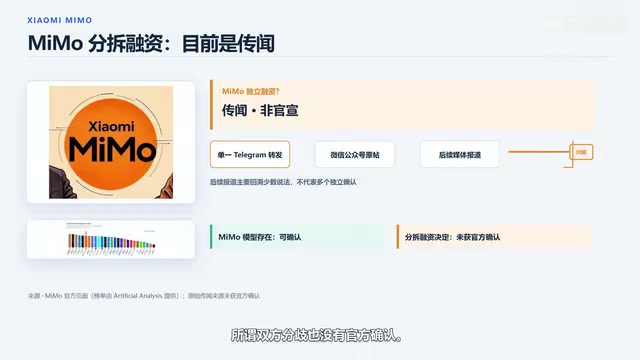
What can be confirmed is that MiMo undertakes model R&D within Xiaomi and is connected to terminal ecosystems such as phones and cars. But that doesn't mean the company has decided to spin it off. When you see headlines like "So-and-so is leaving, a big tech company's AI business is being spun off," first look for company announcements, public responses from the people involved, and explicit funding documents. Without these, keep the word "rumor" in mind and don't treat speculation as an investment conclusion.
Six Stories, One Simple Principle
Model scores depend on test conditions, revenue depends on statistical methodology, automatic payments depend on authorization boundaries, and rumors wait for evidence. Among these six stories, which one do you most want to test first? The new models, Kling's image generation, or the agent's fund permissions?
Related articles

From Command Line to MCP: Two Paths for Connecting Existing Scripts to AI Assistants
How can an existing report-inspection script connect to an AI assistant? This article compares command-line and MCP adapter designs, covering argv parameter passing, tool discovery, ID mapping, result contracts, and timeout cleanup boundaries, helping developers make the same tool return consistent meanings through two entry points.

Is Distance Real? Causal Set Theory Offers a Disruptive Answer
Causal Set Theory proposes a disruptive idea: distance may not be a fundamental property of the universe. This article explains how distance can emerge on larger scales from discrete events and causal order, and explores the difference between "emergent reality" and "fundamentality."

Seoul AI Night: FriendliAI and Over 100 Korean Tech Leaders Discuss the Future
FriendliAI hosted an AI executive exchange event in Seoul, attracting over 100 Korean tech leaders. This article analyzes why inference optimization has become a focal point in Korea's AI ecosystem and what signals this gathering reveals.