GPT-6.2 Leaked, Gemini 4 Spotted? AI Daily Roundup

Rumors swirl around new OpenAI and Gemini models, with subscription quota changes and a wave of domestic open-source small models.
Today's AI news is dense: OpenAI's internal codename GPP-6.2 Beetlejuice was spotted but unconfirmed, a Reddit leak claims Gemini 4 has near-perfect benchmarks attributed to RSI, and DeepSeek denies V4.1 Pro is imminent. OpenAI announced Rosalind API pricing, Anthropic adjusted Claude subscriptions and removed the Ultra 5-hour limit, while OpenAI increased quotas for all users. Open-source releases include SenseTime's 9B recurrent Transformer, Xiaomi's 0.8B OCR model, and Microsoft's 4B operation agent. In compute and brain-computer interfaces, Google's space TPU returned signals, Neuralink showed mind-driven Grok computer control, and BAAI released the embodied model GO3 Preview and the Cell swarm experience learning paradigm.
Today's AI world is packed with information: OpenAI's next-gen model codename unexpectedly leaked, Anthropic adjusted its subscription strategy, Google's new flagship is rumored to deliver "near-perfect" benchmark performance, and domestic vendors made clear moves on open-source models and product roadmaps.
LLM Updates: Rumors and Official Statements Intertwine
GPT-6.2 Spotted, Not Yet Officially Confirmed
OpenAI's internal model codename "GPP-6.2 Beetlejuice" was captured by Distort Tracker and labeled as Internal. This codename echoes earlier rumors about Bio and is believed to be the ultra-large-domain training model following DAG. To be clear, OpenAI has not officially confirmed this, and the previous generation GPP-6.1 Astra has also not been released. The early leak of the codename indicates internal training is underway, but it does not mean a release is imminent.
Gemini 4 Rumors Emerge, Leaker Claims Near-Perfect Benchmarks
According to a Reddit leak, the next-gen flagship Gemini 4 (rumored codename "Z9") scores near-perfect across almost all public and private benchmarks. The rumor attributes this performance to RSI (Recursive Self-Improvement) and claims the model has a stronger understanding of human culture and context. Google has not confirmed this. If true, the generational upgrade cadence after Gemini Carbon would be noticeably faster, further compressing the frontier competition cycle.

A new checkpoint of Gemini 4 Carbon has gone live on the Arena scoring platform, and users can try it directly. Feedback shows the model performs excellently on 3D and Three.js tasks, easily handling high-difficulty problems. One developer used it to generate 3D content in about 3 hours, with results clearly superior to the previous version.
RSI (Recursive Self-Improvement) is a key concept in AI safety and capability discussions, referring to a model's ability to participate in improving its own (or the next generation's) training, architecture, or data pipelines, thereby forming a positive feedback loop of capability iteration. Theoretically, if a model can reliably identify its own flaws and propose improvements, the iteration speed could far exceed the pace of human research. However, this concept currently remains more at the experimental and speculative level, and the industry still has huge disagreements over its feasibility and risks. The leak attributing Gemini 4's benchmark performance to RSI is an unverified strong claim, and readers should treat it as part of the rumor narrative rather than technical fact.
DeepSeek Denies V4.1 Pro Is About to Launch
DeepSeekAd product lead Cui Tianyi explicitly denied that V4.1 Pro is about to launch, stating the model is still in training. Earlier, third-party platform Orca Router announced it was preparing Day Zero support, sparking speculation of an imminent release. With the official statement now in place, that signal should be viewed as a marketing move rather than release progress; the launch window for V4.1 Pro remains undetermined.
Notably, DeepSeek's open platform has launched the application portal for the full Cyber lineup; the Cyber app had previously appeared in the official website's JS code. Applications require mainland registration and real-name verification with a mainland phone number, with no violation records in the past 90 days. The process is: fill out the form, and after approval, create a Cyber Key. Individuals need front and back photos of their ID plus facial verification; enterprises additionally need a license and authorization letter.
OpenAI Rosalind API Pricing Announced
API pricing for GPT-6-Rosalind has been announced: $15 per million input tokens and $75 per million output tokens; GPT-Rosalind Research and Discovery are both $5 input and $25 output. The model has appeared in the OpenAI API changelog and is currently only accessible to organizations approved for the Rosalind research program.
Subscriptions and Quotas: Anthropic Changes Rules, OpenAI Adds Quota
Anthropic changed the names of its Claude subscription plans and removed the 5-hour usage limit on the new Ultra plan. The leaker believes the team is preparing for the release of Fable 5.5, hoping users will no longer be restricted during peak usage, and expects a higher-limit Ultra plan at the $500 tier.
OpenAI's 28-day sprint entered Day 25, and Tibo announced abandoning the quota-cut plan in favor of increasing quotas for everyone: the original plan was to cut Codex and ChatGPT Work quotas for legacy Pro 200 users from 20x to 10x while keeping the $200 monthly fee unchanged. The final decision keeps the 20x for legacy users, doubles the 10x users to 20x, and immediately doubles quotas for Pro 100, Pro 500, and Business Premium as well.
Open Source and Hardware: Domestic Models Rally
SenseTime officially open-sourced SenseNova Loop 9B Preview. This 9B-parameter recurrent Transformer extends computational depth through parameter-sharing loops and MHC popular-constraint hyper-connections rather than simply scaling model size. The company claims it achieves 27B-level performance on complex tasks and surpasses a certain 27B-level model on the WorkBody, ReturnPPT, and AutomationBench benchmarks.
Xiaomi open-sourced the 0.8B-parameter OCR model ZioMeOCR, trained on QN3.5-0.8B Base with about 170 million OCR and document samples. Evaluations show the model ranks first on Rio5 OmniDockBench with a score of 95.24, and a single model can handle document parsing, key information extraction, and OCR visual question answering, outperforming larger models.
Microsoft released the 4-billion-parameter hybrid computer-operation agent MageVL Cowork 4B on Hugging Face, using a single compact policy model that autonomously decides when to click the interface and when to write code. It achieved 66.0% on the Oathworld Verified benchmark, surpassing 27B and 30B parameter agents.
Moonshot's Timmy launched the new 3D Make feature, which can connect to tools like Blender and CAD to create 3D models, assemble scenes, and develop games. It is now live and available at Timmy Work and other entry points.
Additionally, the high-performance OCR model Siri 2.5 with under 4 billion parameters has only 0.7B parameters and directly outputs web-format text that preserves layout structure; complex tables spanning rows and columns and mathematical formulas can be accurately restored without secondary processing.
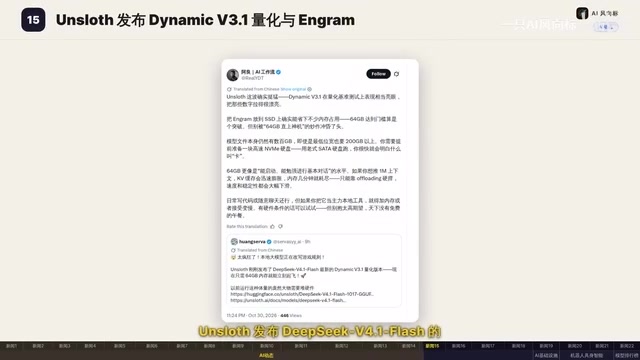
Unsloth released Dynamic quantization and Ngram versions of DeepSeek V4.1 Flash. The Dynamic V3.1 quantization can start with just 64GB of memory, and Ngram places weights on SSD to greatly reduce memory usage. However, model files are still several hundred GB, with the lowest-bit version exceeding 200G, requiring a high-speed NVMe drive.
Compute and Brain-Computer Interfaces: New Scenarios Land
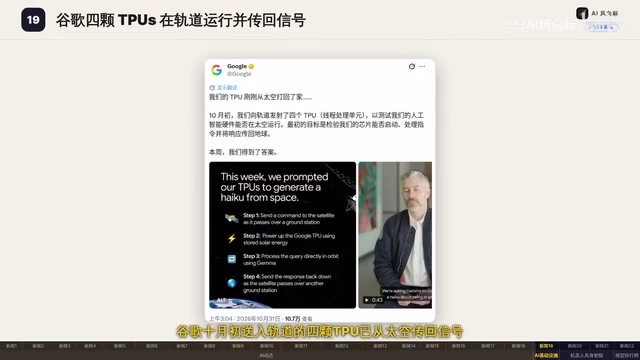
The four TPUs Google sent into orbit in early October have transmitted signals back from space, verifying that AI chips can boot and operate in the space environment. The test goal was for the chip to boot, process a prompt, and send the response back to Earth. This week the team confirmed receiving the returned results: the chip used Gemma to generate a poem. This is the first tangible result of the long-term space compute project.
Neuralink demonstrated a new feature: users silently say "Hey Neuralink" in their minds and describe a task, and the Grok agent can autonomously operate the computer without manually typing commands. Previously, engineers had a patient with ALS develop and test continuously at home for 72 hours, during which speech intent recognition, brain-signal input methods, and iPhone calls were achieved. The company also reported that the patient can output 75 English words per minute with a 5.8% error rate.
Google Anti-Gravity launched plugin-based aggregation, where Google and third-party plugin agents connect to external services. Instead of manually configuring MCP API keys, users can search and install with one click, effective on both the desktop app and CLI. Initial partners include Atlassian, Figma, Canva, Datadog, CrossTrack, Unity, and others.
MCP (Model Context Protocol) is an open protocol that lets AI applications connect to external tools and data sources in a standardized way. Previously, connecting to an external service usually required manually configuring API keys, endpoints, and permissions, which was costly and hard to reuse. Plugin-based aggregation productizes this process: users can install connectors with one click via search, with the platform managing credentials and calls on their behalf, effective on both desktop and command line. This model lowers the barrier for agents to connect to enterprise services (such as design, collaboration, and monitoring tools), and also means the protocol layer is evolving from a developer tool into a distribution entry point for ordinary users.
Robotics: From Pre-training to Swarm Experience
On October 29, BAAI released the embodied model GO3 Preview, achieving full-chain scalable learning from pre-training and post-training to deployment. It has topped three major leaderboards—RoboDojo, RoboTwin, and RoboColosseum—and will be fully open-sourced by the end of 2026. After pre-training, its task transfer and complex skill adaptation capabilities are stronger, validated in Zero Shot and Full Shot tasks, and it can complete long-horizon fine tasks such as making jianbing guozi.
BAAI, together with Tsinghua University and Infinigence AI, released the swarm experience learning paradigm Cell. On five real tasks, Cell policies all exceeded the average level of 6 human teleoperators, leading by up to 16.7 percentage points; in the phone packaging task, robots scaled from 16 to 96 units, and the success rate improved further from 86.7%.
Leaderboards: Head Packed Tight, Domestic Open Source Catching Up
Competition at the top of the intelligence leaderboard is tight: Gemini 4 Carbon High leads with 59 points, Claude Opus 5.5 Max with Fallback follows closely at 58, and GPT-6 Aster Max ranks third with 57. Among open-source and domestic players, Pimmy K3.1 Pro performs best, ranking ninth with 46 points.
From today's information, three threads intertwine: model codename rumors, subscription quota adjustments, and a密集 wave of small open-source model releases. The real watershed remains official confirmation and actual usability. Rumors can reflect the pace of competition, but should not be treated as release progress.
Background Supplement
A Recurrent Transformer is a structure that lets a model perform multiple iterative computations on the same set of parameters during inference. The core idea is to "trade depth for width": repeatedly processing hidden states through parameter-sharing recurrent layers to extend effective computational depth without significantly increasing parameter count. This differs from the traditional direction of stacking more layers or parameters, and theoretically helps control memory and deployment costs, but it also brings challenges such as training stability, gradient propagation, and inference latency. SenseTime's claim that its 9B model achieves 27B-level performance is precisely the selling point of this approach; actual results still need validation on more independent benchmarks and real tasks.
OCR (Optical Character Recognition) models are responsible for locating and recognizing text in images. Traditional pipelines usually split detection and recognition into two stages, while recent multimodal large models tend to use a single model end-to-end for document parsing, key information extraction, and visual question answering. The value of small-parameter OCR models lies in local deployment and low inference cost, suitable for batch document processing; the difficulty lies in restoring complex layouts, multi-row multi-column tables, and mathematical formulas. Evaluations often use layout fidelity and structured output accuracy as key metrics, and whether a single model can handle detection, recognition, and understanding simultaneously is the core criterion for judging its practicality.
One-line Summary
Rumors swirl around new OpenAI and Gemini models, while subscription quota adjustments and domestic open-source small models are released densely.
Paragraph Summary
Today's AI world is information-dense: OpenAI's internal codename GPP-6.2 Beetlejuice was captured but not officially confirmed, a Reddit leak claims Gemini 4 benchmarks are near-perfect and attributes this to RSI, and DeepSeek explicitly denies that V4.1 Pro is about to launch. OpenAI announced Rosalind API pricing; Anthropic adjusted Claude subscriptions and removed the Ultra 5-hour limit, while OpenAI increased quotas for everyone. On the open-source side, SenseTime released a 9B recurrent Transformer, Xiaomi open-sourced a 0.8B OCR model, and Microsoft released a 4B operation agent. In compute and brain-computer interfaces, Google's space TPU successfully transmitted signals back, and Neuralink demonstrated mind-driven Grok computer operation. BAAI released the embodied model GO3 Preview and the swarm experience learning paradigm Cell.
Related articles

AI Can Read Neural Network Weights Directly: Do Models Already Exceed Expectations?
A Reddit developer experiment shows language models can directly read neural network weights and infer their function. Astra, Opus 5.5, and Muse Spark 1.3 all passed the test, sparking discussion on model generalization and training sources.

India's Microdrama Market Explodes: EloElo Secures $80M Investment from NBCUniversal
EloElo secures $80M from NBCUniversal to boost StoryTV, its microdrama platform with over 33M monthly active users, as India's microdrama market draws global capital.

Acoustic Detection of Multi-Rotor UAVs: Fusing Handcrafted Features with Pre-Trained Embeddings
Study reveals data leakage from random splits in UAV acoustic detection, proposes source-disjoint protocol with stacked ensemble of handcrafted features and YAMNet embeddings, achieving 95.29% accuracy for low-cost drone detection.