GPT-6.2 Officially Released: Astra Pricing and Sol Economy Edition Explained

November 18 AI Daily recaps the GPT-6.2 release, OpenAI dual-version pricing, Quin4 Max's new architecture, and the week's product showdown.
Big Fat Fish AI Daily Episode 20 covers four AI developments: GPT-6.2 officially released with upgrades in professional work and 3D capabilities, plus a reminder to back up first; OpenAI launched GPT-6.2 Astra and Sol dual versions, with Astra not seeing a major price cut and still costing more than Fable 5.2, while Sol is more economical but its limits are unaddressed; Quin4 Max arrives with a new architecture, 16 benchmarks, and real-world demonstrations; and the weekly AI roundup shows multiple vendors concentrating product releases amid clear competition. The digest stresses cross-validating community info with official announcements and focusing on upgrade costs, pricing shifts, and real workflow performance.
Introduction: AI Daily News Roundup
On November 18, Big Fat Fish AI Daily (Episode 20, labeled Episode 27 in the video) walked viewers through the four core developments in the AI world that day. Presented in a "plain English" style, this episode covered the GPT-6.2 series release, OpenAI's dual-version pricing strategy, the debut of Quin4 Max's new architecture, and a roundup of the week's major AI news. For developers tracking model iteration cadence and cost-effectiveness, this daily digest offers a dense cross-section of information.
GPT-6.2 Officially Released: Upgrades in Professional Work and 3D Capabilities
According to a video posted by Bilibili creator "BAE压白压," GPT-6.2 has been officially released, with core changes concentrated in two areas: professional work scenarios and 3D capabilities. The version number change signals substantive adjustments to underlying capabilities rather than simple parameter tuning.
The daily digest specifically reminds viewers: remember to back up before upgrading. Brief as it is, this tip points to potential compatibility issues during model version transitions—for production environments that depend on stable API output, version migration is never a painless operation. The creator brushes it off with "don't ask me how I know," hinting at pitfalls that may arise in actual use.
The video reached 58,000 views, the highest among the four segments, reflecting the developer community's strong interest in GPT-6.2's real-world performance.
The "backup" reminder when upgrading model versions typically means more than saving code or config files. In production environments, a version switch can trigger subtle changes in output format, reasoning style, and even API behavior, affecting downstream tasks. Common compatibility risks include: prompt effectiveness drifting under the new version, changes to JSON mode output structure, updates to tool-calling protocols, and adjustments to context window or rate limits. A practical approach is to retain a snapshot or endpoint route of the old version while running a regression test suite to compare old vs. new outputs, confirming critical business pipelines are stable before fully switching over.
OpenAI's Dual-Version Strategy: The Pricing Logic of Astra and Sol
The second segment, from creator "图灵坐标," focused on OpenAI's release of GPT-6.2 Astra and GPT-6.2 Sol. The key takeaway from the daily digest: the rumored major price cut did not materialize—Astra's pricing remains higher than Fable 5.2.
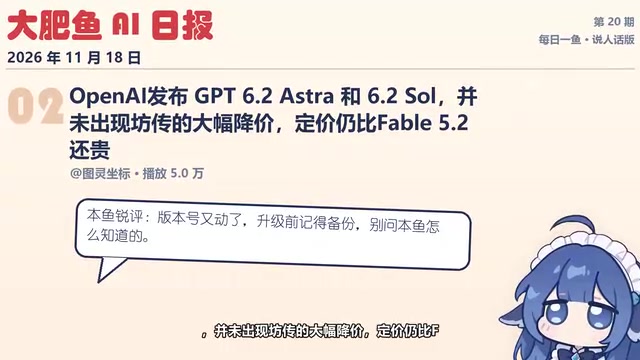
There is a notable discrepancy here: the title mentions "Astra price cut," but the body analysis points out that no major price reduction actually occurred. This tension in wording precisely reflects how pricing information is easily simplified or misread in transmission. For enterprise model selection, whether something "saves money" or not needs to be calculated against specific use cases rather than judged from headlines. The Sol version is described as "more economical," but its capability differences from Astra and the boundaries of its applicability are not elaborated in the daily digest, requiring further consultation of official documentation.
The video reached 50,000 views, close to the first segment, indicating that pricing strategy is also a topic of high community interest.
The naming strategy for dual versions (like Astra and Sol) typically means the vendor has split a single generation of base models into two product lines—"capability-first" and "cost-first"—possibly differentiating pricing through different model sizes, inference budgets, context lengths, or rate limits. For enterprises, model selection should not rely on unit price alone but should calculate cost per task: use the capability version for high-difficulty tasks and the economy version for high-frequency simple tasks, paired with routing strategies for dynamic distribution. Additionally, pricing is affected by factors like caching and batch-call discounts, which headline claims of "price cuts" often overlook.
Quin4 Max Released: 24K New Architecture and 16 Benchmarks
The third segment, posted by "BAE压白压," reported the official release of Quin4 Max, bringing a new architecture along with 16 benchmarks and real-world work demonstrations. The figure "24K" appears alongside "new architecture" in the daily digest; its specific meaning should be confirmed against the video content, but from context it likely refers to a core specification or parameter identifier.

The combination of 16 benchmarks plus real-world work demonstrations suggests this release aims to support capability claims with evidence closer to actual use rather than relying solely on benchmark scores. For teams evaluating new models, real-world work demonstrations often carry more reference value than standardized benchmarks—the latter can be optimized for, while the former is harder to fake. The video reached 35,000 views, slightly lower in popularity than the first two, but with no shortage of technical information density.
The difference between standardized benchmarks and real-world work demonstrations deserves elaboration. Benchmarks typically have fixed questions and scoring scripts, and models may achieve high scores through targeted training or prompt engineering; real-world work demonstrations, however, involve open-ended tasks, multi-step tool calls, and human judgment, making them harder to "game." Therefore, when evaluating new models, priority should be given to task complexity in demonstrations, disclosure of failure cases, and reproducibility, treating benchmark scores as reference rather than decision basis.
Weekly AI News Roundup: The Year's Strongest Product Showdown
The fourth segment, from creator "产品均," rounded up AI news for the week of November 15 under the theme "Three Fools Battle for the Year's Strongest Product." This phrasing carries a community tongue-in-cheek tone, pointing to the competitive situation where multiple vendors concentrated product releases in the same time window.

This video reached 17,000 views, the lowest of the four, but as a weekly overview its value lies in connecting scattered release events into trend threads. When multiple heavyweight products debut in a short period, the significance of any single news item gets diluted, and horizontal comparison actually reveals more about each vendor's strategy—whether competing on capability ceiling, cost-effectiveness, or ecosystem integration.
Observations on Multi-Source Cross-Validation
The four segments in this daily digest come from four different creator accounts, forming a community-level multi-source information structure. BAE压白压 covered both the GPT-6.2 release and Quin4 Max, 图灵坐标 handled OpenAI pricing analysis, and 产品均 provided the weekly overview. This division of labor allows information within the same time window to be presented from different angles.
A note: community daily digest information undergoes secondary processing, and tension may exist between headlines and body text (such as the "Astra price cut" phrasing). Specific specifications and pricing should be based on official announcements. The value of a daily digest lies in quickly building an information map, not in replacing primary sources.
Conclusion
From this episode, model iteration continues to accelerate: version numbers keep changing, dual-version strategies are becoming the norm, and new architectures arrive alongside benchmark demonstrations. For developers, what truly matters is not the version number itself but upgrade costs, pricing changes, and performance differences in actual workflows. Back up, calculate, verify—these three things are worth repeating through every wave of releases.
Content compiled from Big Fat Fish AI Daily Episode 20 video information. Specific specifications and pricing should be based on official announcements.
One-line Summary
November 18 AI Daily covers the GPT-6.2 release, OpenAI dual-version pricing, Quin4 Max's new architecture, and the week's product showdown.
Paragraph Summary
This episode of Big Fat Fish AI Daily (Episode 20) covers four AI developments: GPT-6.2 officially released with upgrades focused on professional work and 3D capabilities, plus a reminder to back up before upgrading; OpenAI launched GPT-6.2 Astra and Sol dual versions, with Astra not seeing a major price cut and still priced above Fable 5.2, while Sol is more economical but its capability boundaries are not elaborated; Quin4 Max released with a new architecture, accompanied by 16 benchmarks and real-world work demonstrations; the weekly AI news roundup shows multiple vendors concentrating product releases, with clear competitive dynamics. The daily digest emphasizes that community information needs cross-validation with official announcements, tension may exist between headlines and body text, and developers should focus on upgrade costs, pricing changes, and actual workflow performance.
Related articles

Jingle Jam 2026 Registration Opens: Lewis Uses Old Footage to Rally Volunteers for Fundraising
Jingle Jam 2026 fundraising registration is open. Lewis uses old footage edited into a new video, calling on viewers to create fundraising pages at jingle jam.tiltify.com to support eight charities. The event takes place in the first two weeks of December.

Gemini 4 Neon Hands-On Test: Can It Replace Claude Opus 5.5?
A Bilibili creator tests Gemini 4 Neon, Claude Opus 5.5, and GPT 6.2 across three coding Agent challenges—pelican animation, 3D racing, and code-generated video—to see if Gemini can replace Opus.
FBI-Warned Artex: How an AI Attack Framework With No In-House Model Pries Open Enterprise Doors
The FBI-warned open-source AI attack framework Artex has no model of its own—it plugs into Claude, GPT, and other external LLMs to drive an agent loop, turning ordinary tools like Nmap into an automated attack pipeline. This article examines three real cases—South Korean finance, ConnectWise, and Barracuda—analyzes the three drivers of speed, cost, and noise, and outlines defenses such as exposure inventory and short-lived credentials.