GPT-6.5 Leak Rumors and MiniMax M3.1 Flash: The AI Model Arms Race Escalates

A dense week of AI model news: OpenAI rumors, Anthropic's intent-understanding breakthrough, MiniMax's low-price disruption, and Google's Gemini 4 Carbon falling short.
This week brought a dense wave of AI news, with all major players making moves. On OpenAI's side, GPT-6.5 clues on the parody site opensi.lol were debunked, but GPT-6.1T appearing in Microsoft's evaluation configs is more noteworthy. Anthropic's new model demonstrates intent understanding—going from fixing a single bug to identifying an entire class of problems—representing a major leap for autonomous coding agents. Google's Gemini 4 Carbon early checkpoints fell short of Claude Opus 5.5 in testing and were even weaker than the existing Gemini Argon, debunking the earlier "matches Opus 5.5" claim. MiniMax M3.1 Flash is disrupting the market with 15 cents per million input tokens and over 200 tokens/sec, with real-world costs nearly 88 times lower than Opus 5.5—though output quality still lags, making it better suited as a scaffolding tool. Also worth watching: OpenAI's legacy language modernization, the Zhipu GLM series, the Kimi K3.1 leak, NVIDIA's inference optimization, and the Dream1 robot model.
This Week in AI: Leaks, Launches, and a Price War
The week opened with a flood of information. From possible GPT-6.5 clues at OpenAI, to Anthropic's new model breaking ground in autonomous coding, to MiniMax disrupting the market with extremely low pricing, nearly every major player had news. Based on a roundup by Bilibili creator World of AI, cross-referenced with sources like The Information and Reuters, we're in a window where model releases are noticeably accelerating.

OpenAI: GPT-6.5 Rumors and a Microsoft Code Leak
A Suspicious Countdown Site
Someone spotted a website called opensi.lol with references to "6.5" buried in its HTML source code, along with a countdown to 10 AM San Francisco time on November 1. That timing happens to coincide with day 28 of OpenAI's "28-day delivery promise," fueling plenty of speculation.
But a reality check is in order: domain history archives show the site was already described as "an independent OpenAI parody site for sale" back on September 23. So this is most likely not an official signal—just a coincidence that feels a little too deliberate.
GPT-6.1T in Microsoft's Evaluation Configs
Another clue is more worth watching. According to reports, 18 evaluation configurations appeared in Microsoft pull requests, updated from GPT-5.6T to GPT-6.1T. This isn't text on some parody site—it's an actual code change in Microsoft's evaluation infrastructure, suggesting OpenAI's next-generation model may already be entering test preparation.
Anthropic's New Model: From "Fix One Bug" to "Fix a Whole Class of Problems"
A report from The Information previewed the coming wave of model releases, with details on Anthropic's new model drawing particular attention. According to one anonymous tester, the model no longer just fixes the specific bug you point to—it can recognize that the bug is part of a larger problem and proactively ask whether to address the entire class of related issues.
This is significant for autonomous coding agents. One of the biggest limitations of current models is that you have to explicitly tell them what to look for and what to fix. A model that can understand broader intent and spot problems you haven't noticed yet is a different tier of assistance. The report also says the model is better at thinking outside the box rather than repeating conventional solutions.
Autonomous Coding Agent refers to AI systems that can independently complete coding tasks with minimal human intervention. Their capability spectrum typically spans several levels: the most basic is modifying specified code based on explicit instructions; more advanced is autonomously locating problems, planning fixes, and executing them; a higher level requires the model to understand the overall structure of a codebase and the developer's intent, proactively identify potential issues, and offer suggestions beyond the original instructions. Most mainstream models today sit at the first two levels, with the core bottleneck being "intent understanding"—the model can only handle explicitly given task boundaries and cannot infer what the developer actually wants to achieve. The "identify an entire class of problems and proactively ask" behavior shown by Anthropic's new model is precisely the key marker of crossing from "instruction executor" to "collaborative partner," and the watershed for autonomous coding agents becoming practical.
Google Gemini 4 Carbon: Early Checkpoints Disappoint
Business Insider previously reported that Google's internally tested Gemini 4 Carbon could match Claude Opus 5.5 in coding ability. But based on actual testing of two different checkpoints (Carbon B and Carbon C), that claim is "absolutely wrong."
In head-to-head coding tasks against Opus 5.5, the Carbon checkpoints were not on the same level at all. More surprisingly, compared with Google's existing Gemini Argon model, there was almost no meaningful improvement—Carbon was slightly faster, but actual coding quality was even worse. Of course, these are only early checkpoints with room for improvement, but the claim of "matching Opus 5.5" doesn't hold up at present.
MiniMax M3.1 Flash: A Low-Price, High-Performance Shockwave
Performance and Pricing
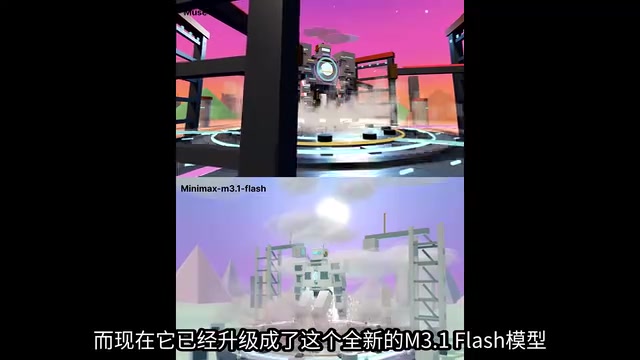
MiniMax M3.1 Flash has officially launched after its preview period. The company confirmed that "SpaceMoney Alpha," which previously appeared anonymously on leaderboards, was an early version of it. The new model runs at over 200 tokens per second—three times faster than the previous M3 generation—at roughly 70% lower cost.
On benchmarks, M3.1 Flash scored 62.2% on AutomationBench, compared with 50.3% for Claude Opus 5 and 45.8% for GPT-5.6. On pricing, it's just 15 cents per million input tokens and 60 cents for output, with cached input as low as 1.5 cents per million—whereas Claude Opus 5 is $5 for input and $25 for output.
Real-World Comparison: A Staggering Cost Gap
In a web design test, MiniMax completed a landing page task for just 1 cent, while Opus 5.5 cost $1.22—nearly 88 times cheaper and 4 times faster. In an underwater submarine chase scenario test, MiniMax finished for about 21 cents, Gemini 3.8 Flash about $1.43, and Claude Haiku 5.5 about 17 cents.
To be clear: lower cost doesn't mean better output. Opus 5.5's finished quality is noticeably superior. A more realistic approach is to use MiniMax as a scaffolding tool, then refine with a stronger model.
Pro Version on the Way
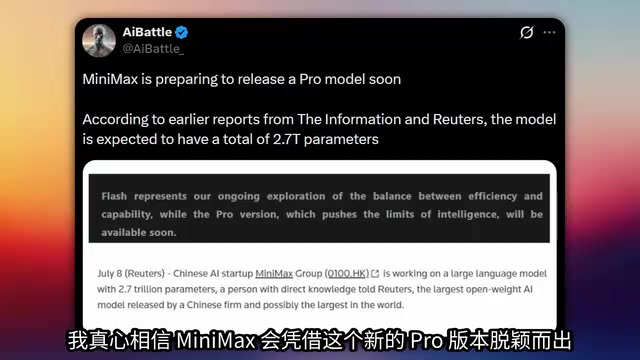
According to reports, MiniMax is also preparing a more powerful M3.1 Pro series, possibly with up to 2.7 trillion parameters, which could make it one of the largest AI models in scale. Parameters don't equal performance, but combined with the Flash version's showing, the Pro is worth anticipating.
Token Pricing and Cached Input are two core variables in the cost structure of LLM APIs. A token is the basic unit of text a model processes, roughly equal to 0.75 English words or half a Chinese character. Input tokens refer to the prompts users send, while output tokens refer to the content the model generates—the latter is usually priced higher. Cached input is a cost-optimization mechanism: when multiple requests contain the same prefix content (such as system prompts or long documents), the provider can cache that portion of the computation to avoid redundant work, billing it at an extremely low price. MiniMax M3.1 Flash pushing cached input down to 1.5 cents per million tokens means that in scenarios like agents that repeatedly carry the same context, actual costs can drop even further. Understanding this structure is key to seeing why its price gap with Opus 5.5 gets magnified to nearly a hundredfold in real-world tests.
Other Notable Developments
OpenAI Legacy Language Modernization: OpenAI emphasized that its latest models have significantly improved understanding of legacy languages like COBOL, Fortran, and Visual Basic, helping developers migrate old systems without breaking existing functionality. This is one of the most underrated applications of AI coding—a vast number of banks and government infrastructure still depend on these languages.
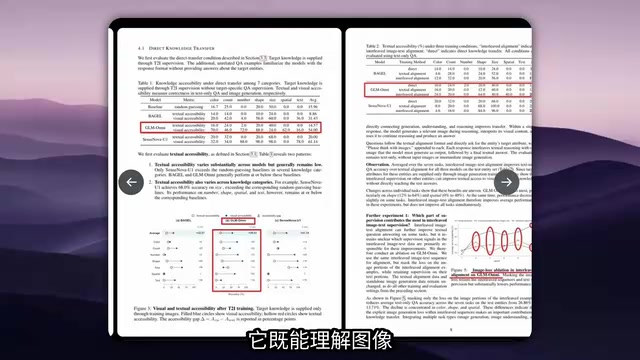
Zhipu GLM Series: The coding platform Zcode launched a workflow mode that can orchestrate multiple AI agents simultaneously and track progress in real time. A research paper disclosed the internal multimodal model GLM Omni, which can both understand and generate images, with image-text alignment accuracy improving from 12.57% to 26.86%. GLM 5.3, through post-training alone, jumped from 4.6 to 28.3 on Terminal Bench.
Kimi K3.1: Appeared in a pull request and was closed 7 minutes later. Leaked information shows it uses the same tokenizer and chat format as Kimi K3, introduces four reasoning levels—low, medium, high, and Max (Max being the default)—and supports image input.
NVIDIA Inference Optimization: Achieved 423 tokens per second per user on the 2.8-trillion-parameter Kimi K3 model, a 1.68x speedup on the same architecture, thanks to roughly 12,000 lines of highly optimized CUDA kernel code and Mega Kernel Fusion technology—with no additional hardware required.
Dream1 Robot Foundation Model: Dreamlabs emerged from stealth mode with a model that can operate dual-arm robots it has never been trained on to complete unfamiliar tasks. Access starts at $3 per hour, and the API is now open to developers.
Legacy Code Modernization is a direction in AI coding with extremely high commercial value but relatively low public attention. Languages like COBOL, Fortran, and Visual Basic were born last century and still underpin a large number of the world's banking core systems, government tax platforms, and aviation scheduling infrastructure. The pool of maintainers for these systems shrinks every year, while migration costs are extremely high—by some estimates, modernizing legacy systems across the U.S. federal government alone costs tens of billions of dollars annually. If AI models can accurately understand the semantics and business logic of these languages and generate equivalent modern-language code without breaking existing functionality, they would directly tap into a massive enterprise market with strong willingness to pay. OpenAI emphasizing this capability is essentially carving out a differentiated scenario beyond the red ocean of coding.
Takeaways
The key signal this week isn't any single model, but the divergence of competitive dimensions: OpenAI is finding scenarios in legacy code modernization, Anthropic is going deep on "intent understanding" in autonomous coding, MiniMax is tearing open a gap with price and speed, and Google is still catching up. For developers, tool choices are becoming more diverse—using cheap models to build the skeleton and strong models to refine may be more pragmatic than betting on a single model.
Related articles

34 AI Coding Assistants Battle It Out in the Terminal — How to Avoid Picking Wrong
34 AI coding assistants are flooding the terminal, and Orca supports multi-agent parallelism. This article analyzes the consolidation trend behind the gold rush, the cost traps of multi-agent parallelism, and how to maintain an agent-neutral workflow to avoid picking the wrong tool.

Gemini CLI in Practice: An AI Coding Agent in Your Terminal
A deep dive into Gemini CLI: from installation and authentication to building a task management app hands-on, covering plan mode, auto-debugging, GEMINI.md context persistence, and token cost tracking.

Open Design: A Free Open-Source Alternative to Claude Design That Activates Your Coding Agent
Open Design is a free, open-source Claude Design alternative that runs locally with 250+ design skills, auto-detects 16 coding agents, and supports prototypes, slides, and mobile UIs.