GPT-6.5 Leaks Surface Alongside Claude Fable 5.5 and Gemini 4 Carbon

Multi-source leaks sketch a dense next-gen model release period; credibility must be graded by evidence.
This article rounds up a week of concentrated AI model leaks and early testing info, covering OpenAI GPT-6.5 and GPT-6.1 Terra, Anthropic Claude Fable 5.5, Google Gemini 4 Carbon, and Chinese vendors' MiniMax M3.1 Flash, Kimi K3.1, GLM Omni/5.3, and DeepSeek 4.1 Flash, plus Nvidia's vLLM inference optimization and Dreamlabs' robotics foundation model. It grades credibility for each clue: Microsoft code PRs, official releases, and paper-backed info are reliable; the mysterious website countdown was debunked as a spoof, and Gemini 4 Carbon's "on par with Opus 5.5" claim was refuted by testers. The takeaway: in a dense release period, trust verifiable code and official data, and stay cautious about single-source leaks.
A Week of AI Leaks: Next-Gen Models Emerge en Masse
Over the past week, the AI world has been nearly overwhelmed by a flood of leaks and early testing information. From OpenAI's GPT-6.5 clues to Anthropic's Claude Fable 5.5 and Google's Gemini 4 Carbon, and on to new developments from Chinese players MiniMax, Kimi, and Zhipu, multiple independent sources collectively paint a picture of a "concentrated release period for next-generation models." According to The Information, a wave of dense large-model releases may arrive this month, spanning new models from Anthropic, Google, and OpenAI; and clues from Microsoft's code repository, a mysterious website, and social platforms provide varying degrees of corroboration for these rumors.

GPT-6.5: Dual Signals from a Mysterious Website and Microsoft Code
The earliest clue about GPT-6.5 came from a mysterious website called OpenCLoli, purchased by Tibo, whose HTML source code secretly contains the characters "6.5" along with a countdown pointing to 10 a.m. San Francisco time on November 1. Tellingly, this time exactly coincides with the final day of Tibo's earlier "28-day countdown," leading many to speculate that OpenAI might close out its consecutive release plan with a blockbuster new model.
However, this clue has a clear twist: users who dug into the website's historical archives found that a September 23 record described the domain as "an independent OpenAI spoof site for sale," so it is not an authoritative official source. But another clue is relatively solid—GPT-6.1 (codename Terra) has reportedly appeared in a Microsoft code pull request, in which 18 evaluation configurations were updated from "GPT-5.6 Terra" to "GPT-6.1 Terra." Code changes are more credible than website countdowns, suggesting Microsoft may already be preparing to test or integrate OpenAI's next-generation Terra model.
A code pull request (PR) is a core collaboration mechanism on code hosting platforms like GitHub: after a developer completes a set of changes, they open a PR against the main repository, requesting that their changes be merged in. A PR clearly displays the specific lines of code added, deleted, or replaced, as well as the configuration files and evaluation entries involved. So when 18 evaluation configuration changes updating "GPT-5.6 Terra" to "GPT-6.1 Terra" appear in a Microsoft PR, such information typically reflects real engineering activity—Microsoft's internal process for integrating and testing OpenAI models in Azure or related products. Unlike marketing pages or countdown websites, PRs are a byproduct of internal development processes, and the cost of faking or spoofing them is very high—which is the fundamental reason they are more credible than the mysterious website clue.
Claude Fable 5.5: From Bug Fixing to Proactively Discovering a Class of Problems
According to The Information, Anthropic's upcoming model is very likely Fable 5.5, with significantly improved reasoning and intuition. An anonymous tester revealed that the model does not merely fix a single bug as the user requests, but can recognize that the bug may belong to a larger class of hidden issues and proactively ask whether to address them all together. This ability to "infer the rest from one instance" is a major breakthrough for autonomous coding agents—one of the biggest pain points of existing models is that users must explicitly specify what to investigate and what to fix.
The report also notes that Fable 5.5 is better at breaking out of conventional thinking rather than restating routine solutions or common-sense advice. Existing models are already quite good at following instructions, but coming up with creative solutions to entirely novel and unknown problems remains a huge challenge.
Gemini 4 Carbon: Early Checkpoints Overrated?
Regarding Google's Gemini 4 Carbon, Business Insider previously cited sources saying its coding ability was "on par with Opus 5.5." But multiple testers—including the author of the original video for this article—personally tested the Carbon B and Carbon C checkpoints and concluded that this claim is completely untrue. The tester said the actual code quality of these checkpoints not only falls noticeably short of Opus 5.5, but shows almost no substantive improvement even compared with Google's existing Gemini 4 Argon model; while speed is slightly faster, code quality has actually declined.
A quick note: these are only early checkpoints and there is still plenty of room for improvement in subsequent iterations. But the claim of "coding performance on par with Opus 5.5" does not hold up at the current stage, and it may take Google several more months to catch up to that level.
A "checkpoint" is an intermediate snapshot during model training, containing all weight parameters at a given moment. Large-model training often lasts for months, and teams periodically save checkpoints to evaluate progress, roll back experiments, or use for internal testing. Early checkpoints typically have only completed part of the training data or training stages, and there is a clear gap between their capabilities and the final released version. The Carbon B and Carbon C mentioned in the article are two snapshots from different stages of Google's Gemini 4 training process. Conclusions drawn by testers based on early checkpoints can only reflect the level "at that moment" and cannot be directly equated with the final product; but conversely, if early checkpoints are already clearly behind competitors at the same stage, it also indicates that Google will need extra iteration time to close the gap.
MiniMax M3.1 Flash: Extreme Cost-Effectiveness and Benchmark Performance
On the Chinese vendor side, MiniMax M3.1 Flash has officially launched after ending its preview phase, and the company confirmed that the mysterious model "SpaceMoney Alpha," which previously swept the leaderboards, was indeed its early version. The model is said to have processed over 200 trillion tokens, with a generation speed exceeding 200 tokens per second—nearly three times faster than the previous-generation M3—and at roughly 70% lower cost.
The benchmark data is particularly notable: in automated evaluations, M3.1 Flash reportedly scored 62.2%, compared with Claude Opus 5.5's 50.3% and GPT-5.6 SO's 45.8%; on the DeepSway test it achieved 74%, enough to stand on equal footing with far more expensive models in coding evaluations. On pricing, it costs just $0.15 per million input tokens and $0.60 for output, with cached input as low as $0.15 per million; compared with Claude Opus 5.5's $5 per million input and $25 output, and GPT-5.6 SO's $4 and $20, the cost advantage is very clear.

In actual tests, M3.1 Flash's recreation of the Space Rabbit Fairy Island trailer surpassed Muse and DeepSeekAd 4.1 Flash in image quality; recreating a Tesla police car chase scene cost only $2.34, nearly 24% cheaper than DeepSeek's roughly $3.07; and building a landing page for a new hardware product launch cost just 1 cent—nearly 88 times cheaper than Opus 5.5's $1.22, and 4 times faster. Of course, lower cost does not mean better results—Opus 5.5's actual output was indeed better—but MiniMax can serve as a low-cost baseline framework that is then refined with stronger models.
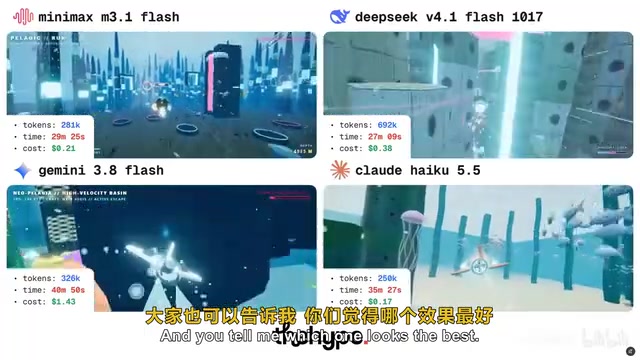
In a complex visual code test involving a submarine chase scene, MiniMax took about 29 minutes and cost about 21 cents—nearly 7 times cheaper than Gemini 3.8 Flash and 1.8 times cheaper than DeepSeek 4.1 Flash, while also generating faster. The tester personally thought Haiku performed best, but MiniMax M3.1 Flash ranked second. Combining multiple benchmarks and prompt tests, the model ranks 18th overall—quite impressive for a Flash rapid version.
Separately, MiniMax is reportedly preparing to launch a more powerful M3.1 Pro version, potentially with as many as 2.7 trillion parameters, which could make it one of the largest AI models to date. The news comes from early reports by The Information and Reuters.
Chinese Vendors Blooming on Multiple Fronts: Kimi, GLM, and DeepSeek
Kimi K3.1: Reasoning Tiers Glimpsed in a PR
According to leaks, someone spotted traces of Kimi K3.1 in a related PR, but the request was mysteriously closed just 7 minutes later. Before it disappeared, test data showed it had already been deployed on DeepInfra, with records dating back to October 18. The model uses the same tokenizer and a chat format completely identical to Kimi K3, but adds four reasoning levels—low, medium, high, and highest—with the highest set as default, and supports image input.
GLM Omni and GLM 5.3: Multimodality and Post-Training Potential
While Zhipu AI awaits the debut of GLM 5.4 and 5.5, its coding platform Zcode has introduced a Git workflow mode, allowing developers to coordinate multiple AI agents simultaneously; a demo showed 10 independently running sub-agents with real-time progress tracking.
A newly surfaced paper reveals an internal multimodal model called GLM Omni that can understand images and generate images, truly absorbing new information through visual generation. According to the report, researchers raised image-text alignment accuracy from 12.57% to 26.86%.
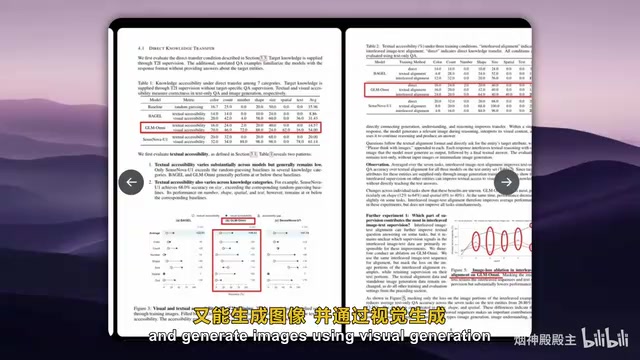
Another development comes from GLM 5.3: it reportedly achieved major gains through post-training alone, without changing the base architecture or adding parameters, with its Terminal Bench score soaring from 4.6 to 28.3. This shows that enormous performance potential can be unlocked through better post-training, without training an entirely new model from scratch.
Post-training refers to all training stages after a base model completes large-scale pre-training, typically including supervised fine-tuning (SFT), reinforcement learning from human feedback (RLHF), rejection sampling, and specialized reinforcement training for reasoning and tool use. Its characteristic is that it does not change the model's base architecture or increase parameter scale, but rather "activates" capabilities already latent from the pre-training stage through higher-quality data, reward signals, and training strategies. GLM 5.3's leap from 4.6 to 28.3 on Terminal Bench is a typical example of post-training's value: with the same set of base weights, a more refined post-training process can produce order-of-magnitude changes in performance on terminal command-line tasks. This also means that competition in model capability is not confined to parameter count and pre-training compute—post-training methodology is equally a key battleground.
DeepSeek 4.1 Flash Now Free
According to the original content, DeepSeek 4.1 Flash (the 1017 model) is now completely free in OpenCode, with no cumbersome setup required and all backend updates already completed.
Nvidia Inference Optimization and New Robotics Progress
A striking piece of news comes from Nvidia: it reportedly achieved a single-user inference speed of 423 tokens per second on the Kimi K3 model with as many as 2.8 trillion parameters, delivering a 1.68x speedup on the exact same hardware architecture. This is thanks to a new vLLM optimization developed by Nvidia's SendML team, centered on a deeply optimized decoding kernel written in QDSL that uses "mega-kernel fusion" technology to greatly reduce inference overhead, backed by roughly 12,000 lines of deeply optimized low-level kernel code. This means that without adding hardware or changing the model, better software alone can unlock substantial performance. Nvidia is reportedly working on applying similar optimizations to DeepSeek 4.1 and other models.
In robotics, Dreamlabs has emerged from stealth with Dreamman, an entirely new robotics foundation model designed to operate robots it has never encountered before. According to the company, DreamE enables dual-arm robots to perform tasks they were not specifically trained for—even operations never done before—at a cost of just $3 per hour, and the DreamAPI is now open to developers. Its generalization reliability in real-world environments remains to be seen, but the prospect of foundation models directly adapting to different robots without extensive retraining is worth anticipating.
vLLM is currently a mainstream open-source large-model inference engine, whose core innovation is PagedAttention—managing the KV cache (key-value cache) by borrowing the idea of virtual memory paging from operating systems, thereby greatly reducing memory waste and improving throughput. The decoding stage of inference requires generating tokens one by one, calling a large number of small operators each time, and operator launch and scheduling overhead can significantly slow things down. "Mega-kernel fusion" means merging multiple fine-grained operators into a single larger GPU kernel executed in one pass, reducing kernel launches and memory round-trips to unlock higher throughput on the same hardware. The QDSL-based decoding kernel and roughly 12,000 lines of low-level optimization code described in the article are the engineering realization of this approach: without adding GPUs or changing model weights, software-layer optimization alone boosts single-user generation speed by 1.68x.
Judgment from Cross-Source Verification
Overall, the most credible items in this week's leaks are the GPT-6.1 Terra references in Microsoft's code repository, the official launch and pricing of MiniMax M3.1 Flash, and the benchmark gains from GLM 5.3's post-training—these are backed by code, official releases, or papers. Relatively uncertain are the mysterious website clue for GPT-6.5 (already debunked by historical records as a spoof site) and the claim that Gemini 4 Carbon is "on par with Opus 5.5" (which multiple testers' hands-on testing does not support). During a period of dense model releases, remaining cautious about single-source leaks and focusing on verifiable code and official data remains key to judging the true level of next-generation models.
Related articles

Deleted Reddit Post Sparks Debate Over AI Content Moderation
A Reddit post removed with only a 'Removed by Reddit' notice highlights AI content moderation's transparency gaps, misjudgment risks, and appeal challenges for platforms and creators.

DSH + Ollama Local LLM Deployment in Practice: Free Chat with Da Fei Yu
Bilibili creator tests DSH + Ollama local LLM deployment end to end: Ollama install, Xunlei-accelerated downloads, ModelScope GGUF model import, DSH custom API address setup, and a comparison of Qwen 3.5 4B, 8B, Gemma, and other models on 8GB VRAM, with advice on choosing local deployment vs. API calls.

Tested: A $899 Mac Mini vs. a $200/Month AI Subscription
Real-world test of whether an M4 Mac mini can replace a $200 AI subscription: 16GB can't fit large models, and both speed and quality fall short—but privacy, no caps, and near-zero running costs make it an ideal host for an always-on agent. Includes buying advice per configuration and money-saving strategies.