GPT-6 Astra Built a Vocabulary Match-3 Game in 20 Minutes with Just Two Prompts
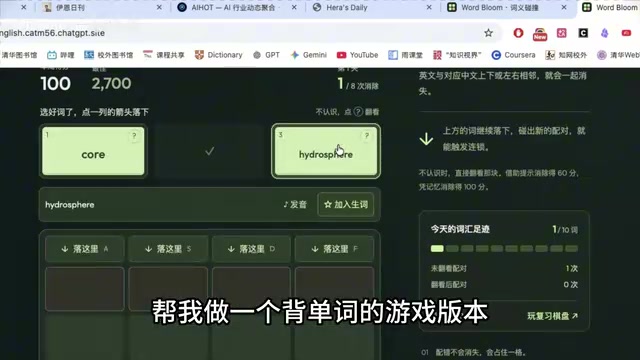
Two prompts, 20 minutes, one vocabulary match-3 game — and a lesson on why product thinking matters more than ever.
A Bilibili creator sent GPT-6 Astra just two prompts and got two fully playable game versions in 20 minutes without reading any code. Version 1 split gameplay and vocabulary study into separate phases; a more precise second prompt produced Version 2, where English words and Chinese meanings became the tiles themselves — learning fused into the core mechanic. The gap between the two versions wasn't technical; it was product logic. The experiment highlights a structural shift: AI is rapidly lowering the barrier to turning ideas into working products, making the ability to clearly define what you want to build the new scarce and valuable skill.
A Real Experiment: No Coding, a Working Game in 20 Minutes
A Bilibili creator recently shared a fascinating experiment. While studying English, he kept getting distracted by games — so he thought: why not have AI build him a game where he could play match-3 and learn vocabulary at the same time?
The process was surprisingly simple. He never looked at a single line of code. He sent GPT-6 Astra just two prompts, and within about 20 minutes, he had two fully playable game versions. This wasn't a tech demo meant to impress — it was a practical demonstration of what building products looks like in the age of AI.
Version 1: It Ran, But It Got It Wrong
After sending his initial idea, the first version appeared in about 10 minutes. It was indeed a tile-matching game with vocabulary built in — technically functional by any measure.
But the product logic was off. Version 1's design had you play a round of tile-matching, then pause the game to memorize a word. As the creator put it, it felt like "playing happily and suddenly having a teacher stop the game to quiz you on your homework."
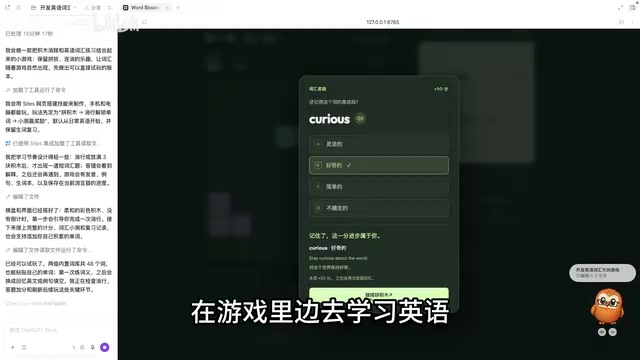
In other words, the AI treated "playing the game" and "learning vocabulary" as two separate components. Studying became an interruption bolted onto the game rather than woven into it. All the features were there — but the experience was fundamentally wrong.
Version 2: Making Vocabulary the Game Mechanic Itself
After identifying the problem, the creator sent a second, more precise prompt: don't treat vocabulary study and the game as two separate parts — make the words themselves the matching rule.
Another 10 minutes later, Version 2 arrived. This time, English words and their Chinese meanings were the tiles. Players had to match words with their correct translations to clear them, and could tap any tile for a hint if they didn't recognize a word. Learning was no longer an interruption — it was the core mechanic for progressing through the game.
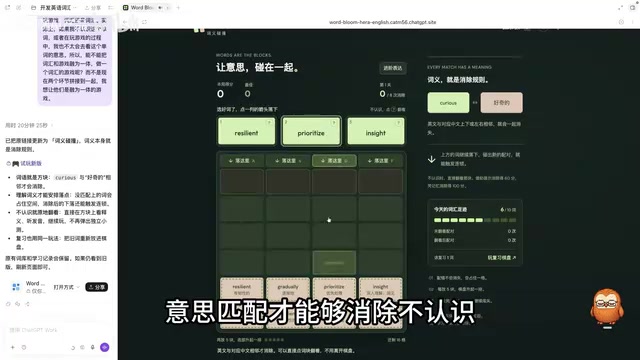
From idea to two complete game versions: no code reviewed, 20 minutes total, two prompts sent — each one producing a fully working build. That kind of iteration speed was unimaginable not long ago.
This design philosophy has a specific name in the field of game-based learning: intrinsic integration — embedding learning content into the game's core mechanics rather than layering it on as an external reward or penalty. Research shows that when learning goals and game goals closely overlap, players experience lower cognitive load and better memory retention. Version 1 followed what's known as extrinsic integration: using the game as a reward to drive learning, with the two logically separated — a pattern behind the failure of countless early educational games. Version 2 made "recognizing word-meaning pairs" directly equivalent to "completing a match," so every effective interaction simultaneously fulfilled both the game action and the memory reinforcement. That's the ideal form of gamified learning design.
The Real Barrier Is Shifting from Writing Code to Defining Products
The most thought-provoking part of this experiment isn't that "AI writes code faster with fewer bugs" — it's a deeper shift: the barrier to writing code is falling, while the barrier to defining a product is actually rising.

The biggest difference between Version 1 and Version 2 wasn't a feature added or removed — it was a fundamental difference in product logic. AI can rapidly turn an idea into something that runs, but what actually tests you is product thinking: can you clearly define what "built it" means versus what "built it right" means?
Version 1 was "built it." Version 2 was "built it right." What moved the AI from the former to the latter wasn't better coding ability — it was the prompt that precisely described the product logic.
This shift is closely tied to the "requirements gap" problem long discussed in software engineering. In traditional development workflows, product managers describe requirements in documents, engineers translate them into code, and information inevitably distorts through multiple rounds of translation. AI coding tools compress the "description → implementation" chain — but in doing so, they expose the quality of requirement definitions more directly than ever. A vague input now produces a "looks usable but fundamentally off-target" output at remarkable speed. This is exactly why, in prompt engineering, the task framing matters more than technical details: your depth of understanding of the product goal determines how precise your constraints can be — and whether AI delivers Version 1 or Version 2.
What This Means for Everyone Else
This experiment sends a clear signal to people without technical backgrounds: the technical barrier between having an idea and having a working product is being rapidly flattened by AI. You don't need to know how to code to validate a product concept in half an hour.
But being able to use AI isn't the same as knowing how to build a product. When implementation becomes cheap, knowing clearly what to implement becomes the scarce skill. Those who can break a vague idea down into clear product logic — and judge whether a version "runs" or "actually works" — hold the new core competitive advantage.
Looked at from another angle, this is also a reminder for every creator, product thinker, and learner: the more powerful AI becomes, the more valuable product thinking gets. The tools will write the code for you. They won't define what a good product is.
Related articles

CSS Anchor Positioning: A New UI Positioning Approach Without JavaScript
A deep dive into CSS Anchor Positioning: from anchor-name and position-anchor to the anchor() function, position-area shorthand, position-try-fallbacks, anchor-size, and upcoming anchor queries.

New AI Chart Interaction: Continuous Follow-up Questions and Visualization in Conversation
Explore a new AI interaction method for continuously generating charts in conversation. Use the /visualize command to ask follow-up questions and visualize answers in the same chat window, improving data analysis efficiency.

Cursor Merges Into X Subscription: Paid Plans Share Unified Usage Pool, Grok Model Coding Usage Doubled
Cursor joins The X Subscription with a unified usage pool and doubled Grok coding quota. Third-party models shift to API pricing. Existing users can keep or migrate plans.