GPT-6 Astra Cracks WWI German Military Radio Cipher: A New Milestone in AI Reasoning

GPT-6 Astra allegedly cracked a WWI German cipher, showcasing LLM reasoning potential but raising reproducibility and data leakage concerns.
A Hacker News post claims OpenAI's GPT-6 Astra successfully cracked a WWI German military radio cipher, sparking community debate. The article examines the historical context of WWI German ciphers, the multilingual reasoning and hypothesis-testing capabilities required, and three core community concerns: reproducibility, potential training data leakage, and true difficulty level. It also clearly distinguishes between cracking hand ciphers and breaking modern standards like AES or RSA — two fundamentally different problems — while noting genuine potential for historical research applications.
Overview
A post on Hacker News that sparked widespread discussion claims that OpenAI's next-generation model, GPT-6 Astra, successfully cracked a German military radio cipher from World War I. The post received 58 upvotes and 21 comments, reflecting the tech community's keen interest in the potential of large language models for historical cryptanalysis.
For those who have long followed the intersection of cryptography and artificial intelligence, the significance of this case goes beyond simply "solving an old cipher." It demonstrates the large language model's combined capabilities in symbolic reasoning, pattern recognition, and historical context understanding.
Note: This article is based on limited publicly available information from Hacker News. The original post contains few details, and some technical inferences represent editorial background analysis. Readers should consult additional primary sources before drawing conclusions.
Historical Background: WWI German Military Ciphers
World War I was the period when radio communications and codebreaking truly entered the stage of modern warfare. The German military relied heavily on radio to transmit operational orders, and these signals became prime targets for interception and decryption by Allied intelligence agencies.
Encryption Methods of the Era
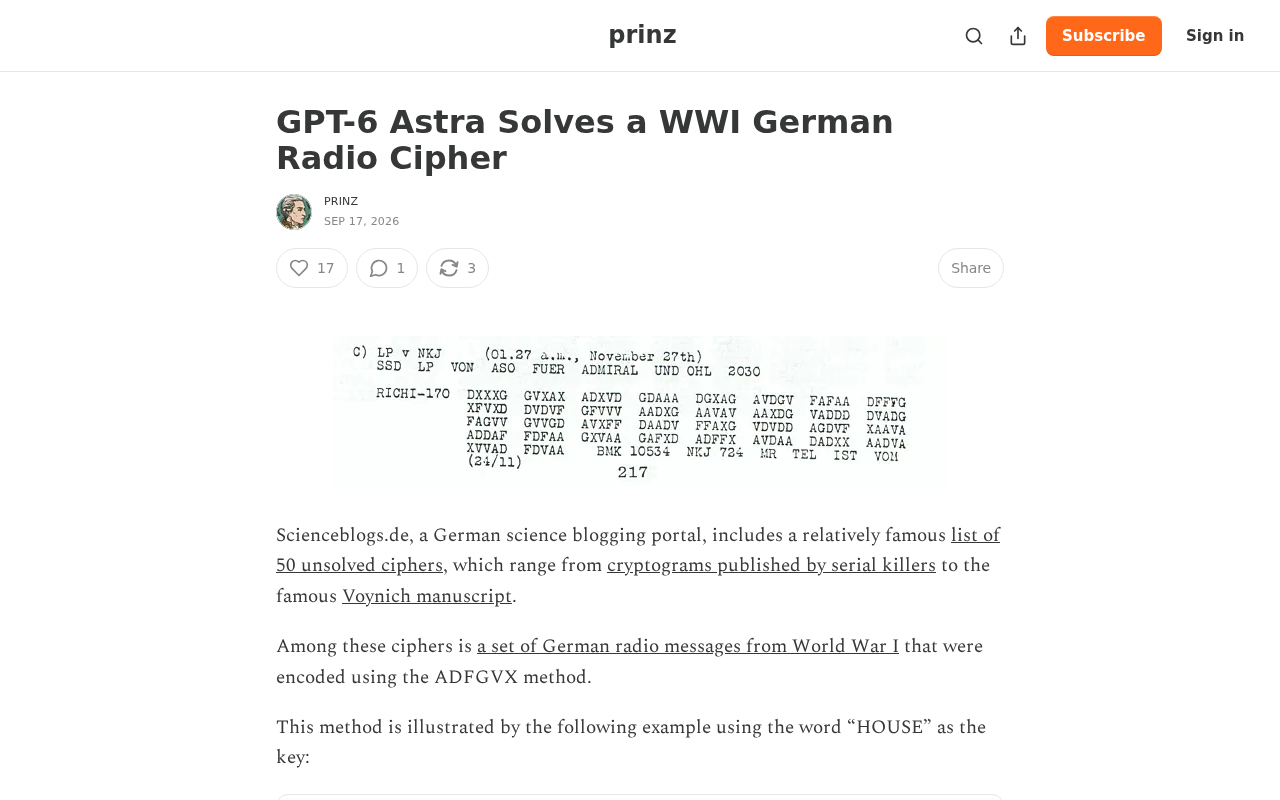
German military ciphers of WWI typically employed substitution ciphers, transposition ciphers, and codebook-based encoding systems. These methods depended on manual encryption and decryption, and breaking them required close collaboration among mathematicians, linguists, and intelligence officers. The famous Zimmermann Telegram incident is a classic example of how codebreaking during this period changed the course of the war.
The Zimmermann Telegram incident occurred in January 1917, when German Foreign Secretary Arthur Zimmermann sent an encrypted telegram via radio to Mexico, inviting it to form an alliance with Germany against the United States. The telegram used a predecessor to Germany's ADFGVX diplomatic cipher and was intercepted and decrypted by British intelligence's "Room 40." The decryption work was carried out by cryptanalysts Nigel de Grey and Montgomery Belfort over several weeks. The contents were subsequently revealed to the U.S. government, directly contributing to America's declaration of war against Germany that April — one of the most iconic cases of codebreaking altering the course of history. The ADFGVX cipher itself combined both substitution and transposition mechanisms and was considered quite difficult to break at the time, yet it was ultimately defeated through a combination of intelligence work and mathematical analysis.
The Challenges of Codebreaking
Historical cipher analysis faces multiple obstacles: ciphertext may contain transmission errors and noise, complete codebooks are rarely available, the language is period-specific German (including military jargon and abbreviations), and sample sizes are often limited. These factors can render traditional methods like frequency analysis ineffective, requiring inference based on contextual and domain knowledge.
What GPT-6 Astra's Capabilities Suggest
If a general-purpose large language model can crack these historical ciphers, it suggests a convergence of several key capabilities.
Multilingual and Historical Context Understanding
Deciphering a WWI German military cipher requires the model to understand the vocabulary, grammatical structures, and military communication conventions of historical German. This is precisely where the breadth of a large language model's training data provides an advantage — it can draw on vast historical text knowledge to judge whether a decrypted result "makes sense."
Symbolic Reasoning and Hypothesis Testing
At its core, codebreaking is a process of search and verification: proposing possible keys or substitution rules, checking whether the resulting plaintext is coherent, and iteratively refining the approach. Newer reasoning-oriented models have shown marked improvement on tasks requiring multi-step logic and self-verification, which is likely why GPT-6 Astra is capable of handling this kind of task.
Comparison with Specialized Tools
It's worth considering that dedicated cryptanalysis tools may still outperform general-purpose models on specific cipher types. The advantage of large models lies in their generality — without needing to be individually programmed for each cipher type, they can complete the entire process from hypothesis to verification through natural language interaction. This "zero-shot" or "few-shot" codebreaking capability is what truly captured the community's attention.
Key Concerns in Community Discussion
The level of engagement on Hacker News shows that the tech community views these demonstrations with both interest and caution. Common threads in the discussion include:
- Reproducibility: Can the decryption process be independently verified, or does it rely on specific prompts and luck?
- Training data leakage risk: Was the answer to this ciphertext already present in the model's training data, making the "cracking" essentially a memory retrieval?
- Difficulty assessment: What level of difficulty does this cipher represent in historical cryptography, and how strong must the reasoning actually be to solve it?
These are healthy questions to ask. Any claim about AI cracking a cipher should clearly distinguish between "genuine reasoning-based decryption" and "recalling an answer from training data" — two fundamentally different scenarios.
Potential Applications and Limitations
Historical Research and Archaeology
If large language models genuinely possess the ability to decrypt historical ciphers, they could become powerful tools for historians and cryptography researchers, helping to decode previously undeciphered historical documents, encrypted diaries, or unknown manuscripts.
The Realistic Boundaries
It's important to recognize that the security of modern encryption standards (such as AES and RSA) is grounded in computational complexity, not linguistic patterns or historical context. A large language model cracking a WWI hand cipher and cracking modern cryptography are problems of entirely different orders of magnitude. The former involves pattern and contextual reasoning; the latter requires astronomical computational resources or algorithmic breakthroughs. This kind of demonstration should not be over-interpreted as a threat to modern encryption security.
AES (Advanced Encryption Standard) and RSA are the two cornerstones of modern cryptography. AES is a symmetric encryption algorithm with key lengths of 128, 192, or 256 bits; its security derives from mathematical operations in finite fields. Brute-forcing 256-bit AES would require trying 2²⁵⁶ possibilities — an impossible feat with any foreseeable computing power within the lifetime of the universe. RSA is an asymmetric encryption algorithm whose security relies on the computational difficulty of factoring large integers. Neither algorithm has any exploitable linguistic patterns or contextual clues; the natural language understanding and probabilistic inference at which language models excel have no foothold here. By contrast, WWI hand ciphers have an extremely limited keyspace, and the ciphertext itself carries statistical regularities (such as letter frequency distributions), making them "weak encryption" at the information-theoretic level. The gap between the two is not a matter of degree — it is a difference in fundamental type.
Conclusion
Regardless of the specific details, the case of GPT-6 Astra cracking a WWI German cipher provides an interesting lens through which to examine the reasoning boundaries of large language models. It both showcases the potential of general-purpose models for cross-domain symbolic reasoning and reminds us to maintain scientific skepticism when evaluating such claims — the true value lies in reproducible, verifiable capabilities, not in a single impressive demonstration.
As reasoning-oriented models continue to evolve, the application of AI in specialized domains such as historical cryptanalysis and ancient script interpretation is well worth continued attention.
Background Note
Training data leakage is one of the most critical methodological issues when evaluating the true reasoning capabilities of large language models. If the plaintext solution to a historical cipher has appeared in any form within the model's pretraining corpus — such as in academic papers, Wikipedia entries, or digitized historical archives — then the model producing the correct answer is essentially pattern matching or memory retrieval, not real-time reasoning. Common methods for distinguishing the two include: testing with never-before-published ciphertexts, requiring the model to show its reasoning process step by step and manually verifying the logical consistency of each step, and running multiple independent tests on similar but detail-varied ciphers to assess generalization. This case currently lacks such rigorous verification, which is the core reason the community maintains a cautious stance.
Related articles

uGAP: An AI Platform Unifying 100+ African Geospatial Datasets
uGAP is an African geospatial AI platform by a University of Cape Town team, unifying 120+ African datasets with a Python SDK for discovery, processing, and model training, already used in cyclone flood mapping.

Cursor Can Now Control Your Computer: AI Agents Can Drive Desktop Apps for Testing
Cursor adds desktop control: AI agents can drive desktop apps like the iOS Simulator to test their own features. We analyze the impact on dev workflows, possible technical approaches, and reliability concerns.

Vibecoding a Custom Inference Engine: High Hopes, Harsh Reality
A Reddit developer shares the real experience of vibecoding a custom inference engine: running GGUF Q4 models in the browser with WebGL2 and GLSL, only to fall into tokenizer debugging hell. This article analyzes the engineering challenges of browser-side LLM inference and why cloning llama.cpp is the more rational choice.