GPT-6 Astra Hands-On: 4 Prompts to Build a AAA-Style Game and 3D Scene

Developer spends $1,500 testing GPT-6: 4 prompts, a playable shooter, self-testing agents — but AGI claims remain speculation.
A developer with early GPT-6 access demonstrated several striking agent capabilities: building a multiplayer Call of Duty-style game in 4 prompts, converting a PDF floor plan into a playable 3D map in about an hour, and creating a fully functional desktop tool in 16 minutes. GPT-6 performs best in Codex, where Computer Use and Browser Use give it full local permissions and authenticated sessions. The model's self-testing loop — generate, screenshot, identify issues, re-prompt, iterate — stands out as the most significant qualitative leap. The article maintains perspective: visual results don't equal engineering reliability, and claims about AGI timelines and industry hardware scale are unverified personal accounts.
A developer who got early access a week before the official launch spent roughly $1,500 in credits putting OpenAI's GPT-6 — codenamed Astra — through its paces. His conclusions are striking: just 4 prompts to build a Call of Duty-style game, a 5th prompt to add multiplayer, and minutes later he was live-streaming it with 20 other players. This article breaks down the key takeaways he shared — and tries to separate genuine progress from excitement-fueled overreach.
AI's Capability in 3D Graphics Is Vastly Underestimated
The author's first and most direct claim: in 3D graphics, AI is already faster and better than most humans.
He ran a concrete experiment — he found a PDF of a mansion online, complete with a description and floor plan. He handed the document to the model and asked it to build the entire house in Blender, verify it, then turn that building into a new map for a Call of Duty-style game, naming it "Estate," aligned with the gameplay format of a project he'd previously built called Call of Singularity. About an hour later, the model returned both a Blender scene and a playable Modern Singularity map — complete with a helicopter you could fly, shoot from, and get shot down in.
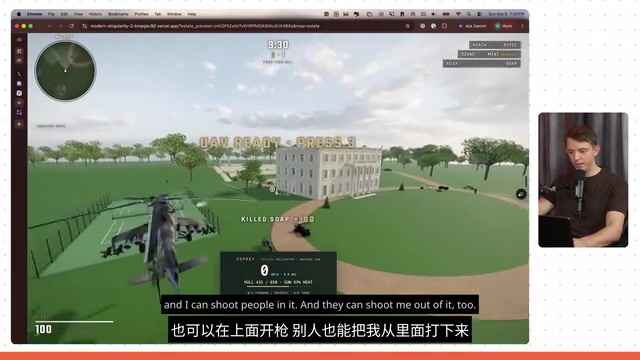
This capability isn't limited to games. The author noted a trend emerging on X: people using Codex and the model to create photorealistic 3D educational renders — for example, exploding a Tesla component part by part, letting you zoom in to see what each piece is and does, and toggling between assembled and disassembled states. His inference: the production of digital assets is being rapidly de-scarce-ified. What remains truly scarce is turning those assets into something useful in the physical world — such as pairing them with 3D printing.
A note of caution: the author himself admits he can't evaluate the accuracy of those industrial renders, since he's not an engine specialist. Visual impressiveness and engineering reliability are two different things.
Context: Blender is an open-source 3D creation suite supporting modeling, materials, rendering, animation, and game asset export. Traditionally, converting a PDF floor plan into a playable game map requires a chain of highly specialized steps: architectural modeling → UV unwrapping → texture mapping → engine import → collision volume setup → game logic scripting. Each step demands domain expertise, and the full pipeline typically takes days or weeks. What's described here — handing the model a PDF and receiving a playable map roughly an hour later — means the model must understand the spatial relationships in the floor plan and then execute every engineering step above, driving Blender via code or scripts. That's what surprises practitioners: each of those steps used to be its own bottleneck, and the agent tool chain has compressed them all into a single continuous automated flow.
Web Coding "Solved"? On-Demand Software with Near-Zero Barriers
The second takeaway is closer to everyday development: the author believes "Web Coding has been solved" — you can generate software on demand, and the barrier to building personal tools has dropped to nearly zero.
He offered an example from that same morning. While making slides at a coffee shop, he got tired of the loop: search Google Images, drag the image down, remove the background, paste it back. So he asked Codex to build a Raycast-style desktop app — triggered by a keyboard shortcut, it searches Google Images, automatically removes backgrounds, and saves or copies results to a designated folder. He says it took 16 minutes to build. Hit Command+Shift+Space, type a keyword, done. He later added multi-keyword parallel search and an AI feature that breaks a piece of text into multiple precise search queries.
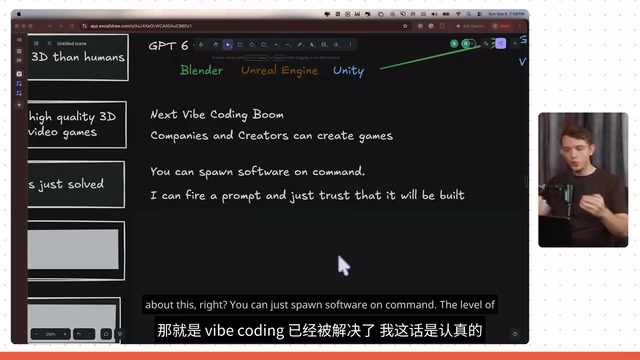
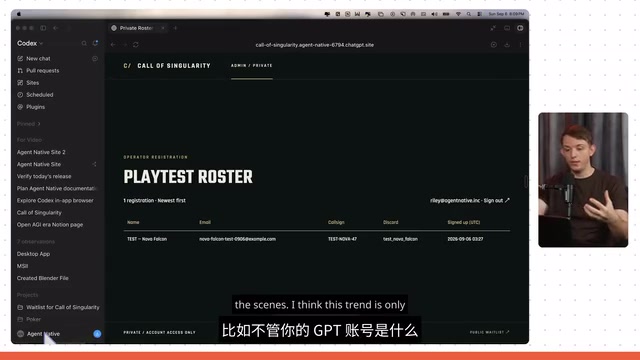
He's also bullish on lightweight use cases like landing pages. To make it easy for people to sign up for Call of Singularity, he had the model build a game-themed site and deploy it to ChatGPT Sites, with a private admin panel for his email only to track who submitted their info.
From there, he floated a business idea: a platform where creators can host games they've built for free, with in-game currency and transactions — like Roblox but with fewer creative constraints, potentially sparking a new wave of Web Coding where creators build games and small worlds for their audiences the way others build PDFs, courses, or communities. This is personal speculation with no product to point to yet — treat it as a directional view, not established fact.
Self-Testing Loops: The Agent Plays Its Own Game to Verify Results
What actually made the author feel like "AGI is close" was a notable improvement in the model's self-evaluation ability. Give it a task and it completes it, evaluates its own result, identifies what needs to change, revises, and re-evaluates — repeatedly.
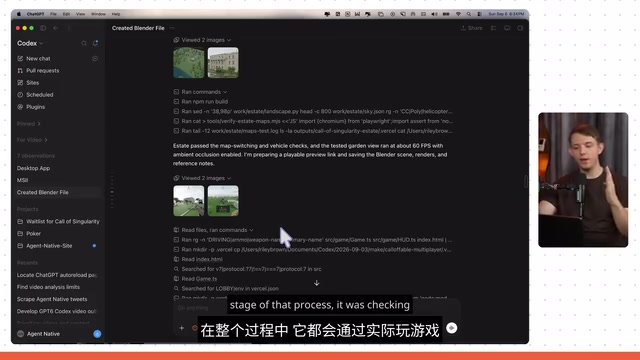
While building the Blender map, the model generated the map, took a screenshot inside Blender to assess whether it could be successfully compiled into the game, then expanded the vehicle system to include helicopter boarding, then launched an actual match, moved through the map as a character, and inspected the building. He noted the house initially appeared too white with incorrect textures — when the model detected this, it re-prompted itself and iterated through a test-evaluate-re-prompt loop until it was satisfied.
This capability is also advancing rapidly in the "computer operation" dimension. The author cited a comparison test: having the new model and its predecessor each open Microsoft Paint and draw a portrait from a photo — the gap was obvious. He also mentioned industry context — reportedly, OpenAI has purchased tens of thousands of Mac Minis and Mac Studios for reinforcement learning and Computer Use agent training, while Anthropic rents Mac Minis through AWS, with both companies running thousands of machines around the clock to train and evaluate AI computer control. These figures come from the author's account and haven't been independently verified — readers should apply appropriate skepticism.
Context: This "generate → evaluate → re-prompt" loop is generally known in AI as an Agentic Loop or the ReAct (Reasoning + Acting) paradigm. Unlike traditional single-turn Q&A, agents observe environmental feedback after each action — screenshots, error messages, runtime logs — and fold that back into the reasoning context for the next step, forming a closed iterative loop. The key distinction is the source of "perception": in a text chat, the model can only rely on user descriptions, whereas an agent with Computer Use permissions can take screenshots to directly observe visual state — allowing it to catch problems the user never even noticed (like washed-out textures or broken collision volumes). This autonomous error-correction capability is one of the most significant qualitative shifts in agent tool chains compared to a year ago, and it's the main basis for the author's "AGI is near" framing — though the academic community remains deeply divided on how far general intelligence actually is from task-specific self-testing.
Why Codex, and Why Mac Mini
The author emphasizes that the same model performs noticeably better inside Codex. While you can use GPT-6 in Cursor, this model was designed for the Codex Harness and its tool chain: Computer Use, Browser Use (launching a local browser, filling forms, testing websites), screenshot feedback, game building, site deployment, and file management — basically anything you can do on your computer, it can do.
The key is permissions and authenticated sessions. Because it runs on your own machine with full access — logged into GitHub, Vercel, and other tools, holding your API keys, with all browser tabs already authenticated — it operates quickly and smoothly. That's both the source of its power and an obvious security concern: handing complete computer control to an agent means risk and capability are two sides of the same coin.
This leads to his final takeaway: the Mac Mini setup remains the most capable approach. He bought a new Mac Mini alongside a Linux machine, intending to run Codex full-time and control it remotely from his phone or iPad — a "always available, 24/7" Codex instance. He plans to set it up this week and record a video on running Anthropic, Grok, and other agents on the same configuration.
Context: Computer Use and Browser Use are two distinct agent capability interfaces. Computer Use means the model perceives screen state via screenshots and then simulates mouse and keyboard actions to control any desktop application — first publicly demonstrated by Anthropic in late 2024 with the Claude 3.5 Sonnet update, then followed by other labs. Browser Use is more focused on browser automation: operating within an already-authenticated browser session to fill forms, extract data, and trigger page interactions. Compared to headless browser scripts like Selenium or Playwright, the advantage is leveraging existing login sessions without needing to handle CAPTCHAs or OAuth flows again. Combined, agents can seamlessly operate almost any SaaS tool as the user — which is exactly the technical reason for the "quickly and smoothly" experience the author describes, and the underlying logic behind his repeated equation of "permissions = capability."
Closing: Stay Clear-Eyed Beyond the Excitement
The author's overall assessment: we're in an exponential growth phase, AI's ability to control computers and its general intelligence will keep improving, and "the AGI era is arriving." He even argues the first threshold was crossed when the previous generation of Claude Code launched — people just didn't immediately notice.
As a reader, it's worth splitting this account into two layers. The first layer is reproducible, concrete results — 4 prompts to generate a game, 16 minutes to build a desktop tool, PDF to 3D to game map — these are real capability demonstrations. The second layer is sweeping inferences drawn from personal experience — AGI imminent, a creator game economy rising, large-scale industry hardware procurement — all lacking independent verification. The former is sufficient to show that the progress in today's agent tool chains is genuinely remarkable. The latter is better treated as imaginative provocation than settled conclusion.
Related articles

"Black October": Did AI Uncover 3% of All Critical Vulnerabilities Ever?
A Reddit post claims 3% of all critical software vulnerabilities ever were found in the past month, dubbed 'Black October.' We break down the statistical issues, how AI-assisted code auditing accelerates discovery, and how developers should respond.

Microsoft Project Gecko: Using AI to Bridge Language Gaps for African Farmers
Microsoft's Project Gecko launches PharmaChat, letting African farmers ask questions in their native language and get precise video clips and farming book chapters via AI. The project also releases three interactive manuals to advance inclusive AI.

Musk's Space Dominance: How Starlink Throttling Undermines Ukraine's Defense
SpaceX's Starshield throttling disabled Ukraine's high-speed interceptor drones, exposing how Musk's private control over low Earth orbit communications affects battlefield dynamics and national security, and highlighting the risks of commercial space militarization and space governance dilemmas.